


- Multi-jurisdiction regulation
- Segregated client funds
- Negative balance protection
- Simple proprietary platform
- Transparent spread-only pricing
- No MT4 or MT5 support
- Limited algorithmic trading tools
- No third-party Expert Advisors
- Limited educational resources
- No copy trading support
Plus500 operates as a regulated multi-asset CFD broker, and its status as a publicly listed company adds a layer of financial transparency rarely found among retail CFD brokers. This regulatory footprint directly affects fund safety and investor protection eligibility for traders opening an account, since client funds are segregated from company assets in line with standard practice among licensed brokers.
Its pricing model relies mainly on spreads built into most CFD trades, with no separate commission charged in most cases, differing from brokers that charge fixed commissions per lot. The exact cost structure and account tiers vary by instrument and region, which matters when comparing it against other CFD providers.
Instead of offering third-party platforms such as MetaTrader, Plus500 provides its own proprietary WebTrader and mobile trading platform. Deposit methods, withdrawal processing and customer support channels are all structured around this in-house platform ecosystem.
This review examines each of these areas in detail, starting with the question every trader asks first: is Plus500 a safe and trustworthy broker in 2026?
Is Plus500 a Safe and Trustworthy Broker in 2026?

Yes, Plus500 qualifies as a safe and trustworthy broker overall, supported by its publicly listed status, an extended operating history, and licenses from multiple financial regulators. This overview weighs those three factors before breaking down the specific licenses and safeguards that back this verdict.
These three factors work together to build a consistent trust profile. Plus500’s parent company is publicly listed, which subjects it to public financial disclosure and audit requirements that privately held CFD brokers do not face. On top of that, Plus500 has operated in the online CFD trading industry for many years, a track record that supports its overall market credibility. Finally, its multi-jurisdictional regulatory footprint, detailed in the following sections, further reinforces this trustworthiness rating rather than relying on a single license alone.
What Regulatory Licenses Does Plus500 Hold?
Plus500 holds licenses across several major jurisdictions, with each regulated entity assigned to traders based on their country of residence. This regulatory grouping determines which rules, protections, and account terms apply to a given trader.
- FCA (UK) – FCA regulation covers Plus500’s UK entity, applying UK conduct of business rules and segregated client fund requirements.
- CySEC (Cyprus) – CySEC oversees the entity serving EU/EEA-based clients under MiFID II standards.
- ASIC (Australia) – ASIC regulates the entity offering services to Australian residents.
- MAS (Singapore) – The Monetary Authority of Singapore licenses the entity operating for Singapore-based traders.
- FMA (New Zealand) – The Financial Markets Authority (FMA) of New Zealand regulates the entity serving New Zealand clients.
- ISA (Israel) – The Israel Securities Authority (ISA) covers the entity operating under Israeli securities law.
Traders in other regions, including parts of the United States and various emerging markets, may connect to entities operating under separate local frameworks, and account terms can differ accordingly.
How Does Plus500 Protect Client Funds?
Plus500 protects client funds through four core measures: segregated client accounts, negative balance protection, regulator-specific compensation schemes, and the financial transparency required of a publicly listed company. Building on the licensing structure outlined above, each safeguard reduces a distinct type of risk that traders face when depositing money with a CFD broker.
Segregated accounts keep client money apart from Plus500’s own operating funds at approved banking institutions, so company liabilities cannot reach client balances. Negative balance protection caps a trader’s losses at their account equity, preventing debt beyond the deposited amount during extreme market volatility.
Compensation schemes vary by regulator and add a further layer of protection if a firm becomes insolvent:
- FCA-regulated clients: FCA regulation also means eligible UK clients of Plus500 can access the UK’s Financial Services Compensation Scheme, which provides a form of protection for client funds should the broker become insolvent.
- CySEC-regulated clients: CySEC regulation also means eligible EU/EEA clients of Plus500 can access the Investor Compensation Fund, which provides a form of protection for client funds should the broker become insolvent.
Plus500’s parent company trades on the London Stock Exchange, and this listing subjects it to ongoing financial reporting and audit obligations that add external scrutiny beyond regulatory oversight alone.
What Trading Platforms Does Plus500 Offer?
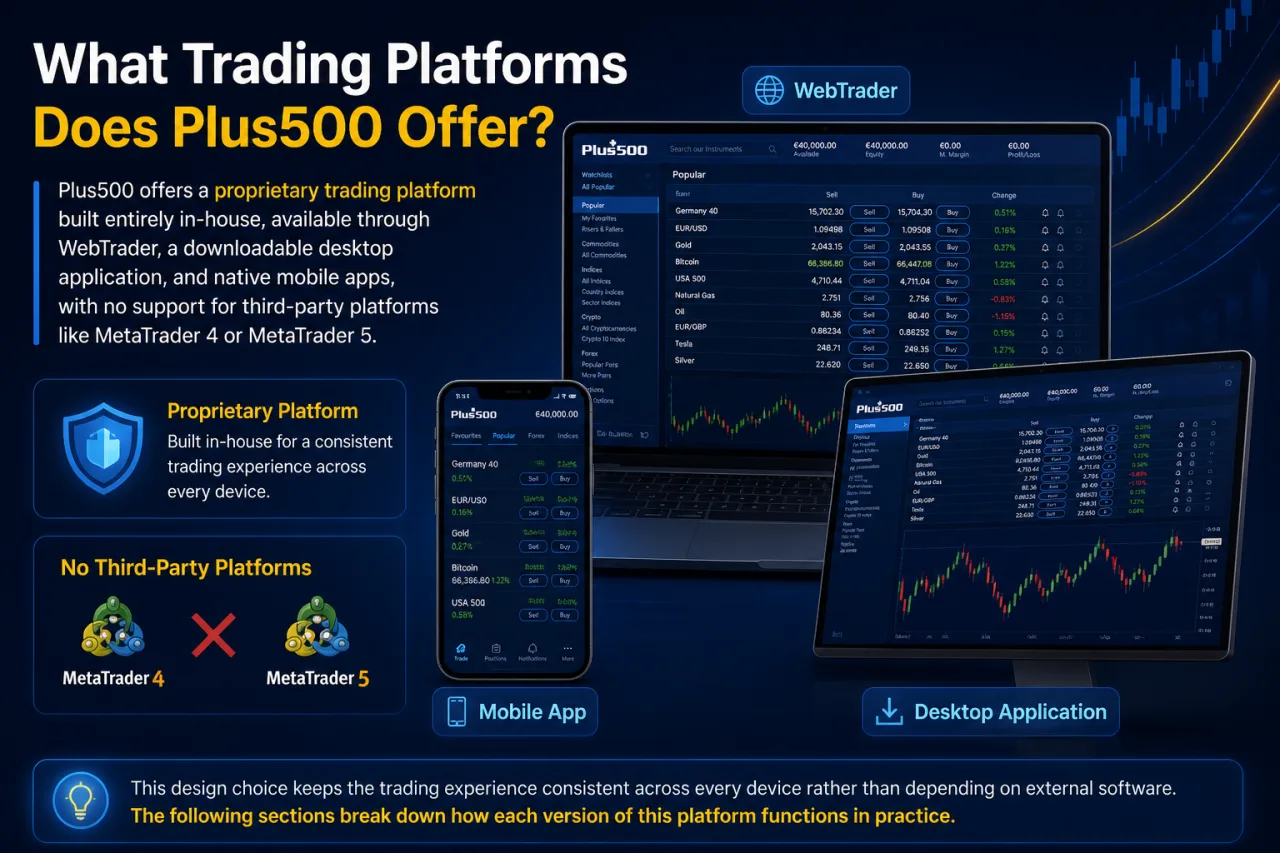
Plus500 offers a proprietary trading platform built entirely in-house, available through WebTrader, a downloadable desktop application, and native mobile apps, with no support for third-party platforms like MetaTrader 4 or MetaTrader 5. This design choice keeps the trading experience consistent across every device rather than depending on external software. The following sections break down how each version of this platform functions in practice.
Plus500 WebTrader vs Mobile App: What Are the Differences?
WebTrader wins on chart depth and multi-tasking with several instruments open at once, while the mobile app wins on convenience for managing positions and receiving alerts away from a desktop. Both versions share the same underlying account, pricing, and instrument list, so this comparison covers usability rather than cost or execution differences.
WebTrader runs directly in a browser without any download beyond the optional desktop application, giving traders a larger workspace for technical analysis, multiple watchlists, and side-by-side chart layouts. It suits traders who plan trades methodically before entering the market and want more screen space for order management.
The mobile app, available for iOS and Android devices, mirrors the core functionality of WebTrader but prioritizes speed and simplicity over layout depth. It supports opening and closing positions, setting stop-loss and take-profit levels, and receiving push notifications on price movement or account activity.
Neither version requires a separate login for a different account type, since Plus500 synchronizes balances, open trades, and history in real time across both platforms.
What Trading Tools and Features Are Available on Plus500?
Plus500 groups its trading tools into five main categories: charting tools, technical indicators, price alerts, risk management tools, and an integrated economic calendar. These features sit directly within WebTrader and the mobile app rather than requiring any external add-on software.
- Charting tools: multiple timeframes, drawing tools, and adjustable layouts for tracking price action across open positions.
- Technical indicators: common categories such as trend, momentum, and volatility studies, applied directly onto the chart interface.
- Price alerts: notifications when an instrument reaches a set price level, useful for monitoring markets without keeping the platform open continuously.
- Risk management tools: standard stop-loss and take-profit orders, alongside a guaranteed stop option that closes a position at the exact specified price even during volatile market gaps, though this feature typically carries an additional cost.
- Economic calendar: scheduled macroeconomic releases and events that commonly affect currency, index, and commodity prices, allowing traders to plan entries and exits around anticipated volatility.
What Are Plus500’s Fees, Spreads and Commissions?
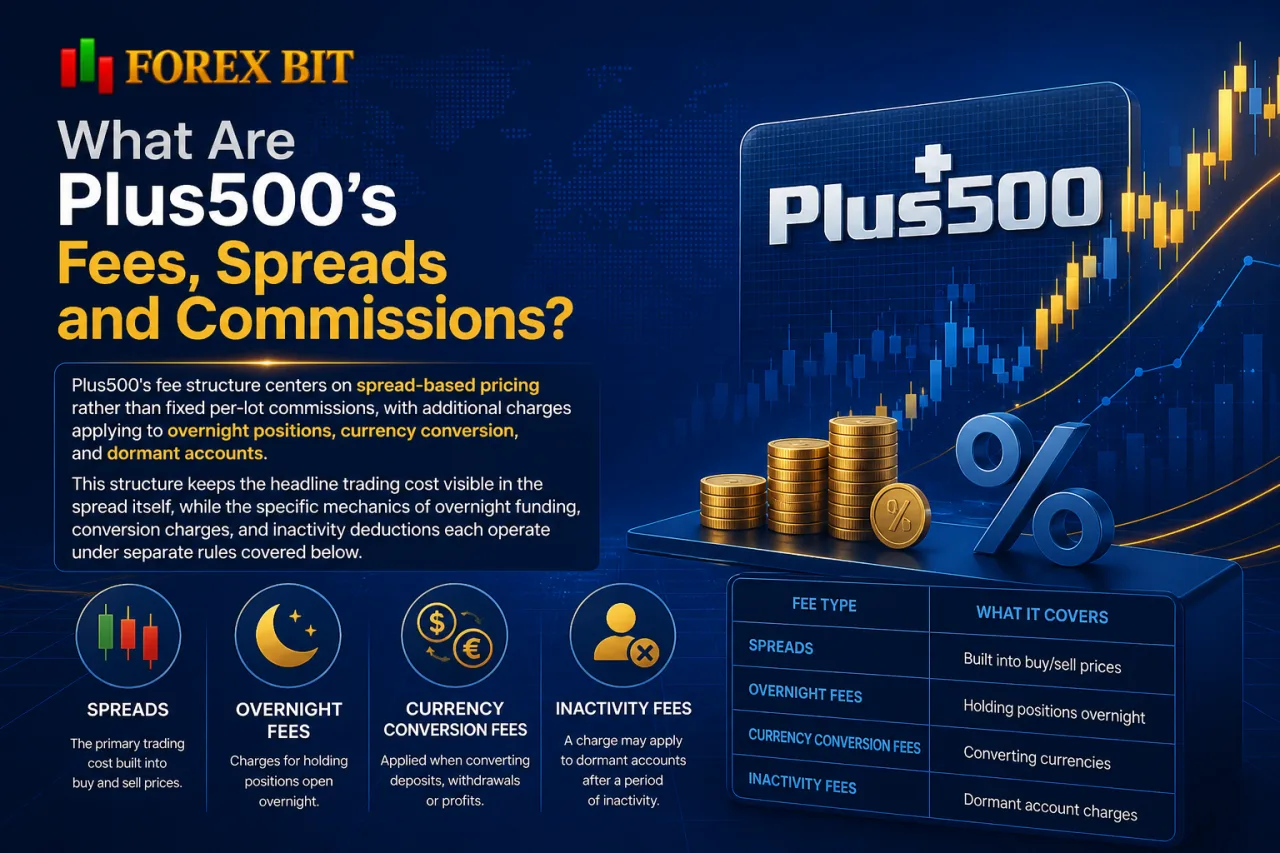
Plus500’s fee structure centers on spread-based pricing rather than fixed per-lot commissions, with additional charges applying to overnight positions, currency conversion, and dormant accounts. This structure keeps the headline trading cost visible in the spread itself, while the specific mechanics of overnight funding, conversion charges, and inactivity deductions each operate under separate rules covered below.
How Do Plus500 Spreads Compare to Other Brokers?
Plus500’s spreads on major forex pairs generally align with typical ranges seen among spread-only CFD brokers, though exact pricing shifts with market volatility and session liquidity rather than staying fixed. This variable structure directly affects how Plus500’s cost competitiveness holds up against other CFD and forex providers.
Spreads widen during low-liquidity periods, such as around major news releases or outside peak trading hours, a pattern common across most spread-based brokers rather than unique to Plus500. Because no separate per-lot commission applies on most instruments, the quoted spread represents the full trading cost on a given position, aside from overnight and conversion charges addressed separately.
Traders comparing costs across brokers typically weigh three factors together rather than spread size alone:
- Consistency of pricing during normal market conditions
- Presence or absence of added commissions on top of the spread
- Overall execution reliability during volatile sessions
Compared to the wider CFD and forex broker landscape, Plus500’s no-commission, spread-only model sits in line with other zero-commission providers, while commission-based brokers often advertise tighter raw spreads offset by a separate per-lot fee. This means the effective cost between the two models often ends up comparable rather than one being clearly cheaper. Exact figures shift frequently with market conditions, so checking Plus500’s live platform directly before trading remains the most reliable way to confirm current pricing.
What Hidden or Additional Charges Should Traders Know About?
Plus500 applies four main non-trading charges: an inactivity fee, a currency conversion fee, an overnight funding charge, and a nominal withdrawal-related deduction under certain conditions. These sit apart from the spread-based cost already covered and directly affect the total amount a trader keeps over time.
- Inactivity feeAn inactivity fee is typically charged after an account remains dormant for a defined period without any trading activity, deducted from the available balance.
- Currency conversion feeA currency conversion fee is typically applied when a trade’s currency differs from the account’s base currency, added on top of the underlying spread.
- Overnight funding chargeAn overnight funding charge is typically deducted for positions held open past the daily cutoff time, calculated as a percentage of the position’s value.
- Withdrawal-related deductionA withdrawal fee may apply in specific circumstances, such as processing through certain payment methods, depending on the account’s region.
Traders reviewing their statement of costs typically find these charges listed separately from the spread, since Plus500 does not bundle them into the quoted trading price shown on WebTrader or the mobile app.
What Account Types Does Plus500 Offer?
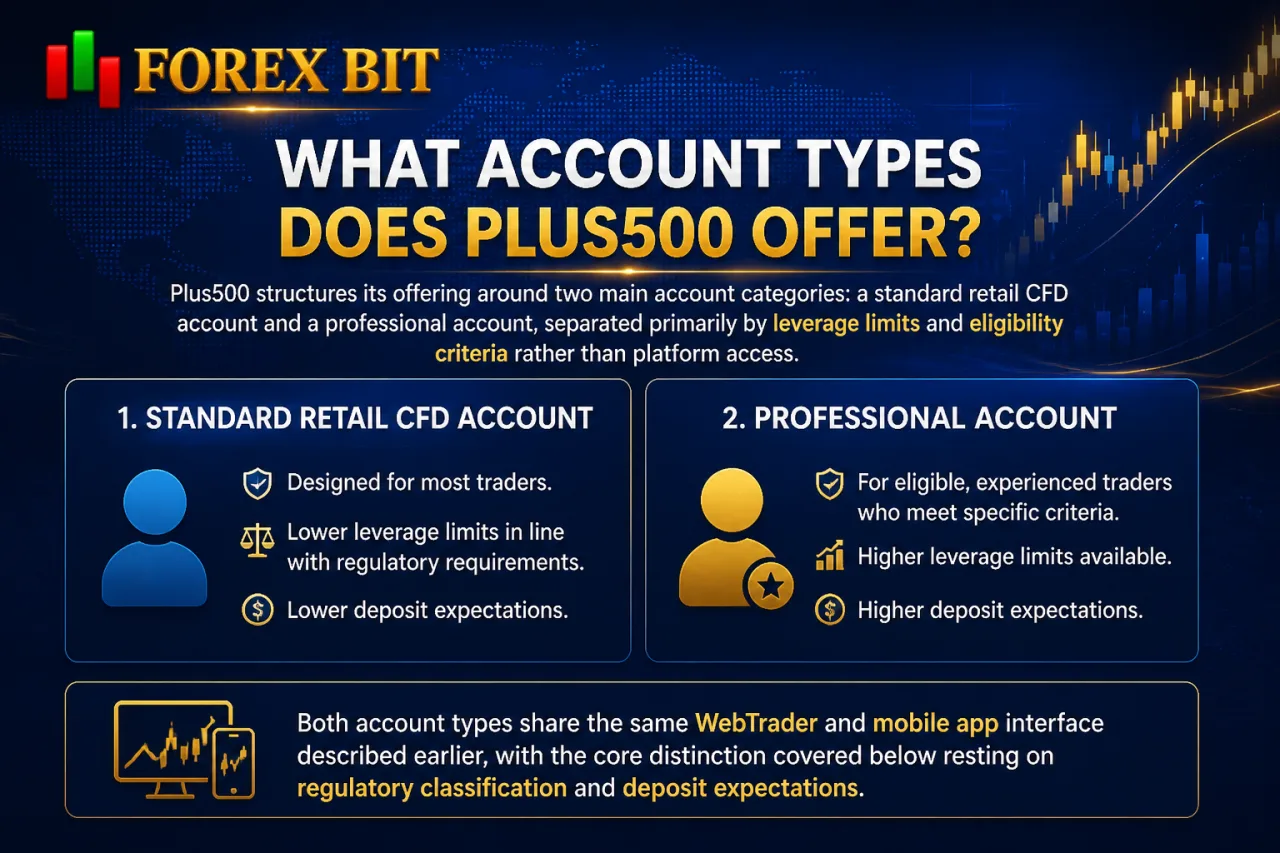
Plus500 structures its offering around two main account categories: a standard retail CFD account and a professional account, separated primarily by leverage limits and eligibility criteria rather than platform access. Both account types share the same WebTrader and mobile app interface described earlier, with the core distinction covered below resting on regulatory classification and deposit expectations.
Retail vs Professional Account: What Is the Difference?
The retail account applies capped leverage and standard regulatory protections, while the professional account unlocks higher leverage limits in exchange for reduced safeguards and stricter eligibility screening. This distinction follows directly from the account structure outlined above and shapes margin requirements, risk exposure, and the protections a trader keeps once classified.
Retail classification, the default status under frameworks like ESMA and the FCA, caps leverage at levels set by the applicable regulator per instrument class and keeps negative balance protection and compensation scheme access fully intact. Professional classification raises available leverage above retail limits but generally removes guaranteed negative balance protection.
Qualifying for professional status typically requires meeting at least two of three criteria:
- Holding a portfolio exceeding a defined financial threshold
- Demonstrating a history of frequent trading activity at a significant size over a recent period
- Having relevant professional experience in the financial services sector
Exact thresholds for each criterion are set by the relevant regulator rather than by Plus500 itself, and traders considering reclassification should confirm the current figures directly with Plus500 or their regulator before applying.
Traders who qualify gain higher margin efficiency but assume greater capital risk, since larger leverage magnifies both gains and losses relative to the smaller deposits required to open equivalent position sizes.
What Leverage Does Plus500 Provide to Traders?
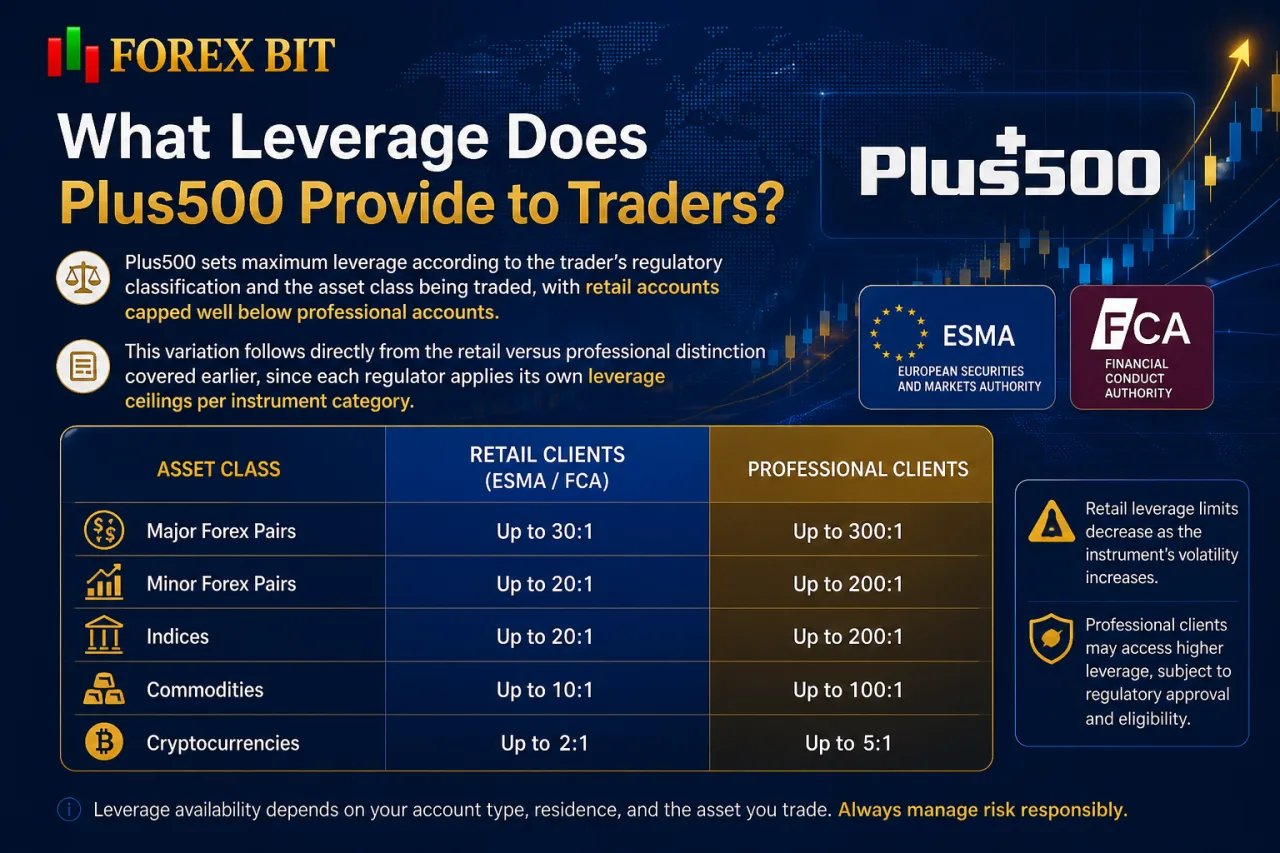
Plus500 sets maximum leverage according to the trader’s regulatory classification and the asset class being traded, with retail accounts capped well below professional accounts. This variation follows directly from the retail versus professional distinction covered earlier, since each regulator applies its own leverage ceilings per instrument category.
Retail clients under frameworks such as ESMA and the FCA face tiered limits that scale down as an instrument’s volatility profile rises, while professional clients access substantially higher ratios once qualifying under the criteria outlined previously.
Maximum leverage for retail accounts typically follows a tiered scale across asset classes, from major forex pairs down to individual shares, with lower caps applied to riskier or more volatile instruments.
- Forex pairs generally carry the highest available leverage among retail-eligible instruments
- Major stock indices carry moderate leverage relative to forex
- Commodities carry leverage set below indices in most regulatory tiers
- Individual shares carry the lowest leverage among the four asset classes
Jurisdictions outside ESMA, CySEC, and FCA oversight, including certain accounts under ASIC or MAS, may permit different leverage ceilings, since each regulator sets its own thresholds independently rather than following a single global standard.
What Markets and Instruments Can You Trade on Plus500?
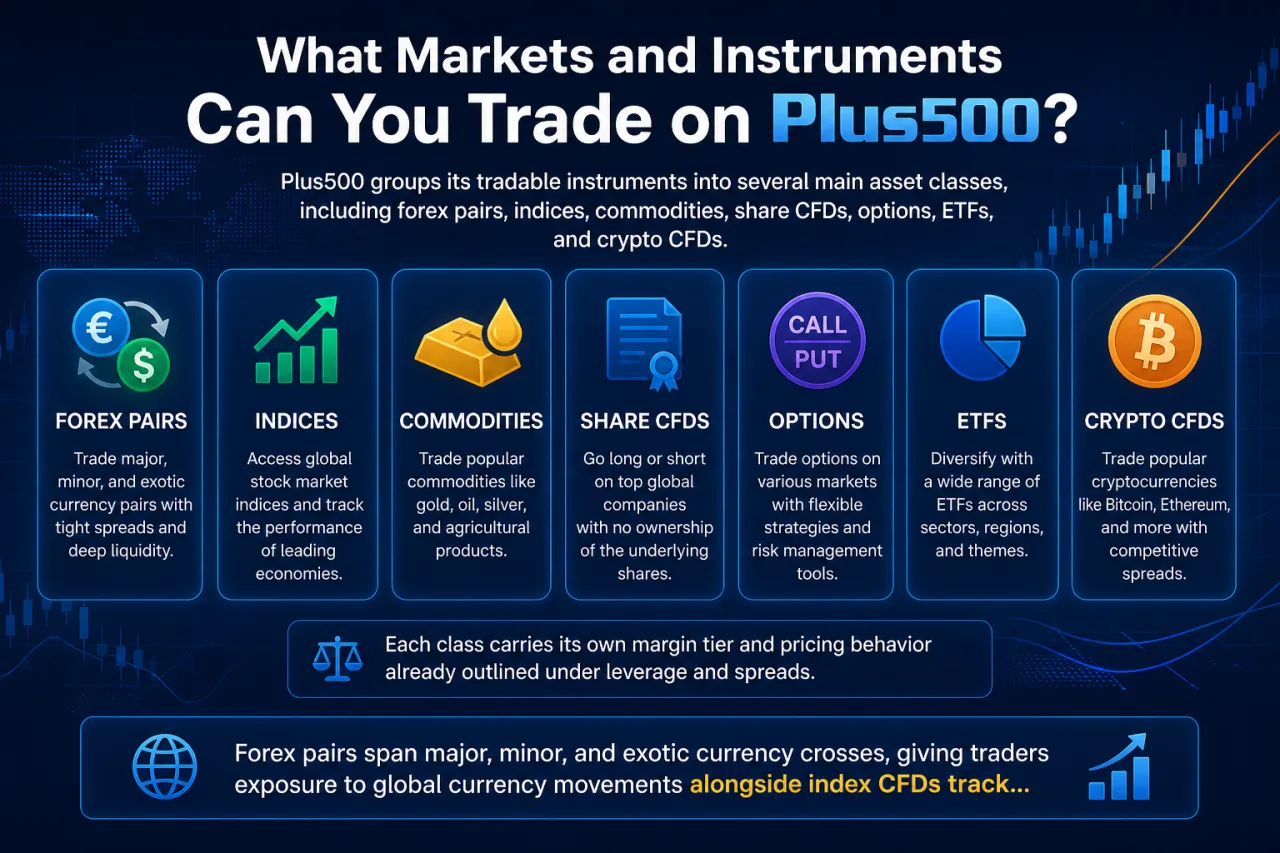
Plus500 groups its tradable instruments into several main asset classes, including forex pairs, indices, commodities, share CFDs, options, ETFs, and crypto CFDs. Each class carries its own margin tier and pricing behavior already outlined under leverage and spreads, but the breadth of coverage across asset types is what distinguishes Plus500’s markets menu.
Forex pairs span major, minor, and exotic currency crosses, giving traders exposure to global currency movements alongside index CFDs tracking benchmark stock markets across multiple regions. Commodities cover energy, metals, and agricultural products, while share CFDs let traders speculate on individual company price movements without owning the underlying stock.
Plus500 also lists options CFDs on select indices and commodities, ETF CFDs tracking diversified fund baskets, and crypto CFDs on major digital assets, rounding out a multi-asset lineup accessible through the same WebTrader and mobile app interface described earlier in this review.
How Do You Deposit and Withdraw Funds on Plus500?
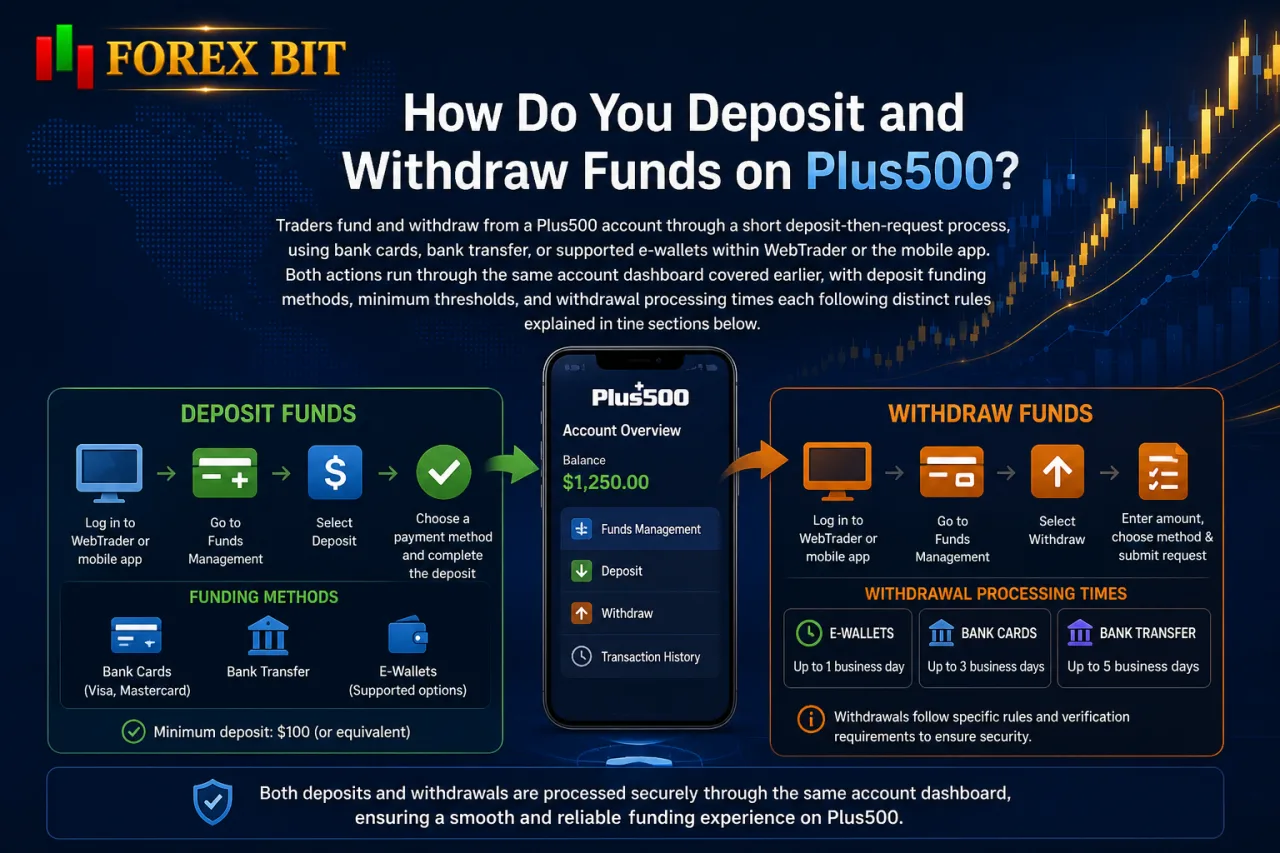
Traders fund and withdraw from a Plus500 account through a short deposit-then-request process, using bank cards, bank transfer, or supported e-wallets within WebTrader or the mobile app. Both actions run through the same account dashboard covered earlier, with deposit funding methods, minimum thresholds, and withdrawal processing times each following distinct rules explained in the sections below.
What Payment Methods Does Plus500 Accept?
Plus500 accepts four main payment method categories for deposits and withdrawals: debit/credit cards, bank transfer, PayPal, and other e-wallets such as Skrill. This funding lineup ties directly into the deposit-then-request process described earlier, with availability shifting by region and account entity.
Debit and credit cards process deposits almost instantly in most cases, making them the most common funding choice among traders opening an account. Bank transfer supports larger deposit amounts but generally takes longer to clear compared to card payments, both for funding and for withdrawal requests.
PayPal and Skrill offer faster withdrawal turnaround than bank transfer in regions where Plus500 supports them, though not every regulated entity offers the same e-wallet selection. Card-based funding methods used to open an account typically become the required route for withdrawals up to the original deposit amount, a practice commonly applied among regulated CFD brokers to limit money-laundering risk.
- Debit/credit cards: fast deposits, standard withdrawal route
- Bank transfer: higher deposit limits, slower processing
- PayPal: available in select regions for both deposits and withdrawals
- Skrill and other e-wallets: regional availability varies by regulated entity
Traders opening an account confirm the exact methods, limits, and processing times available for their specific regulated entity before funding.
How Good Is Plus500 Customer Support?

Plus500’s customer support qualifies as generally responsive, built around a 24/7 live chat channel, email support, and an internal ticketing system rather than phone-based service. This support structure runs independently of the WebTrader and mobile app trading environment, though it connects directly to the same account dashboard traders already use for deposits and platform access.
Live chat functions as the primary contact method, allowing traders to reach a support agent without leaving the platform interface. Email support and the ticketing system handle more detailed inquiries, such as account verification or withdrawal-specific questions, where a written record benefits both the trader and Plus500’s compliance team.
Plus500 offers multilingual customer support across its regulated entities, generally aligning language coverage with the regions each license serves.
User feedback on responsiveness varies by region and regulated entity, with live chat typically producing faster resolution than email for routine account questions.
Who Is Plus500 Best Suited For?

Plus500 groups its ideal users into a few clear profiles: casual CFD traders, mobile-first traders, and beginners seeking a simple interface, while traders needing MT4/MT5, expert advisors, or copy trading fit better elsewhere. This fit follows directly from the platform, fees, and account structure already outlined, and the profiles below break down why each group aligns or clashes with what Plus500 offers.
Casual traders benefit from the spread-only pricing and straightforward WebTrader layout, since no commission tracking or complex fee sheet stands between them and a trade. Mobile-first traders gain from the synchronized app experience, where positions, alerts, and account balance stay consistent whether trading from a desktop or a phone.
Beginners find value in the guided interface, built-in economic calendar, and risk tools like guaranteed stops, which reduce the learning curve compared to more technical platforms.
Experienced traders who rely on automated strategies, custom indicators, or social copy trading typically look outside Plus500, since the broker’s proprietary platform does not support MT4, MT5, or third-party expert advisors. This limitation matters most for algorithmic traders and those following external signal providers.
What Are the Main Advantages and Disadvantages of Plus500?
Plus500’s main advantages center on multi-jurisdictional regulation, a simple proprietary platform, and transparent spread-based pricing, while its main disadvantages involve no MT4/MT5 support and limited educational resources. This balance follows directly from the regulation, platform, and fee structure already outlined in this review, weighing what strengthens Plus500’s appeal against what narrows its fit for certain trader types.
Pros:
- Licensing across multiple regulators gives traders segregated funds and negative balance protection under recognized frameworks.
- The single WebTrader and mobile app interface removes the complexity of choosing between multiple platforms.
- Spread-only pricing keeps cost tracking straightforward compared to brokers layering commissions on top of spreads.
Cons:
- The absence of MT4 and MT5 blocks access to custom expert advisors, algorithmic strategies, and third-party indicator libraries that many experienced traders rely on.
- Plus500 also provides comparatively limited educational content, such as structured courses or in-depth market analysis, compared with brokers that build dedicated learning hubs alongside their trading platforms.
These trade-offs position Plus500 as stronger for straightforward CFD trading than for traders requiring automation, custom scripting, or extensive in-house educational programs.
What Makes Plus500’s Corporate Structure and Market Position Unique?
Plus500’s corporate structure stands apart through its London Stock Exchange listing and multi-entity regulatory setup, a combination uncommon among retail CFD brokers that typically remain privately owned. This dual distinction shapes both the transparency traders can verify and the licensing terms that apply based on their country of residence, with the specifics broken down below.
Does Plus500 Offer Any Promotions or Loyalty Programs?
No, Plus500 does not run deposit bonuses, welcome offers, or loyalty reward schemes, since regulators across most of its licensed jurisdictions restrict or ban CFD trading incentives tied to deposits. This regulatory stance directly answers whether promotions or loyalty programs form any part of the Plus500 offering.
Regulators such as the FCA, CySEC, and ASIC generally restrict CFD brokers from offering monetary bonuses or trading credits designed to encourage larger deposits, since these incentives can push traders toward excessive risk-taking.
Plus500 instead positions its value around the core account features already outlined earlier in this review, such as spread-based pricing and the risk management tools built into WebTrader and the mobile app, rather than promotional incentives. No tiered VIP program, cashback scheme, or referral bonus structure appears as a standard, publicly disclosed feature across its regulated entities.
Traders comparing brokers on promotional value typically find spread competitiveness and platform reliability more relevant to long-term trading costs than a one-time welcome offer.
Which Countries Are Restricted from Using Plus500?
Plus500 restricts residents of the United States from opening a retail CFD trading account, alongside several other jurisdictions where local regulation prohibits or limits CFD trading. The exact list of excluded countries changes over time. This restriction follows directly from the multi-entity regulatory structure covered earlier, since each Plus500 entity only serves the countries its specific license authorizes.
Countries commonly excluded from standard Plus500 CFD services include:
- United States retail traders, due to domestic derivatives regulation limiting offshore CFD access
- Jurisdictions under international sanctions or trade restrictions
- Countries where local financial authorities have not authorized CFD trading products
Traders confirm eligibility for their country of residence directly on Plus500’s website before attempting to register, since entity availability and restricted-country lists change as regulatory frameworks evolve across regions.
Conclusion
Plus500 earns its trustworthy standing through licenses across the FCA, CySEC, ASIC, MAS, FMA, and ISA, combined with segregated client funds, negative balance protection, and the disclosure obligations of a London Stock Exchange listing. Spread-based pricing, a proprietary WebTrader and mobile platform, and multi-asset market access reinforce a broker built for straightforward CFD trading rather than automation or copy trading.
Limited educational resources and the absence of MT4/MT5 remain the clearest trade-offs. Overall, traders seeking a regulated, transparent, and simple CFD broker in 2026 have sufficient grounds to consider Plus500 a safe and credible choice.
Thomas Dite is the Best Forex Brokers Research Manager at Forex Bit, specializing in researching, comparing, and editing broker-related content for different trader needs. He focuses on evaluating trading platforms, costs, regulation, account conditions, and other key factors to help readers make more informed broker comparisons.
Email: [email protected]