
Compare Forex-bit.com forex account types, deposits, leverage and spreads to find the best fit for your trading style. Read the full breakdown now.
Forex Account Types & Trading Conditions Guide

A forex account is an account opened with a forex broker or trading provider that allows a trader to access the foreign exchange market, place currency trades, manage margin, and track open positions and account equity.
However, not every forex account works the same way. Brokers may offer different pricing structures, minimum trade sizes, execution models, leverage limits, platforms, and account features.
The names used for these accounts also vary between providers, which means terms such as Standard, Raw Spread, Micro, Professional, or Swap-Free should not be treated as universal industry standards.
Understanding the main Forex Account Types and their trading conditions helps traders compare brokers more accurately and choose an account that matches their trading volume, strategy, capital, and experience.
With this in mind, Forex Bit examines the main types of forex accounts below, highlighting their key features, trading conditions, and suitability for different types of traders.
What Is a Forex Account?

A forex account is a trading account through which a client buys or sells currency pairs such as EUR/USD, GBP/USD, or USD/JPY.
Depending on the broker and jurisdiction, a forex account may provide access to spot forex, rolling spot forex, forex CFDs, or other leveraged currency products.
The account normally records:
- Available balance
- Account equity
- Used and available margin
- Open and pending positions
- Realized and unrealized profit or loss
- Deposits and withdrawals
- Trading fees
- Overnight financing or swap charges
Most retail forex trading involves leverage. Instead of paying the full notional value of a position, the trader deposits margin and receives exposure to a larger position.
This makes margin and leverage two of the most important conditions to review before opening a forex account. Leverage can amplify both profits and losses, and regulators warn that leveraged forex products can expose traders to substantial risk.
What Are the Main Forex Account Types?
There is no single global classification system for Forex Account Types. Each broker can structure and name its accounts differently.
For example, some providers separate accounts according to spread and commission structure, while others differentiate accounts by trading size, platform, customer classification, or financing conditions.
The most common categories include:
- Demo Account
- Standard or Spread-Only Account
- Raw Spread or Commission-Based Account
- Micro or Cent Account
- Swap-Free Account
- Professional or VIP Account
These categories can overlap. A broker may, for example, offer a swap-free version of a Standard account or allow micro-sized trades within a Raw Spread account.
What Is a Demo Forex Account?

A demo forex account allows traders to use a trading platform with virtual funds instead of real money.
Demo accounts are commonly used to:
- Learn how a trading platform works
- Practice placing orders
- Test indicators
- Test Expert Advisors or automated strategies
- Learn position sizing
- Become familiar with margin calculations
- Evaluate a broker’s platform before opening a live account
A demo account is particularly useful for beginners because mistakes do not result in direct financial losses.
However, demo trading should not be assumed to reproduce every live-market condition.
Some demo environments may differ from live accounts in areas such as:
- Slippage
- Liquidity
- Order execution
- Financing adjustments
- Price gaps
- Emotional pressure
IG, for example, states that some conditions in its demo environment differ from live trading, including slippage and certain financial adjustments.
Therefore, a profitable demo strategy does not automatically produce the same result when transferred to a live forex account.
What Is a Standard Forex Account?
A Standard account is one of the most common forms of retail forex account.
In many broker structures, the primary trading cost is incorporated into the bid-ask spread rather than being charged as a separate forex commission.
This type of pricing is also sometimes called:
- Spread-only pricing
- Standard pricing
- Commission-free forex pricing
“Commission-free” does not mean trading is free. The broker may still earn from the spread between the bid and ask price.
For example, FOREX.com currently distinguishes between a spread-only account and a RAW Pricing account, illustrating how account classification can be based primarily on pricing rather than trader experience or deposit size.
A Standard account may appeal to traders who prefer:
- Simple trading costs
- No separate forex commission calculation
- Moderate trading frequency
- Straightforward account management
However, the spread can be wider than on commission-based or raw-spread pricing models.
What Is a Raw Spread Forex Account?
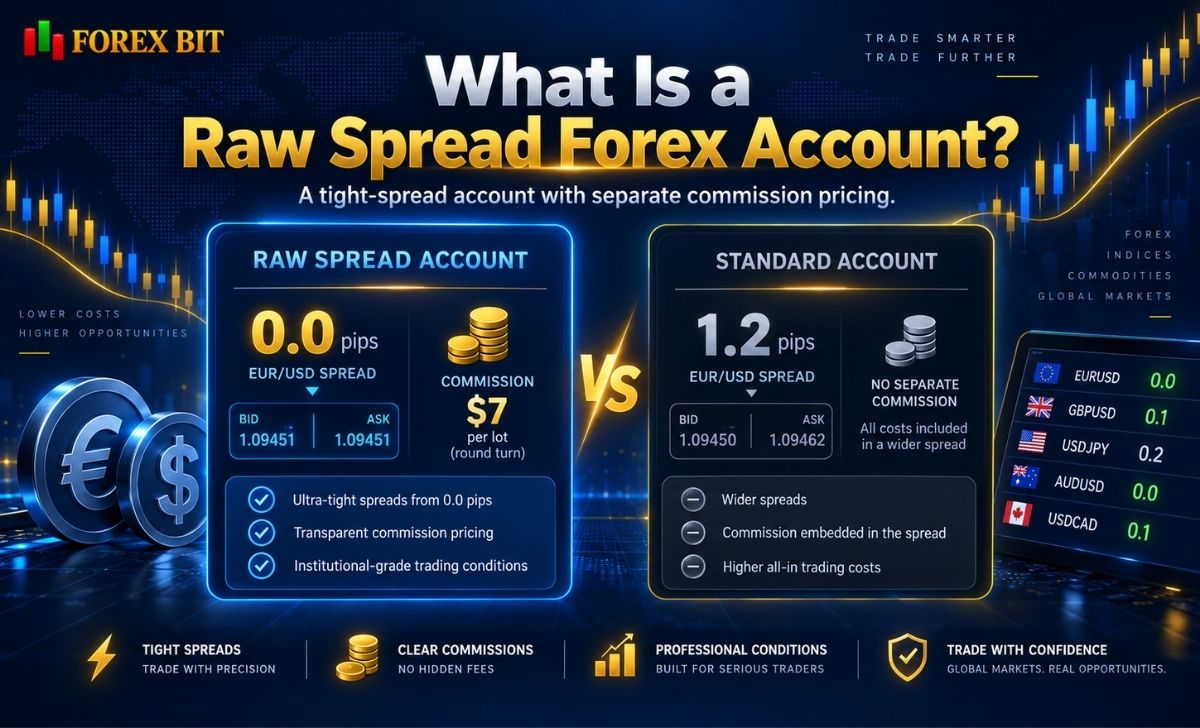
A Raw Spread account generally offers access to tighter bid-ask spreads while charging a separate commission on trading volume.
The total cost of a trade therefore consists primarily of:
Spread + Commission
Depending on the broker, these accounts may also be called:
- Raw Pricing accounts
- Commission accounts
- Razor accounts
- ECN-style accounts
The terminology is not standardized, so traders should examine the actual pricing rather than relying only on the account name.
For example, FOREX.com’s RAW Pricing model combines reduced spreads with a commission based on trading volume. Its spread-only account uses a different pricing structure.
Raw-spread pricing may be attractive to:
- Scalpers
- Day traders
- Algorithmic traders
- High-frequency traders
- Traders with relatively high monthly volume
However, a lower advertised spread does not automatically make a Raw Spread account cheaper.
A trader should calculate the all-in trading cost, including both spread and commission.
Spreads are also variable in many forex markets. They can widen when liquidity falls or volatility rises, including around major economic announcements.
What Is a Micro or Cent Forex Account?
A Micro account or Cent account is designed to allow smaller position sizes or smaller account balances.
The terminology varies significantly between brokers.
In traditional forex lot terminology:
| Lot Type | Currency Units |
|---|---|
| Standard lot | 100,000 |
| Mini lot | 10,000 |
| Micro lot | 1,000 |
These conventional lot sizes are documented by both FOREX.com and IG.
On platforms using lots, a micro lot commonly corresponds to 0.01 standard lot, or approximately 1,000 units of the base currency.
However, brokers do not always use fixed lot increments.
OANDA, for example, explains that its proprietary platform can support position sizing in individual currency units rather than requiring traders to choose only standard, mini, or micro lots.
This illustrates an important distinction:
A micro trade size is not necessarily the same thing as a dedicated Micro account.
Some brokers offer small position sizes within their regular forex account instead of creating a separate Micro Account tier.
What Is a Swap-Free Forex Account?

A Swap-Free forex account is structured so that qualifying positions do not incur the conventional overnight swap or interest mechanism used on standard trading accounts.
These accounts are sometimes referred to as:
- Islamic accounts
- Sharia-compliant accounts
- Interest-free accounts
Availability and eligibility depend entirely on the broker.
Traders should not assume that “swap-free” means there are no charges for holding positions over time.
Some brokers apply:
- Administration fees
- Fixed holding charges
- Alternative financing charges
- Restrictions on certain instruments
- Maximum swap-free holding periods
For example, Pepperstone currently describes a swap-free account where an administrative charge can apply after a position has been held for a specified period.
Before opening this Forex Account Type, traders should check the broker’s current swap-free policy rather than assuming all overnight costs are removed.
What Is a Professional Forex Account?
A Professional forex account is generally intended for clients who meet specific experience, trading activity, or financial criteria.
It should not be confused with an account that simply contains “Pro” or “Professional” in a broker’s marketing name.
Under regulated client-classification frameworks, being classified as a professional client can materially affect regulatory protections.
Professional accounts may offer features such as:
- Different leverage limits
- Different margin requirements
- Volume-based pricing
- Access to additional products
- Dedicated account services
However, higher leverage is not inherently an advantage. It increases market exposure relative to account capital and therefore increases risk.
Professional status may also result in the loss or reduction of protections available to retail clients.
A trader should therefore review the legal implications of professional classification instead of choosing an account solely because it advertises higher leverage.
How Do Forex Account Types Compare?
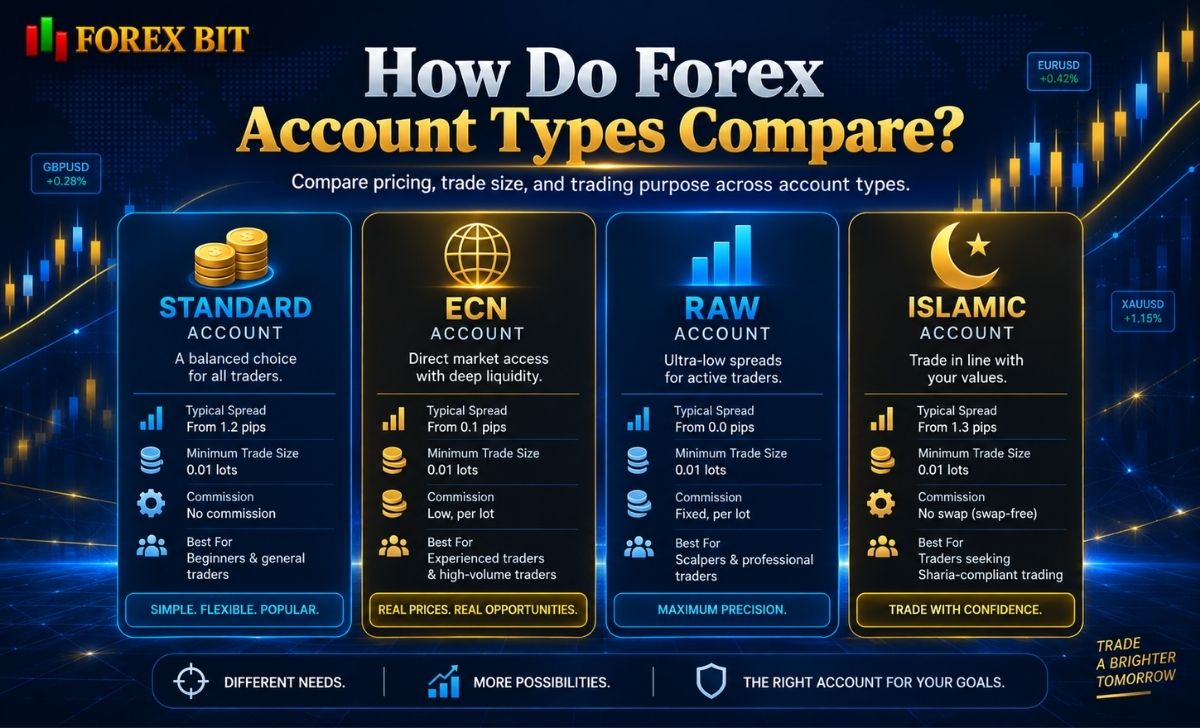
The following table summarizes common account structures.
| Forex Account Type | Typical Pricing Structure | Common Use |
|---|---|---|
| Demo | Virtual funds | Platform practice and strategy testing |
| Standard / Spread-Only | Trading cost primarily through spread | General retail trading |
| Raw Spread | Tighter spread + commission | Active and cost-sensitive trading |
| Micro / Cent | Smaller position sizes | Smaller-scale live trading |
| Swap-Free | Alternative overnight financing structure | Traders requiring swap-free conditions |
| Professional / VIP | Broker or regulatory criteria apply | Eligible experienced/high-volume traders |
These descriptions are general categories rather than fixed specifications.
Minimum deposits, leverage, commissions, spreads, instruments, margin levels, and execution rules must always be checked directly with the individual broker.
What Trading Conditions Should You Compare Before Opening a Forex Account?
Choosing between Forex Account Types requires more than comparing account names.
The following conditions can significantly affect trading costs and risk.
Minimum Deposit
The minimum deposit is the smallest amount required to activate or fund an account.
There is no universal minimum deposit for a forex account.
One broker may have no formal minimum, another may require a modest initial deposit, and another may set different funding requirements depending on the account or jurisdiction.
A higher minimum deposit also does not automatically mean better trading conditions.
Traders should distinguish between:
- Required minimum deposit
- Broker-recommended starting capital
- Minimum amount needed to open a specific trade
These are different figures.
Minimum Trade Size
Minimum trade size determines the smallest position that can be opened.
A broker may allow:
- Individual currency units
- 0.01 lot
- 0.1 lot
- One mini contract
- Other instrument-specific minimums
Minimum volume can also differ between forex pairs and other products available through the same account.
A trader planning to use precise risk management should therefore check the contract specification for each instrument.
Spread
The spread is the difference between the bid price and ask price.
If EUR/USD is quoted at:
1.1000 / 1.1001
the spread is one pip.
Spreads can be:
- Fixed
- Variable
- Marked up by the broker
- Raw or near-raw plus commission
Variable spreads can widen during volatile or illiquid conditions.
For active traders, even a small difference in average spread may materially affect total trading costs over hundreds or thousands of transactions.
Commission
Some forex accounts charge a separate commission.
The commission may be calculated:
- Per lot
- Per side
- Per round trip
- Per notional amount traded
When comparing a Standard and Raw Spread account, traders should calculate:
Total Trading Cost = Spread Cost + Commission
Comparing the advertised spread alone can be misleading.
Leverage
Leverage controls how much market exposure a trader can obtain relative to the margin committed.
For example:
- 10:1 leverage means $1 of margin controls $10 of exposure.
- 30:1 leverage means $1 controls $30.
- 50:1 leverage means $1 controls $50.
Higher leverage reduces the initial margin required for a position but increases the amount of exposure relative to the trader’s capital.
Regulatory limits vary by jurisdiction.
In the United Kingdom, FCA rules restrict leverage on retail CFDs to between 30:1 and 2:1 depending on the underlying asset. The rules also include a 50% account-level margin close-out requirement and negative balance protection for retail CFD accounts.
ESMA’s CFD intervention framework specifies leverage of 30:1 for major currency pairs and 20:1 for non-major currency pairs for retail clients under that framework.
In the United States, current NFA rules require minimum security deposits of 2% for specified major currency transactions and 5% for other forex transactions. Those percentages correspond to maximum effective leverage of approximately 50:1 and 20:1 respectively.
This is why a broker should not advertise one universal leverage figure without considering the entity and country under which a client is registered.
Margin Requirement
Margin is the capital required to maintain leveraged exposure.
A simplified relationship is:
Required Margin = Position Value ÷ Leverage
For example, if a position has a notional value of $30,000 and leverage is 30:1:
$30,000 ÷ 30 = $1,000 required margin
Actual broker calculations can be more complex and may depend on:
- Currency pair
- Position size
- Account currency
- Regulatory classification
- Market volatility
- Tiered margin schedules
Traders should use the broker’s contract specifications or margin calculator for exact values.
What Are Margin Call and Stop-Out Levels?
A margin call occurs when account equity falls relative to the margin required to maintain open positions.
A stop-out or margin close-out mechanism allows positions to be closed when the account no longer satisfies specified margin requirements.
These thresholds are not universal.
They depend on:
- Broker rules
- Product type
- Regulatory jurisdiction
- Client classification
In the UK retail CFD market, FCA rules require providers to close positions when funds fall to 50% of the margin required to maintain open positions at account level.
That percentage should not be applied automatically to every forex broker worldwide.
What Are Forex Swap and Overnight Financing Charges?
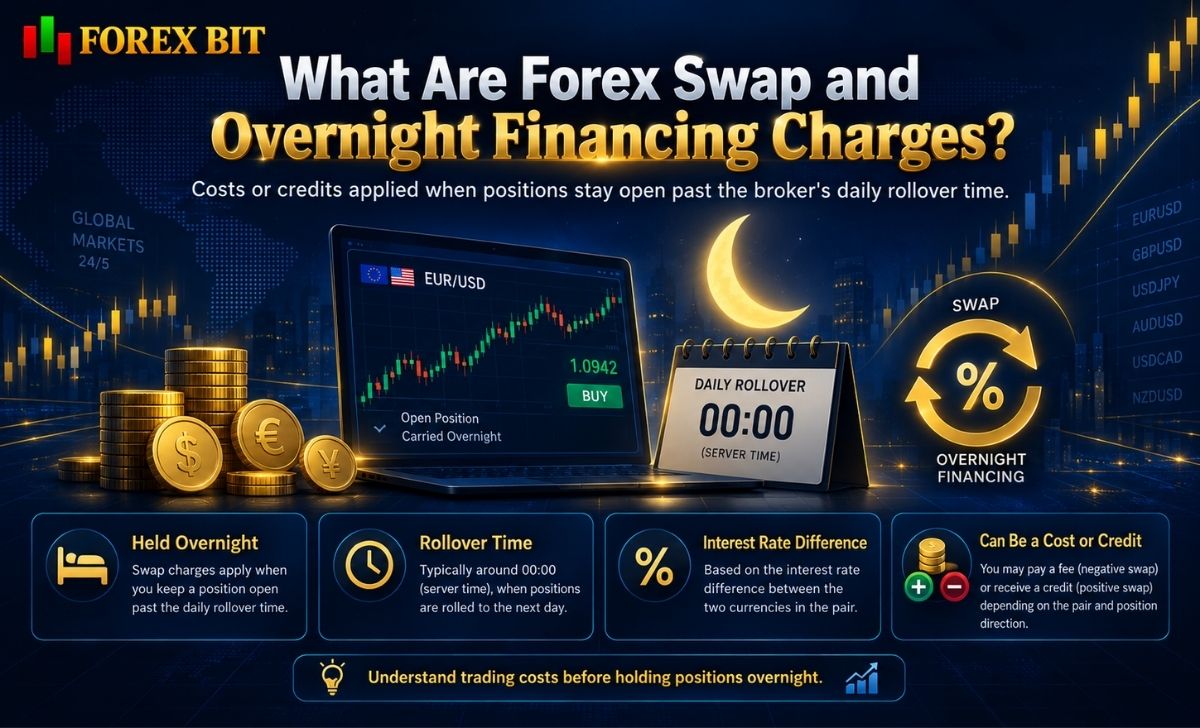
A position that remains open beyond a broker’s daily financing cutoff may incur an overnight financing adjustment, often called:
- Swap
- Rollover
- Overnight financing
- Financing charge
The amount can depend on:
- Currency pair
- Direction of the trade
- Interest-rate differential
- Broker markup
- Position size
- Number of rollover days
Swap can sometimes be positive and sometimes negative.
Certain days may also carry multiple days of rollover to account for settlement conventions and weekends.
Traders holding positions for several days or weeks should include financing costs when comparing forex account types.
Does Execution Quality Change Between Forex Accounts?
Execution quality can be just as important as the advertised spread.
Factors to examine include:
- Execution speed
- Slippage
- Order rejection rate
- Price improvement
- Liquidity
- Execution model
- Maximum order size
Slippage occurs when an order is executed at a different price from the price expected when the order was submitted.
It can be positive or negative.
Fast-moving markets and periods of limited liquidity can increase the probability of slippage. FOREX.com, for example, notes that fast-moving conditions can result in execution away from the previously displayed market price.
Claims such as “no slippage,” “institutional execution,” or “direct liquidity access” should therefore be verified against the broker’s execution policy rather than inferred from the account name.
Can Scalping, Hedging and Expert Advisors Be Used With Every Forex Account?
Not necessarily.
Permission to use:
- Scalping
- Hedging
- Expert Advisors
- Automated trading
- High-frequency strategies
- APIs
- Copy trading
depends on the broker, platform, account type, and jurisdiction.
Traders using automated or short-term strategies should verify these conditions before funding an account.
They should also check:
- Minimum order distance
- Maximum number of open orders
- Maximum lot size
- API availability
- VPS support
- Platform compatibility
- Restrictions on latency arbitrage or abusive trading practices
Do not assume that a Raw Spread or Professional account automatically permits every trading strategy.
Does the Base Currency of a Forex Account Matter?
Yes.
A forex account has a base or account currency used to calculate:
- Balance
- Equity
- Profit and loss
- Margin
- Deposits
- Withdrawals
- Fees
Common account currencies may include USD, EUR, GBP and other currencies depending on the broker.
If deposits, withdrawals, or trading profits are denominated in another currency, currency conversion charges may apply.
Choosing an appropriate base currency may therefore reduce unnecessary conversion costs.
Which Forex Account Type Is Best for Beginners?

There is no universally best forex account for beginners.
A beginner may benefit from starting with:
- A demo account to learn the platform.
- A live account that supports small position sizes.
- A simple and transparent fee structure.
- Conservative leverage.
- Clear margin and risk controls.
A Standard or spread-only account may be easier to understand because trading costs are usually concentrated in the spread.
However, account simplicity should not replace comparison of regulation, execution quality, trading costs, and risk.
Which Forex Account Type Is Better for Scalping?
Scalpers commonly prioritize:
- Low all-in transaction costs
- Tight spreads
- Fast execution
- Stable platform performance
- Low latency
- Transparent commissions
For this reason, a Raw Spread or commission-based forex account may be worth considering.
But the correct comparison is not:
Standard spread vs. Raw spread
It is:
Standard total cost vs. Raw spread + commission + execution quality
A raw account with low spreads but expensive commissions can still cost more than another account.
Which Forex Account Is Better for High-Volume Traders?
High-volume traders should examine:
- Commission per traded volume
- Average spread
- Volume rebates
- Execution statistics
- Maximum trade size
- Liquidity
- API access
- VPS support
- Account-management services
Some brokers offer VIP or Active Trader programs rather than a separate Professional account.
Professional regulatory classification should be treated separately from broker loyalty or volume programs.
How Should You Choose a Forex Account?
Before opening a forex account, compare the following:
| Factor | What to Check |
|---|---|
| Regulation | Which legal entity holds the account? |
| Account type | Standard, Raw, Micro, Swap-Free or another structure |
| Minimum deposit | Required amount versus recommended funding |
| Minimum trade size | Units or minimum lot size |
| Spread | Typical/average spread, not only minimum advertised spread |
| Commission | Per side, lot or notional value |
| Leverage | Maximum permitted in your jurisdiction |
| Margin | Initial and maintenance requirements |
| Stop-out | Exact margin close-out threshold |
| Swap | Overnight financing policy |
| Execution | Slippage, liquidity and execution model |
| Platform | MT4, MT5, proprietary platform or others |
| Automation | EA, API and VPS availability |
| Base currencies | Deposit and account currency options |
| Withdrawals | Methods, processing rules and fees |
A trader should compare the complete trading conditions, not simply select the account offering the highest leverage or lowest advertised spread.
Conclusion
A forex account is more than a place to deposit funds and execute currency trades. Its pricing structure, margin requirements, leverage, trade size, execution conditions, financing costs, and regulatory protections can directly affect both trading costs and risk.
The most common Forex Account Types include Demo, Standard or Spread-Only, Raw Spread, Micro or Cent, Swap-Free, and Professional or VIP accounts. However, these terms are not standardized across the forex industry.
One broker’s Standard account may differ significantly from another broker’s Standard account, while a feature described as a separate account by one provider may simply be an optional setting at another.
For that reason, traders should compare the actual conditions behind each forex account rather than relying on its name.
Before opening an account, verify the broker’s current spread, commission, minimum trade size, leverage, margin rules, stop-out level, overnight financing, execution policy, regulatory entity, and account eligibility directly from the broker’s official documentation.
Isabella Brown is the Forex Trading Guide Manager at Forex Bit, focusing on educational content about broker safety, trading costs, account types, platforms, and key Forex/CFD concepts. Her work helps readers understand trading terms, broker conditions, and practical checks before evaluating or using a brokerage service.
Email: [email protected]



Best Brokers

Trade with the world’s largest retail broker and benefit from better - than - market conditions.

We offer a superior trading environment that puts traders in the best position to profit.

Trade with the best trading conditions. WIN THE BEST TRADING ACCOUNT AWARD.

Trade global markets with Interactive Brokers – a highly regulated multi-asset broker built for active and professional investors.






Forex Bit provides independent forex broker reviews, comparisons, guides, and industry news to help traders make informed decisions.
Best Brokers
Metatrader 5 Brokers
Metatrader 4 Brokers
Lowest Spread Forex Broker
Regulated Forex Brokers
Forex Copy Trading
Ctrader Brokers
Best Forex Broker For Beginners