
Curious how an Islamic forex account works? Discover swap-free conditions, spreads, eligibility and account rules before you open one.
Islamic Forex Account: Swap-Free Trading Conditions Guide

An Islamic forex account is a swap-free trading account that removes overnight interest (rollover) charges to comply with Sharia principles prohibiting riba. Instead of swap fees, brokers may apply a fixed administrative fee or wider spread on positions held overnight.
Islamic account conditions differ across brokers mainly in spread markup, holding time limits, and eligible instruments. Some brokers apply swap-free terms only to specific account tiers or trading platforms.
The spread or commission difference between Islamic (swap-free) accounts and standard accounts varies by broker. Some brokers charge wider spreads or fixed fees in place of overnight swap interest.
Eligibility for a swap-free account typically requires proof of religious affiliation or self-declaration during account registration. Some brokers require clients to confirm they follow Islam before approving an Islamic (swap-free) account, though verification requirements vary from one broker to another. The application process is usually completed through the broker’s account settings or client verification form.
Islamic accounts often carry restrictions such as maximum holding periods and limited access to certain leveraged instruments. These restrictions may include limits on how long positions can be held or reduced access to certain trading instruments, depending on the broker’s policy. Spreads on these accounts can also be slightly wider than standard accounts to offset the absence of swap charges.
Forex Bit breaks down how swap-free trading actually works, the types of Islamic accounts available, and how they compare to standard accounts in the sections below.
What Is an Islamic Forex Account and How Does Swap-Free Trading Work?
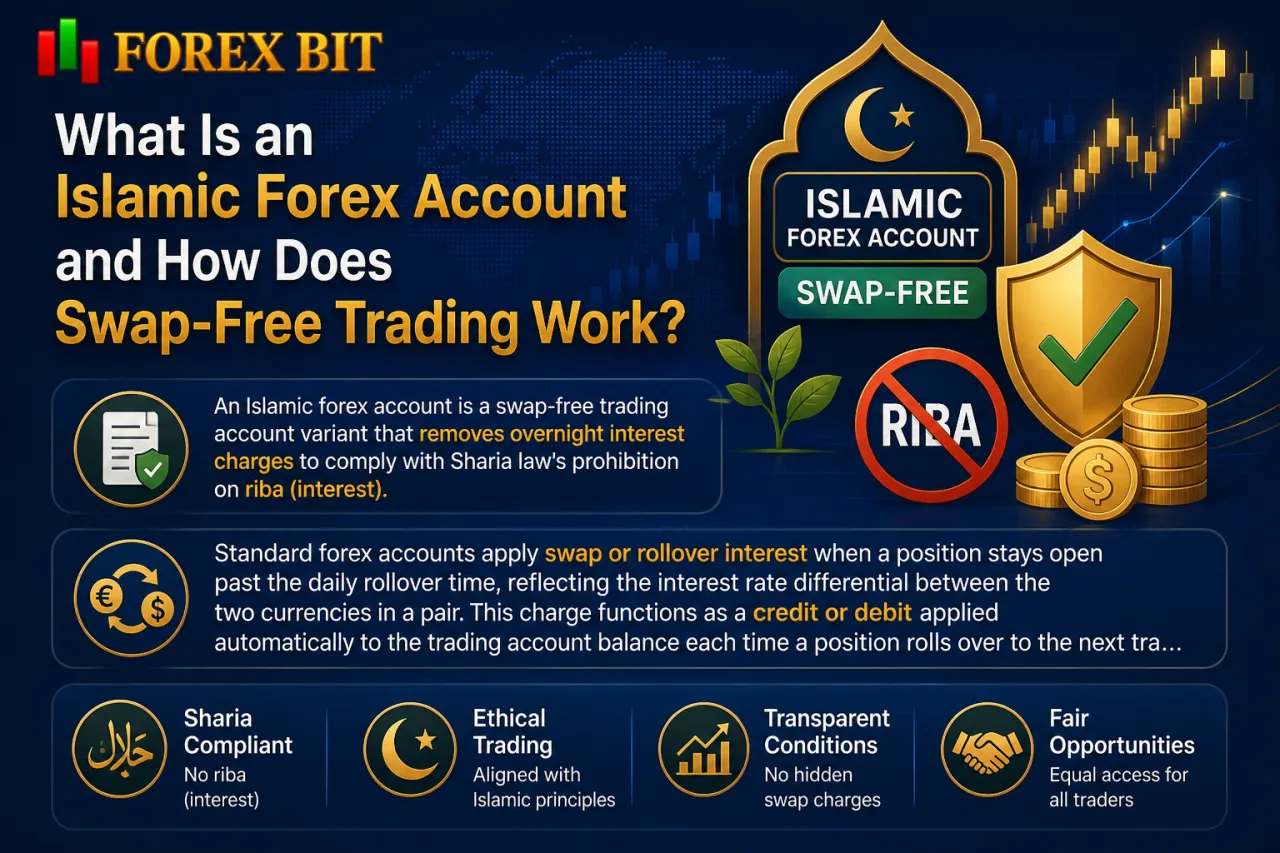
An Islamic forex account is a swap-free trading account variant that removes overnight interest charges to comply with Sharia law’s prohibition on riba (interest). Standard forex accounts apply swap or rollover interest when a position stays open past the daily rollover time, reflecting the interest rate differential between the two currencies in a pair. This charge functions as a credit or debit applied automatically to the trading account balance each time a position rolls over to the next trading day.
Swap-free accounts remove this mechanism entirely rather than adjusting it. No interest is credited or debited on overnight positions, regardless of the currency pair or the prevailing interest rate differential between the base and quote currencies. Brokers offset the lost swap revenue through alternative means already described, such as fixed administrative charges or wider spreads, rather than through daily interest calculations.
The core distinction from a standard account lies in this single mechanism: the swap component of the trade is disabled, while other trading conditions such as spreads, execution, and leverage generally follow the same structure as the broker’s regular accounts unless stated otherwise.
What Are the Different Types of Islamic Accounts Offered by Forex Brokers?
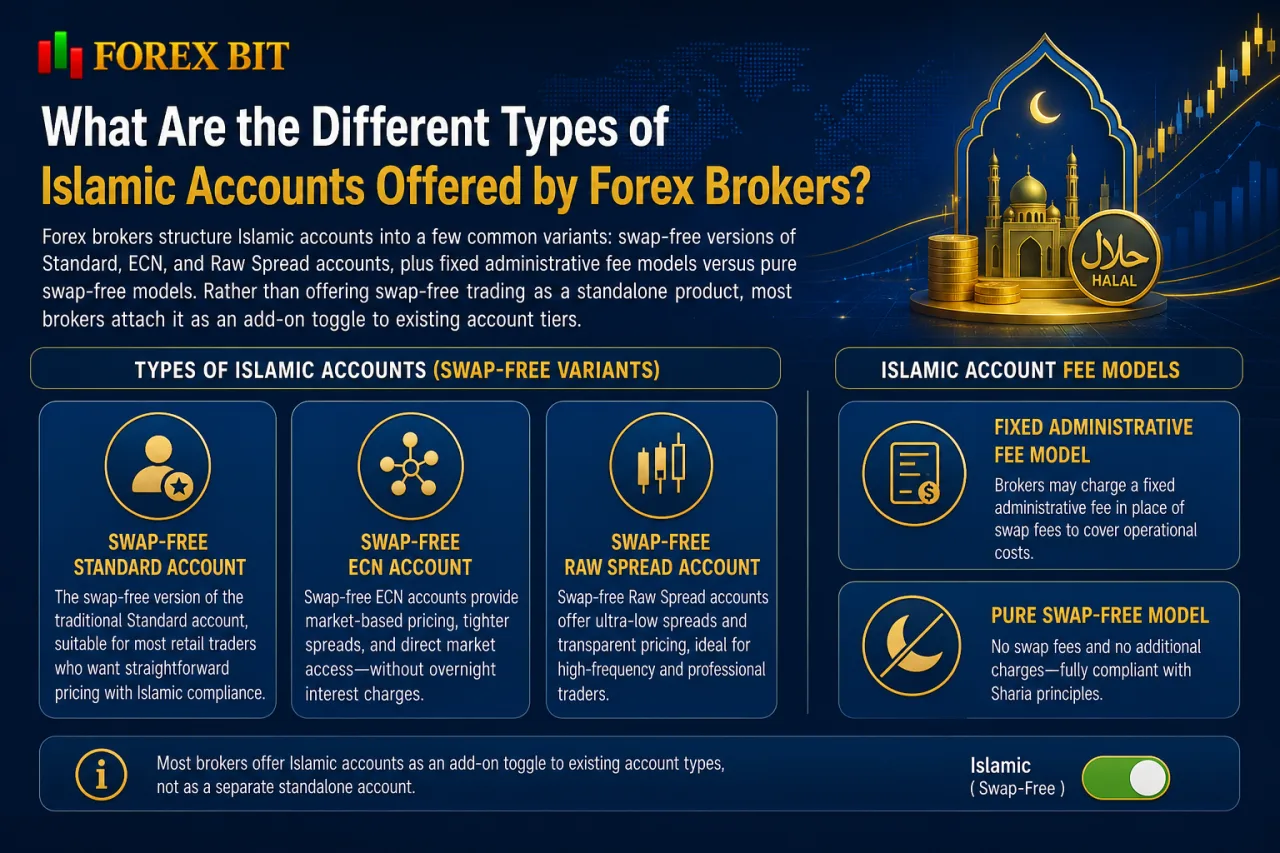
Forex brokers structure Islamic accounts into a few common variants: swap-free versions of Standard, ECN, and Raw Spread accounts, plus fixed administrative fee models versus pure swap-free models. Rather than offering swap-free trading as a standalone product, most brokers attach it as an add-on toggle to existing account tiers.
This grouping explains how the swap-free feature applies across different account structures. The sections below break down the swap-free variants of Standard, ECN, and Raw Spread accounts, the distinction between fixed fee and pure swap-free pricing models, and how brokers position Islamic status as an added setting rather than a separate product line.
How Do Swap-Free Standard Accounts Differ From Swap-Free ECN/Raw Accounts?
Swap-free Standard accounts price the missing swap through a spread markup, while swap-free ECN/Raw accounts charge a fixed per-lot commission on top of tighter raw spreads. This structural difference carries through minimum deposit and typical cost levels between the two variants.
Standard swap-free accounts commonly require a lower minimum deposit and embed the swap-free cost invisibly inside the spread, making the account simpler for smaller balances but harder to benchmark against a pure interbank rate. ECN/Raw swap-free accounts usually demand a higher minimum deposit and quote spreads closer to raw market conditions, replacing the swap charge with a transparent, itemized fee visible on each trade confirmation.
Spread markup on swap-free Standard accounts tends to run wider than on the equivalent swap-free ECN/Raw variant, since the cost is absorbed into the spread rather than billed separately.
- Cost transparency: ECN/Raw swap-free variants isolate the fee as a line-item commission.
- Cost structure: Standard swap-free variants fold the fee into the quoted spread.
- Deposit threshold: ECN/Raw swap-free variants typically set a higher minimum deposit than Standard swap-free variants.
Islamic Account vs Standard Account: What Are the Key Differences in Trading Conditions?
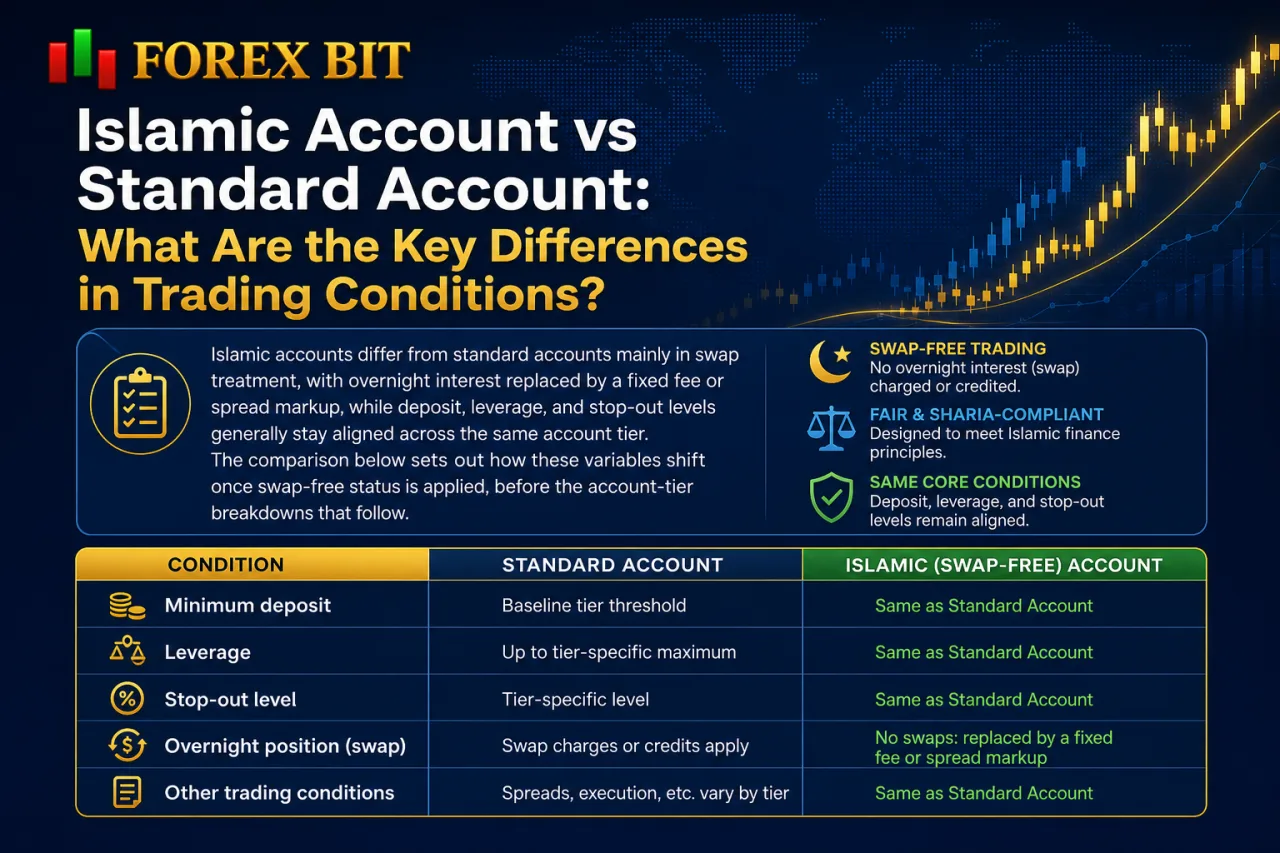
Islamic accounts differ from standard accounts mainly in swap treatment, with overnight interest replaced by a fixed fee or spread markup, while deposit, leverage, and stop-out levels generally stay aligned across the same account tier. The comparison below sets out how these variables shift once swap-free status is applied, before the account-tier breakdowns that follow.
| Condition | Standard Account | Islamic (Swap-Free) Account |
|---|---|---|
| Minimum deposit | Baseline tier threshold | Same as underlying tier |
| Base currency | Broker-standard options | Same as underlying tier |
| Leverage | Tier-standard maximum | Same as underlying tier, some instruments restricted |
| Spreads | Tier-standard spread | Equal or wider on Standard variant |
| Commissions | Tier-standard commission | Equal, or additional fixed fee on ECN/Raw variant |
| Stop-out/margin call | Tier-standard level | Same as underlying tier |
| Swap charge | Interest applied on rollover | Removed, replaced by fee or markup |
Deposit thresholds, base currency options, leverage caps, and stop-out/margin call levels generally stay tied to the underlying account tier rather than to swap-free status itself. The only structural variable that shifts consistently is the swap line: it disappears and is replaced by a fixed administrative charge or a spread adjustment, depending on whether the account sits on a Standard or ECN/Raw pricing model.
Do Islamic Accounts Have Wider Spreads or Extra Fees Compared to Standard Accounts?
Yes, Islamic accounts carry wider spreads or extra fixed fees compared to standard accounts in most cases, since brokers must replace lost swap revenue through another pricing channel. This offsetting mechanism ties back to the same spread markup and administrative fee models outlined for Standard versus ECN/Raw swap-free variants above.
The extra cost applies under specific conditions rather than uniformly across every account:
- Applies when positions remain open past the daily rollover cutoff, since swap-free status only affects overnight holding rather than intraday trades.
- Applies more visibly on Standard swap-free accounts, where the fee sits inside the quoted spread rather than as a separate line item.
- Applies as a per-lot administrative charge on ECN/Raw swap-free accounts, itemized separately from the raw spread and commission.
- Applies selectively when brokers restrict swap-free terms to certain instrument groups, leaving other instruments priced under standard swap conditions.
Whether the fee is charged as a spread markup or a fixed administrative amount depends on the account tier and the broker’s specific swap-free policy rather than a single fixed rule across the industry.
Who Is Eligible to Open a Swap-Free Islamic Forex Account?
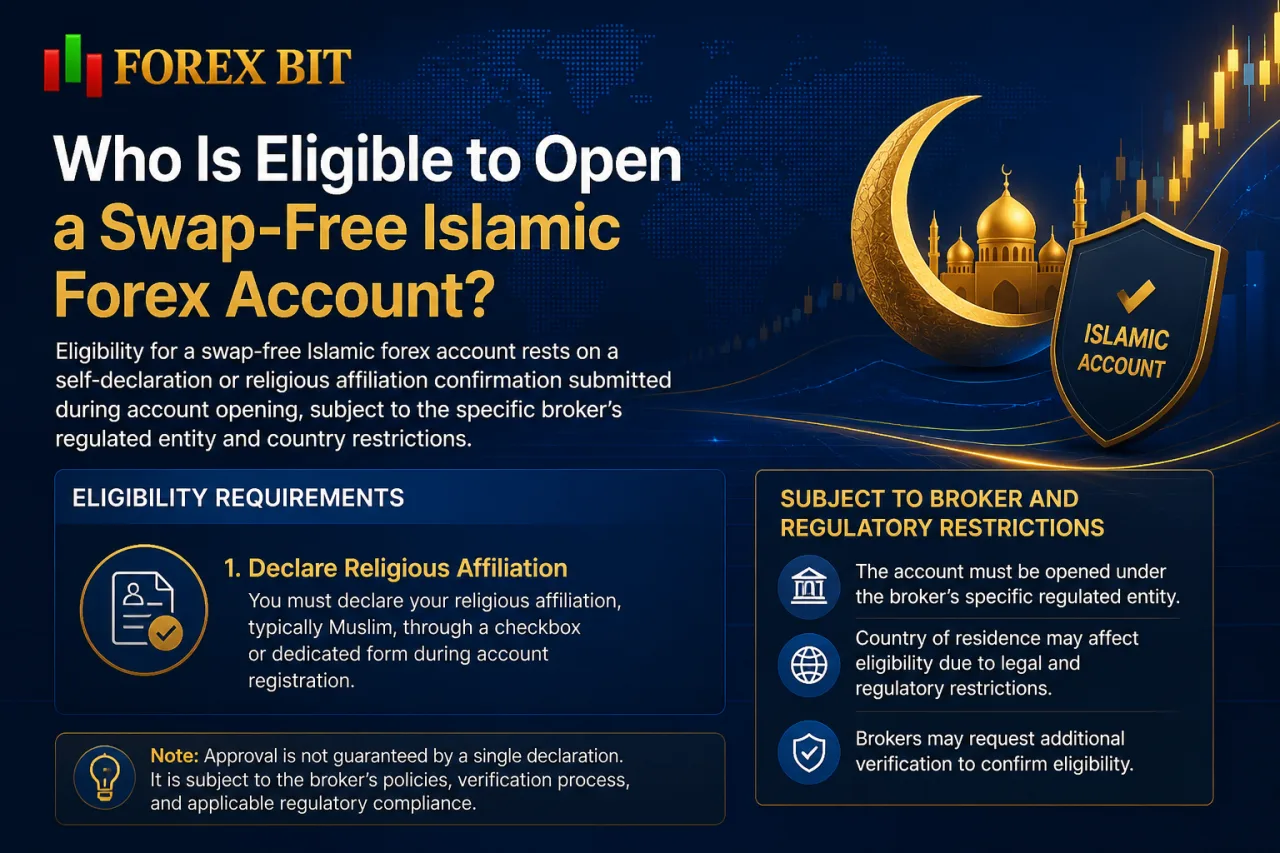
Eligibility for a swap-free Islamic forex account rests on a self-declaration or religious affiliation confirmation submitted during account opening, subject to the specific broker’s regulated entity and country restrictions. This eligibility question ties back to the registration process already outlined, but the conditions that determine approval extend beyond a single declaration step.
- Declaring religious affiliation, typically Muslim, through a checkbox or dedicated form during account registration or activation.
- Residing in a country where the broker’s regulated entity permits swap-free accounts, since some entities restrict the offering to specific jurisdictions.
- Holding an account under a broker entity that supports Islamic trading, as not every regulatory license or platform within the same broker group offers the feature.
- Submitting standard KYC documentation, such as identification and proof of address, matching the verification already required for the underlying standard account.
Some brokers require additional confirmation beyond the initial declaration if trading volume or holding patterns suggest the account is being used to bypass swap costs rather than for religious compliance. Approval timelines and documentation depth vary by broker rather than following one uniform standard across the industry.
How to Open and Activate a Swap-Free Islamic Trading Account?
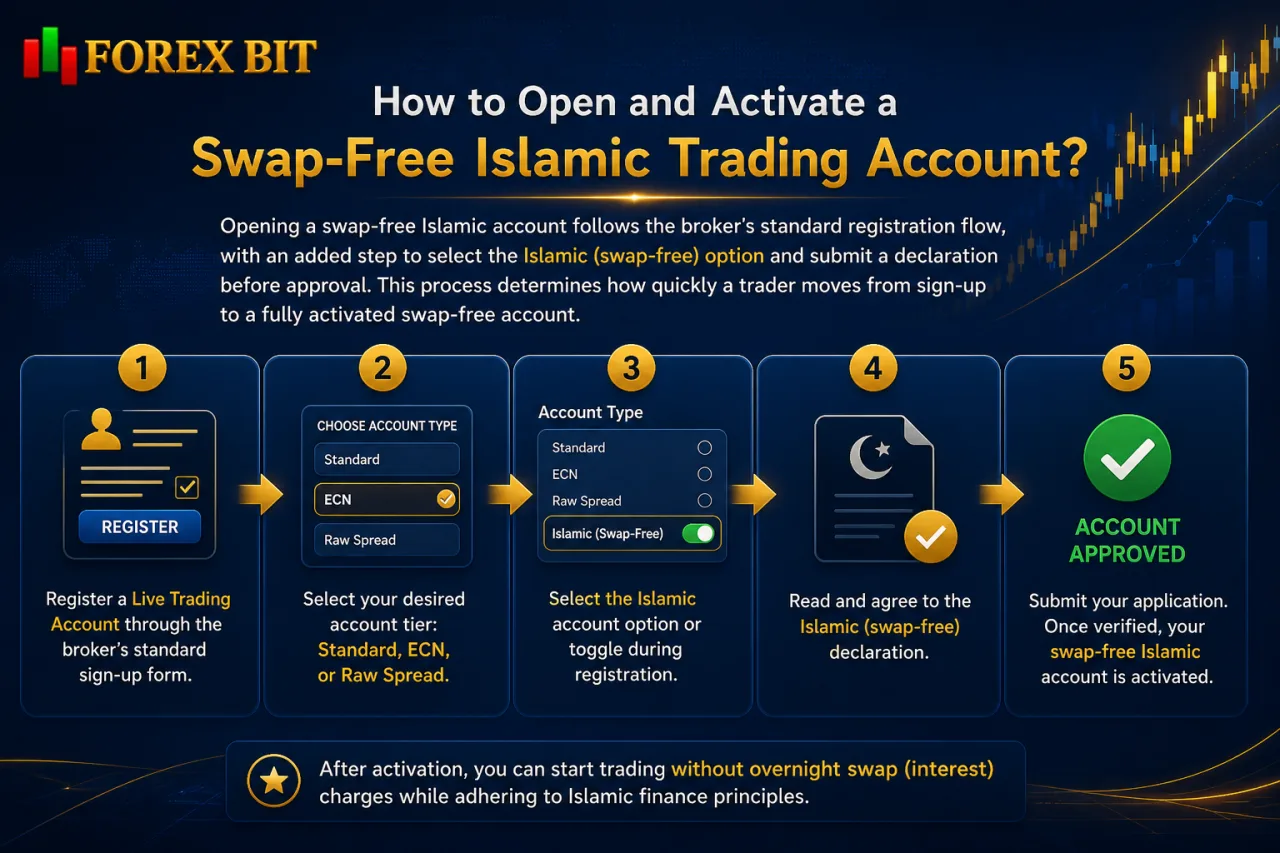
Opening a swap-free Islamic account follows the broker’s standard registration flow, with an added step to select the Islamic (swap-free) option and submit a declaration before approval. This process determines how quickly a trader moves from sign-up to a fully activated swap-free account.
- Registering a live trading account through the broker’s standard sign-up form, selecting the desired account tier (Standard, ECN, or Raw Spread).
- Selecting the Islamic account option or toggle during registration, or activating it afterward through account settings.
- Submitting a religious affiliation declaration or self-certification form as part of the swap-free request.
- Completing standard KYC verification, including identification and proof of address, alongside the swap-free declaration.
- Waiting for broker review and approval before swap-free status applies to open or new positions.
Existing standard accounts convert to swap-free status through a request submitted via the client portal or support team, rather than requiring a new account to be opened. Approval timelines for both new applications and conversion requests vary by broker rather than following one fixed processing period.
What Restrictions Apply to Islamic Accounts Regarding Instruments, Holding Period, and Trading Style?
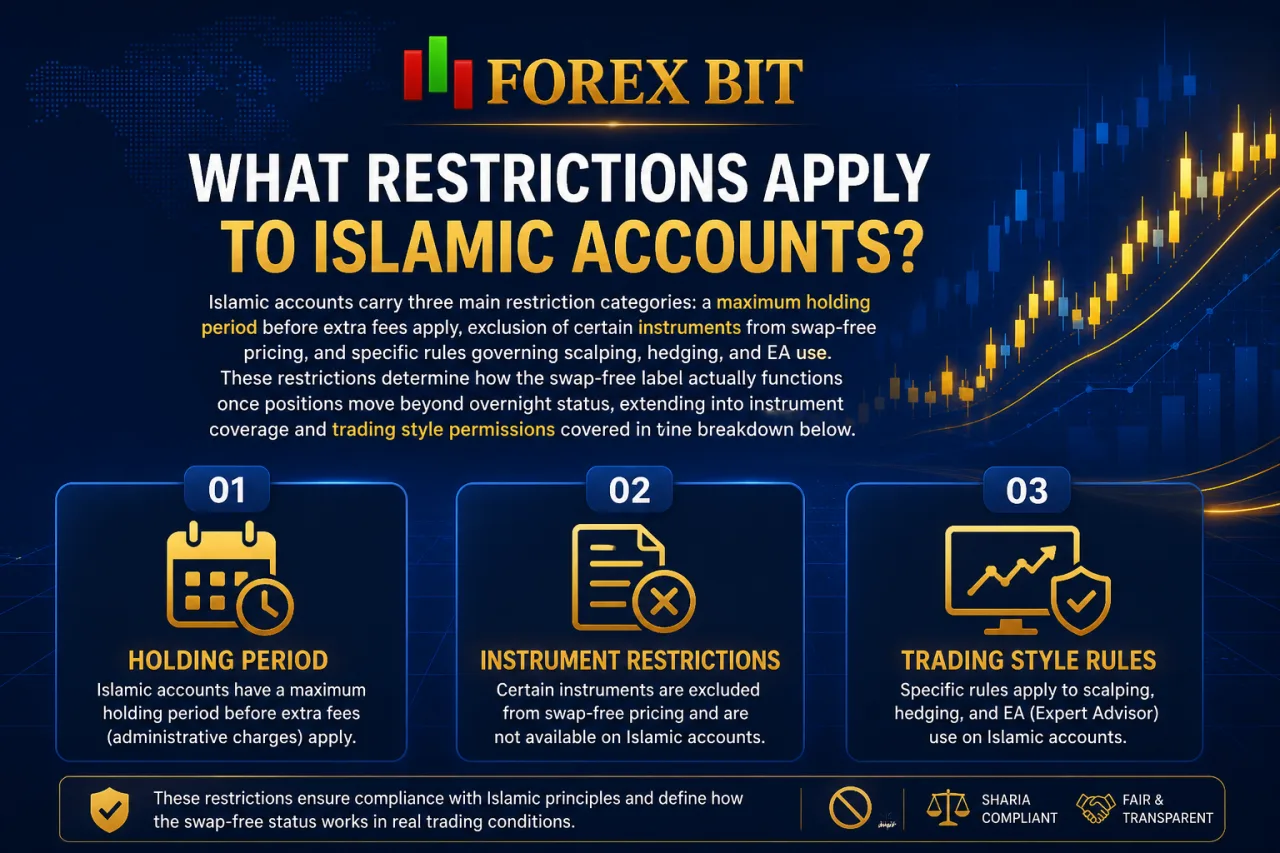
Islamic accounts carry three main restriction categories: a maximum holding period before extra fees apply, exclusion of certain instruments from swap-free pricing, and specific rules governing scalping, hedging, and EA use. These restrictions determine how the swap-free label actually functions once positions move beyond overnight status, extending into instrument coverage and trading style permissions covered in the breakdown below.
Is Scalping and Automated Trading (EA) Allowed on Islamic Accounts?
Scalping and expert advisor (EA) trading remain allowed on most Islamic accounts, though brokers apply the same style restrictions that govern the underlying standard account tier. This trading style question extends the holding period and instrument restrictions already outlined for swap-free accounts into scalping, hedging, and automation policy specifically.
- Permits scalping when the underlying account tier (Standard, ECN, or Raw Spread) already allows short-term, high-frequency trading.
- Permits hedging on swap-free accounts under the same rules applied to the standard version of that account tier.
- Permits EA and algorithmic trading provided the strategy does not exploit the swap-free status to hold positions solely for interest arbitrage.
- Restricts or reviews accounts showing repetitive overnight holding patterns inconsistent with normal trading activity, since this pattern can trigger the additional confirmation checks noted earlier for swap-free eligibility.
Brokers reserve the right to revoke swap-free status or reclassify an account if trading behavior suggests the Islamic designation serves to avoid swap fees rather than to meet religious requirements. Policy specifics on scalping limits, minimum holding times, and permitted EA use vary by broker rather than following one uniform industry standard.
What Are Some Lesser-Known Facts About Islamic Account Provisions Across Brokers?
Some brokers apply uncommon Islamic account provisions, including country-restricted swap-free eligibility, time-limited grace periods before standard swap fees resume, and platform-specific differences between MT4 and MT5. These edge cases extend beyond the standard eligibility and holding-period rules already outlined, shaping how swap-free status actually behaves once an account moves outside typical usage patterns.
Do Swap-Free Conditions Vary Between MT4 and MT5 Platforms?
Yes, swap-free conditions vary between MT4 and MT5, mainly in how the fixed administrative fee or spread markup is applied and displayed on each platform. This platform question extends the fee-structure distinction already outlined between Standard and ECN/Raw swap-free variants into execution and reporting differences specifically.
- Displays the swap-free fee as an itemized commission line in MT5’s more detailed order history, while MT4 often folds the equivalent cost into the spread only.
- Applies identical margin, leverage, and stop-out settings across both platforms for the same account tier, since platform choice does not alter the underlying account conditions.
- Executes orders under the same execution model (market or instant) on both platforms, with no platform-specific slippage advantage tied to swap-free status.
- Restricts certain instruments from swap-free pricing on one platform but not the other in some cases, depending on the broker’s symbol configuration.
Whether a specific fee variance exists between MT4 and MT5 for a given broker depends on that broker’s platform setup rather than a universal rule.
Can a Standard Account Be Converted to Islamic Status Without Reopening a New Account?
Yes, a standard account converts to Islamic status without reopening a new account, since brokers process swap-free activation as an account-level setting change rather than a fresh registration. This conversion question extends the activation steps already outlined for opening a swap-free account into what happens on an existing live account instead.
- Retains the existing account number, trade history, and balance, since the conversion only toggles the swap-free flag rather than migrating funds.
- Requires the same religious affiliation declaration or self-certification form submitted for a new swap-free application.
- Applies swap-free treatment to positions opened after approval, while positions already open before the switch may still accrue swap under the broker’s standard terms.
- Depends on broker-specific processing time, since some accounts activate swap-free status within the same trading session while others require manual review.
Some brokers impose a waiting period or restrict conversion frequency to prevent traders from toggling swap-free status to avoid costs selectively.
Conclusion
An Islamic forex account removes overnight swap interest and substitutes it with a spread markup or a fixed administrative fee, with the exact pricing model depending on whether the underlying tier is a Standard or ECN/Raw account. Deposit thresholds, leverage, and stop-out levels stay tied to that same tier, while eligibility rests on a religious declaration plus standard KYC checks, and restrictions may apply to holding periods, instrument coverage, or trading style.
Traders seeking lower cost transparency fit the ECN/Raw swap-free variant, while those prioritizing simplicity and lower deposits fit the Standard swap-free version, and conversion from an existing account remains possible without opening a new one.
Isabella Brown is the Forex Trading Guide Manager at Forex Bit, focusing on educational content about broker safety, trading costs, account types, platforms, and key Forex/CFD concepts. Her work helps readers understand trading terms, broker conditions, and practical checks before evaluating or using a brokerage service.
Email: [email protected]



Best Brokers

Trade with the world’s largest retail broker and benefit from better - than - market conditions.

We offer a superior trading environment that puts traders in the best position to profit.

Trade with the best trading conditions. WIN THE BEST TRADING ACCOUNT AWARD.

Trade global markets with Interactive Brokers – a highly regulated multi-asset broker built for active and professional investors.






Forex Bit provides independent forex broker reviews, comparisons, guides, and industry news to help traders make informed decisions.
Best Brokers
Metatrader 5 Brokers
Metatrader 4 Brokers
Lowest Spread Forex Broker
Regulated Forex Brokers
Forex Copy Trading
Ctrader Brokers
Best Forex Broker For Beginners