
Confused about margin call vs stop out? See how each level works, when positions get closed, and how to protect your account from forced liquidation.
Margin Call vs Stop Out: Key Differences for Traders

A margin call warns traders that account equity has dropped near the required maintenance level, while a stop out automatically closes open positions once equity falls below a broker-defined threshold. The margin call acts as a warning stage, whereas the stop out is an enforced action that removes trader control over position management.
Margin call and stop out levels are typically expressed as a percentage of used margin relative to account equity, though the exact thresholds vary by broker. Some brokers set the margin call at a higher percentage than the stop out level, creating a buffer zone before forced liquidation occurs.
When a stop out is triggered, the broker automatically closes open positions, often starting with the largest losing trade, until margin requirements are restored, though the exact order can vary by broker. Traders lose control over which positions remain open once this process begins.
Traders avoid margin calls and stop outs primarily by maintaining sufficient free margin, using lower leverage, and setting stop-loss orders on open trades. Monitoring the margin level percentage in real time also reduces the risk of unexpected forced liquidation.
Forex Bit breaks down these mechanics further below, starting with a direct comparison of how margin call and stop out differ before examining each concept individually in forex trading.
What Is the Difference Between Margin Call and Stop Out?
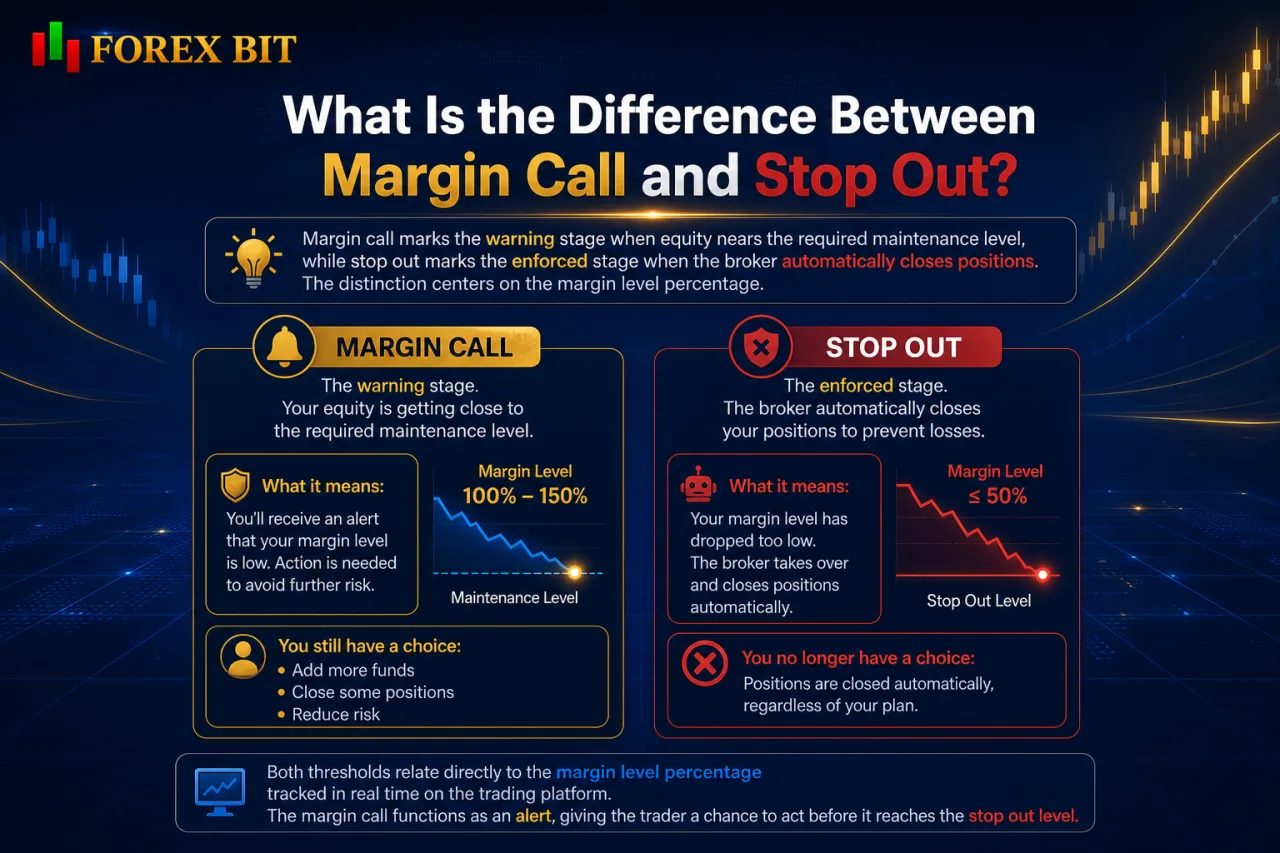
Margin call marks the warning stage when equity nears the required maintenance level, while stop out marks the enforced stage when the broker automatically closes positions. The distinction centers on the margin level percentage: margin call notifies the trader that action is needed, whereas stop out removes that choice entirely.
Both thresholds relate directly to the margin level percentage tracked in real time on the trading platform. The margin call functions as an alert, giving the trader an opportunity to add funds or close losing trades voluntarily. The stop out functions as an execution mechanism, triggering the broker’s system to liquidate positions without further input from the trader.
The table below summarizes the structural and functional differences:
| Aspect | Margin Call | Stop Out |
|---|---|---|
| Trigger point | Equity approaches the maintenance margin threshold | Equity falls below the broker-defined stop out level |
| Action taken | Notification sent to the trader | Automatic closure of open positions |
| Trader control | Retained; trader can deposit funds or close trades | Lost; broker executes closures without consent |
| Consequence | Warning only, account remains active | Positions are liquidated, potentially at a loss |
This comparison shows margin call as a preventive signal and stop out as the corrective action that follows if the warning goes unaddressed.
What Is a Margin Call in Forex Trading?
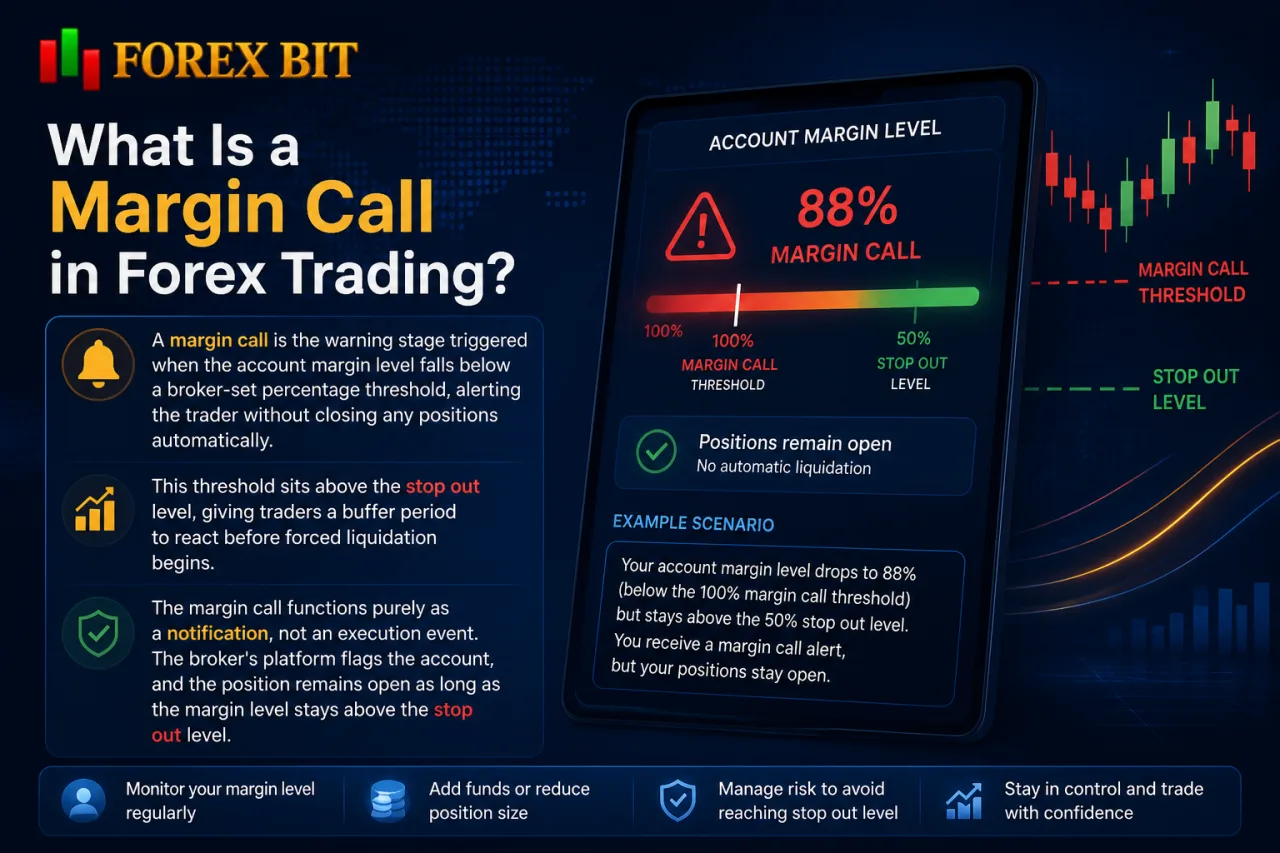
A margin call is the warning stage triggered when the account margin level falls below a broker-set percentage threshold, alerting the trader without closing any positions automatically. This threshold sits above the stop out level, giving traders a buffer period to react before forced liquidation begins.
The margin call functions purely as a notification, not an execution event. The broker’s platform flags the account, and the position remains open as long as the margin level stays above the stop out threshold. No trade is closed automatically at this stage, distinguishing margin call clearly from stop out.
Traders receiving a margin call typically respond in one of the following ways:
- Depositing additional funds to raise account equity and restore the required margin level.
- Closing losing positions manually to free up used margin and reduce exposure.
- Reducing overall exposure by cutting lot sizes on open trades.
Each action aims to push the margin level back above the maintenance threshold before the stop out level is reached, preserving the trader’s ability to manage positions directly.
What Is a Stop Out in Forex Trading?
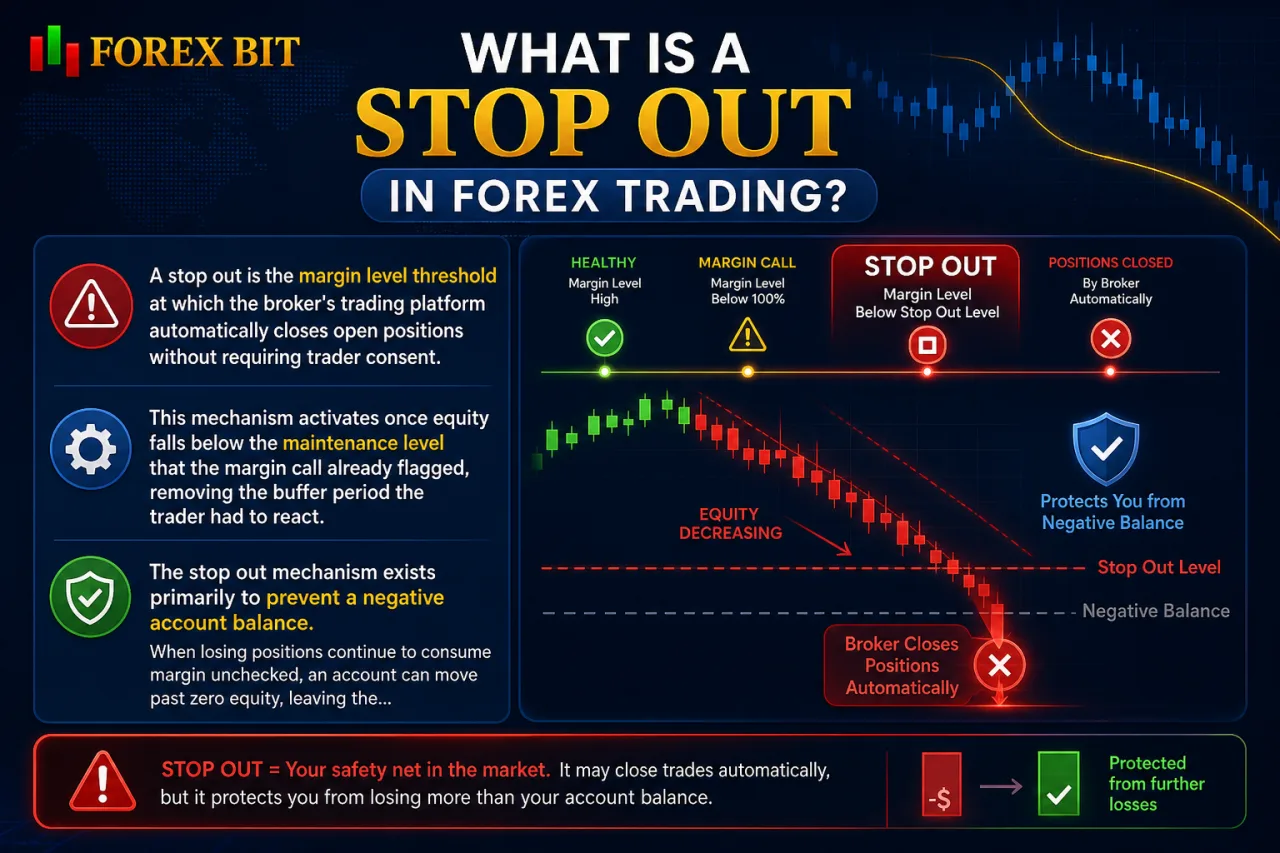
A stop out is the margin level threshold at which the broker’s trading platform automatically closes open positions without requiring trader consent. This mechanism activates once equity falls below the maintenance level that the margin call already flagged, removing the buffer period the trader had to react.
The stop out mechanism exists primarily to prevent a negative account balance. When losing positions continue to consume margin unchecked, an account can move past zero equity, leaving the trader owing money beyond the initial deposit. Forced liquidation at the stop out level stops losses before they exceed available funds, protecting both the trader and the broker from uncovered exposure.
The forced liquidation process follows a defined sequence:
- Identifying the losing position with the largest negative floating balance.
- Closing that position first to release used margin.
- Recalculating the margin level after each closure.
- Repeating the process on remaining positions until margin requirements are restored.
Execution during this process occurs at prevailing market prices, which can differ from the price a trader might have chosen manually.
How Are Margin Call and Stop Out Levels Calculated Per Broker?
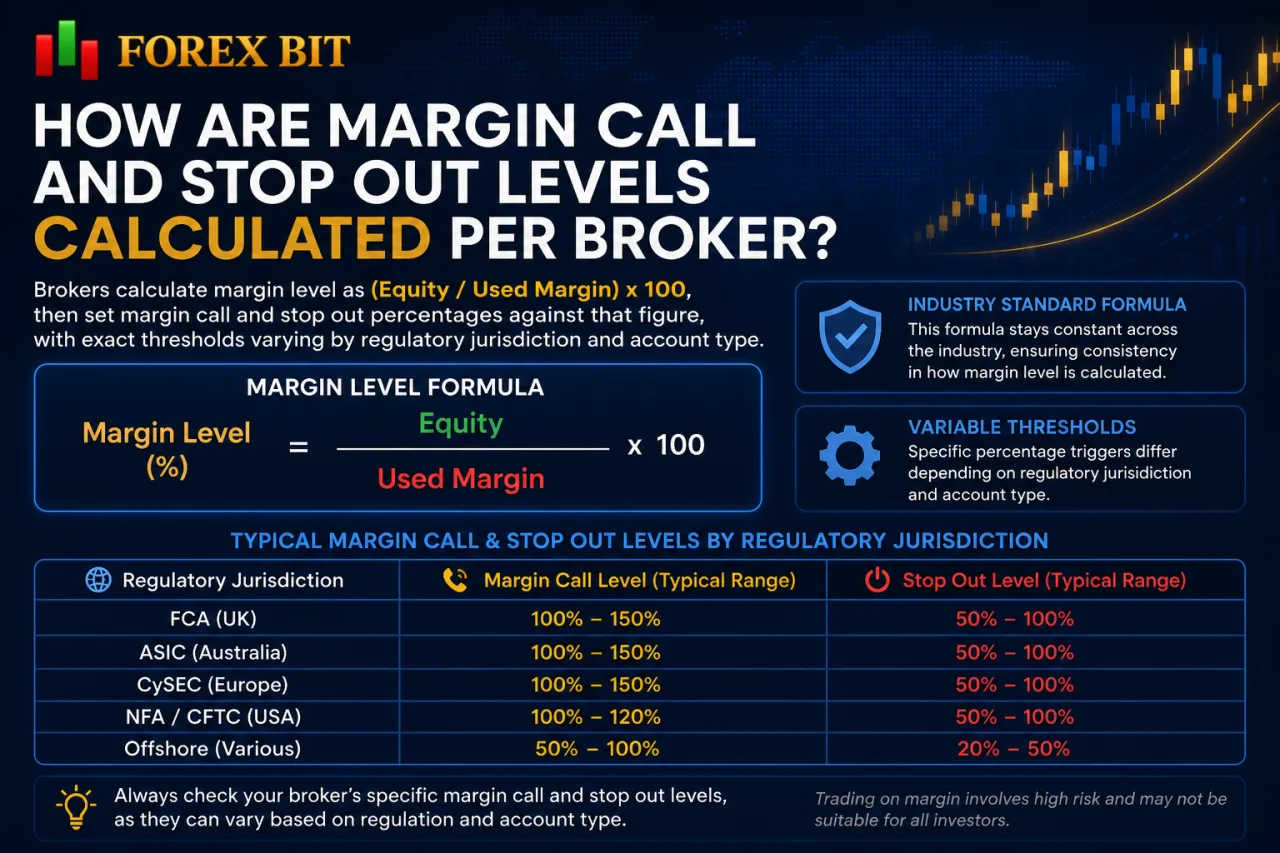
Brokers calculate margin level as (Equity / Used Margin) x 100, then set margin call and stop out percentages against that figure, with exact thresholds varying by regulatory jurisdiction and account type. This formula stays constant across the industry, but the specific percentage triggers differ depending on where a broker holds its license and which account tier a trader uses. The subsections below break down the formula itself and the typical threshold ranges tied to different regulatory tiers.
How Does Regulation Affect Margin Call and Stop Out Percentages?
Regulated brokers under FCA or ESMA-aligned frameworks face mandated stop out ceilings. Offshore-regulated brokers set thresholds with greater discretion. This regulatory divide directly shapes how much buffer a trader retains between the margin call warning and forced liquidation.
The comparison centers on how strictly each jurisdiction caps the minimum stop out level a broker can offer.
- Regulated brokers under frameworks tied to ESMA guidance typically enforce a minimum stop out level as a floor, preventing brokers from allowing accounts to run closer to zero equity before liquidation.
- FCA-regulated entities apply investor protection rules that restrict how low a stop out threshold can be set for retail clients.
- Offshore regulators in jurisdictions with lighter oversight permit brokers to configure lower stop out levels, giving accounts less protective buffer before automatic closure.
- Professional or institutional account classifications under stricter regulators often carry different, less conservative thresholds than retail tiers within the same broker.
These distinctions mean traders comparing brokers should verify the specific stop out percentage tied to their regulatory entity and account classification rather than assuming a uniform industry standard.
What Happens to Open Positions When Stop Out Is Triggered?
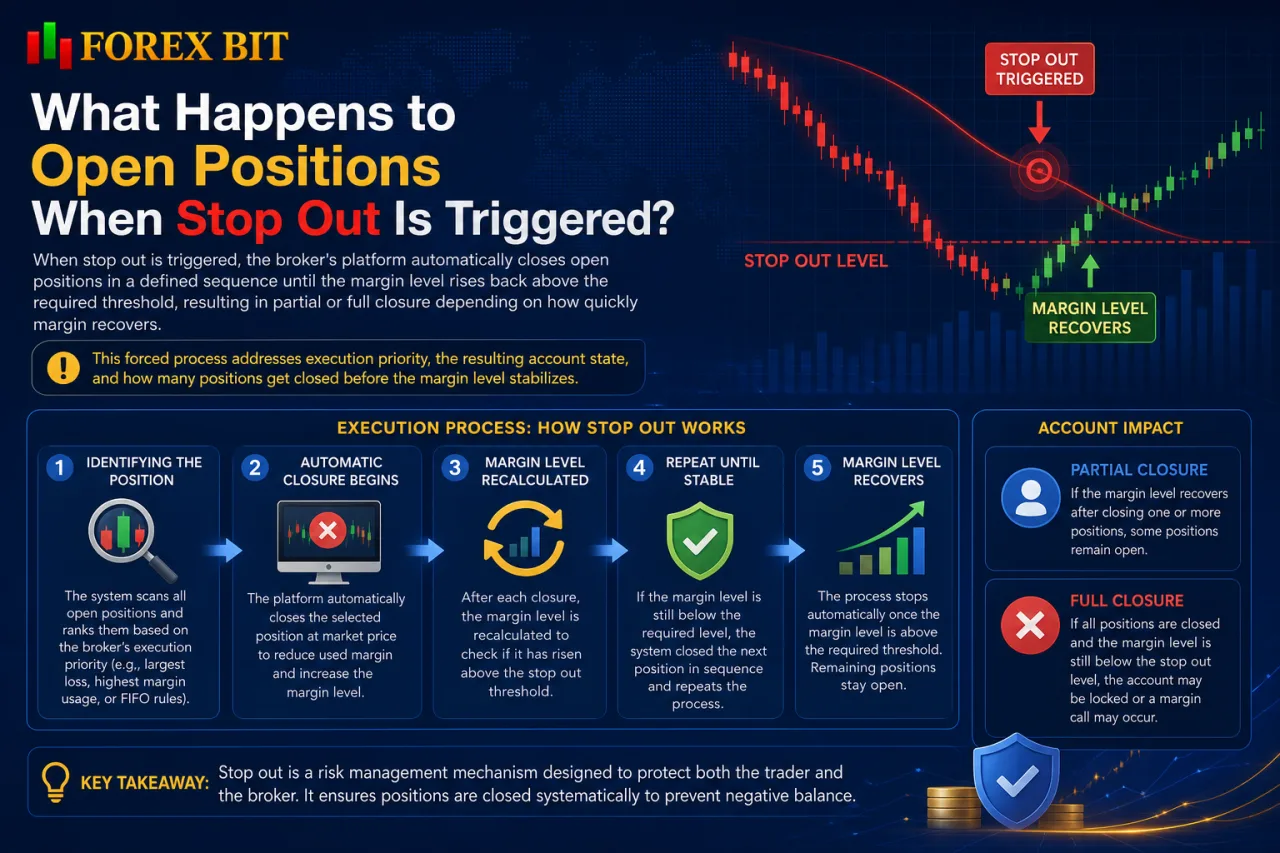
When stop out is triggered, the broker’s platform automatically closes open positions in a defined sequence until the margin level rises back above the required threshold, resulting in partial or full closure depending on how quickly margin recovers. This forced process addresses execution priority, the resulting account state, and how many positions get closed before the margin level stabilizes.
Execution priority and account impact differ across the following stages:
- Identifying the position carrying the largest floating loss as the first candidate for closure.
- Closing that position at the prevailing market price, which recalculates the margin level immediately afterward.
- Continuing closures on remaining losing positions in sequence if the margin level still sits below the stop out threshold.
- Stopping the process once equity relative to used margin returns above the required level, which can leave some positions open if only partial closure was needed.
Some brokers close all open positions simultaneously rather than sequentially, so the exact order depends on the platform’s execution policy. Following closure, the resulting account balance reflects realized losses from the liquidated trades, while any remaining open positions continue to carry floating risk under the new, lower margin usage.
Is a Negative Account Balance Possible After a Stop Out?
Negative account balance remains possible after a stop out when the broker does not enforce negative balance protection, since forced liquidation executes at prevailing market prices that can gap past the stop out level during fast-moving markets. This gap risk determines whether the answer varies for a given trader.
The outcome depends on broker policy and jurisdiction rather than a single universal rule.
- Retail clients under regulators such as ESMA-aligned entities or the FCA typically benefit from mandatory negative balance protection, which resets any deficit back to zero.
- Offshore-regulated brokers with lighter oversight may leave the negative balance on the account, requiring the trader to cover the shortfall.
- Professional or institutional accounts often fall outside standard negative balance protection guarantees, even under stricter regulators.
- Volatile market events, such as sudden price gaps around major news releases, increase the likelihood that stop out execution slips past the intended threshold.
Traders confirm negative balance protection terms directly with their broker’s legal documentation, since the stop out mechanism alone does not guarantee a floor at zero equity.
How to Avoid Margin Calls and Stop Outs?
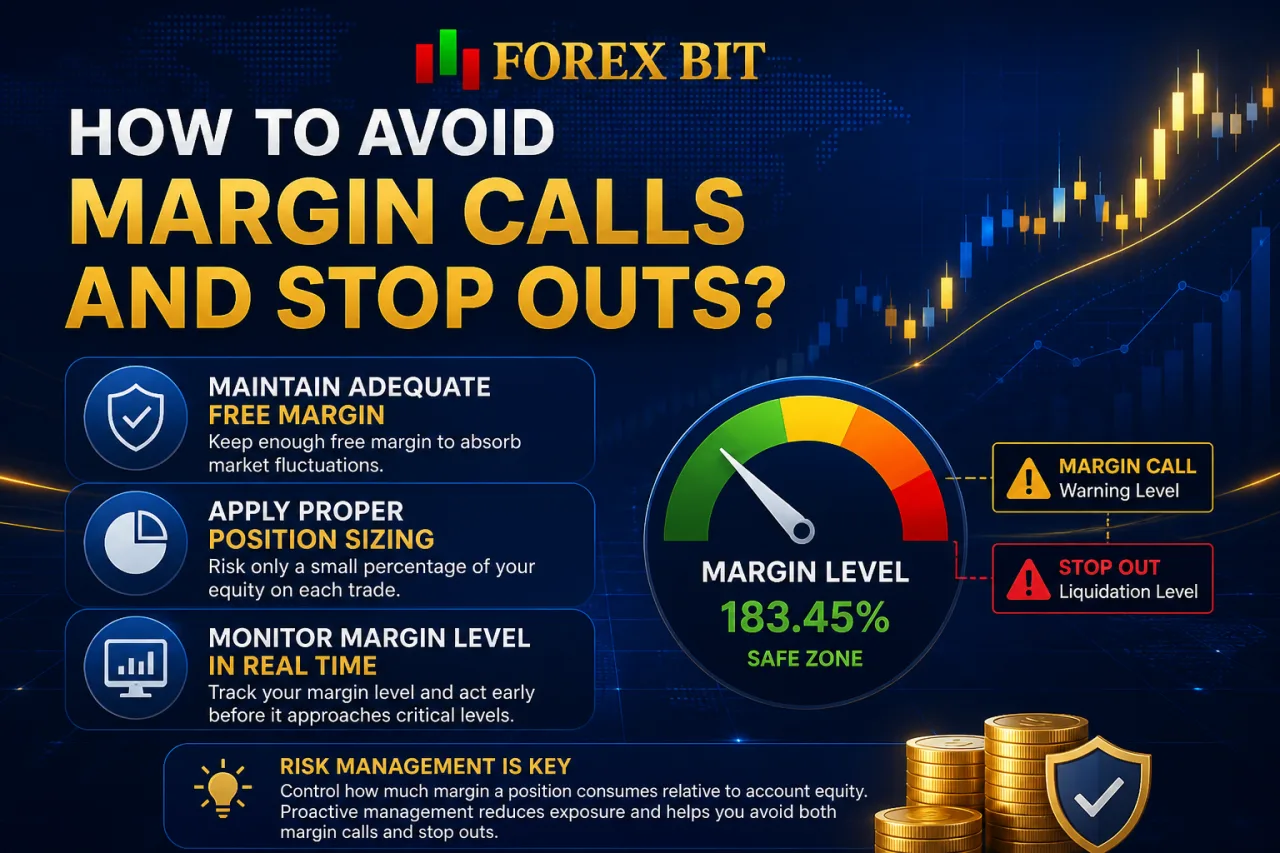
To avoid margin calls and stop outs, traders maintain adequate free margin, apply proper position sizing, and monitor margin level in real time. These practices reduce exposure before equity approaches the maintenance threshold discussed in the sections above, cutting the likelihood of reaching either the margin call warning or the stop out liquidation stage.
Practical risk management centers on controlling how much margin a position consumes relative to account equity, rather than reacting only after a margin call notification appears. The following steps address that goal directly:
- Sizing positions according to account equity rather than maximum available leverage.
- Avoiding excessive leverage ratios that shrink the buffer between the margin call and stop out levels.
- Placing stop-loss orders on every open trade to cap floating losses before they consume used margin.
- Keeping free margin well above the maintenance requirement instead of trading near the threshold.
- Monitoring the margin level percentage in real time through the trading platform’s account summary.
Combining these steps keeps equity further from both the margin call and stop out thresholds, preserving trader control over position management under adverse price movement.
How Do Margin Call and Stop Out Differ Across Trading Platforms and Instruments?
Margin call and stop out thresholds set at the broker or account level interact with platform-specific settings on MetaTrader 4/5 or cTrader, while instrument volatility across forex majors, exotic pairs, CFDs, and cryptocurrencies changes how fast either threshold gets reached. Platform configuration determines where the trigger fires, and instrument behavior determines how quickly equity moves toward it. The subsections below separate these two variables, starting with platform-level execution settings before addressing volatility differences across instrument classes.
Does Hedging Affect Margin Call and Stop Out Calculations?
Yes, hedging affects margin call and stop out calculations, since hedging-allowed accounts often apply reduced margin requirements on offsetting positions in the same instrument. This reduction changes the effective margin level relative to the stop out threshold discussed in the previous sections.
When a broker permits hedging, opening a buy and a sell position on the same pair does not always require full margin for both trades. Instead, the platform may calculate a lower combined margin requirement, since the offsetting exposure limits potential loss. Hedged margin reduction percentages vary by broker and account type, with each broker setting its own rules for how much margin relief applies to offsetting positions.
This lower margin usage raises the margin level percentage compared to an unhedged equivalent position, since used margin sits lower against the same equity figure. As a result, hedged accounts reach the margin call and stop out thresholds more slowly under adverse price movement, though the offsetting position still carries its own floating profit or loss that factors into overall equity.
How Does High Market Volatility Trigger Slippage During Stop Out?
High market volatility triggers slippage during stop out when prices move too fast for the broker’s system to execute closures at the exact stop out price, filling orders at the next available market price instead. This price gap connects directly to the negative balance question raised above, since slippage determines whether liquidation lands above or below zero equity.
Fast-moving markets widen the distance between the price a stop out order intends to close at and the price it actually fills at. During sudden news releases or thin liquidity periods, prices can jump several levels in an instant, skipping over the exact stop out threshold entirely.
- Executing the closure at the next available price rather than the intended stop out level once volatility spikes.
- Skipping multiple price levels during a gap, especially around major news events or low-liquidity trading hours.
- Pushing the fill price further from equity’s true position, deepening the loss beyond what the stop out level projected.
- Leaving equity below zero in extreme cases, even when the broker advertises negative balance protection, since protection resets the balance only after the slippage-driven loss registers.
This gap risk explains why negative balance protection acts as a post-execution correction rather than a guarantee that prevents slippage itself.
Conclusion
Margin call and stop out function as two sequential stages built around the same margin level calculation, with the warning phase preserving trader control and the enforced phase removing it entirely. Broker regulation, account classification, hedging rules, and instrument volatility all shape where each threshold sits and how quickly an account moves from one to the other.
Traders who size positions conservatively, apply stop-loss orders, and track margin level percentage in real time keep equity away from both triggers. Understanding this distinction gives traders the clarity needed to manage leverage responsibly and avoid forced liquidation under adverse market conditions.
Isabella Brown is the Forex Trading Guide Manager at Forex Bit, focusing on educational content about broker safety, trading costs, account types, platforms, and key Forex/CFD concepts. Her work helps readers understand trading terms, broker conditions, and practical checks before evaluating or using a brokerage service.
Email: [email protected]



Best Brokers

Trade with the world’s largest retail broker and benefit from better - than - market conditions.

We offer a superior trading environment that puts traders in the best position to profit.

Trade with the best trading conditions. WIN THE BEST TRADING ACCOUNT AWARD.

Trade global markets with Interactive Brokers – a highly regulated multi-asset broker built for active and professional investors.






Forex Bit provides independent forex broker reviews, comparisons, guides, and industry news to help traders make informed decisions.
Best Brokers
Metatrader 5 Brokers
Metatrader 4 Brokers
Lowest Spread Forex Broker
Regulated Forex Brokers
Forex Copy Trading
Ctrader Brokers
Best Forex Broker For Beginners