
Confused about free margin vs used margin? See how each is calculated, how they affect margin calls, and what they mean for your trading account.
Free Margin vs Used Margin: Key Differences Explained

Used margin is the portion of account equity locked to keep open positions active, while free margin is the remaining equity available to open new trades or absorb losses. These two figures together determine how much room a trading account has before a broker restricts further activity.
Used margin is calculated by multiplying the position’s notional value by the margin requirement percentage set for that instrument, while free margin equals total equity minus used margin. Both values update in real time as trade prices and floating profit or loss change.
Margin level, expressed as equity divided by used margin as a percentage, directly determines when a margin call or stop-out is triggered, based on a broker-defined threshold that varies from one broker to another. As free margin shrinks toward zero, the risk of automatic position closure increases sharply.
Margin requirements are not standardized across the industry; they vary depending on account type, leverage tier, and broker-specific policy. Forex Bit compiles this variation across brokers to help traders compare conditions before choosing an account.
Understanding these mechanics starts with a clear side-by-side comparison of how used margin and free margin function within a trading account, detailed next.
Free Margin vs Used Margin: What Is the Difference?
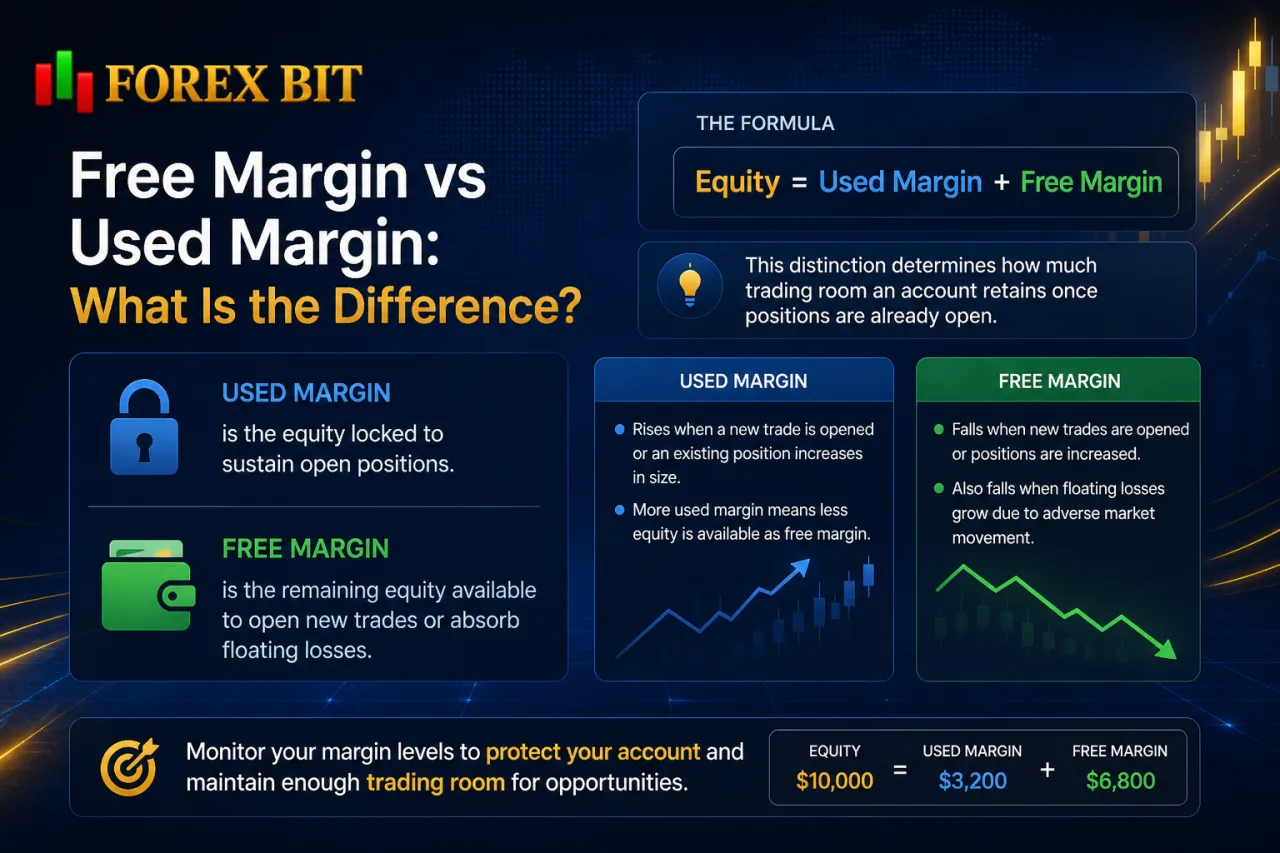
Used margin is the equity locked to sustain open positions, while free margin is the remaining equity available to open new trades or absorb floating losses, expressed by the formula Equity = Used Margin + Free Margin.
This distinction determines how much trading room an account retains once positions are already open. Used margin rises whenever a new trade is opened or an existing position increases in size, reducing the equity portion classified as free. Free margin falls not only when new trades are placed but also when floating losses widen, since equity itself declines while used margin stays fixed for that position.
A simplified example illustrates the relationship on a Forex-bit.com trading account: if equity stands at $1,000 and an open position locks $200 as used margin, free margin equals $800, leaving that amount available for additional trades or to cushion adverse price movement. A specific numeric example of equity, used margin, and free margin values is used here purely for illustration and does not represent actual figures from any specific account.
Once equity minus used margin drops close to zero, free margin no longer offers a buffer against losses, pushing the account nearer to the margin thresholds already outlined.
What Is Used Margin?
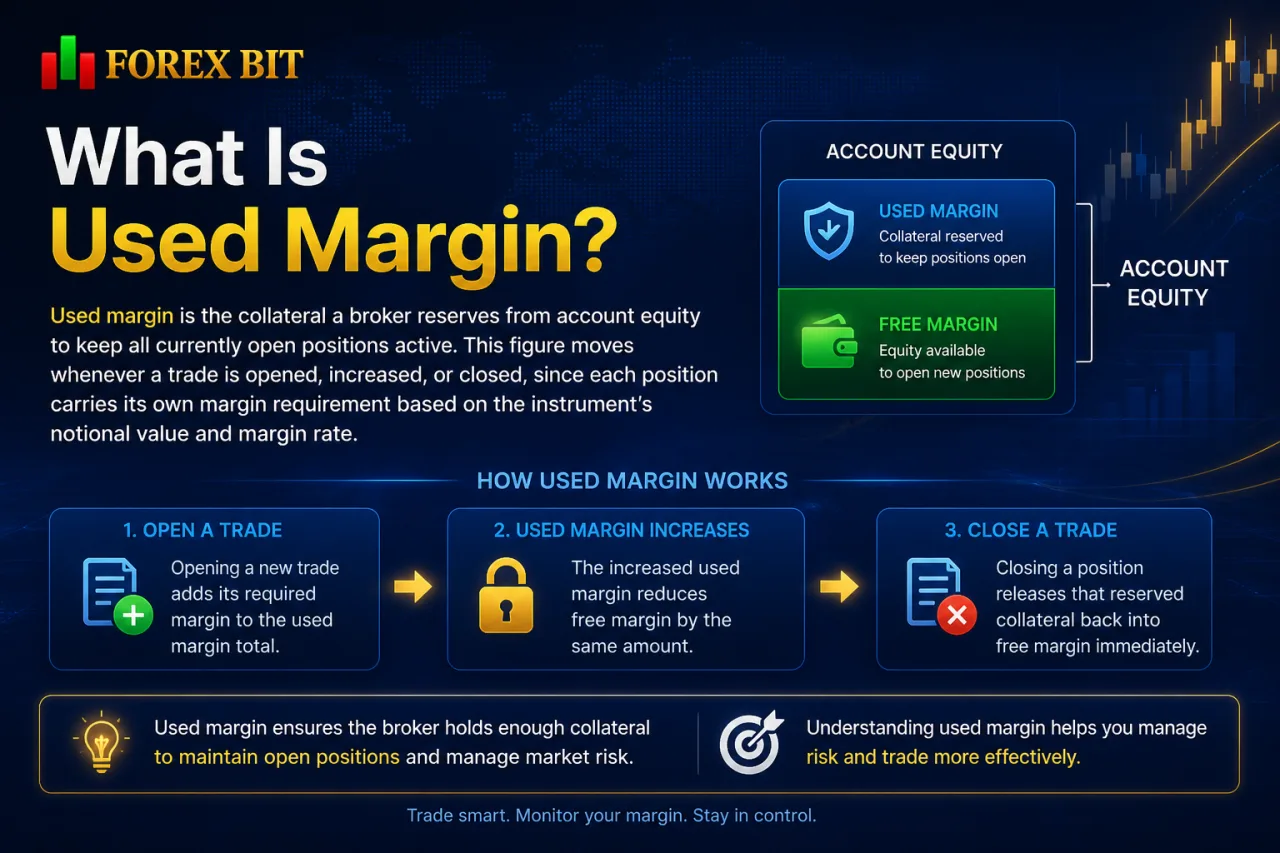
Used margin is the collateral a broker reserves from account equity to keep all currently open positions active. This figure moves whenever a trade is opened, increased, or closed, since each position carries its own margin requirement based on the instrument’s notional value and margin rate.
Opening a new trade adds its required margin to the used margin total, reducing free margin by the same amount. Closing a position releases that reserved collateral back into free margin immediately, regardless of whether the trade closed in profit or loss.
Partial position closes or reduced lot sizes lower used margin proportionally rather than releasing it all at once.
Used margin reflects only the collateral tied to open exposure and excludes pending orders that have not yet been executed. The specific margin rate applied per instrument and account type determines how much used margin a given position requires, and these rates vary depending on account type, leverage tier, and broker-specific policy.
What Is Free Margin?
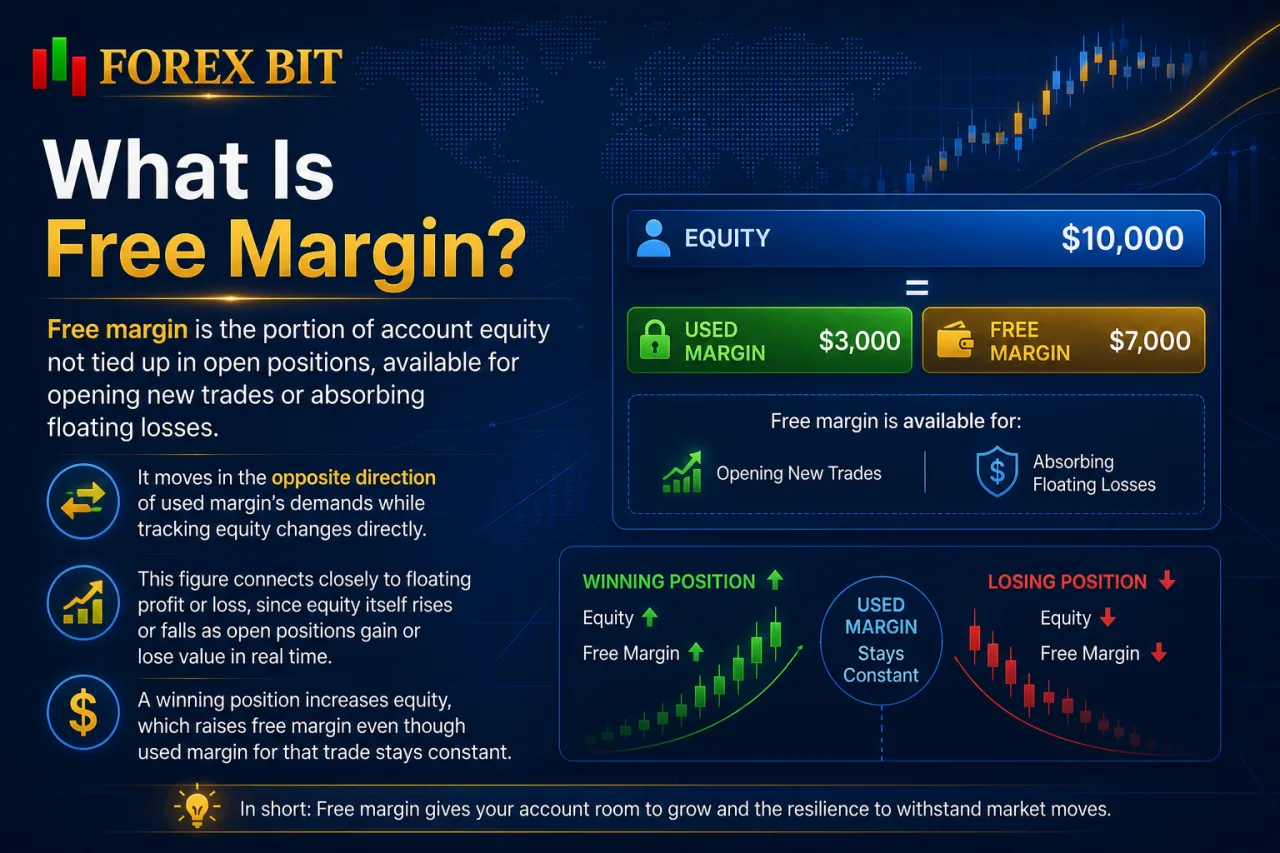
Free margin is the portion of account equity not tied up in open positions, available for opening new trades or absorbing floating losses. It moves in the opposite direction of used margin’s demands while tracking equity changes directly.
This figure connects closely to floating profit or loss, since equity itself rises or falls as open positions gain or lose value in real time. A winning position increases equity, which raises free margin even though used margin for that trade stays constant. A losing position reduces equity, shrinking free margin while used margin remains unchanged until the position closes.
Free margin therefore serves two functions on a Forex-bit.com account: it represents the collateral base for placing additional trades, and it acts as the buffer absorbing adverse price movement before the margin level approaches the levels discussed for margin calls and stop-outs. When free margin reaches zero, no further positions can open and existing trades face heightened risk of forced closure as floating losses continue to consume remaining equity.
How Are Free Margin and Used Margin Calculated?
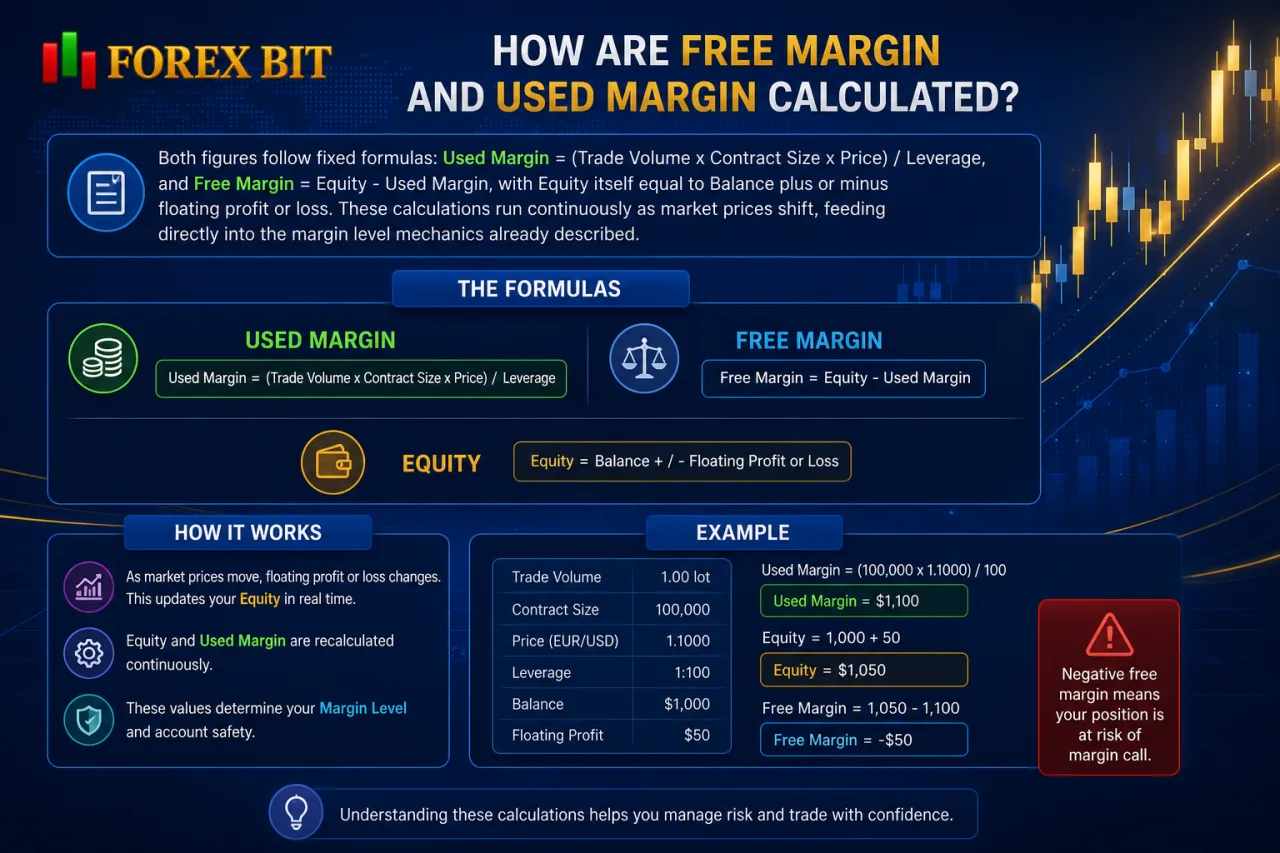
Both figures follow fixed formulas: Used Margin = (Trade Volume x Contract Size x Price) / Leverage, and Free Margin = Equity – Used Margin, with Equity itself equal to Balance plus or minus floating profit or loss. These calculations run continuously as market prices shift, feeding directly into the margin level mechanics already described.
The steps below break down how each component interacts with the others. A worked example then applies these formulas to a specific trade for a clearer picture.
How Does Leverage Affect These Calculations?
Leverage sets the divisor in the used margin formula, so higher leverage lowers used margin for the same position size and raises free margin by the same amount. This mechanic connects directly to the calculation already outlined, since leverage is the single variable separating two accounts holding identical notional exposure.
Comparing 1:30 against 1:500 on the same trade volume makes the effect measurable rather than abstract.
A position requiring $1,000 of used margin at 1:30 leverage requires a much smaller amount of used margin at 1:500 leverage, given identical trade volume, contract size, and price, since used margin scales inversely with the leverage ratio.
- Lower used margin at higher leverage leaves a larger share of equity classified as free margin, widening the buffer against floating losses described earlier.
- Higher leverage does not change equity or floating profit and loss directly, since only the used margin denominator shifts, leaving the underlying position size and market exposure unchanged.
Leverage tiers vary by account type and jurisdiction, meaning the same nominal position can consume different amounts of used margin depending on which leverage cap the broker applies to that account.
How Do Margin Levels Affect Margin Calls and Stop-Out?
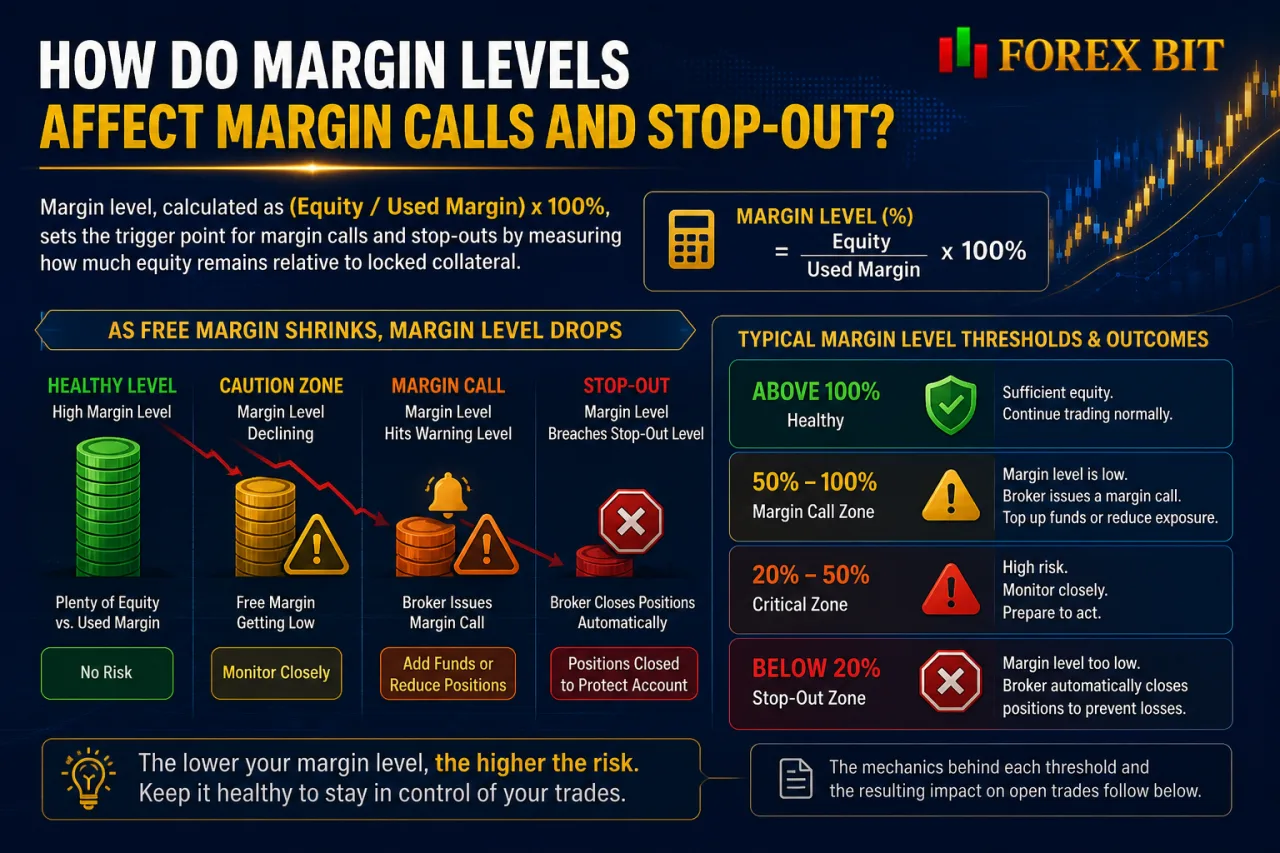
Margin level, calculated as (Equity / Used Margin) x 100%, sets the trigger point for margin calls and stop-outs by measuring how much equity remains relative to locked collateral. As free margin shrinks and this percentage drops, brokers issue warnings first, then force-close positions once the level breaches a defined floor. The mechanics behind each threshold and the resulting impact on open trades follow below.
What Happens When Free Margin Reaches Zero?
No new trades open once free margin reaches zero, and a stop-out becomes likely as the margin level falls to the broker’s defined threshold. This scenario represents the endpoint of the free margin depletion process already outlined, where equity no longer exceeds used margin by any usable amount.
At this stage, the trading platform blocks order requests that would add further used margin, since no free margin remains to cover the additional collateral requirement. Existing positions stay open only as long as the margin level holds above the broker’s stop-out floor, but continued floating losses push equity down further while used margin for open trades stays fixed. The exact margin level percentage that triggers stop-out varies by broker and account type.
Once the margin level breaches that floor, the broker’s system automatically closes one or more positions, starting typically with the largest floating loss, to restore the account to a sustainable margin level. This forced closure removes the trader’s control over exit timing, distinguishing a stop-out from a voluntary close.
How Do Margin Requirements Differ by Account Type or Broker?
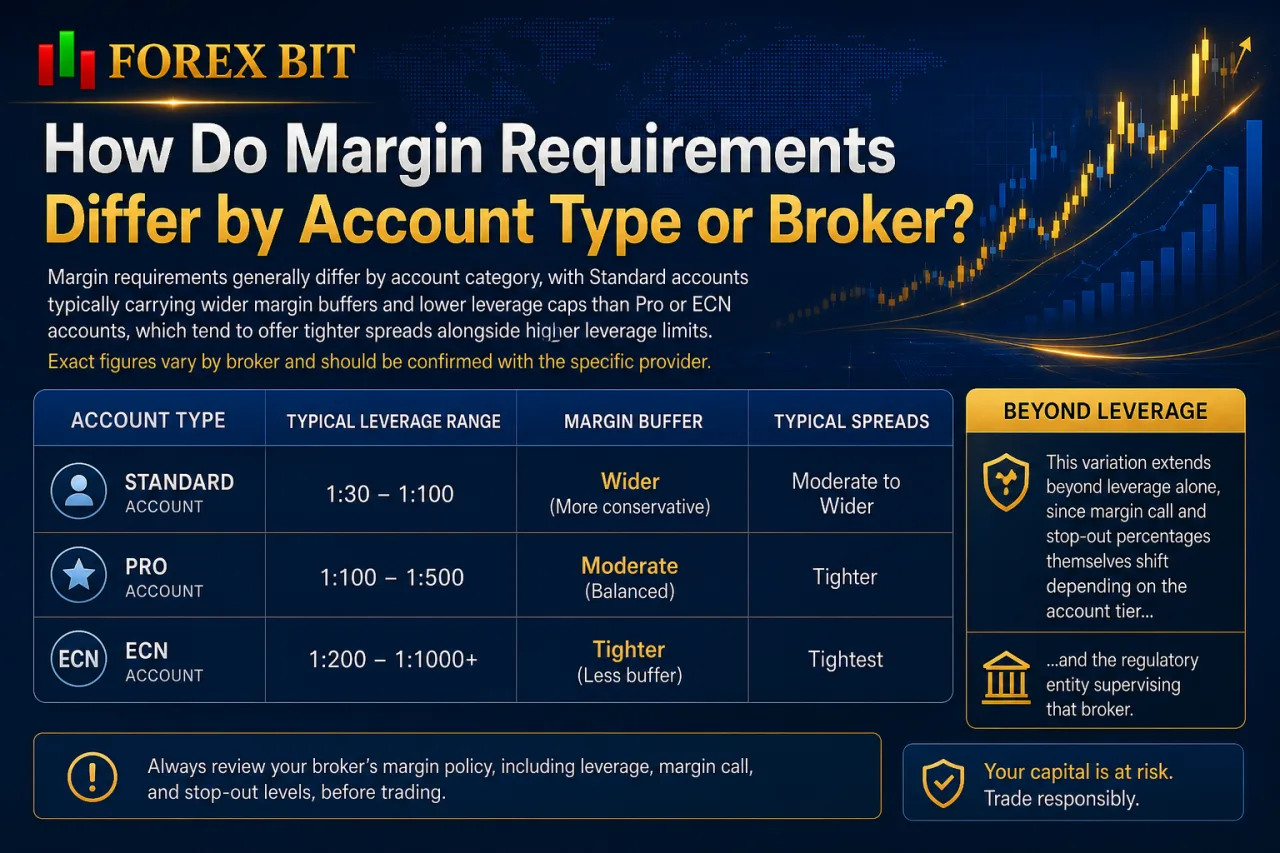
Margin requirements generally differ by account category, with Standard accounts typically carrying wider margin buffers and lower leverage caps than Pro or ECN accounts, which tend to offer tighter spreads alongside higher leverage limits; exact figures vary by broker and should be confirmed with the specific provider.
Margin call and stop-out percentages shift depending on the account tier a trader holds. Standard accounts commonly carry higher margin call and stop-out thresholds, while Pro or ECN tiers tend to operate with tighter thresholds alongside their higher leverage limits.
This variation also extends across regulatory jurisdictions. A broker regulated under one jurisdiction may enforce a lower stop-out floor than the same broker operating under a different regulatory license, since regional rules set separate caps on leverage and margin protections.
Professional or VIP account tiers, where available, often carry different margin call thresholds than retail-facing Standard accounts, reflecting the higher risk tolerance assumed for those classifications.
The table below lists representative account types alongside their maximum leverage, margin call level, and stop-out level for comparison.
| Account Type | Max Leverage | Margin Call Level | Stop-Out Level |
|---|---|---|---|
| Standard | Lower cap, varies by jurisdiction | Higher percentage threshold | Higher percentage threshold |
| Pro / ECN | Higher cap, varies by jurisdiction | Lower percentage threshold | Lower percentage threshold |
| Professional / VIP | Highest cap, subject to regulatory eligibility | Varies by broker policy | Varies by broker policy |
Exact figures for each column vary by broker and regulatory entity, so traders confirm current values directly against their account’s specific terms.
What Are Common Mistakes Traders Make When Managing Free and Used Margin?
Traders repeat a set of practical margin mistakes, including over-leveraging that thins the free margin buffer, ignoring floating losses’ drag on equity, oversizing lot volume relative to balance, and failing to monitor margin level during volatile price swings. These pitfalls sit beyond the core formulas already outlined, since they concern behavior and monitoring habits rather than calculation mechanics. The categories below break down each recurring error.
How Can Traders Maintain a Healthy Free Margin Buffer?
Traders maintain a healthy free margin buffer by sizing positions relative to available equity, attaching stop-loss orders to every trade, avoiding multiple simultaneous high-exposure positions, and monitoring margin level alerts continuously. This approach directly targets the free margin depletion risks outlined above, shifting margin management from reactive to proactive.
Four practices support this buffer consistently:
- Sizing each position so used margin consumes only a limited share of free margin, leaving room for floating losses.
- Attaching stop-loss orders that cap potential drawdown before equity erosion pushes the margin level toward the stop-out floor.
- Avoiding concurrent trades that each carry high notional exposure, since combined used margin compounds faster than isolated positions.
- Monitoring margin level alerts or platform notifications that flag approach toward the broker’s margin call threshold.
Applying these practices together keeps free margin from collapsing suddenly during volatile price swings, preserving the equity buffer discussed throughout the margin call and stop-out mechanics.
Conclusion
Used margin and free margin function as two sides of the same equity equation: one locks collateral against open exposure, the other measures the cushion left for new trades or adverse price moves. Their relationship drives margin level, the metric brokers monitor to trigger margin calls and, eventually, stop-outs.
Leverage, account type, and regulatory jurisdiction all reshape how much margin a given position consumes, which is why identical trade sizes behave differently across brokers. Traders who track margin level continuously, size positions conservatively, and use stop-loss orders keep free margin from collapsing during volatile swings, protecting open positions from forced liquidation.
Isabella Brown is the Forex Trading Guide Manager at Forex Bit, focusing on educational content about broker safety, trading costs, account types, platforms, and key Forex/CFD concepts. Her work helps readers understand trading terms, broker conditions, and practical checks before evaluating or using a brokerage service.
Email: [email protected]


Best Brokers

Trade with the world’s largest retail broker and benefit from better - than - market conditions.

We offer a superior trading environment that puts traders in the best position to profit.

Invest and trade global markets with eToro – a Nasdaq-listed multi-asset platform built around social investing and CopyTrader.

Trade with the best trading conditions. WIN THE BEST TRADING ACCOUNT AWARD.






Forex Bit provides independent forex broker reviews, comparisons, guides, and industry news to help traders make informed decisions.
Best Brokers
Metatrader 5 Brokers
Metatrader 4 Brokers
Lowest Spread Forex Broker
Regulated Forex Brokers
Forex Copy Trading
Ctrader Brokers
Best Forex Broker For Beginners