
Confused about cent account vs standard account? Compare deposits, lot sizes, leverage & risk to pick the right one for your trading style.
Cent Account vs Standard Account: Key Differences Explained

A Cent account and a Standard account differ mainly in trade size denomination, minimum deposit, leverage, and risk exposure per trade, with Cent accounts generally requiring smaller deposits and allowing smaller trade sizes than Standard accounts. These structural differences directly shape which account fits a trader’s capital size and experience level.
Beginners with small capital generally find Cent accounts more suitable, since these accounts typically require a lower minimum deposit and reduce monetary risk per trade compared to Standard accounts. This setup allows new traders to practice with real market conditions without committing significant funds.
Lot size and minimum trade size differ because Cent accounts denominate balances in cents while Standard accounts use full base currency units, resulting in smaller trade increments on Cent accounts. This distinction affects how precisely traders can control position sizing.
Cent accounts support more controlled risk management and strategy testing since each trade carries lower monetary value under similar leverage conditions. Traders refining a strategy typically rely on this lower-stakes environment before scaling up.
Forex Bit breaks down these distinctions further below, starting with a direct comparison of Cent Account vs Standard Account: What Are the Key Differences?
Cent Account vs Standard Account: What Are the Key Differences?
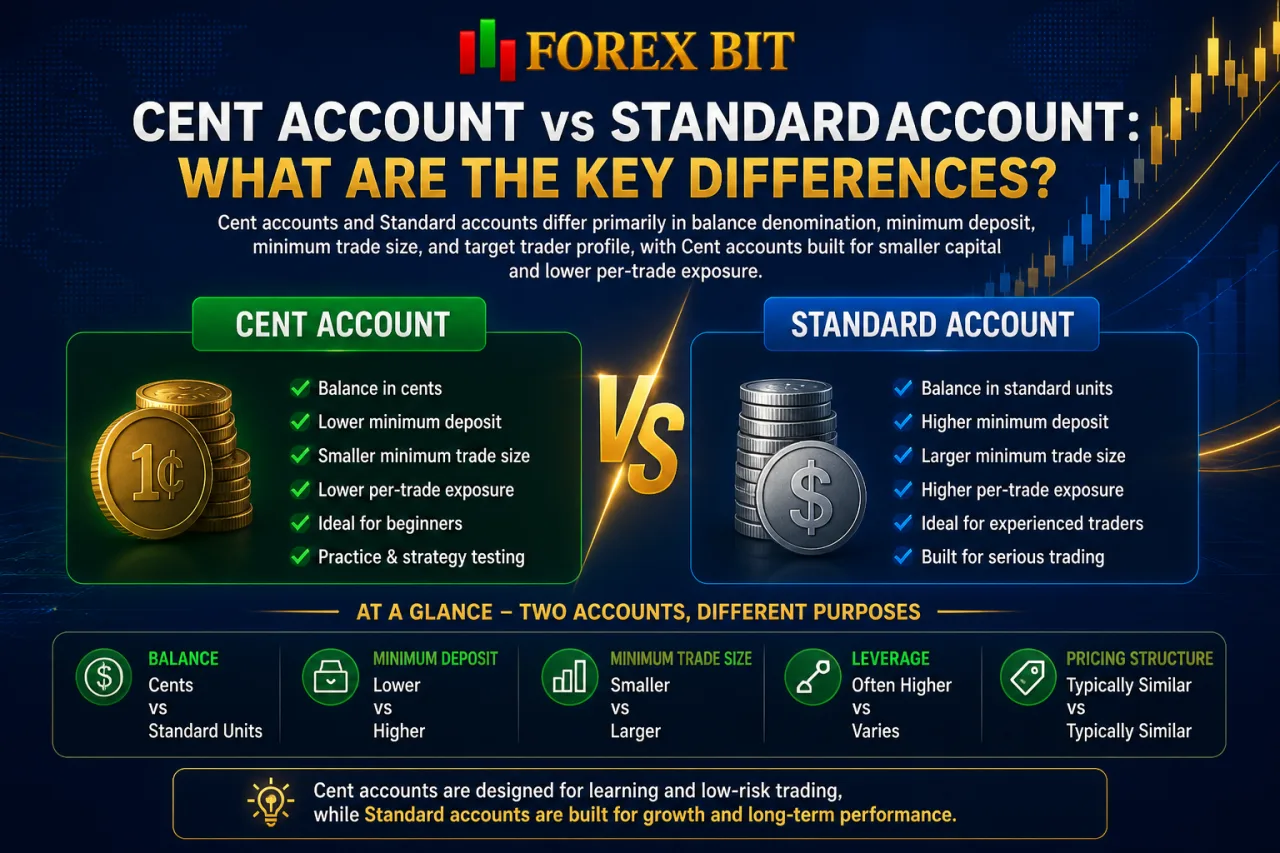
Cent accounts and Standard accounts differ primarily in balance denomination, minimum deposit, minimum trade size, and target trader profile, with Cent accounts built for smaller capital and lower per-trade exposure. This section frames the core distinctions before breaking down deposit requirements, lot sizing, leverage, and pricing structures in the dedicated comparisons that follow.
At a glance, the two account types serve different stages of a trader’s development:
- Cent accounts denominate balances in cents, requiring lower minimum deposits and permitting fractional lot sizes.
- Standard accounts denominate balances in full base currency units, typically requiring higher minimum deposits and standard lot increments.
- Cent accounts suit beginners and strategy testers seeking reduced monetary risk per trade.
- Standard accounts suit experienced or higher-volume traders seeking full-size positions and typically tighter spread-to-commission ratios.
| Feature | Cent Account | Standard Account |
|---|---|---|
| Account currency | Cents (e.g., USC) | Standard (e.g., USD) |
| Minimum deposit | Lower | Higher |
| Minimum lot size | Smaller (fractional) | Standard (0.01 lot typical) |
| Leverage | Varies by broker/jurisdiction | Varies by broker/jurisdiction |
| Spreads/commissions | Often wider spreads, low/no commission | Often tighter spreads, commission-based options available |
| Suitability | Beginners, strategy testing | Active and higher-volume traders |
These differences carry direct implications for deposit planning and risk sizing, which the following breakdown addresses in detail.
What Is a Cent Account?
A Cent account is a micro-scale trading account that denominates balance, equity, and trade results in cents rather than whole base currency units, following the standard convention that 1 USD equals 100 cents. This structural feature directly shapes how profit and loss appear on the trading terminal.
Profits and losses on a Cent account display in the cent currency unit (for example, USC), so a deposit of 1,000 standard currency units shows as 100,000 cents on the account statement. This denomination lowers the monetary weight of each pip movement compared to a Standard account holding the same nominal capital.
The purpose of a Cent account centers on micro-scale trading: it lets traders execute real trades under live market conditions while keeping absolute currency exposure small. This makes it a practical entry point before transitioning to a Standard account.
What Is a Standard Account?
A Standard account is a retail forex account that denominates balance, equity, and trade results in whole base currency units such as USD or EUR, using standard lot conventions rather than cent-based denomination. This structure directly shapes how position size and account value display on the trading terminal.
Balance and profit/loss figures on a Standard account show in full currency units, so a deposit of 1,000 USD appears as 1,000 USD rather than as a cent-denominated figure. Trade size follows standard lot increments, with one standard lot typically representing 100,000 units of the base currency and smaller increments available in fractions of a lot.
This account type functions as the typical account for regular retail traders who hold larger capital or seek full-size position exposure. It also commonly serves as the destination account once a trader moves beyond the Cent account stage described earlier.
Which Account Type Is Better for Beginners with Small Capital?
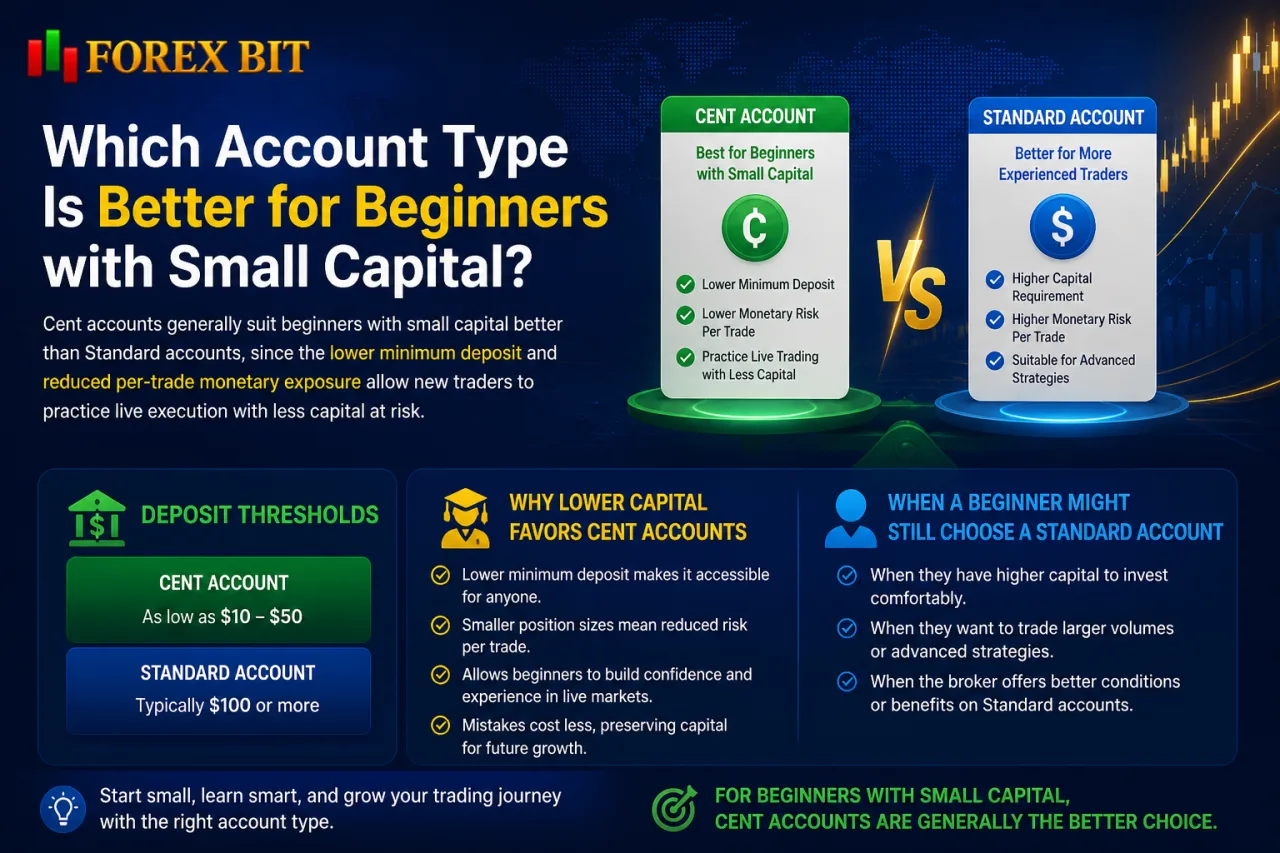
Cent accounts generally suit beginners with small capital better than Standard accounts, since the lower minimum deposit and reduced per-trade monetary exposure allow new traders to practice live execution with less capital at risk. This suitability question breaks down into deposit thresholds, the reasoning behind why lower capital favors Cent accounts, and the specific cases where a beginner might still open a Standard account instead.
What Is the Minimum Deposit for Each Account Type?
Cent accounts typically require a lower minimum deposit than Standard accounts, allowing traders to open a live account with a small sum of real money for testing purposes. This deposit gap directly addresses how much capital a trader commits before executing live trades on either account type.
Standard accounts generally set a higher minimum deposit threshold than Cent accounts, reflecting the full base-currency denomination and larger nominal position sizes involved, though exact figures vary by broker and jurisdiction.
The lower entry threshold on Cent accounts serves traders who want to validate a strategy under live execution conditions without exposing significant funds. Standard accounts, by contrast, suit traders who already hold sufficient capital and prioritize full-size lot trading over minimal deposit exposure.
Minimum deposit figures differ across brokers and regulatory entities, so exact thresholds require verification against each broker’s official account specification page rather than a single fixed number.
Is a Cent Account Safer for First-Time Traders?
Yes, a Cent account reduces financial risk exposure for first-time traders learning to trade with real funds, since smaller monetary values per pip lower the psychological pressure of loss compared to a Standard account. This risk-reduction question ties directly back to the deposit and lot-size differences already outlined between the two account types.
Three factors support this lower-risk profile for beginners:
- Smaller monetary loss per trade keeps drawdowns within a manageable psychological threshold.
- Lower minimum deposit limits total capital exposed while learning live execution.
- Real market conditions on a live account still apply, unlike a demo account, preserving authentic order execution and emotional response to actual money at stake.
The reduced absolute currency value per trade does not eliminate risk entirely, since percentage-based losses on account equity remain proportionally the same as on a Standard account.
The safety benefit applies mainly to the emotional and capital-preservation side of trading. A beginner absorbs mistakes without significant financial damage while building consistency before transitioning to a Standard account.
How Do Lot Size and Minimum Trade Size Differ Between Cent and Standard Accounts?
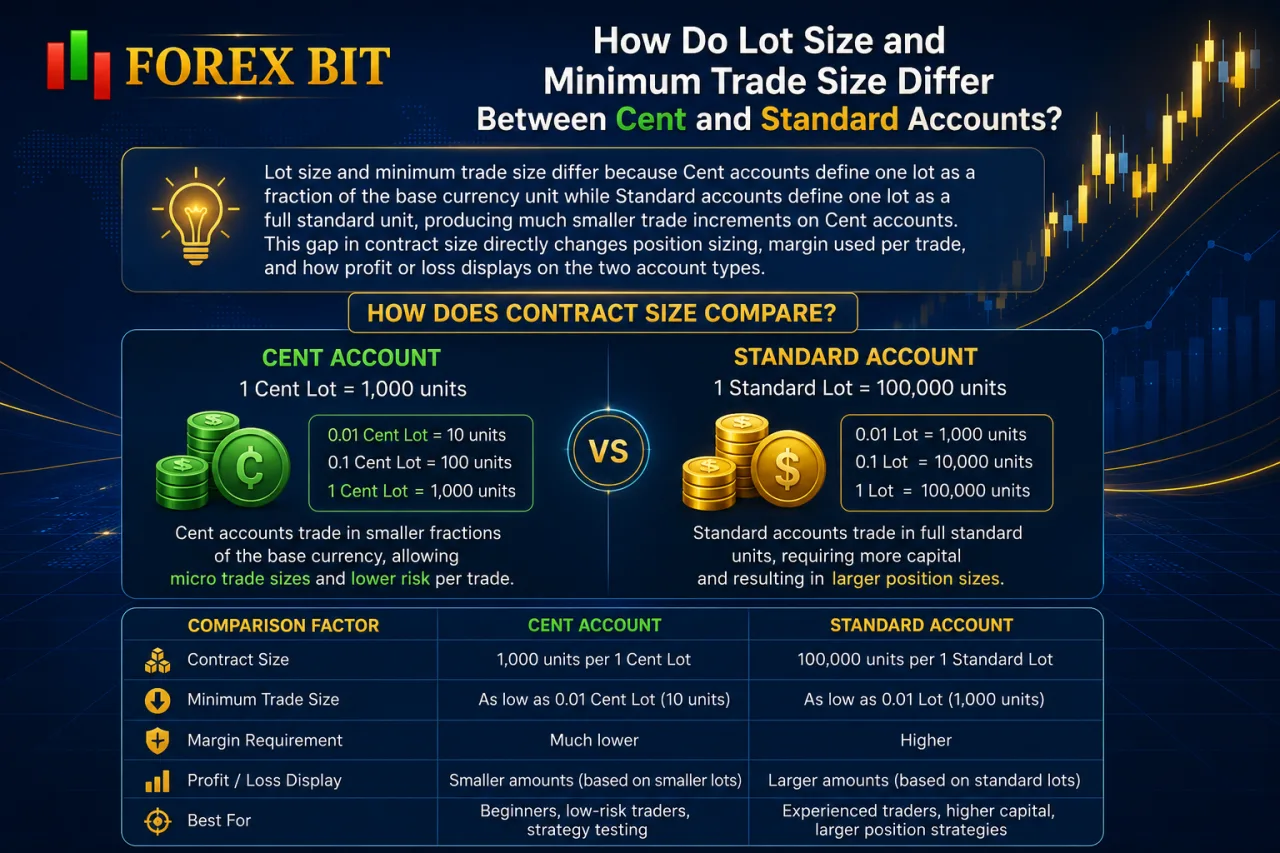
Lot size and minimum trade size differ because Cent accounts define one lot as a fraction of the base currency unit while Standard accounts define one lot as a full standard unit, producing much smaller trade increments on Cent accounts. This gap in contract size directly changes position sizing, margin used per trade, and how profit or loss displays on the two account types, as broken down below.
A Cent account contract size generally equals a smaller fraction of a standard lot, since balances are denominated in cents, while a Standard account contract size generally equals 100,000 units of the base currency per lot, consistent with conventional forex lot sizing. This difference in contract size means a trader on a Cent account opens positions with far smaller nominal exposure than a trader placing the same lot number on a Standard account.
Smaller contract size on Cent accounts lowers the margin required per trade under equivalent leverage, allowing finer control over position sizing relative to available capital. Because each lot represents fewer base currency units, traders adjust exposure in smaller increments without triggering large margin consumption. Standard accounts, with larger contract size, require proportionally more margin per lot, which suits traders holding larger capital seeking full-size exposure.
Profit and loss on a Cent account calculate and display in cents, while profit and loss on a Standard account calculate and display in whole base currency units. A pip movement on a Cent account translates into a cent-denominated result, whereas the same pip movement on a Standard account translates into a dollar-denominated result of proportionally larger nominal size.
What Is the Minimum Trade Size in a Cent Account vs a Standard Account?
A Cent account generally allows a minimum trade size far smaller than a Standard account, since one lot on a Cent account represents a fraction of the base currency unit rather than a full 100,000-unit standard lot. This gap in minimum tradeable volume ties directly to the contract size differences already outlined between the two account types.
Cent accounts typically permit micro-lot trading starting from a small fraction of a standard lot, letting traders open positions with very small nominal value.
Standard accounts typically set the minimum trade size at a small fraction of a standard lot, equivalent to a portion of the base currency’s full contract size, following conventional forex lot increments.
This difference in minimum volume gives Cent account holders finer control over position sizing relative to available capital, since each increment of volume moves nominal exposure by a smaller amount than the same increment on a Standard account. Traders adjusting risk in small steps, or testing a strategy with limited capital, use this finer granularity to fine-tune lot size without jumping straight to a full standard lot’s worth of exposure. Standard accounts, with larger minimum increments, suit traders whose capital and risk tolerance already accommodate full-size lot steps.
How Does Leverage Compare Between Cent and Standard Accounts?
Cent and Standard accounts generally offer comparable maximum leverage ratios at a given broker, since leverage caps typically depend on the regulatory entity and instrument rather than on cent versus standard denomination. This leverage comparison ties directly into how margin per trade shifts once contract size differs between the two account types.
Leverage figures on both account types remain subject to regulatory jurisdiction, meaning a broker regulated under multiple entities may cap leverage differently depending on which entity holds the client’s account, regardless of whether the account is Cent or Standard.
The practical difference emerges when leverage combines with lot size rather than from leverage alone:
- Cent accounts consume smaller absolute margin per lot, since each lot represents a fraction of a standard contract, so identical leverage produces lower margin usage in nominal terms.
- Standard accounts consume larger absolute margin per lot at the same leverage ratio, reflecting the full 100,000-unit contract size per standard lot.
This means a trader applying the same leverage ratio on both accounts still experiences a smaller margin footprint on a Cent account purely due to smaller contract size, not due to a different leverage cap.
Which Account Is More Suitable for Risk Management and Practicing Strategies?
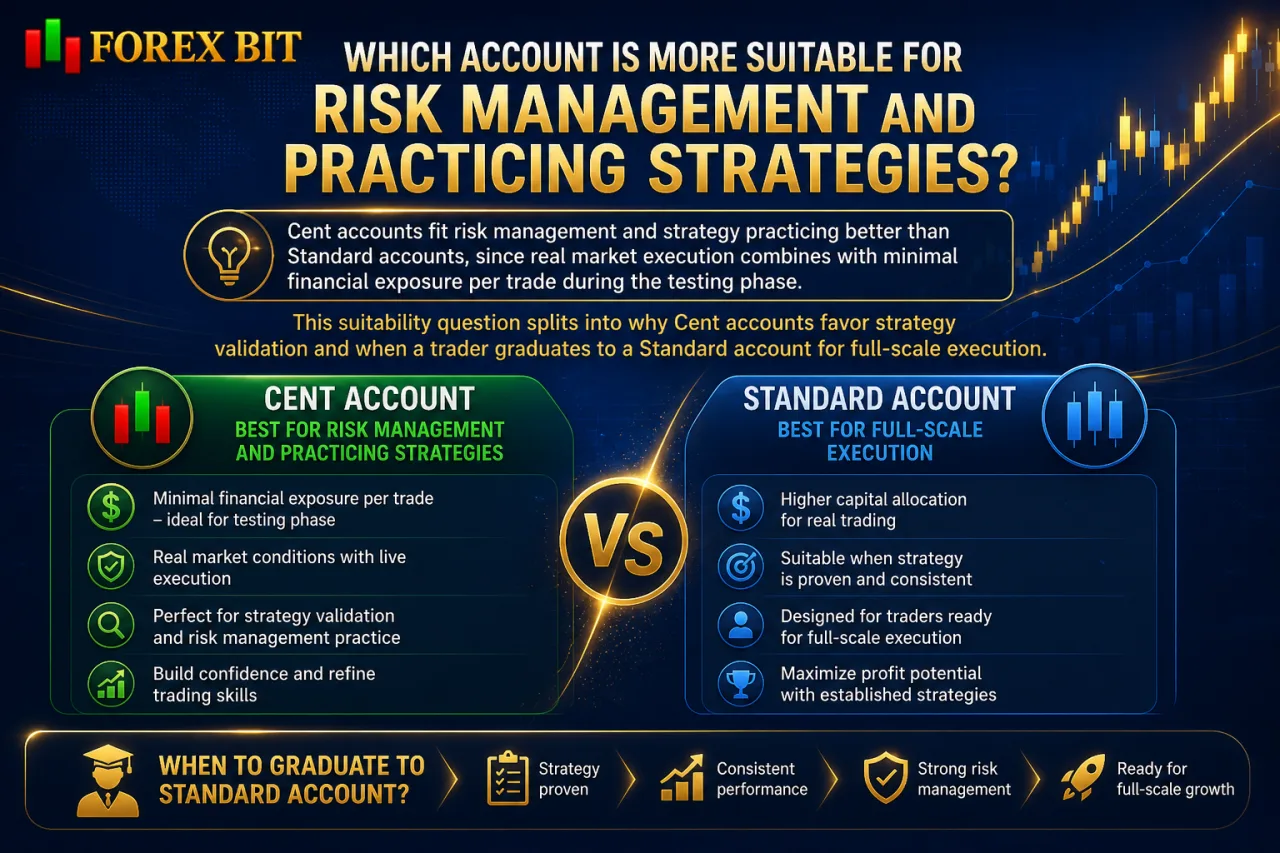
Cent accounts fit risk management and strategy practicing better than Standard accounts, since real market execution combines with minimal financial exposure per trade during the testing phase. This suitability question splits into why Cent accounts favor strategy validation and when a trader graduates to a Standard account for full-scale execution.
How to Use a Cent Account to Practice Risk Management Before Scaling Up?
To use a Cent account for practicing risk management before scaling up, traders follow a sequence of testing strategy consistency, tracking win/loss ratio, and adjusting position sizing over a defined period. This process turns the lower monetary exposure of a Cent account into a structured pathway toward Standard account trading rather than a random trial run.
The sequence generally involves the following steps:
- Executing the same strategy repeatedly on the Cent account to confirm consistency across varying market conditions.
- Recording win/loss ratio and average trade outcome to identify whether the strategy produces a reliable edge.
- Adjusting position sizing incrementally, since the small contract size on a Cent account permits fine-grained changes without large margin shifts.
- Reviewing drawdown behavior against account equity to confirm risk tolerance before committing larger capital.
- Transitioning capital to a Standard account once consistency, win/loss data, and position sizing rules hold stable over the tested period.
This structured process validates trading discipline under live execution before moving to full-size Standard account trading.
When Should a Trader Switch from a Cent Account to a Standard Account?
A trader switches from a Cent account to a Standard account once three signals appear together: consistent profitability over a tested period, larger capital available for deposit, and a strategy requiring position sizes beyond the Cent account’s fractional lot range. This transition question builds directly on the strategy-testing sequence already outlined for Cent account trading.
Each signal plays a distinct role in confirming readiness:
- Demonstrating consistent profitability across varied market conditions rather than a single winning streak.
- Accumulating larger capital that justifies moving into full base-currency denomination.
- Requiring larger position sizes than the fractional lot increments a Cent account permits.
- Confirming stable win/loss ratio and drawdown control already tracked during the Cent account testing phase.
None of these signals alone justifies the switch; a trader holding sufficient capital but lacking consistent results still carries unresolved risk into a Standard account. The combination of proven strategy discipline and adequate capital marks the practical point for moving from cent-denominated exposure to full standard lot trading.
What Other Trading Conditions Vary Between Cent and Standard Accounts?
Cent and Standard accounts also diverge in spread and commission structure and swap-free eligibility, beyond the core deposit and lot-size differences already outlined. These secondary conditions shape trading cost and instrument access rather than position sizing, so the following breakdown separates pricing and Islamic account availability for each account type.
Both account types generally follow the same underlying execution approach offered by the broker, so execution speed and order handling remain consistent across Cent and Standard accounts. The distinctions that matter most for traders choosing between the two lie in pricing and swap-free eligibility, which are detailed in the sections below.
Do Spreads and Commissions Differ Between Cent and Standard Accounts?
Yes, spreads and commissions differ between Cent and Standard accounts, with Cent accounts typically carrying wider spreads and low or no commission, while Standard accounts typically offer tighter spreads with an optional commission-based pricing model. This pricing gap ties directly into the cost structure a trader absorbs on each account type beyond the deposit and lot-size differences already outlined.
Cent accounts generally apply a spread-only pricing model, since the small nominal trade size on this account type makes a per-lot commission less practical for the broker to structure.
Standard accounts generally offer a choice between a wider spread with zero commission or a tighter raw spread paired with a fixed commission per lot, depending on the broker’s account tier.
This cost structure shapes suitability by trading style:
- Testing a strategy with minimal absolute cost favors the Cent account’s spread-only model.
- Executing high-volume or scalping strategies favors the Standard account’s commission-based tier, since tighter raw spreads reduce cost per round turn at larger trade sizes.
Exact spread figures and commission rates require verification against each broker’s official account specification page, since pricing varies by broker and regulatory entity.
Are Swap-Free Options Available for Both Account Types?
Yes, swap-free options generally exist for both Cent and Standard accounts, since Islamic account status typically applies as an add-on feature rather than a separate account category tied to denomination. This swap-free availability question connects directly to the spread and commission differences already outlined for each account type.
Eligibility and terms still vary by broker and jurisdiction rather than applying uniformly:
- Requesting swap-free status on either account type generally requires a separate application confirming religious eligibility.
- Restricting swap-free availability by regulatory entity occurs at some brokers, limiting the feature to specific licensed entities. Swap-free eligibility generally depends on the regulatory entity overseeing the broker and the trader’s jurisdiction, since some regulators restrict or prohibit swap-free account offerings.
- Applying administrative fees in place of swap charges occurs on some swap-free Cent or Standard accounts held beyond a set period. Some brokers apply an administrative fee in place of swap charges on swap-free accounts once positions remain open beyond a certain holding period, though the exact fee structure and threshold vary by broker.
Traders confirm exact swap-free eligibility and any holding-period restrictions against the broker’s official account specification page before opening either account type.
Conclusion
The core distinction between a Cent and a Standard account rests on denomination, deposit threshold, and contract size, not on leverage caps or Islamic account eligibility, which apply similarly across both structures depending on broker and jurisdiction. Cent accounts fit beginners with small capital and traders validating a strategy under live conditions with minimal monetary exposure, thanks to fractional lot sizing and lower margin per trade.
Standard accounts fit traders holding larger capital, executing full-size positions, or pursuing high-volume and scalping strategies where tighter commission-based spreads reduce cost per trade. Capital size, trading experience, and strategy scale determine the correct choice between the two.
Isabella Brown is the Forex Trading Guide Manager at Forex Bit, focusing on educational content about broker safety, trading costs, account types, platforms, and key Forex/CFD concepts. Her work helps readers understand trading terms, broker conditions, and practical checks before evaluating or using a brokerage service.
Email: [email protected]



Best Brokers

Trade with the world’s largest retail broker and benefit from better - than - market conditions.

We offer a superior trading environment that puts traders in the best position to profit.

Trade with the best trading conditions. WIN THE BEST TRADING ACCOUNT AWARD.

Trade global markets with Interactive Brokers – a highly regulated multi-asset broker built for active and professional investors.






Forex Bit provides independent forex broker reviews, comparisons, guides, and industry news to help traders make informed decisions.
Best Brokers
Metatrader 5 Brokers
Metatrader 4 Brokers
Lowest Spread Forex Broker
Regulated Forex Brokers
Forex Copy Trading
Ctrader Brokers
Best Forex Broker For Beginners