
Confused about regulated vs unregulated forex broker risks? Discover how licenses, fund protection & compensation schemes differ before you trade.
Regulated vs Unregulated Forex Broker: Key Differences

A regulated forex broker operates under the legal oversight of a financial authority that enforces capital requirements, fund segregation, and reporting standards, while an unregulated broker faces no such external accountability. This distinction directly determines how much legal recourse a trader has if a broker mismanages funds or ceases operations.
Verifying a broker’s license typically involves checking the relevant regulator’s official register using the license number or legal entity name listed on the broker’s website. Matching the registered entity to the one accepting deposits is essential, since a brand can operate multiple entities under different jurisdictions.
Regulated brokers typically offer protections such as segregated client accounts, negative balance protection, and access to a compensation scheme that can reimburse traders if the firm becomes insolvent, though the specific safeguards and reimbursement limits vary by regulator. These protections vary significantly depending on the regulator and legal entity a trader is registered under.
Trading with an unregulated broker carries the risk of losing all deposited funds with no legal authority to intervene, and such brokers are often identified by the absence of a verifiable license number or registered legal entity. Forex Bit breaks down these warning signs to help traders assess broker safety before opening an account. The sections below compare regulated and unregulated brokers, explain how to verify licensing status, and outline the protections regulated brokers are required to provide.
What Is the Difference Between a Regulated and an Unregulated Forex Broker?
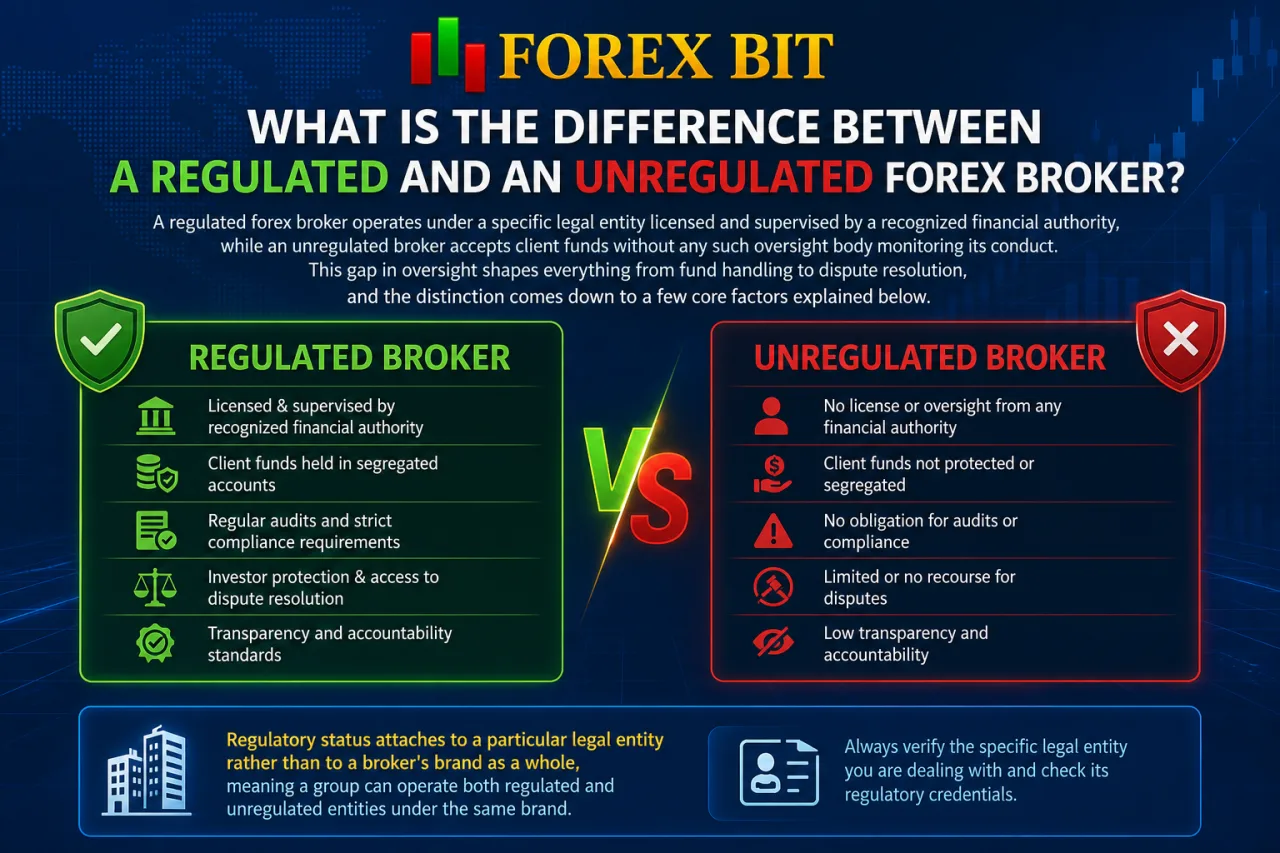
A regulated forex broker operates under a specific legal entity licensed and supervised by a recognized financial authority, while an unregulated broker accepts client funds without any such oversight body monitoring its conduct. This gap in oversight shapes everything from fund handling to dispute resolution, and the distinction comes down to a few core factors explained below.
Regulatory status attaches to a particular legal entity rather than to a broker’s brand as a whole, meaning a group can register one entity with a strict regulator like the FCA, ASIC, CySEC, or the FSCA while onboarding clients from other regions through a separate, less-supervised entity. A trader signing up under the offshore entity receives none of the protections tied to the regulated one, even if both share the same website and logo. Checking which specific entity holds the account, not just the parent brand name, determines the actual level of oversight in place.
Which Areas of a Broker’s Operations Do Regulators Actually Oversee?
Regulators primarily oversee five areas of a broker’s operations: capital adequacy, client fund segregation, financial reporting, conduct rules, and dispute resolution mechanisms. These oversight areas set the baseline context before examining the specific protections tied to a regulated legal entity.
- Capital adequacy requires brokers to hold minimum operating capital so the firm can absorb losses without collapsing.
- Fund segregation mandates client deposits sit in accounts separate from the broker’s own operating funds.
- Financial reporting obligates brokers to submit periodic audits and disclosures to the regulator.
- Conduct rules govern marketing claims, leverage limits, and how client orders are executed.
- Dispute resolution gives clients access to a formal complaints process or ombudsman if a broker acts unfairly.
Each regulator enforces these areas with different intensity, and an offshore or unregulated entity typically applies none of them with external verification.
Why Might a Broker Be Regulated in One Country But Not Another?
A broker holds regulation in one country but not another because global brands often register separate legal entities in different jurisdictions, applying for a license only where the local regulator requires it to legally solicit clients. This structural setup is what allows a single brand to display a regulatory badge while operating largely outside oversight elsewhere.
A group targeting European clients typically registers a strict-tier entity under CySEC or a similar EU-recognized regulator to comply with local marketing and solicitation laws, since operating without a license there carries direct legal risk. That same group often opens a separate entity in a lightly regulated offshore jurisdiction to onboard clients from regions with weaker enforcement.
Which entity a trader gets onboarded to depends primarily on country of residence, not on personal choice. A trader based in a country without strict solicitation enforcement often gets routed to the offshore entity by default, even if the broker’s marketing prominently features its regulated arm. Checking the specific legal entity named in the account-opening agreement, not the homepage regulatory logo, confirms which jurisdiction actually applies.
How Can You Verify a Forex Broker’s License and Regulatory Status?
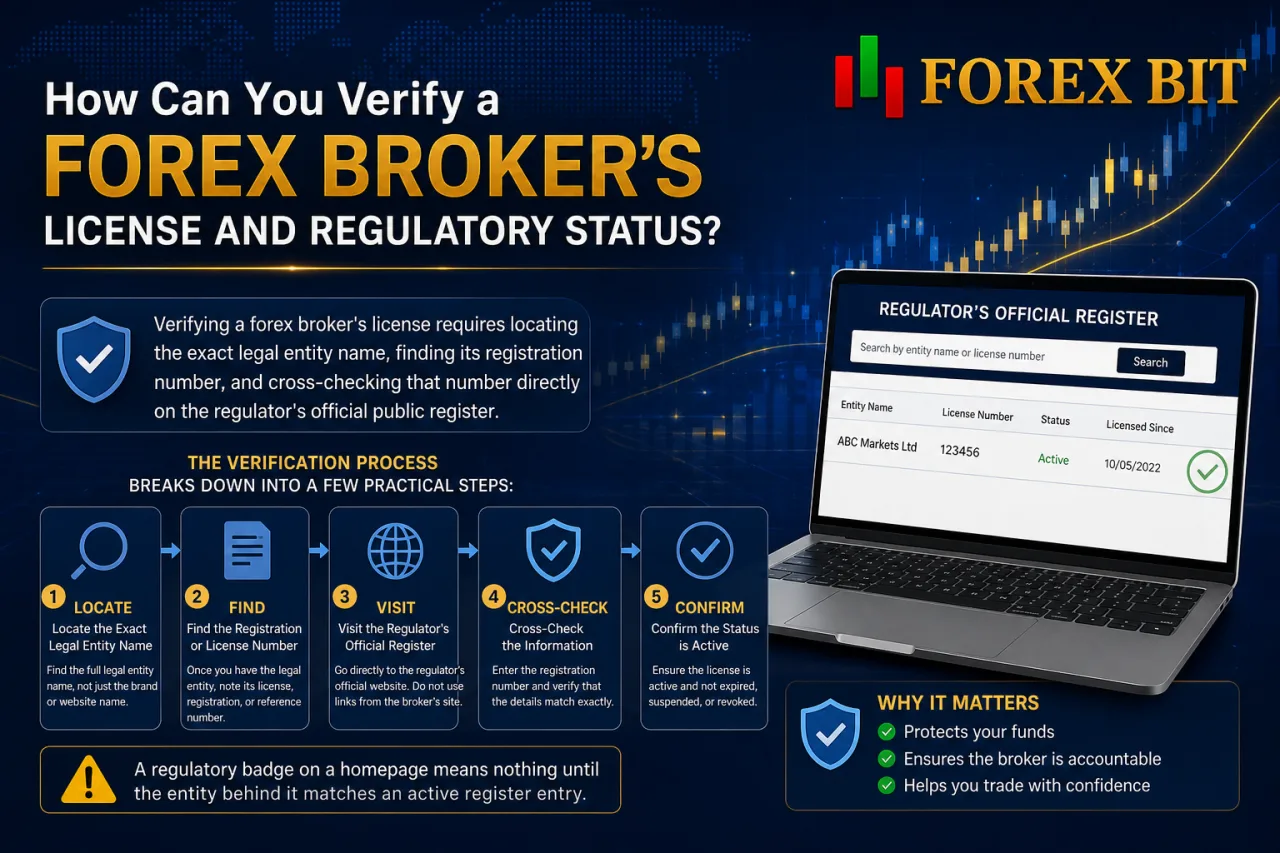
Verifying a forex broker’s license requires locating the exact legal entity name, finding its registration number, and cross-checking that number directly on the regulator’s official public register. This process resolves the exact issue raised above, since a regulatory badge on a homepage means nothing until the entity behind it matches an active register entry.
The verification process breaks down into a few practical steps traders can apply to any broker before funding an account.
- Locate the broker’s full legal entity name, usually stated in the footer, the account-opening agreement, or the terms and conditions page.
- Find the license or registration number listed alongside that entity, often printed near the same footer text or in a dedicated “regulation” page.
- Cross-check the number on the regulator’s own public register, such as the FCA, ASIC, CySEC, or FSCA database, rather than trusting a badge or certificate image on the broker’s site.
- Confirm the entity name on the register matches the entity named in the account agreement exactly, since a near-identical name can belong to an unrelated or offshore company.
A mismatch between the register entry and the entity accepting deposits signals that the advertised license does not cover the account being opened.
What Are the Official Regulator Registers You Should Check?
The official regulator registers to check include the FCA register for UK entities, ASIC’s connect register for Australian entities, CySEC’s register for Cyprus and EU entities, the FSCA register for South African entities, and the DFSA register for Dubai-based entities. This list of registers connects directly to the verification process described above, since each tier applies its own scope of oversight and compensation backing.
- FCA (UK) maintains a public register covering firms authorized to solicit and service UK-based clients under strict capital and conduct rules.
- ASIC (Australia) lists Australian financial services licensees along with the specific activities each license permits.
- CySEC (Cyprus/EU) registers investment firms passported across the European Economic Area under MiFID-aligned rules.
- FSCA (South Africa) records licensed financial services providers operating under South African conduct standards.
- DFSA (Dubai) oversees firms operating within the Dubai International Financial Centre under its own regulatory framework.
Requirements and client protections differ significantly between tier-1 regulators such as the FCA and ASIC versus offshore or lightly regulated registers, as capital minimums, audit frequency, and compensation scheme access vary by jurisdiction. An entity listed only on an offshore register outside these five typically operates with far lower verified oversight than one matched to a tier-1 register.
What Red Flags Suggest a License Claim May Be False or Misleading?
A license claim likely turns out false when the legal entity name on the register does not match the entity accepting deposits, when the license shows expired or revoked status, or when the number belongs to a different company entirely. This set of warning signs extends the verification process outlined above by flagging the specific mismatches that turn a routine register check into a red flag.
- Mismatched entity name: the register lists a name similar but not identical to the one in the account agreement, often a sign of an unrelated or offshore affiliate.
- Expired or revoked license: the register shows the entity once held authorization that has since lapsed or been withdrawn, meaning current oversight no longer applies.
- Borrowed license number: the number on the broker’s site actually belongs to a different, unrelated firm on the register, a tactic sometimes called clone-firm fraud.
- Unverifiable regulator name: the broker cites a regulator by name without providing any registration ID that can be searched on that regulator’s public database.
Any one of these signs indicates the advertised regulatory status does not cover the account being opened, regardless of how the license is presented on the broker’s marketing pages.
What Protections Do Regulated Forex Brokers Offer Traders?
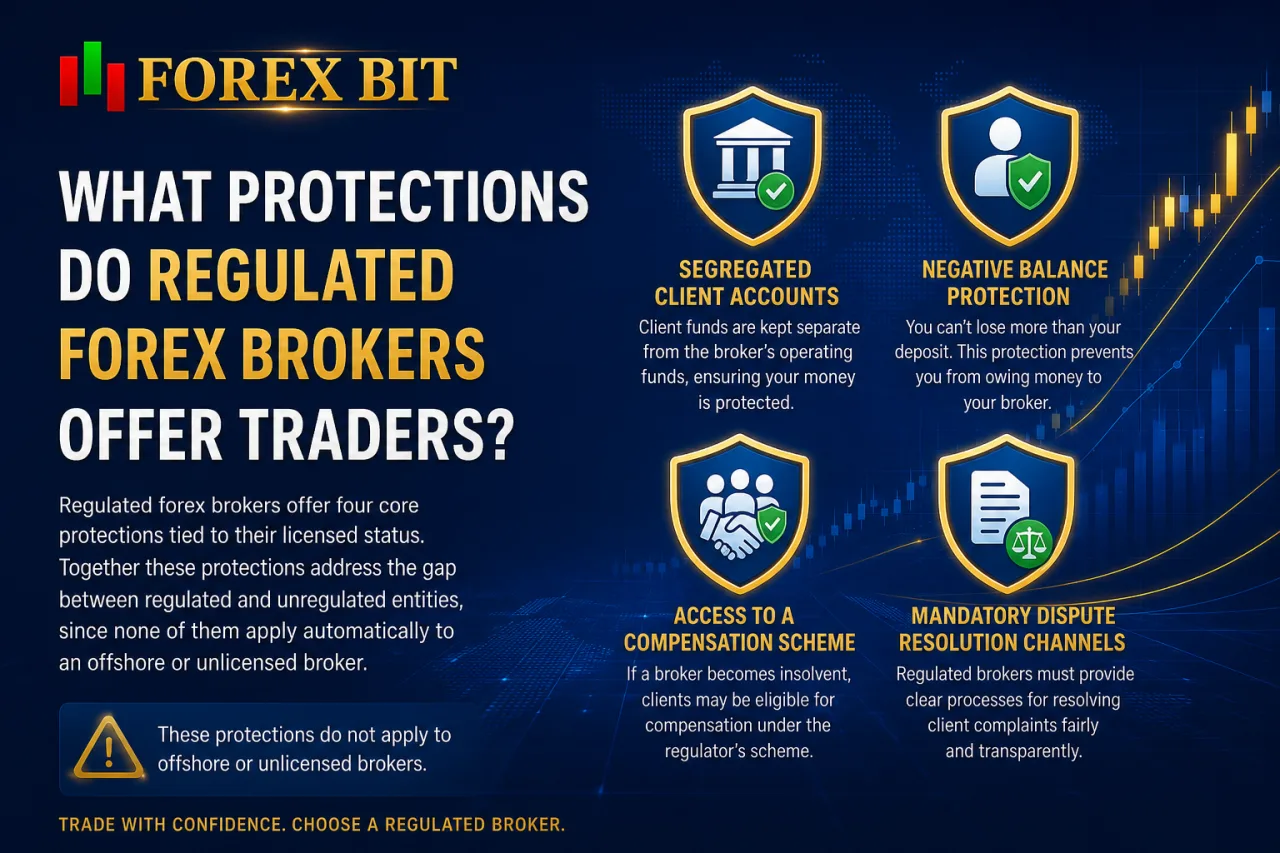
Regulated forex brokers offer four core protections tied to their licensed status: segregated client accounts, negative balance protection, access to a compensation scheme, and mandatory dispute resolution channels. Together these protections address the gap raised earlier between regulated and unregulated entities, since none of them apply automatically to an offshore or unlicensed broker. Segregated accounts keep client deposits separate from company operating funds, negative balance protection caps trader losses at the deposited amount, compensation schemes offer partial reimbursement if a broker fails, and dispute mechanisms give clients a formal complaints path. Each protection carries different rules and limits depending on the specific regulator and legal entity a trader is registered under.
What Is Segregated Client Fund Protection and Why Does It Matter?
Segregated client fund protection is a regulatory requirement that keeps trader deposits in bank accounts separate from a broker’s own operating capital, preventing the firm from using client money to cover business expenses or losses. This structural separation directly addresses the fund-misuse risk raised in the discussion of core protections above.
Segregation matters because it limits what happens to client deposits if a broker faces financial trouble. Funds held at an approved bank under a segregated account structure generally remain identifiable as client property, keeping them outside the pool of assets general company creditors can claim during insolvency proceedings.
This differs sharply from an unregulated setup, where deposits sit in the same accounts as company funds with no external check on how they get used.
The requirement itself is not universal or guaranteed. Tier-1 regulators such as the FCA and ASIC enforce segregation with regular audits and approved-bank standards, while offshore or lightly regulated jurisdictions may impose the rule on paper without verifying compliance in practice. A trader registered under a weaker jurisdiction’s entity often has no reliable way to confirm that segregation is actually enforced.
What Is Negative Balance Protection and Which Brokers Must Provide It?
Negative balance protection is a regulatory guarantee that caps a trader’s losses at the deposited amount, preventing an account from falling below zero even during extreme market volatility. This protection extends the compensation and dispute-resolution safeguards outlined above by addressing a scenario those protections do not cover: a sudden price gap that would otherwise leave a trader owing the broker money.
This guarantee is not applied uniformly across every regulator. Negative balance protection is generally required for retail clients under ESMA-aligned rules across the EU and under FCA rules for UK-based retail accounts.
Outside these jurisdictions, the requirement often disappears entirely. Brokers regulated under ASIC, FSCA, or various offshore registers may offer negative balance protection as a voluntary feature rather than a binding legal obligation, and enforcement of that promise depends on the specific entity a trader is registered under. A trader opening an account through an offshore or lightly regulated entity of a global broker cannot assume the same negative balance guarantee applies simply because the group’s EU or UK entity offers it.
Are Regulated Brokers Backed by an Investor Compensation Scheme?
Yes, regulated brokers are backed by an investor compensation scheme, though eligibility depends entirely on the specific legal entity a client is registered under rather than the broker’s brand as a whole. This ties directly into the segregation and negative balance protections outlined above, since a compensation scheme acts as the last line of defense if those safeguards still leave a shortfall after insolvency.
The FCA-regulated entity of a broker falls under the UK’s Financial Services Compensation Scheme (FSCS), which reimburses eligible client claims up to a set limit if the firm fails, though traders should check the current limit directly with the FSCS.
A CySEC-regulated entity falls under the Investor Compensation Fund (ICF), which covers eligible Cyprus-licensed investment firms up to a set limit per client; traders should confirm the current limit directly with CySEC.
Not every regulator operates a comparable scheme. ASIC and the FSCA do not run an equivalent client compensation fund for forex broker insolvency, and offshore or lightly regulated entities typically offer no compensation backing at all. A trader registered under a group’s offshore arm cannot claim FSCS or ICF coverage simply because an affiliated entity elsewhere in the same brand carries that protection.
What Are the Risks of Trading With an Unregulated Forex Broker?
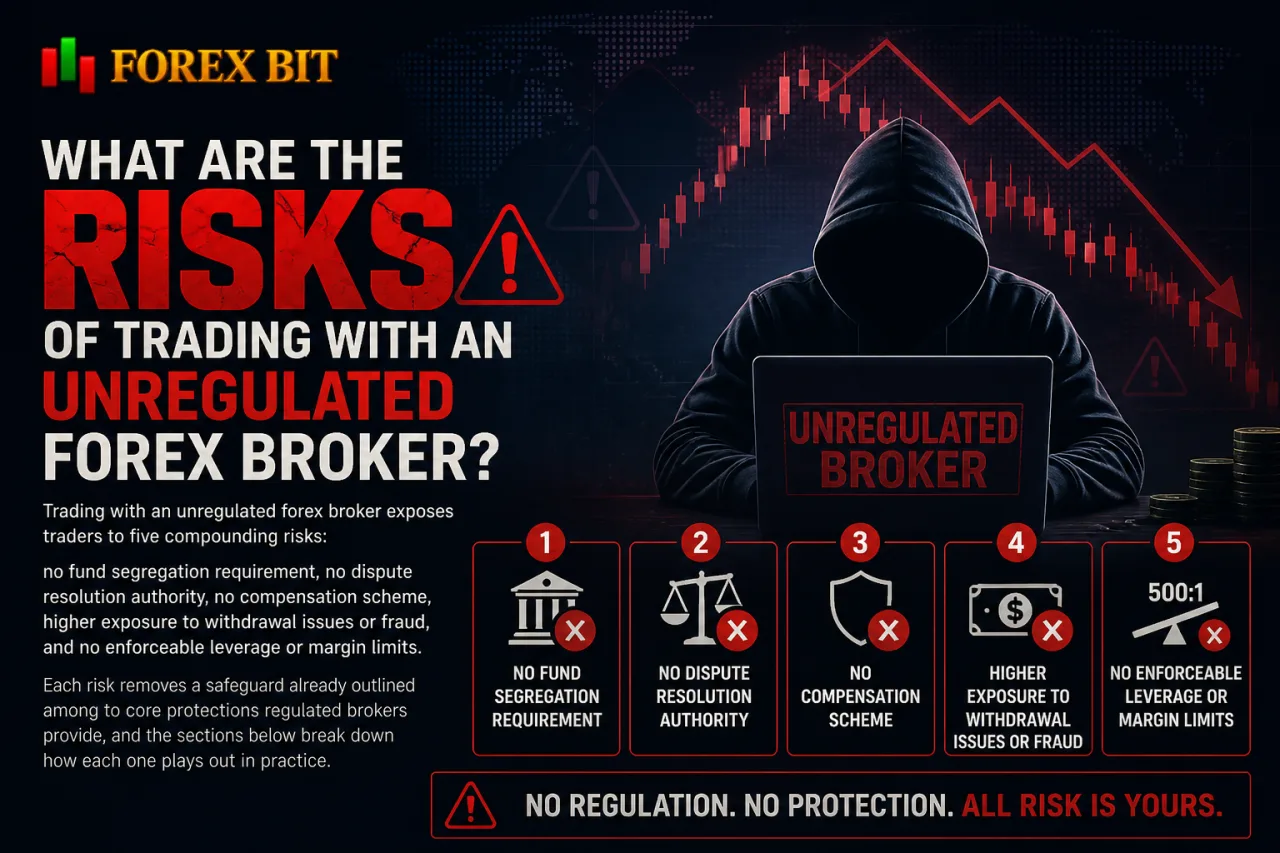
Trading with an unregulated forex broker exposes traders to five compounding risks: no fund segregation requirement, no dispute resolution authority, no compensation scheme, higher exposure to withdrawal issues or fraud, and no enforceable leverage or margin limits. Each risk removes a safeguard already outlined among the core protections regulated brokers provide, and the sections below break down how each one plays out in practice.
How Can You Identify an Unregulated or Falsely Regulated Broker?
Identifying an unregulated or falsely regulated broker requires running a four-point checklist: cross-checking the license on the regulator’s register, confirming a verifiable physical address and legal entity, screening the broker against regulator warning lists, and treating unrealistic bonus or profit promises as a red flag. This checklist builds directly on the register-verification and red-flag points already covered above, applying them as a practical screening routine before an account gets funded.
- Cross-check the license number or entity name directly on the regulator’s public register rather than trusting a badge displayed on the broker’s site.
- Confirm a real, checkable physical address and a named legal entity in the terms and conditions, since a missing or generic address often signals no fixed regulatory jurisdiction.
- Screen the broker’s name and known aliases against a regulator’s warning or alert list, which several tier-1 regulators publish for firms operating without authorization.
- Treat guaranteed profits, no-risk bonuses, or deposit-matching offers with skepticism, since regulated entities under strict conduct rules face limits on these marketing tactics that offshore or unregulated firms typically ignore.
A broker failing more than one of these checks signals that its regulatory claims do not hold up under direct verification.
What Recourse Do Traders Have If an Unregulated Broker Refuses Withdrawals or Disappears?
Traders holding an account with an unregulated broker generally have little to no formal legal recourse if withdrawals get refused or the firm disappears, since no recognized regulator, ombudsman, or compensation scheme sits behind the entity. This gap in legal recourse follows directly from the compounding risks outlined above, particularly the absence of a supervising authority.
- No regulator to escalate a complaint to: an unregulated entity answers to no licensing body that can compel a response or investigate the account.
- No ombudsman or formal dispute channel: regulated brokers offer a complaints process backed by an external adjudicator; an unregulated broker offers no equivalent structure.
- No compensation scheme to file a claim with: funds lost to an unregulated firm’s insolvency or refusal to pay fall outside any FSCS-style or ICF-style reimbursement mechanism.
- Limited practical fund recovery: chargebacks through a card provider or bank sometimes recover partial amounts, but success depends heavily on payment method and timing rather than any guaranteed legal right.
A regulated broker’s client, by contrast, can escalate an unresolved complaint to the licensing regulator or a designated ombudsman, giving the dispute a formal path outside the broker’s own control. That structural difference is the core distinction separating regulated from unregulated legal recourse.
How Do Regulatory Standards Differ Across Regions and Broker Types?
Regulatory standards fall into three broad tiers, strict tier-1 authorities, moderate mid-tier regulators, and lightly supervised offshore registers, each applying different leverage caps, reporting obligations, and enforcement strength. This tiering builds directly on the register-verification checklist already covered above, since where a broker’s legal entity sits within these tiers determines how much practical protection its license actually carries. The distinctions below cover leverage restrictions, reporting depth, and enforcement power across these tiers.
Why Do Some Forex Brokers Restrict or Block Traders From Certain Countries?
Some forex brokers restrict or block traders from certain countries because operating there without a local license would breach that country’s securities or financial services law. This restriction operates as a legal compliance measure rather than a marketing choice or a broker-specific quirk.
- Requires a specific local license before soliciting or servicing residents of a given jurisdiction, as is the case for retail forex firms targeting the United States under CFTC and NFA rules.
- Blocks applicants automatically once a checkout or KYC system detects a restricted country of residence.
- Avoids direct legal exposure for the broker’s licensed entity by refusing clients from jurisdictions where that entity holds no authorization.
- Applies uniformly across the industry, meaning most licensed brokers publish comparable restricted-country lists rather than one broker singling out specific nations.
A broker’s restricted-country list ties directly to which legal entity and license a trader would fall under, not to any judgment about the trader personally.
Can a Broker Hold Multiple Licenses Across Different Regulators at Once?
Yes, a broker holds multiple licenses across different regulators at once, since large brands typically register a distinct legal entity in each jurisdiction where they solicit clients. This structure connects directly to the entity-matching principle raised earlier, because holding multiple licenses does not mean every client shares the same protections.
A single brand name often sits above several legal entities, each carrying its own license, capital requirements, and compensation backing.
- Registers a strict-tier entity under a regulator like the FCA or ASIC to legally serve clients in that market.
- Operates a separate entity under a mid-tier or offshore register for clients in less-regulated regions.
- Assigns clients to a specific entity based on country of residence rather than personal preference.
- Applies different fund segregation, negative balance, and compensation rules to each entity independently.
Confirming which exact entity and license number governs the account being opened, rather than assuming the group’s strongest license applies broadly, determines the actual protections available.
Conclusion
The line between regulated and unregulated forex brokers comes down to accountability: a licensed entity answers to a financial authority through capital rules, fund segregation, and compensation backing, while an unregulated one operates with no external check on client money.
Assessing real trading safety means matching the exact legal entity accepting deposits against an official regulator register, since protections like negative balance protection and compensation schemes attach to that specific entity rather than a broker’s overall brand. Traders who verify licensing status before funding an account, rather than trusting homepage badges, gain a clear, evidence-based answer to whether meaningful legal recourse exists if something goes wrong.
As a Financial Blogger with 5 years of experience, I focus on delivering in-depth market insights, investment strategies, and personal finance advice. My content has helped a diverse audience navigate the complexities of financial planning and stay informed about the latest trends in the financial world.
Email: [email protected]



Best Brokers

Trade with the world’s largest retail broker and benefit from better - than - market conditions.

We offer a superior trading environment that puts traders in the best position to profit.

Trade with the best trading conditions. WIN THE BEST TRADING ACCOUNT AWARD.

Trade global markets with Interactive Brokers – a highly regulated multi-asset broker built for active and professional investors.






Forex Bit provides in-depth analysis of commodities, forex, and stock markets to help traders make informed investment decisions.
Best Brokers
Metatrader 5 Brokers
Metatrader 4 Brokers
Lowest Spread Forex Broker
Regulated Forex Brokers
Forex Copy Trading
Ctrader Brokers
Best Forex Broker For Beginners