
Worried a broker isn’t who they claim? Learn what a clone broker is, key warning signs, and how to verify FCA registration before you invest.
Clone Broker Scams: How to Spot & Verify a Fake Broker

A clone broker is a fraudulent firm that copies the name, address, or registration details of a genuine regulated broker to appear legitimate. Traders often discover the scam only after depositing funds, once withdrawals become impossible.
Verifying a suspected clone requires cross-checking its official registration number directly on the regulator’s public register, rather than relying on links provided by the broker itself. Matching the listed address, phone number, and domain against the regulator’s official record exposes most impersonation attempts.
Clone firms attach a real firm’s license number to a fake website, email, or trading platform with a similar name, making the scam appear officially regulated. This tactic lets scammers borrow the credibility of an authorized entity without any actual regulatory oversight.
If contact from a suspected clone broker occurs, it is advisable to file a complaint with the relevant regulator and check its published warning list before any further contact. Forex Bit outlines these verification steps in detail below, starting with a clear definition of what a clone broker actually is, how to confirm whether a broker is impersonating a genuine regulated firm, and how these scams misuse official registration numbers to appear trustworthy.
What Is a Clone Broker?
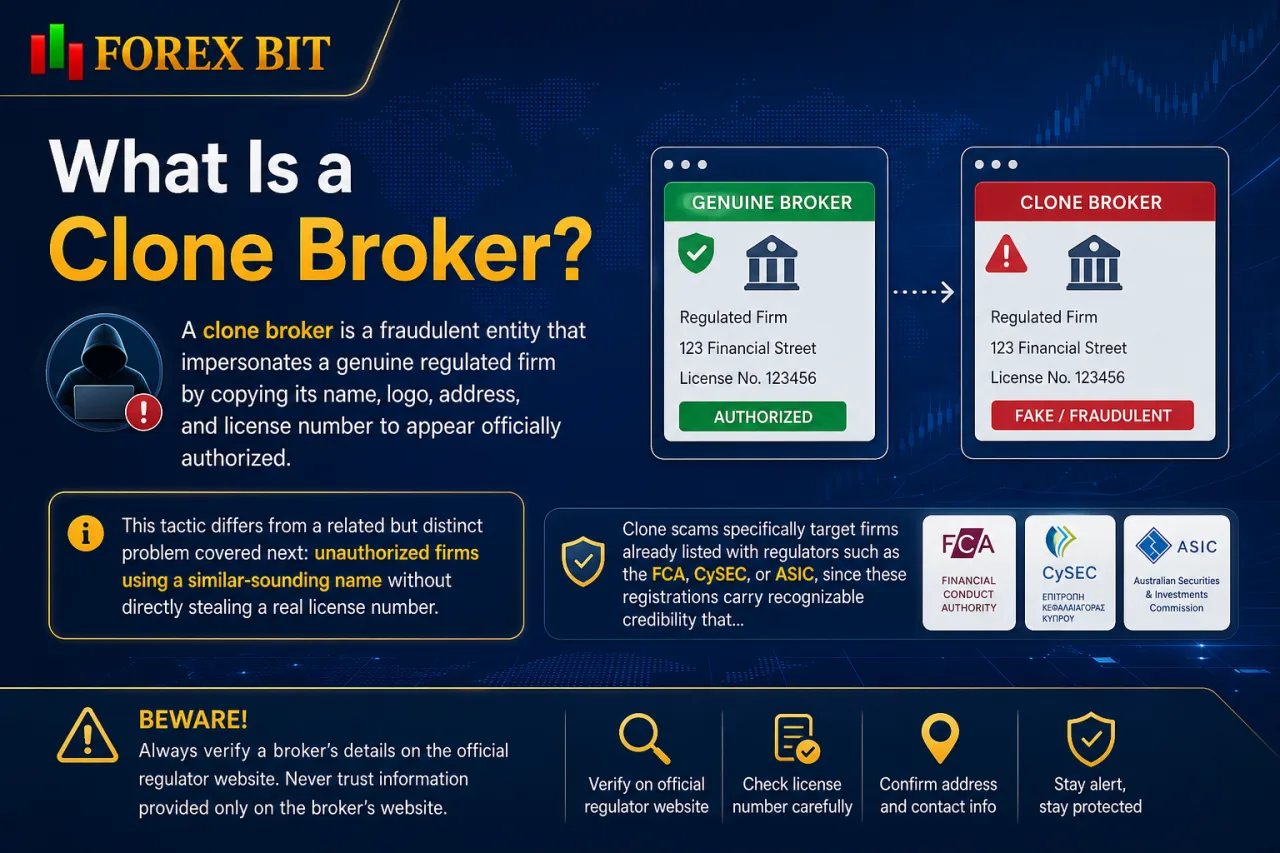
A clone broker is a fraudulent entity that impersonates a genuine regulated firm by copying its name, logo, address, and license number to appear officially authorized. This tactic differs from a related but distinct problem covered next: unauthorized firms using a similar-sounding name without directly stealing a real license number.
Clone scams specifically target firms already listed with regulators such as the FCA, CySEC, or ASIC, since these registrations carry recognizable credibility that traders check before depositing funds. The clone typically builds a near-identical website, reuses the authorized firm’s registered office address, and quotes the same license number in marketing emails or cold calls.
The distinction from a copycat brand matters for verification purposes. A clone claims to BE the exact regulated entity, while a copycat operates under an unauthorized, unrelated name that merely resembles a known broker. The following sections outline how these two problems are identified separately.
What Are the Common Types of Clone Broker Scams?
Clone broker scams fall into three main types: exact clones using a real regulator license number, similar-name clones with altered spelling or domains, and fake websites mimicking a genuine broker’s branding without any license claim. Each variant targets a different weak point in how traders verify legitimacy before depositing funds.
The first type, the exact clone, copies a genuine firm’s name, address, and license number in full, then quotes that number to regulators or victims as proof of authorization. The second type alters the spelling of a known broker’s name or registers a domain with a minor variation, such as an added letter or different suffix, relying on traders skimming rather than checking the URL character by character.
The third type builds a fake trading platform or landing page that visually mirrors a genuine broker’s logo, color scheme, and interface, but does not reference any specific license number at all. This variant instead invents vague claims of regulation or omits licensing details entirely, banking on branding alone to appear credible. Distinguishing these three helps determine which verification step matters most: cross-checking the license number, examining the domain spelling, or confirming the firm’s existence on a regulator’s register in the first place.
How Do Clone Brokers Differ From Genuine Regulated Brokers?
Clone brokers win on visual credibility while genuine regulated brokers win on verifiable data: a matching license number on the regulator’s register, a listed domain, and a physical registered address. Confirming which side of this comparison a firm falls on requires checking each trait separately rather than trusting the overall appearance of the website or email.
License verification separates the two most clearly. A genuine broker’s license number matches the exact firm name and address on the regulator’s public register, while a clone typically shows a mismatched entity name, an outdated address, or a number tied to a completely different company when cross-checked.
Domain status forms the second contrast. Authorized firms usually have their official website listed on the regulator’s Financial Services Register entry, whereas a clone’s domain does not appear anywhere on that record or cannot be confirmed against it.
Physical presence differs as well. Genuine brokers publish a specific, checkable registered office address, while clones list a vague location, a virtual mailbox, or omit an address entirely.
Contact behavior also diverges. Regulated firms rely on standard, traceable communication channels, while clones frequently initiate contact through unsolicited calls or pressure-selling tactics on social media.
How Can You Verify If a Broker Is a Clone of a Genuine Regulated Firm?
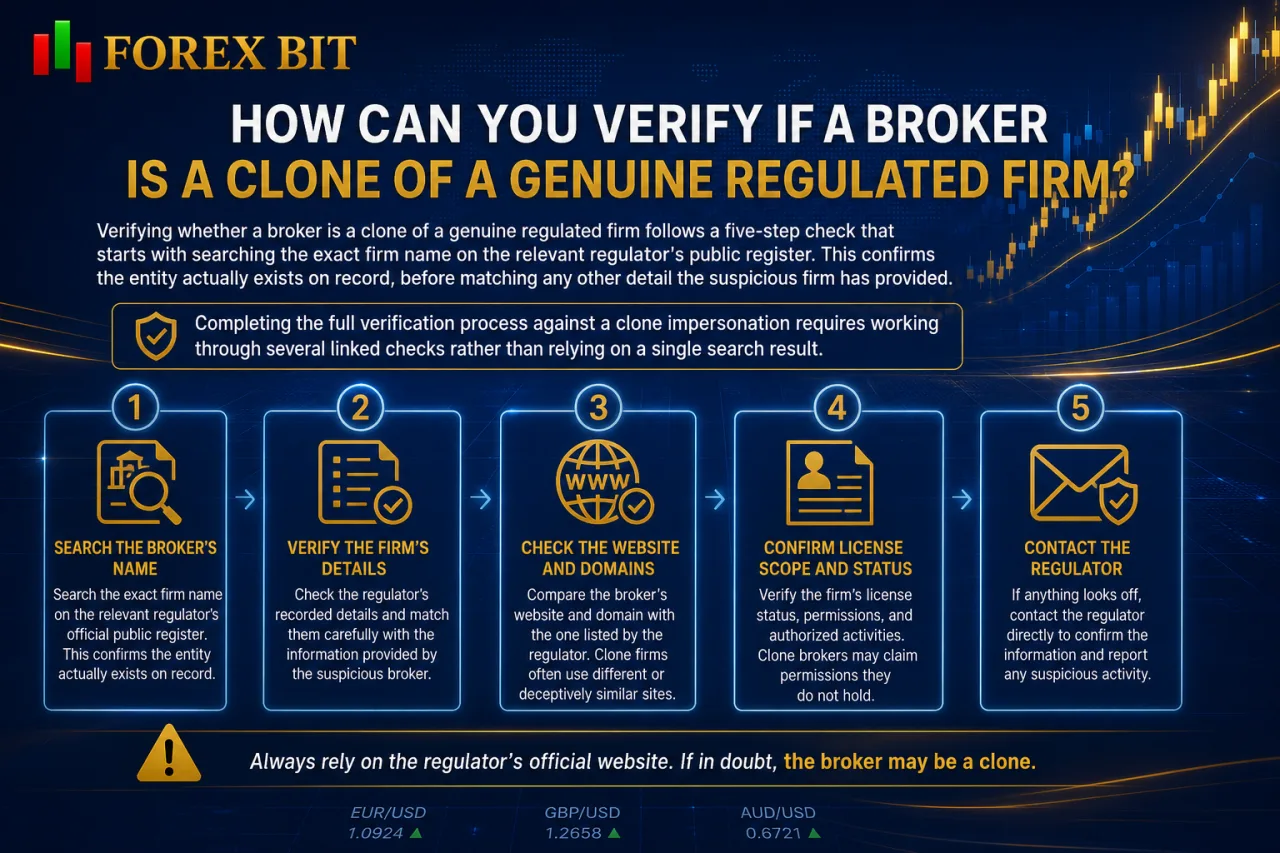
Verifying whether a broker is a clone of a genuine regulated firm follows a five-step check that starts with searching the exact firm name on the relevant regulator’s public register. This confirms the entity actually exists on record, before matching any other detail the suspicious firm has provided.
Completing the full verification process against a clone impersonation requires working through several linked checks rather than relying on a single search result.
- Searching the broker’s name directly on the official register, such as the FCA Financial Services Register, CySEC’s list of authorized firms, or ASIC’s professional registers, instead of clicking a link the broker itself provided.
- Cross-checking the license or registration number quoted by the broker against the number shown on that register entry for the matching firm name.
- Comparing the listed website domain, phone number, and registered address on the regulator’s record against what the suspicious broker has given.
- Calling the regulator directly using contact details published on the regulator’s own official website, not any number supplied by the broker under review.
- Checking the company’s incorporation details against the relevant national business registry to confirm the legal entity actually exists and is active.
A firm passing all five checks against matching official records indicates genuine regulatory status, while any mismatch in address, domain, or license number signals a likely clone.
What Details Should You Cross-Check on a Regulator’s Register?
Cross-checking a broker’s register entry involves six data points: the firm reference number, registered trading name, registered address, official website URL, permitted business activities, and authorization status. Matching these against the suspicious broker’s claims exposes most impersonation attempts before any funds change hands.
Each register entry breaks down into distinct fields that require separate comparison rather than a single glance at the page.
- Confirming the firm reference number (FRN) matches the exact number quoted by the broker, since a mismatched or reused FRN signals a clone.
- Comparing the registered trading name against any secondary or “trading as” names shown, since clones often add subtle variations.
- Verifying the registered address matches what the broker lists on its own site or correspondence.
- Checking the official website URL field, where authorized firms typically show a listed domain that a clone’s site does not appear under.
- Reviewing permitted business activities to confirm the firm holds authorization for the specific service offered, such as forex trading.
- Distinguishing whether the entity is fully authorized or merely appears on a regulator’s warning list, since a warning entry indicates the opposite of legitimacy.
A firm passing all six checks against consistent, matching data indicates the register entry belongs to the genuine authorized company.
Is Contact Information From the Broker’s Website Reliable for Verification?
No, contact information listed on the broker’s own website is not reliable for verification, since clone sites routinely publish fake phone numbers and email addresses that route back to the scammer rather than the genuine firm. This directly undermines any attempt to confirm legitimacy through the suspicious site itself.
A clone operator controls every field on its own website, so a phone call or email sent to the numbers listed there simply reaches the scam operation, which then confirms whatever false claim the trader is checking. Verification only holds up when contact details come from an independent source instead.
- Locating the regulator’s official phone number and email directly on the regulator’s own government or authority website, not through any link supplied by the broker.
- Calling that independently sourced number and asking the regulator to confirm the firm’s name, address, and license status.
- Treating any contact channel provided by the suspicious broker itself as unverified until the regulator confirms it separately.
Only contact details obtained this way from the regulator’s official register carry weight in confirming whether a broker is genuine or a clone.
How Do Clone Firms Exploit FCA and Other Regulator Registration Numbers?
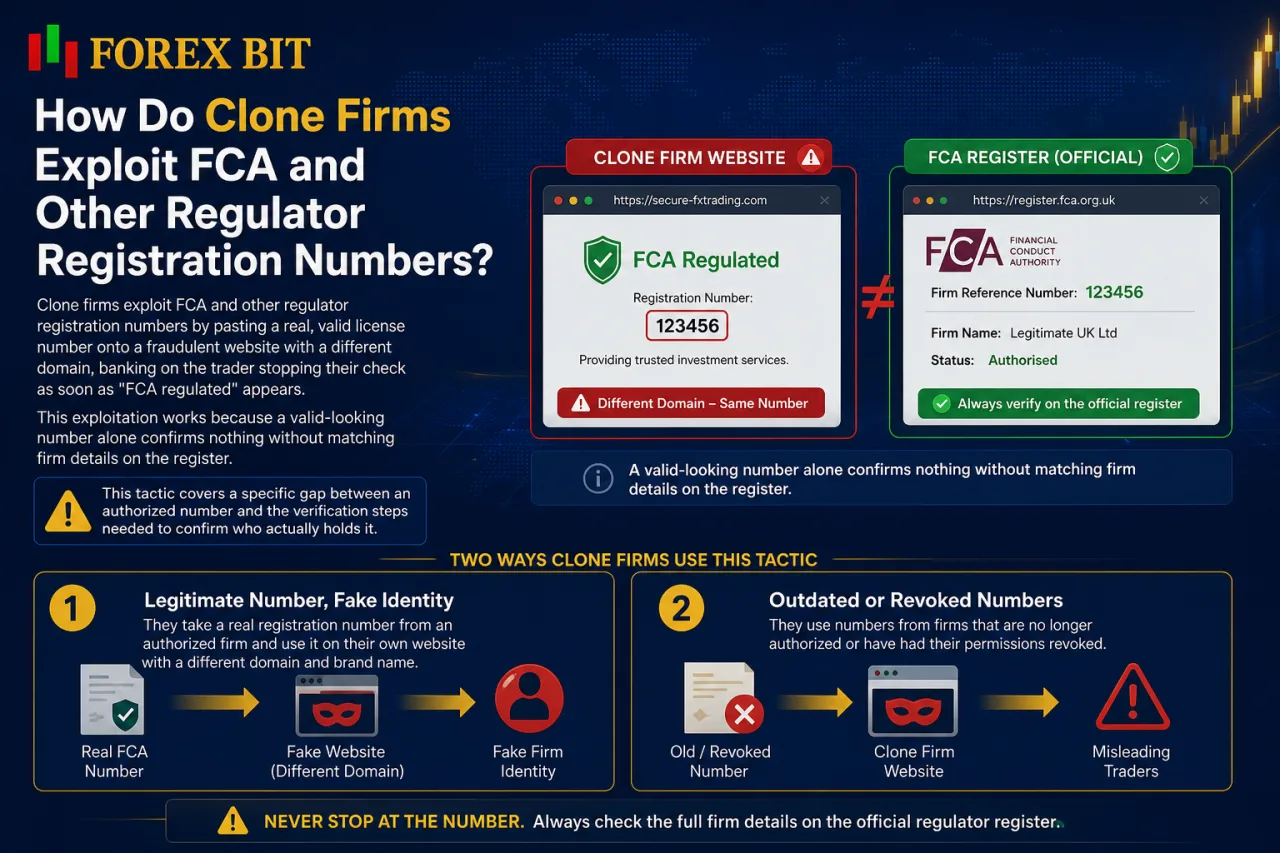
Clone firms exploit FCA and other regulator registration numbers by pasting a real, valid license number onto a fraudulent website with a different domain, banking on the trader stopping their check as soon as “FCA regulated” appears. This exploitation works because a valid-looking number alone confirms nothing without matching firm details on the register.
This tactic covers a specific gap between an authorized number and the verification steps needed to confirm who actually holds it.
Two variations of this exploit appear repeatedly among reported clone cases. Scammers either copy the number verbatim from a genuine firm’s register entry, or alter one or two digits so a quick glance still reads as legitimate to someone unfamiliar with the correct sequence. Both variants rely on the same psychological shortcut: once a trader sees a recognizable regulator’s name attached to a number, the instinct is to treat the site as verified rather than to open the register and confirm the number belongs to that exact domain and address.
Displaying any license number on a website proves only that the number exists somewhere in the regulator’s database, not that the site displaying it is the authorized firm. Confirming ownership of a genuine registration requires matching the firm name, registered address, and domain against that same register entry rather than accepting the number at face value.
Why Does a Matching License Number Not Guarantee Legitimacy?
No, a matching license number does not guarantee legitimacy, since regulators explicitly warn that a genuine number can be copied and reused fraudulently by unrelated firms. Confirming a broker’s status against this risk requires matching every registered detail together, not the number viewed in isolation.
A number alone confirms only that a valid registration exists somewhere on file, not who is actually displaying it. Clone operators exploit this gap by pasting an authentic FRN onto a fraudulent domain, counting on the trader to stop checking the moment a familiar regulator’s name appears.
Full verification depends on cross-referencing several fields at once rather than one isolated data point.
- Matching the registered firm name exactly, since a clone often quotes the correct number under a slightly different or unrelated company name.
- Confirming the registered address corresponds to the same firm shown against that number on the register.
- Verifying the listed domain appears on the regulator’s record, since a clone’s website typically does not.
Only consistency across the name, address, domain, and number together confirms that a firm holding a license number is the genuine authorized entity rather than an impersonator borrowing its credentials.
How Do You Report a Clone Broker Scam or Check Regulator Warning Lists?
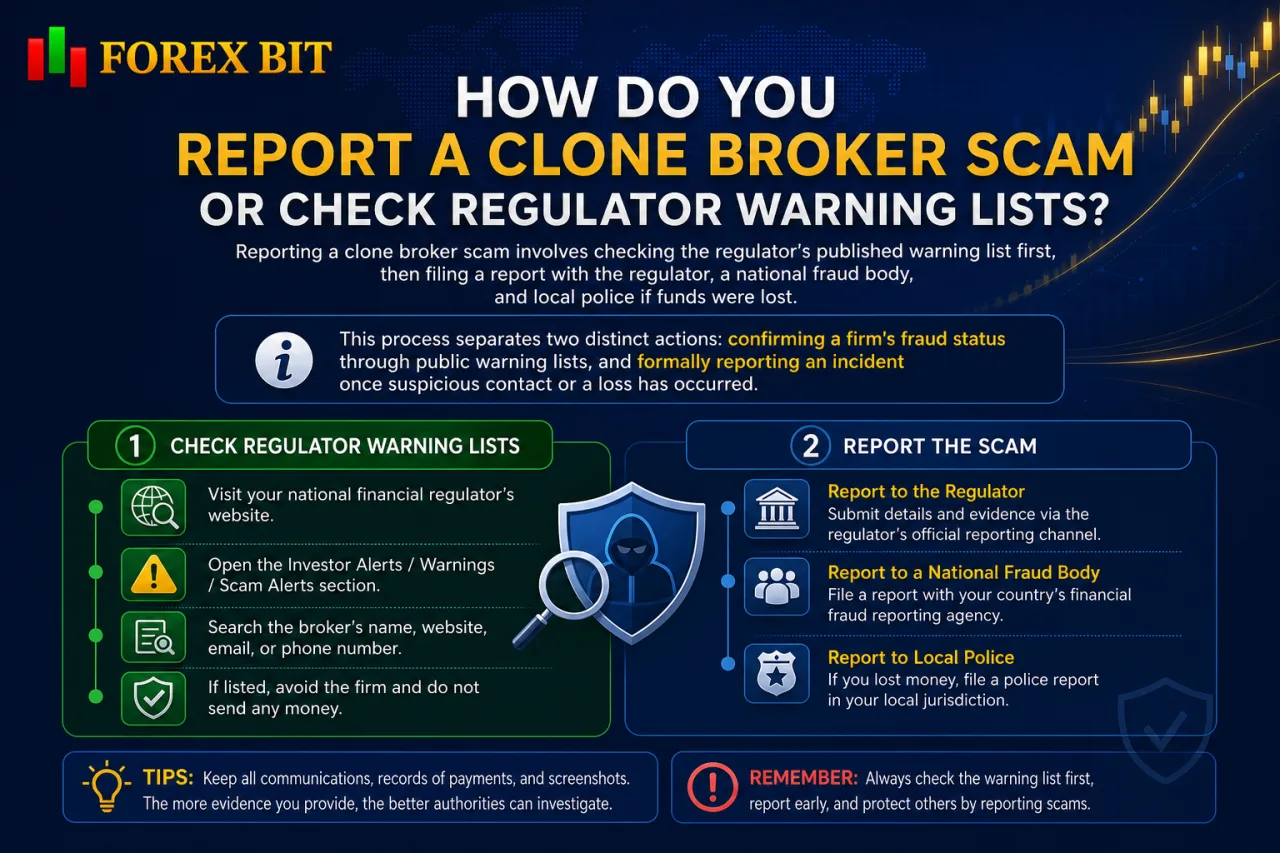
Reporting a clone broker scam involves checking the regulator’s published warning list first, then filing a report with the regulator, a national fraud body, and local police if funds were lost. This process separates two distinct actions: confirming a firm’s fraud status through public warning lists, and formally reporting an incident once suspicious contact or a loss has occurred.
Before filing any report, checking the relevant regulator’s warning list confirms whether a firm has already been flagged as a clone or unauthorized entity. Most major regulators maintain a dedicated list for this purpose:
- FCA Warning List (UK): a searchable database of firms the FCA has identified as unauthorized or as clones of genuine licensed brokers.
- ASIC’s Moneysmart (Australia): publishes alerts and a company/investment checker covering scam and unlicensed operators.
- CySEC warnings (Cyprus): lists firms found to be operating without proper authorization or impersonating regulated entities.
These national lists are not isolated. Regulators share intelligence through the IOSCO alert network, which aggregates warnings from member authorities worldwide, making it possible to cross-check a suspicious broker against multiple jurisdictions rather than a single country’s list alone.
Once a clone broker is confirmed or funds have already been lost, the next step shifts from checking to reporting. In the UK, this means filing a report with Action Fraud, notifying the FCA directly, and contacting local police or a financial crime unit if money was transferred. Other jurisdictions have equivalent fraud-reporting bodies alongside their financial regulator.
What Should You Do If You Already Sent Money to a Suspected Clone Broker?
If money already went to a suspected clone broker, the immediate priority is stopping any further transfer while contacting the bank or card issuer to request a chargeback or payment recall. Acting on this before any other step limits additional losses while a formal fraud process gets underway.
Recovering funds sent to a clone broker follows several linked actions rather than one single fix.
- Halting all further deposits or transfers requested by the broker, including any “fee” to unlock a withdrawal.
- Contacting the bank or card issuer immediately to report the transaction as fraudulent and request a chargeback or SWIFT recall.
- Collecting evidence such as emails, screenshots of the trading platform, transaction receipts, and call or chat logs before the site disappears.
- Filing a formal report with the relevant regulator and a national fraud reporting body, referencing the collected evidence.
- Avoiding any “fund recovery” firm that contacts victims afterward and demands an upfront fee to retrieve lost money, since this pattern matches a well-documented secondary scam targeting people who already lost funds once.
Following these steps in order preserves the strongest possible case for a chargeback or regulatory investigation.
What Are the Warning Signs That Indicate You Might Be Dealing With a Clone Broker?
Warning signs of a clone broker fall into several behavioral categories beyond a license mismatch: unsolicited outreach, pressure tactics, unusual payment demands, a newly registered domain, unrealistic return promises, and withdrawal obstruction. These indicators surface earlier in the relationship than a formal register check, often during the first contact or the first deposit request.
The main patterns to watch for include:
- Unsolicited contact through social media, messaging apps, or cold calls from someone claiming to represent a well-known broker.
- Pressure to deposit funds quickly, often paired with a limited-time bonus or a “closing window” excuse.
- Requests to pay through cryptocurrency or bank transfer to a personal account instead of the broker’s corporate account.
- Promises of guaranteed high returns or “risk-free” trading results.
- Unexpected fees or conditions demanded before a withdrawal is processed.
The categories below break down each pattern separately, since a single red flag rarely confirms a scam but a combination strongly does.
How Does Domain Age or Website History Help Detect a Clone Broker?
A WHOIS lookup tool exposes a clone broker by revealing the domain’s actual registration date, registrant location, and hosting history, which frequently contradicts the firm’s claimed founding year. This check addresses a technical verification method that operates independently of any register cross-check already covered.
Running a domain through a WHOIS lookup service returns the exact creation date of that domain, the registrar handling it, and sometimes the country where it was registered. A broker claiming decades of regulated operation while its domain shows a registration date from only a few months prior signals a clone impersonating an established firm.
- Checking the domain creation date against the founding year the broker advertises on its website.
- Noting the registrant’s listed country, since it frequently does not match the regulator’s jurisdiction the broker claims.
- Reviewing hosting history tools for prior domain ownership changes or a history of redirects tied to other flagged sites.
A newly created domain paired with claims of long-standing regulated status forms one of the clearer technical mismatches available to a trader checking a suspicious broker before depositing funds.
Conclusion
A clone broker survives only on the assumption that a familiar name, logo, or license number is enough proof of legitimacy. That assumption breaks down the moment a trader cross-checks the firm name, registered address, domain, and license number against the regulator’s own public register rather than trusting anything the broker’s website or unsolicited outreach provides.
Combining this register check with a WHOIS domain lookup and independently sourced regulator contact details closes off the exact gaps clones exploit. Spotting a fake broker before depositing funds ultimately depends on verifying every detail separately, since no single matching field, including the license number itself, confirms authenticity on its own.
As a Financial Blogger with 5 years of experience, I focus on delivering in-depth market insights, investment strategies, and personal finance advice. My content has helped a diverse audience navigate the complexities of financial planning and stay informed about the latest trends in the financial world.
Email: [email protected]

Best Brokers

Trade with the world’s largest retail broker and benefit from better - than - market conditions.

We offer a superior trading environment that puts traders in the best position to profit.

Trade with the best trading conditions. WIN THE BEST TRADING ACCOUNT AWARD.

Trade global markets with Interactive Brokers – a highly regulated multi-asset broker built for active and professional investors.






Forex Bit provides in-depth analysis of commodities, forex, and stock markets to help traders make informed investment decisions.
Best Brokers
Metatrader 5 Brokers
Metatrader 4 Brokers
Lowest Spread Forex Broker
Regulated Forex Brokers
Forex Copy Trading
Ctrader Brokers
Best Forex Broker For Beginners