
Learn how to calculate forex trading costs step by step—spread, commission, swaps—with real examples to estimate your true trading expenses.
How to Calculate Forex Trading Costs: Trader’s Guide

Total forex trading costs are calculated by adding the spread cost, any commission charged per lot, and swap or overnight fees accrued for holding a position open. Each component applies differently depending on the account type and broker pricing model, and combining all three gives the true cost of a trade rather than just the quoted spread.
Spread cost is the difference between the bid and ask price built into the trade, while commission is a separate fixed fee charged per lot or per round turn. Raw or ECN accounts typically carry lower spreads plus a commission, whereas standard accounts often bundle the cost entirely into a wider spread.
Swap fees are generally calculated by multiplying the swap rate for the currency pair by the number of lots traded and the number of nights the position stays open. Rates differ for long and short positions and can turn negative or positive depending on the interest rate differential between the two currencies.
The combined spread and commission cost of trading 1 standard lot of EUR/USD varies by broker and account type, and this figure sits on top of any swap charges applied for overnight holding. This figure varies by broker pricing structure and account type, making a step-by-step calculation essential for accurate cost estimation. Forex Bit breaks down each element of this calculation below, starting with the full method for determining total forex trading costs.
How to Calculate Total Forex Trading Costs?
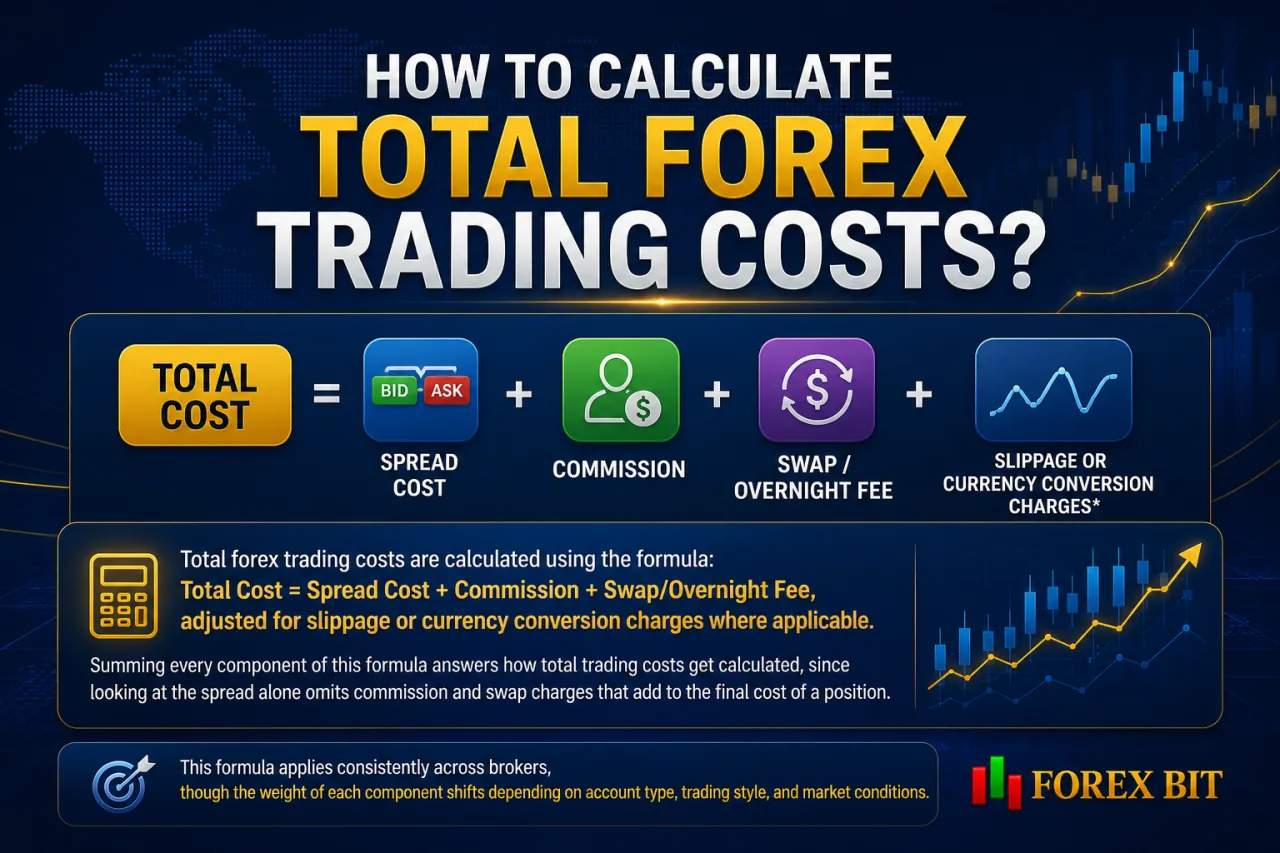
Total forex trading costs are calculated using the formula: Total Cost = Spread Cost + Commission + Swap/Overnight Fee, adjusted for slippage or currency conversion charges where applicable. Summing every component of this formula answers how total trading costs get calculated, since looking at the spread alone omits commission and swap charges that add to the final cost of a position.
This formula applies consistently across brokers, though the weight of each component shifts depending on account type and pricing structure. A raw or ECN account leans more heavily on the commission line, while a standard account concentrates most of the cost inside the spread figure. Swap fees add to the total only when a position remains open past the daily rollover cutoff, and slippage or conversion fees apply in specific execution or currency-mismatch scenarios rather than on every trade.
The subsections that follow break down each of these components individually, using this formula as the consistent framework for calculating spread cost, commission, and swap fees separately before combining them into a total figure.
What Are the Main Components of Forex Trading Costs?
Forex trading costs contain five main components: spread, commission, swap/rollover fee, currency conversion charge, and deposit/withdrawal fee. Grouping these elements by function separates the core trading costs from the secondary charges that apply only in specific scenarios.
- Spread: the built-in gap between the bid and ask price, charged on every trade regardless of account type.
- Commission: a separate fixed fee charged per lot or per round turn, mainly on raw/ECN account structures.
- Swap/rollover fee: an overnight charge or credit applied when a position stays open past the daily rollover cutoff, calculated from the interest rate differential between the two currencies in the pair.
- Currency conversion fee: a charge applied when the account’s base currency differs from the currency pair traded, converting profit, loss, or margin figures at an added rate.
- Deposit/withdrawal fee: a non-trading charge some brokers or payment providers apply on funding or withdrawing account balances.
Spread and commission form the direct cost of entering a trade, while swap applies only on positions held overnight. Currency conversion and deposit/withdrawal fees sit outside the core spread-commission-swap formula but still reduce net trading results when they apply.
How to Calculate Spread Cost Step by Step?
Spread cost is calculated step by step using the formula: Spread Cost = Spread (in pips) x Pip Value x Lot Size, applied per trade before adding any commission. This formula turns the quoted spread into an actual dollar figure rather than an abstract pip count, answering how the spread cost of a trade gets worked out.
The calculation runs through three inputs. The spread figure comes from the broker’s quoted bid-ask difference for the pair at the time of entry, the pip value depends on the currency pair and account currency, and the lot size determines how much that pip value gets multiplied by.
A worked example on a standard lot of EUR/USD illustrates the formula directly:
- Spread: a typical EUR/USD spread of 1.0 pip on a standard account, though the exact figure varies by broker and market conditions.
- Pip value: on a standard lot (100,000 units) of EUR/USD, a one-pip move is generally worth about $10, though the exact amount can shift slightly with exchange rate fluctuations.
- Lot size: 1 standard lot (100,000 units).
- Result: 1.0 pip x $10 = $10 spread cost per round turn.
On a raw or ECN account, a narrower spread of 0.1 to 0.3 pips typically applies, though a per-lot commission still applies on top.
How to Calculate Commission Cost per Trade?
Commission cost per trade is calculated using the formula: Commission = Rate per Lot x Number of Lots x 2, since most ECN/Raw accounts charge the fee on both the opening and closing side of a round turn. This structure sits alongside the spread cost covered above, adding a fixed per-lot charge rather than folding the cost into the price quote.
Raw and ECN account types typically publish a flat rate per standard lot, charged once on entry and again on exit. A trade of 1 standard lot at a broker rate of $3.50 per side works out as follows:
- Rate: $3.50 per lot per side.
- Lots traded: 1 standard lot.
- Round turn multiplier: 2 (entry and exit).
- Result: $3.50 x 1 x 2 = $7.00 total commission.
Commission rates vary by broker, and Raw/ECN accounts generally charge a per-lot round-turn fee on top of the tighter spread. Standard accounts generally skip this separate line item, since the fee gets absorbed into a wider spread instead. Multi-lot trades scale the same formula linearly, so 5 standard lots at the same rate produce a commission of $35.00 for that single round-turn position.
How to Calculate Swap/Overnight Fees for Holding Positions?
Swap fees are calculated using the formula: Swap = (Interest Rate Differential x Lot Size) / 365 x Number of Nights, then converted into the swap rate per lot the broker publishes for that pair. This calculation continues directly from the commission formula covered above, adding the final component needed for a complete cost picture on any position held past the daily rollover cutoff.
Brokers typically quote a swap rate per lot in points or account currency for both long and short sides of a pair, sparing traders from computing the interest rate differential manually on every trade. Many brokers charge triple swap on a specific day of the week, often Wednesday, to account for the weekend settlement cycle, effectively tripling the overnight fee for that single night.
A worked example on 1 standard lot of EUR/USD held overnight applies the published swap rate directly:
- Swap rate: -$5.50 per lot for a long EUR/USD position, as quoted by the broker.
- Lot size: 1 standard lot (100,000 units).
- Nights held: 1 night.
- Result: -$5.50 x 1 = -$5.50 overnight charge for the trade.
On a night that crosses the Wednesday triple-swap rollover, the same position carries the charge for 3 nights instead of 1, giving -$5.50 x 3 = -$16.50 for that rollover.
This swap figure adds directly onto the combined spread and commission cost from the earlier calculations to reach the full holding cost of the position.
Spread Cost vs Commission Cost: What Is the Difference?
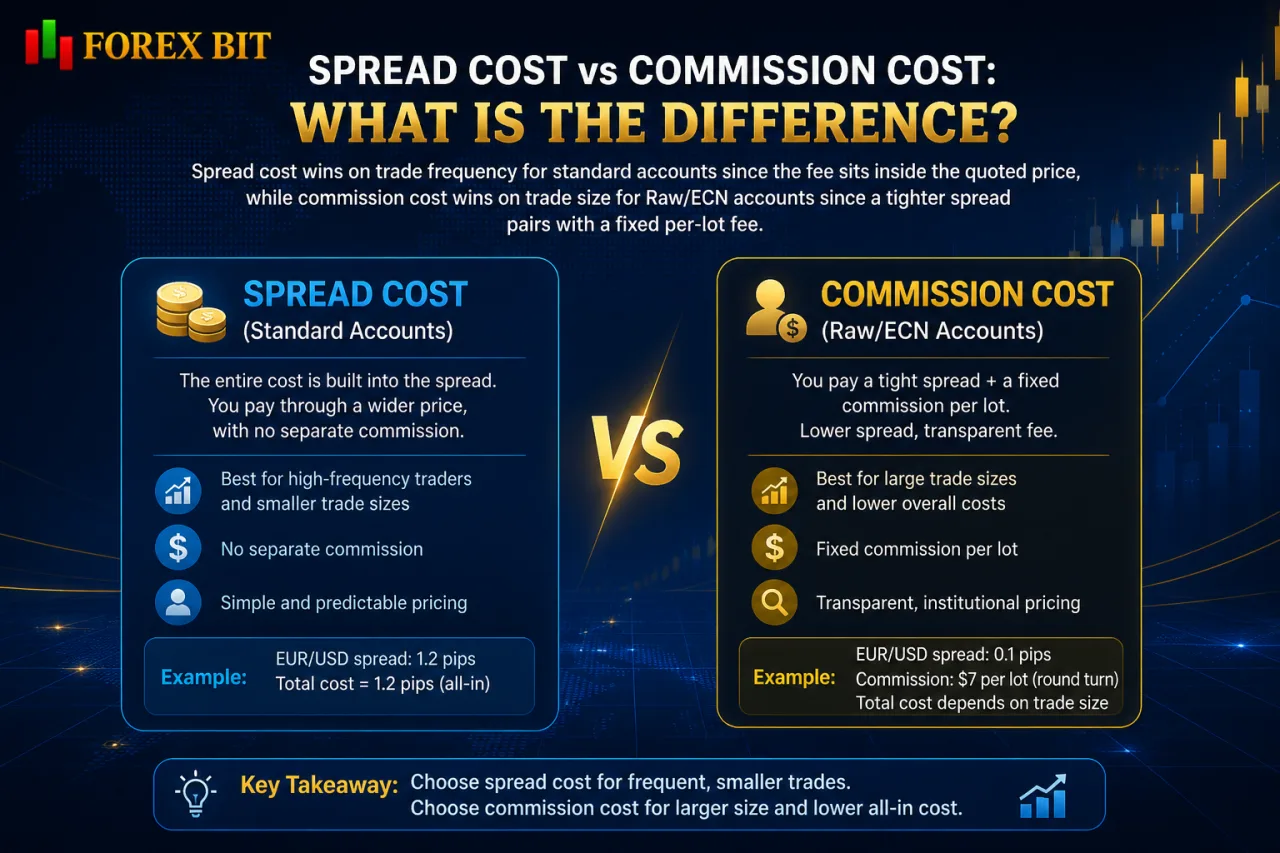
Spread cost wins on trade frequency for standard accounts since the fee sits inside the quoted price, while commission cost wins on trade size for Raw/ECN accounts since a tighter spread pairs with a fixed per-lot fee. This spread-versus-commission comparison continues directly from the swap calculation covered above, splitting the two pricing models that make up the front-end cost of any position before overnight charges apply.
A standard account bundles the entire cost into the spread, so no separate line item appears on the trade confirmation regardless of how many lots get traded. A Raw or ECN account narrows that spread significantly but adds a fixed commission per lot, charged on both the opening and closing side of the round turn.
The following subsections break down when each pricing model produces a lower total cost, comparing scenarios by trade size and trading frequency using the spread and commission formulas established earlier in this guide.
Which Pricing Model Is Cheaper for Different Trading Styles?
The spread-only model favors scalpers and high-frequency day traders on very short holding periods, while the spread+commission model favors swing traders and lower-frequency traders who value tighter pricing per trade over round-turn fees. This trader-style comparison builds on the spread-versus-commission split covered above, matching each pricing model to the trading frequency where it produces the lower total cost.
A scalper executing many trades per session accumulates commission charges quickly under a Raw/ECN model, since each round turn adds a fixed fee regardless of how briefly the position stays open. A swing trader placing fewer trades per week absorbs that same fixed commission across a larger price move, making the tighter spread the dominant cost advantage rather than a disadvantage.
A small comparison table illustrates typical combinations across styles:
| Trading Style | Spread-Only Model | Spread+Commission Model |
|---|---|---|
| Scalper (many trades/day) | Wider spread, no per-lot fee | Tighter spread, commission adds up fast |
| Day trader (several trades/day) | Moderate spread cost per trade | Lower spread offset by moderate commission total |
| Swing trader (few trades/week) | Spread cost spread over fewer trades | Tighter spread with minimal commission impact |
Day traders sit in a middle position, where the better model depends on the exact spread gap and commission rate a broker publishes for that account type.
How Much Does It Cost to Trade 1 Standard Lot of EUR/USD?
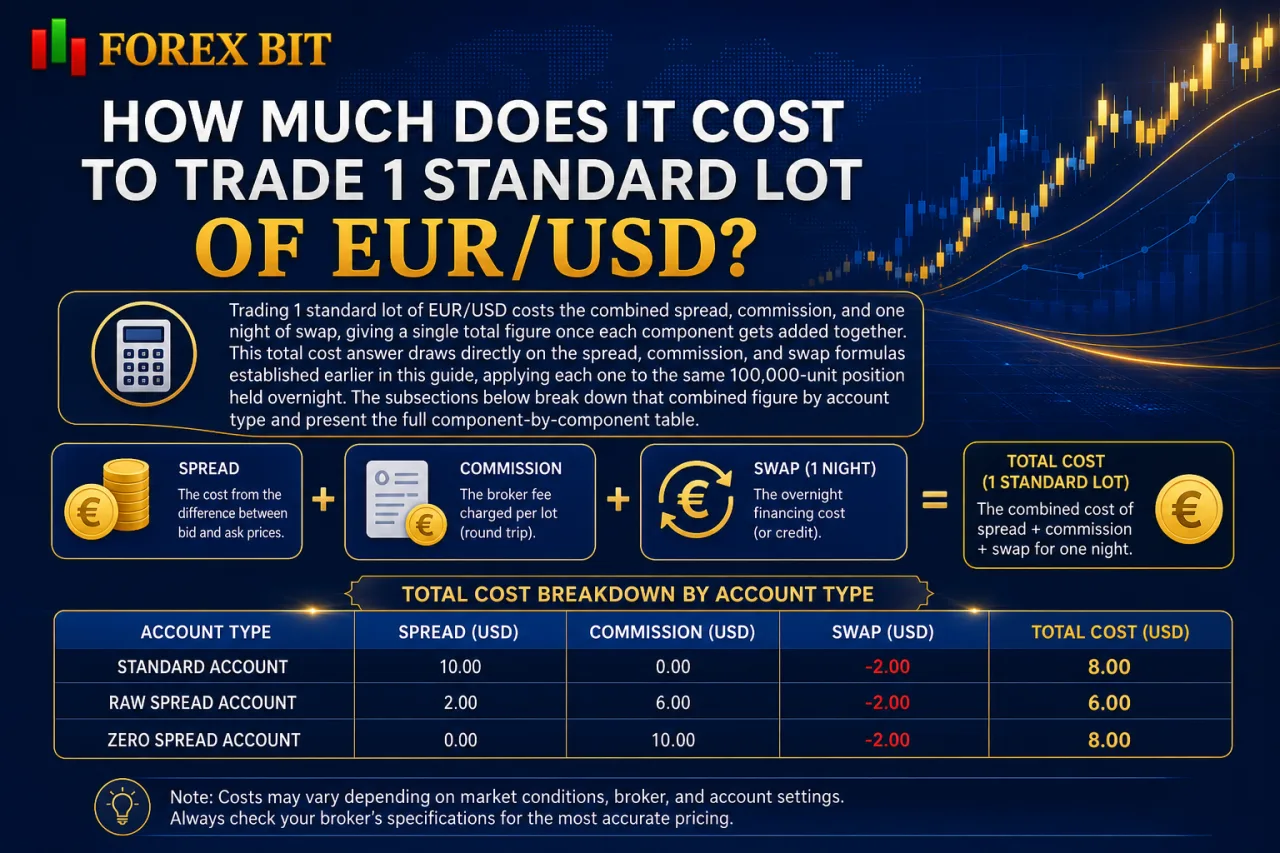
Trading 1 standard lot of EUR/USD costs the combined spread, commission, and one night of swap, giving a single total figure once each component gets added together. This total cost answer draws directly on the spread, commission, and swap formulas established earlier in this guide, applying each one to the same 100,000-unit position held overnight. The subsections below break down that combined figure by account type and present the full component-by-component table.
The table below breaks down each cost component in USD for a 100,000-unit EUR/USD position held overnight, following the formulas explained earlier in this guide.
| Cost Component | Amount (USD) |
|---|---|
| Spread Cost | Calculated from the pip spread times the pip value |
| Commission | Charged per lot according to the broker’s fee schedule |
| Swap Fee | Applied once for the overnight position, positive or negative depending on the direction of the trade |
| Total Cost | Sum of spread cost, commission, and swap fee |
Actual dollar figures shift with the live spread, the broker’s commission rate, and the prevailing swap rate at the time of the trade. Traders get an accurate total by pulling these three inputs from their own broker platform and applying them to the formulas above.
What Factors Cause This Cost Estimate to Vary?
This cost estimate varies based on four main factors: broker/account type, market volatility and liquidity hours, holding period, and interest rate changes affecting swap. Each factor shifts one line item in the spread-commission-swap formula rather than the calculation method itself, so the total figure moves up or down without changing how it gets derived.
- Broker/account type: a standard account bundles cost into a wider spread while a Raw/ECN account splits the same cost into a tighter spread plus a fixed commission per lot.
- Market volatility and liquidity hours: spreads widen during low-liquidity periods or high-impact news releases and narrow during peak trading hours when major sessions overlap.
- Holding period: swap fees accrue for each additional night a position stays open, and the Wednesday triple-swap rollover multiplies that overnight charge for the trades that cross it.
- Interest rate changes: shifts in the interest rate differential between the two currencies in a pair adjust the published swap rate, changing the overnight cost or credit on the same position over time.
These variables interact rather than apply in isolation, compounding into one final total that reflects the specific conditions of each trade.
What Hidden or Rare Costs Can Affect Your Total Trading Expenses?
Hidden or rare costs affecting total trading expenses fall into three main groups: inactivity fees, deposit/withdrawal charges, and currency conversion fees, each sitting outside the core spread-commission-swap formula covered earlier. These charges move away from the per-trade cost calculations established above, applying instead to account behavior and funding rather than to the act of opening or holding a position. The subsections that follow break down each of these three cost types individually.
How Does Currency Conversion Fee Impact Trading Cost?
Currency conversion fees raise trading cost by applying a small percentage markup whenever profit, loss, or deposit currency differs from the account’s base currency. This conversion charge sits outside the spread-commission-swap formula covered earlier, adding a cost layer specifically tied to currency mismatches rather than to the act of opening or holding a position.
Brokers typically apply a markup on the prevailing exchange rate when converting funds, and this rate gets built into the conversion rather than shown as a separate line item.
A brief calculation example illustrates the impact: a trader with a USD-denominated account profits $500 EUR/GBP, and that profit converts back to USD at the daily exchange rate plus the broker’s markup, reducing the final credited amount by a small percentage compared to the raw market rate. The same markup applies in reverse on deposits or withdrawals made in a currency other than the account’s base currency, quietly compounding the total cost of holding an account with a currency mismatch.
Are There Extra Charges Like Inactivity or Withdrawal Fees?
Yes, extra charges like inactivity and withdrawal fees apply on top of spread, commission, and swap costs, though they only trigger under specific account conditions rather than on every trade. This question follows directly from the currency conversion fee covered above, adding the remaining non-trading charges that sit outside the core spread-commission-swap formula.
Inactivity fees typically activate after an account shows no trading activity for a set period, deducting a fixed amount from the balance on a recurring basis until a trade reopens the account or the balance reaches zero. Withdrawal fees depend on the payment method selected, with bank wire transfers more likely to carry a flat charge than e-wallet or card withdrawals, which some brokers process free of charge. Exact inactivity periods and fee amounts vary by broker, so verifying the current schedule directly from the broker’s fee page remains the only reliable way to confirm the figures before opening an account.
These charges count toward the total cost of ownership of an account even though they sit apart from the per-trade cost calculations covered earlier in this guide.
Conclusion
Calculating true forex trading costs comes down to a single formula applied consistently: spread cost plus commission plus swap, adjusted for occasional conversion or non-trading charges. Standard accounts fold cost into the spread, Raw/ECN accounts split it between a tighter spread and a per-lot fee, and swap adds an overnight layer that shifts with the interest rate differential and account type.
Hidden charges like inactivity, withdrawal, and currency conversion fees sit outside this core formula but still affect total account cost. Applying each step above to a specific trade gives a trader the actual dollar cost of that position, rather than an incomplete figure based on the spread alone.
Isabella Brown is the Forex Trading Guide Manager at Forex Bit, focusing on educational content about broker safety, trading costs, account types, platforms, and key Forex/CFD concepts. Her work helps readers understand trading terms, broker conditions, and practical checks before evaluating or using a brokerage service.
Email: [email protected]


Best Brokers

Trade with the world’s largest retail broker and benefit from better - than - market conditions.

We offer a superior trading environment that puts traders in the best position to profit.

Trade with the best trading conditions. WIN THE BEST TRADING ACCOUNT AWARD.

Trade global markets with Interactive Brokers – a highly regulated multi-asset broker built for active and professional investors.






Forex Bit provides independent forex broker reviews, comparisons, guides, and industry news to help traders make informed decisions.
Best Brokers
Metatrader 5 Brokers
Metatrader 4 Brokers
Lowest Spread Forex Broker
Regulated Forex Brokers
Forex Copy Trading
Ctrader Brokers
Best Forex Broker For Beginners