
IC Markets vs Pepperstone compared: raw ECN spreads, commissions, and MT4/MT5/cTrader platforms—find out which suits your trading style.
IC Markets vs Pepperstone: ECN Pricing & Platforms 2026

IC Markets and Pepperstone both target ECN-style traders, but they differ in raw spreads, commission structure, and platform depth. These differences directly affect trading costs for high-frequency and algorithmic strategies.
IC Markets advertises tighter raw spreads on its ECN account, while Pepperstone applies a comparable commission model on its Razor account. The actual cost gap depends on traded volume, instrument, and account currency.
IC Markets supports MT4, MT5, and cTrader, while Pepperstone offers MT4, MT5, cTrader, and TradingView integration. This platform range shapes execution speed and automation options for different trader types.
Pepperstone stands out for its TradingView integration, while IC Markets offers deep liquidity suited to cTrader algorithmic trading. Scalpers and algo traders weigh execution speed against platform flexibility when choosing between the two.
Forex Bit breaks down these ECN pricing and platform differences in detail below, starting with which broker wins on overall ECN pricing and platforms in 2026. Traders are advised to confirm current platform availability directly with each broker before opening an account.
IC Markets vs Pepperstone: Which Broker Wins on ECN Pricing and Platforms in 2026?
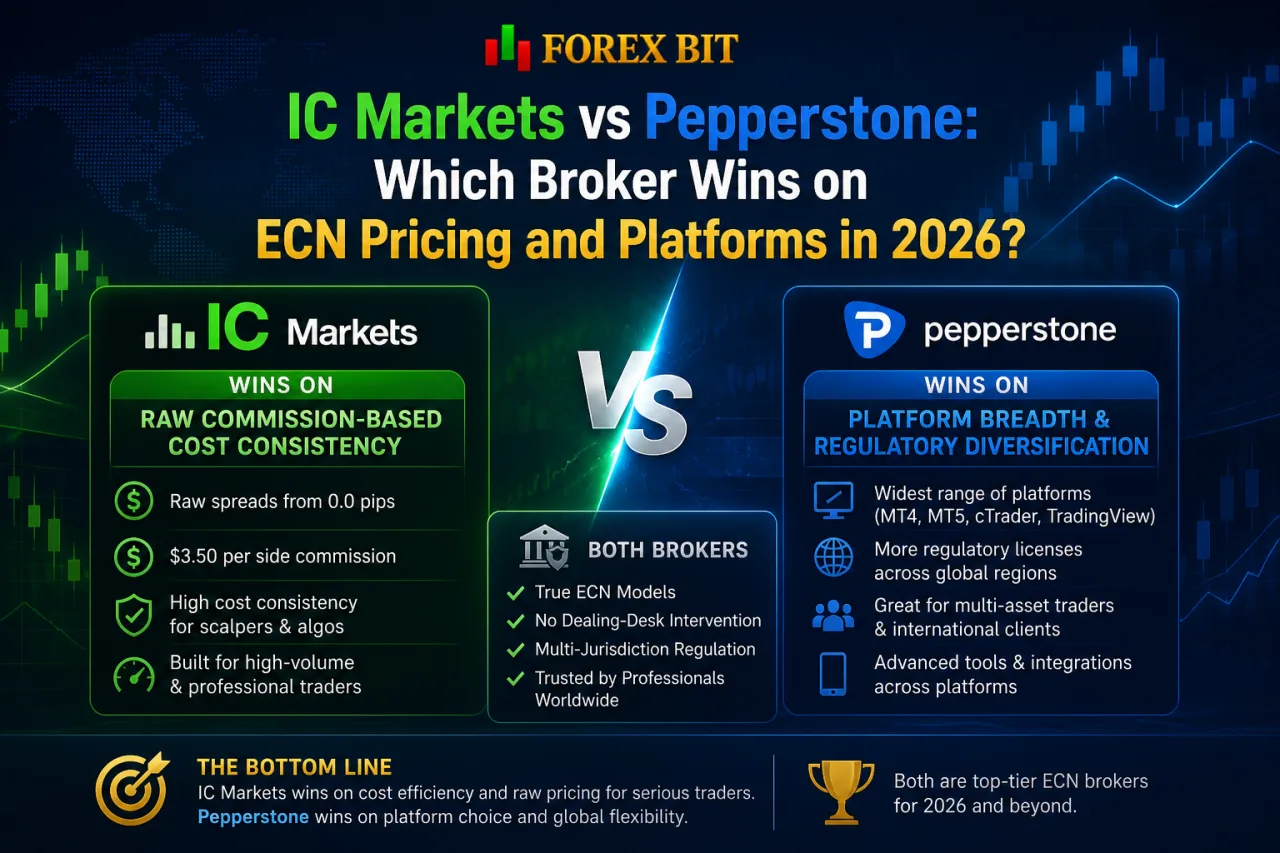
IC Markets wins on raw commission-based cost consistency. Pepperstone wins on platform breadth and regulatory diversification. Both brokers operate true ECN models with no dealing-desk intervention, positioning them for scalpers, algo traders, and high-volume accounts rather than casual retail traders.
IC Markets and Pepperstone are both regulated brokers holding licenses across multiple jurisdictions, giving traders access to regulated entities depending on their region of residence, though traders should verify current licensing status directly with each broker or its relevant regulator before opening an account. This regulatory overlap means neither broker holds a clear safety advantage on paper, though jurisdiction-specific investor protections differ.
The table below previews core differences before a deeper breakdown of each factor.
| Factor | IC Markets | Pepperstone |
|---|---|---|
| ECN spreads | Raw spreads from near-zero, paired with a per-lot commission on the Raw account | Raw spreads from near-zero, paired with a per-lot commission on the Razor account |
| Commission | Per-lot fee on Raw account | Per-lot fee on Razor account |
| Platforms | MT4, MT5, cTrader | MT4, MT5, cTrader, TradingView |
| Regulation | Licensed under ASIC and CySEC, with additional entities under FSA and FSCA depending on region | Licensed under ASIC and FCA, with additional entities under CySEC and FSA depending on region |
| Best for | cTrader algo trading | TradingView-based execution |
Traders prioritizing chart-based execution tools lean toward Pepperstone, while those focused on algorithmic liquidity access favor IC Markets.
Which Broker Offers Lower ECN Spreads and Commissions, IC Markets or Pepperstone?
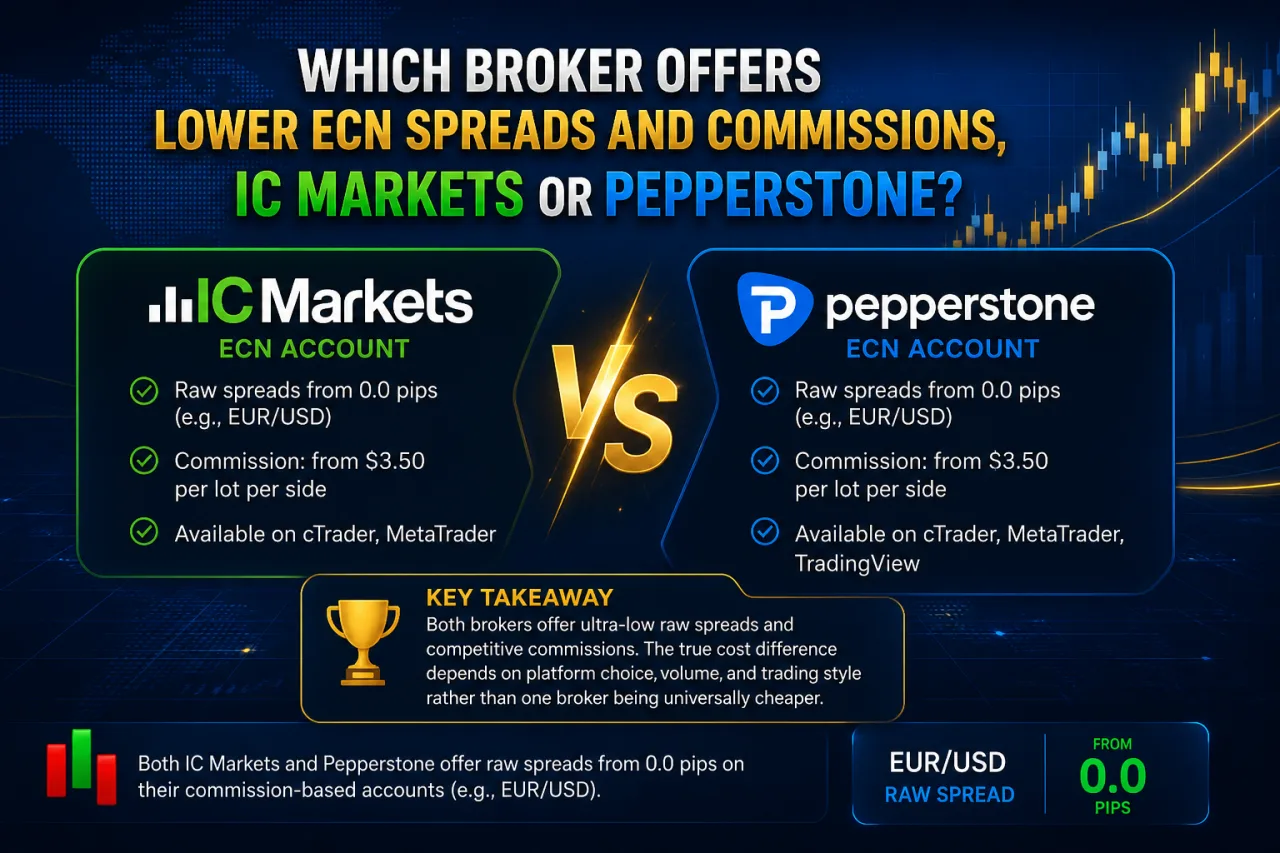
IC Markets and Pepperstone both price ECN accounts on raw spreads plus a per-lot commission, with the effective cost gap depending on the exact platform and volume traded rather than one broker being universally cheaper. This pricing structure applies across their flagship ECN-style accounts, though the commission and platform combination differs enough to affect scalpers and algo traders differently.
Both brokers advertise EUR/USD raw spreads from 0.0 pips on their commission-based accounts, so the real distinction sits in per-lot fees and platform-specific rates. IC Markets charges a per-lot commission on its Raw Spread account, while Pepperstone applies a comparable per-lot commission on its Razor account, though traders should confirm current rates directly with each broker before opening an account.
cTrader accounts on both brokers may carry a different commission structure than the MT4/MT5 Raw and Razor accounts. IC Markets and Pepperstone both offer cTrader accounts, and commission rates on these accounts can differ from their MT4/MT5 counterparts, so traders should confirm current cTrader commission rates directly with each broker before opening an account.
Effective all-in cost across majors ultimately depends on execution quality, account currency, and traded volume tiers at each broker.
How Do Standard (No-Commission) Account Spreads Compare Between IC Markets and Pepperstone?
IC Markets’ Standard account and Pepperstone’s Standard account both build spreads into the price with no separate commission, and average spreads on this account tier can vary between the two brokers, so traders should confirm current spread figures directly with each broker before opening an account.
Both accounts fold liquidity provider costs into a marked-up spread rather than charging a per-lot fee, which matters for traders comparing all-in pricing between IC Markets and Pepperstone.
- IC Markets prices its Standard account through MT4 and MT5 with variable markup spreads and no added commission.
- Pepperstone prices its Standard account through MT4 and MT5 with a similar variable markup model and no added commission.
- Neither broker’s Standard account offers cTrader access, unlike their respective Raw and Razor commission-based accounts.
Traders avoiding separate commission line items favor either Standard account for simplicity, though the wider embedded markup makes both less cost-efficient than the Raw or Razor accounts for high-volume or scalping strategies. Casual and lower-frequency traders generally find the Standard account structure easier to track since the quoted spread already reflects the full trading cost.
Do IC Markets and Pepperstone Charge the Same Commission Across All ECN Platforms?
No, IC Markets and Pepperstone do not charge the same commission across all ECN platforms, since each broker applies a separate per-lot rate to its MT4/MT5 Raw or Razor account versus its cTrader account. This platform-based split matters directly for the commission consistency question raised above.
Both brokers structure pricing around the underlying trading platform rather than a single flat fee applied uniformly.
- IC Markets sets one per-lot commission for its Raw Spread account on MT4 and MT5, and a separate rate for its cTrader account.
- Pepperstone sets one per-lot commission for its Razor account on MT4 and MT5, and a separate rate for its cTrader account.
- Neither broker publishes a unified commission figure that applies identically across MT4, MT5, and cTrader.
Traders should confirm current per-lot commission rates for each platform directly with IC Markets or Pepperstone before opening an account, since these figures are subject to change.
Scalpers and algo traders running strategies on cTrader compare that specific rate rather than the MT4/MT5 Raw or Razor figure, since assuming a single broker-wide commission risks miscalculating actual trading costs.
What Trading Platforms Does Each Broker Support: MT4, MT5, cTrader, or TradingView?
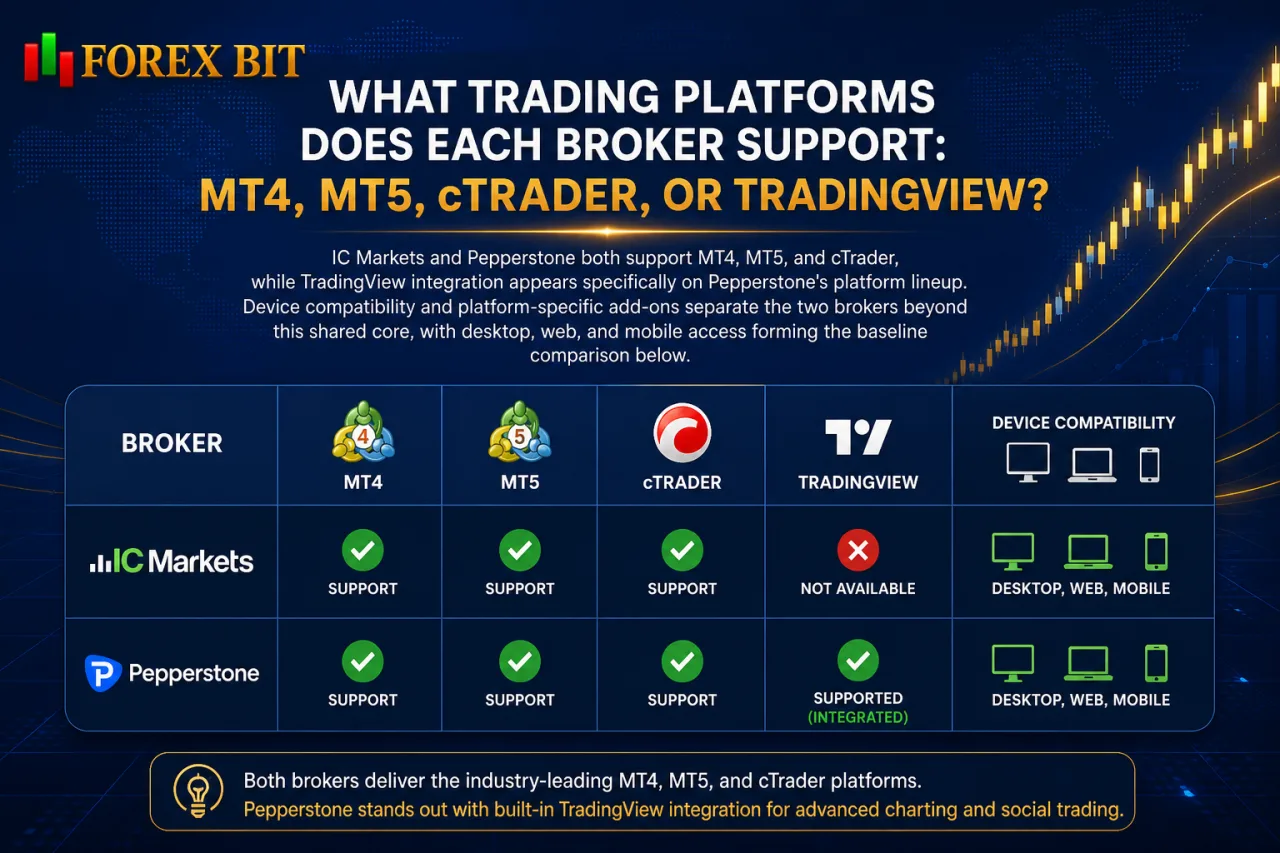
IC Markets and Pepperstone both support MT4, MT5, and cTrader, while TradingView integration appears specifically on Pepperstone’s platform lineup. Device compatibility and platform-specific add-ons separate the two brokers beyond this shared core, with desktop, web, and mobile access forming the baseline comparison below.
Is cTrader Available at Both IC Markets and Pepperstone?
Yes, cTrader is available at both IC Markets and Pepperstone, though account conditions, execution depth, and commission rates differ between the two. This shared availability matters for algo traders and scalpers weighing cTrader specifically rather than MT4 or MT5.
Both brokers run cTrader as a separate account type from their standard MT4/MT5 Raw and Razor offerings, with pricing and technical specifications set independently for that platform.
- IC Markets provides cTrader with its own raw spread and per-lot commission structure, distinct from its MT4/MT5 Raw Spread account.
- Pepperstone provides cTrader with its own raw spread and per-lot commission structure, distinct from its MT4/MT5 Razor account.
- Depth-of-market visibility and order execution behavior on cTrader can vary by broker liquidity setup and connectivity, so traders should confirm current execution specifications directly with each broker before opening an account.
Traders should verify current cTrader commission rates, minimum deposit, and depth-of-market features directly with IC Markets or Pepperstone before opening an account, since these details are subject to change.
Algo traders comparing execution quality on cTrader treat this as a separate evaluation from either broker’s MT4/MT5 pricing.
Which Broker Offers TradingView Integration, IC Markets or Pepperstone?
Both Pepperstone and IC Markets offer some form of TradingView integration, though the setup and account requirements differ between the two brokers. This distinction separates the two brokers on how chart-based execution is configured rather than on raw platform count alone.
Pepperstone connects eligible account types directly to TradingView’s charting interface, letting traders place and manage orders from that environment instead of relying solely on MT4, MT5, or cTrader. IC Markets also supports TradingView access, typically through its cTrader accounts, allowing traders to link charts and order execution through that route.
- Pepperstone links TradingView to live trading through supported account types, subject to region and eligibility rules confirmed directly with the broker.
- IC Markets provides TradingView access primarily via cTrader integration, alongside its native MT4, MT5, and cTrader platforms.
- Order execution through TradingView on either broker routes trades to the same underlying pricing feed used across their other platforms.
Traders should verify current TradingView eligibility, supported account types, and any regional restrictions directly with each broker before opening an account, since integration terms are subject to change.
Traders wanting to execute directly from TradingView charts find that both brokers offer a path to this workflow, though the account setup and eligibility conditions differ and are worth confirming directly with each broker before committing to one.
Which Broker Is Better for Scalping and Algorithmic ECN Trading, IC Markets or Pepperstone?
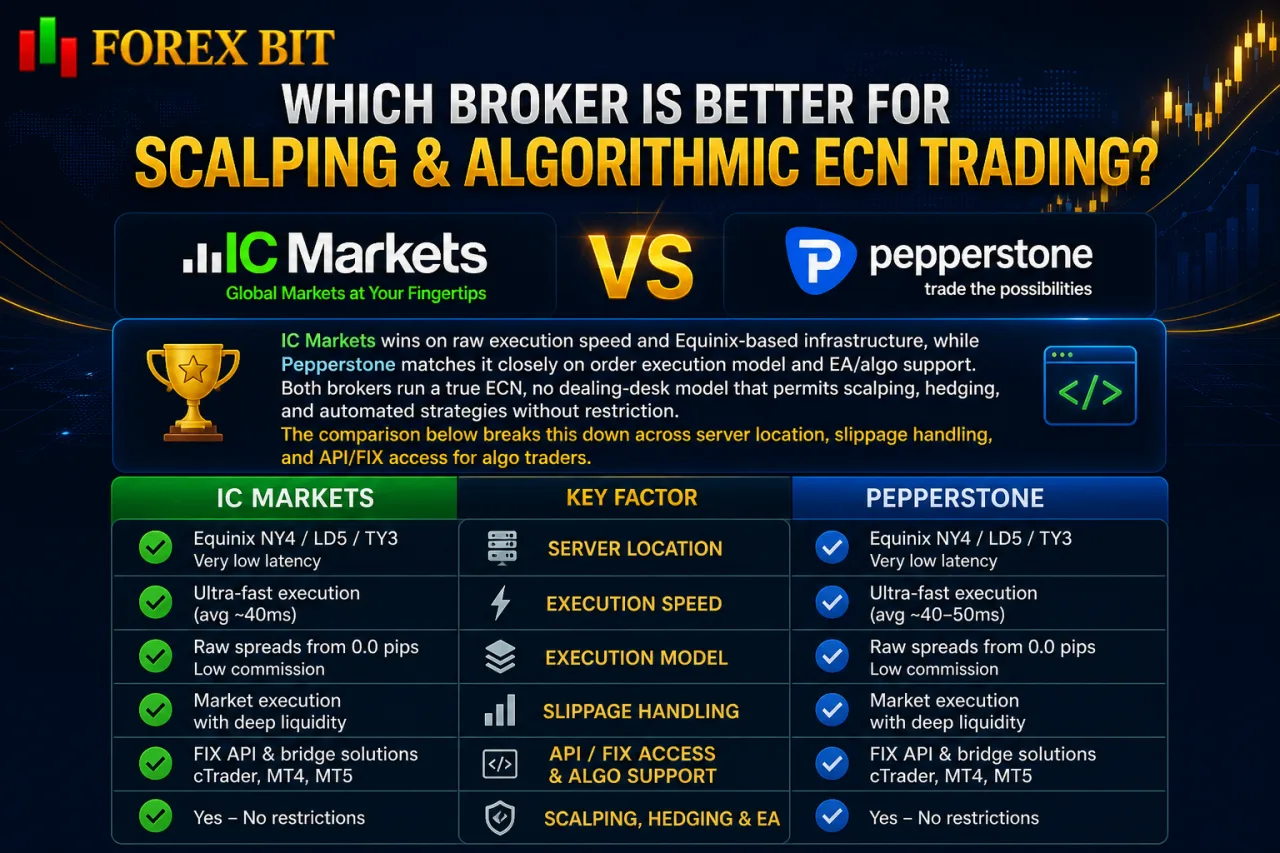
IC Markets wins on raw execution speed and Equinix-based infrastructure, while Pepperstone matches it closely on order execution model and EA/algo support. Both brokers run a true ECN, no dealing-desk model that permits scalping, hedging, and automated strategies without restriction. The comparison below breaks this down across server location, slippage handling, and API/FIX access for algo traders.
How Does Order Execution Speed Compare Between IC Markets and Pepperstone?
IC Markets and Pepperstone both promote fast execution speeds on their ECN accounts, with IC Markets highlighting its Equinix NY4 and LD5 data center placement as a factor in its execution performance, though traders should confirm current execution time figures directly with each broker before opening an account.
This execution speed gap connects directly to where each broker locates its trading servers relative to liquidity providers.
- IC Markets hosts its pricing engine and matching servers inside Equinix data centers in New York and London, placing it close to major bank liquidity feeds.
- Pepperstone also runs part of its infrastructure through Equinix data centers, though exact location parity with IC Markets’ setup should be confirmed directly with the broker.
- Both brokers aggregate pricing from multiple tier-1 banks and non-bank liquidity providers, which affects fill quality during high-volatility news events.
Traders running latency-sensitive scalping or arbitrage strategies verify current average execution time figures and server ping directly with IC Markets or Pepperstone before committing capital, since these numbers shift with liquidity conditions and infrastructure upgrades.
Do Both Brokers Allow Expert Advisors and VPS Hosting for Automated Trading?
Yes, IC Markets and Pepperstone both allow Expert Advisors and free VPS hosting for automated trading, though eligibility rules for the free VPS differ between the two brokers. This EA and VPS support connects directly to the scalping and algo trading focus already established for both brokers’ MT4, MT5, and cTrader accounts.
EA compatibility spans all three shared platforms rather than being limited to one.
- IC Markets permits automated Expert Advisors across MT4, MT5, and cTrader without restricting trading style, including scalping and hedging strategies.
- Pepperstone permits automated Expert Advisors across MT4, MT5, and cTrader with the same lack of restriction on scalping, hedging, or high-frequency EA activity.
- IC Markets offers free VPS hosting tied to a minimum monthly trading volume or account balance threshold, so traders should confirm the current eligibility requirements directly with the broker before opening an account.
- Pepperstone also offers free VPS hosting tied to its own separate eligibility criteria based on trading activity, so traders should confirm the current requirements directly with the broker before opening an account.
Traders should verify current VPS eligibility thresholds and supported EA file formats directly with IC Markets or Pepperstone before opening an account, since these criteria are subject to change. Algo traders running latency-sensitive EAs treat VPS proximity to each broker’s Equinix servers as a separate factor from platform-level EA compatibility alone.
What Additional Account Features Set IC Markets and Pepperstone Apart Beyond Core ECN Pricing?
IC Markets and Pepperstone separate further on minimum deposit thresholds, region-specific leverage caps, funding options, and copy-trading ecosystems rather than raw ECN pricing alone. These secondary differentiators shape which account fits a beginner, a regulated-region trader, or a copy-trading user before comparing the specific mechanics below.
How Do Copy Trading Options Compare Between IC Markets and Pepperstone?
Pepperstone offers access to copy trading and social trading integrations, while IC Markets supports copy trading mainly through third-party MT4/MT5 signal services and automated strategy tools. This ecosystem gap matters directly for traders choosing a broker based on copy or signal-following functionality rather than manual ECN execution.
IC Markets connects traders to copy trading through third-party platforms such as ZuluTrade and Signal Start, allowing MT4/MT5 users to follow signal providers directly within their existing trading environment. Eligibility, supported account types, and available regions vary and should be confirmed directly with the broker.
Pepperstone provides copy trading access through integrations such as cTrader Copy, Myfxbook AutoTrade, and DupliTrade, giving traders a more structured, broker-supported path into automated strategy copying. Supported platforms and regional availability differ, so details should be confirmed directly with the broker.
Traders new to automated strategy following favor Pepperstone’s more structured third-party integrations like cTrader Copy and DupliTrade, while self-directed algo traders on IC Markets rely more on MT4/MT5-native tools such as ZuluTrade and Signal Start. Exact product names and current availability vary by region and change over time, so traders should verify the specific copy trading tools offered through each broker’s official website before making a decision.
Are There Notable Differences in Minimum Deposit or Regional Leverage Limits?
Yes, IC Markets and Pepperstone show notable differences in minimum deposit figures across account types, while regional leverage limits shift for both brokers depending on whether the trading entity falls under ASIC or an offshore regulator. This deposit and leverage split ties directly into the ASIC-versus-offshore regulatory overlap already noted between the two brokers.
Minimum deposit thresholds vary by account rather than applying as one flat figure per broker.
- IC Markets sets its minimum deposit requirement per account type, and the figures differ between the Standard, Raw Spread, and cTrader accounts, so traders confirm current minimum deposit amounts directly with the broker before opening an account.
- Pepperstone sets its minimum deposit requirement per account type, and the figures differ between the Standard and Razor accounts, so traders confirm current minimum deposit amounts directly with the broker before opening an account.
- Both brokers cap retail client leverage at a lower ratio under ASIC oversight, while offshore entities of each broker permit substantially higher leverage, so traders confirm the current leverage limits directly with each broker before opening an account.
Traders should confirm current minimum deposit amounts and leverage caps directly with IC Markets or Pepperstone based on their specific regulated entity, since these figures depend on region and are subject to change. Beginners depositing smaller amounts weigh the account-specific minimum against the leverage ceiling tied to their regulator.
Conclusion
The IC Markets vs Pepperstone comparison comes down to infrastructure focus versus platform breadth. IC Markets stands out through its Equinix NY4 and LD5 server placement, favoring scalpers and algo traders who prioritize raw execution speed and cTrader liquidity depth. Pepperstone counters with a wider platform lineup, adding TradingView integration and a more structured copy trading ecosystem through DupliTrade and Smart Trader Tools.
Both brokers match closely on ECN pricing, EA support, free VPS access, and ASIC-versus-offshore leverage structures. Traders chasing execution speed and algo-friendly liquidity lean toward IC Markets, while those wanting chart-based order execution and copy trading flexibility find Pepperstone the more suitable fit.
As a Financial Analyst with over 5 years of experience, I focus on analyzing financial data to provide actionable insights and recommendations for investment strategies. My expertise in forecasting and financial modeling has helped businesses optimize their financial performance and mitigate risks.
Email: [email protected]
Best Brokers

Trade with the world’s largest retail broker and benefit from better - than - market conditions.

We offer a superior trading environment that puts traders in the best position to profit.

Trade with the best trading conditions. WIN THE BEST TRADING ACCOUNT AWARD.

Trade global markets with Interactive Brokers – a highly regulated multi-asset broker built for active and professional investors.






Forex Bit provides in-depth analysis of commodities, forex, and stock markets to help traders make informed investment decisions.
Best Brokers
Metatrader 5 Brokers
Metatrader 4 Brokers
Lowest Spread Forex Broker
Regulated Forex Brokers
Forex Copy Trading
Ctrader Brokers
Best Forex Broker For Beginners