
XM vs HFM compared: real spreads, execution speed, and account conditions side-by-side to help you pick the right broker for your trading style.
XM vs HFM: Spreads, Execution & Account Conditions

XM’s Zero account and HFM’s Zero Spread account both target low-spread trading on major pairs, though actual spreads vary by market conditions, so the better choice depends on account type and instrument traded. Execution speed and overall trading conditions also diverge enough between the two brokers to influence a trader’s final decision.
XM’s standard accounts carry no commission but wider spreads, while its Zero account charges a fixed commission per lot alongside near-raw spreads; HFM follows a similar dual structure across its account tiers, though exact commission rates should be confirmed directly with each broker as they can change over time. These structural differences directly affect total trading costs for high-frequency versus casual traders.
Execution speed and slippage on HFM’s Zero Spread and Premium accounts versus XM’s standard offerings can vary depending on market conditions, and traders should test both brokers directly during high-volatility periods to compare real execution performance. This gap becomes more noticeable for scalpers and news traders relying on precise order fills.
XM tends to require a lower minimum deposit on its Micro and Standard accounts, while HFM offers higher maximum leverage on certain account types suited to more aggressive traders; exact figures should be confirmed directly on each broker’s official website, as they can change over time. These account condition differences make each broker appeal to distinct trader profiles, from beginners to leverage-focused traders.
Forex Bit breaks down these differences in detail below, starting with a direct comparison of which broker delivers better spreads, execution, and account conditions overall.
XM vs HFM: Which Broker Offers Better Spreads, Execution, and Account Conditions?
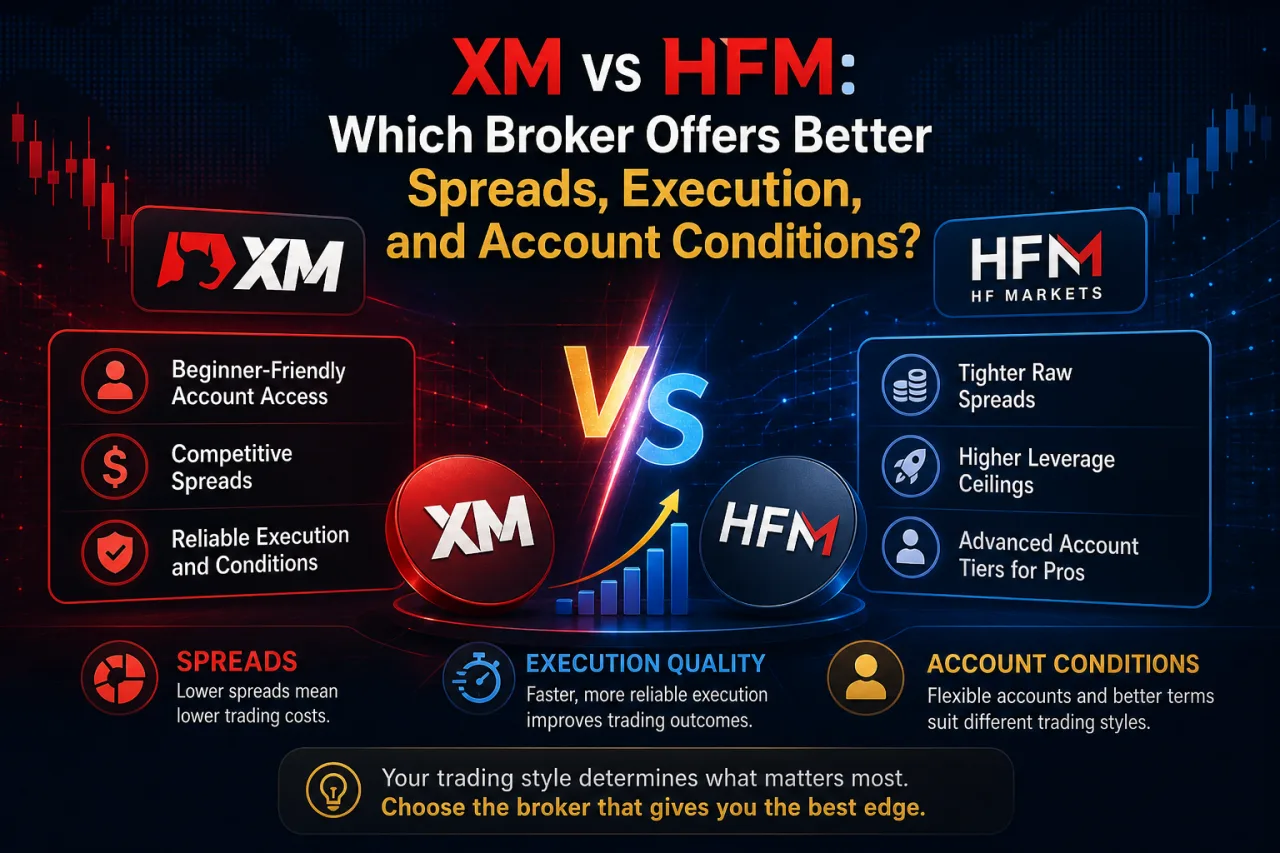
XM performs better for traders prioritizing beginner-friendly account access, while HFM edges ahead for traders seeking tighter raw spreads and higher leverage ceilings on specific account tiers. This section evaluates both brokers across the three factors that most directly affect trading costs and outcomes: spreads, execution quality, and account conditions.
Each area carries different weight depending on trading style. Spread structure shapes cost-per-trade for frequent traders, execution quality determines how reliably orders fill during volatile sessions, and account conditions such as deposit minimums and leverage define accessibility for different capital sizes. The following breakdown separates these three criteria individually rather than treating XM and HFM as a single blended comparison, since a broker’s strength in one area does not necessarily carry over to another.
How Do XM and HFM Spreads and Commissions Compare Across Account Types?
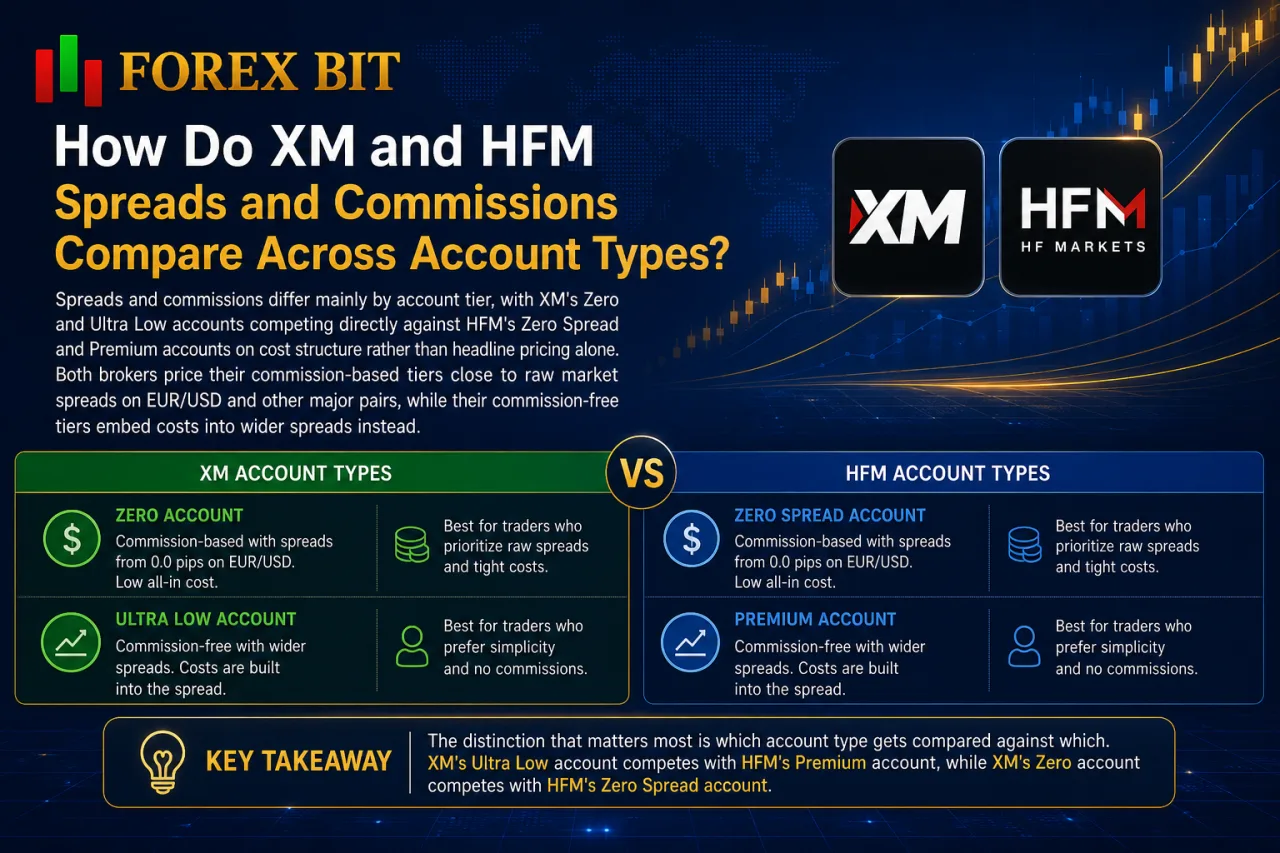
Spreads and commissions differ mainly by account tier, with XM’s Zero and Ultra Low accounts competing directly against HFM’s Zero Spread and Premium accounts on cost structure rather than headline pricing alone. Both brokers price their commission-based tiers close to raw market spreads on EUR/USD and other major pairs, while their commission-free tiers embed costs into wider spreads instead.
The distinction that matters most is which account type gets compared against which. XM’s Ultra Low account and HFM’s Premium account both use markup-only pricing without a separate commission line, making them the more relevant comparison for standard, non-ECN traders. XM’s Zero account and HFM’s Zero Spread account instead charge a fixed per-lot commission on top of near-raw spreads, positioning them for commission-based, ECN-style trading. Exact EUR/USD spread figures and per-lot commission rates for these tiers change with market conditions, so traders should confirm current numbers directly on each broker’s official website before opening an account.
For standard trading without commissions, the two brokers price similarly at the account level, while cost differences show up more clearly once commission-based tiers are compared side by side under matching lot sizes and trading volume.
What Are the Spreads on XM’s Standard, Micro, Ultra Low, and Zero Accounts vs HFM’s Equivalent Accounts?
XM’s Standard and Micro accounts price spreads without commission, its Ultra Low account is generally positioned against HFM’s Premium account on markup-only pricing, and XM’s Zero account is generally positioned against HFM’s Zero Spread account on commission-based, near-raw pricing, though exact indicative spread ranges should be confirmed directly on each broker’s official website as they change with market conditions. The table below maps each XM account type to its closest HFM counterpart, noting whether a per-lot commission applies alongside the spread.
| XM Account | HFM Equivalent | Commission Applies | Indicative Spread Type |
|---|---|---|---|
| Standard | Zero (standard pricing tier) | No | Variable, market-based markup |
| Micro | Cent/Micro-equivalent tier | No | Variable, market-based markup |
| Ultra Low | Premium | No | Reduced markup, no commission |
| Zero | Zero Spread | Yes, per-lot commission | Near-raw, commission-based |
Traders using XM’s Standard or Micro accounts pay costs through spread markup alone, while those on the Zero account pay a separate commission on top of tighter pricing, and HFM mirrors this split between its standard-pricing tiers and the Zero Spread account. Exact pip ranges and commission amounts shift with liquidity and session timing on both brokers. Confirming live figures directly through each broker’s official trading platform or website before selecting an account tier remains the only reliable way to compare current costs.
Which Broker Charges Lower Commissions on Raw-Spread/Zero Accounts, XM or HFM?
Neither XM nor HFM publishes a clear, verifiable advantage in per-lot commission rates on their raw-spread accounts, so traders must confirm current pricing directly on each broker’s official website before comparing costs. This question of which broker charges lower commissions on the Zero-type tiers depends on the exact commission figure quoted at account opening, which shifts over time and is not consistently disclosed in a way that supports a fixed comparison.
XM’s Zero account charges a fixed commission per lot alongside near-raw spreads, and HFM’s Zero Spread account follows the same commission-plus-spread structure, but the specific per-lot rates for each broker should be confirmed directly on each broker’s official website, as published figures can change.
For high-volume traders, even a small difference in per-lot commission compounds significantly across hundreds of monthly trades, making it worth checking both brokers’ live commission schedules rather than relying on marketing pages. Total cost per trade also depends on the underlying spread at execution time, not the commission alone, so scalpers and high-frequency traders benefit from testing both accounts under real trading conditions before committing volume to either broker.
How Does Order Execution Speed and Slippage Differ Between XM and HFM?
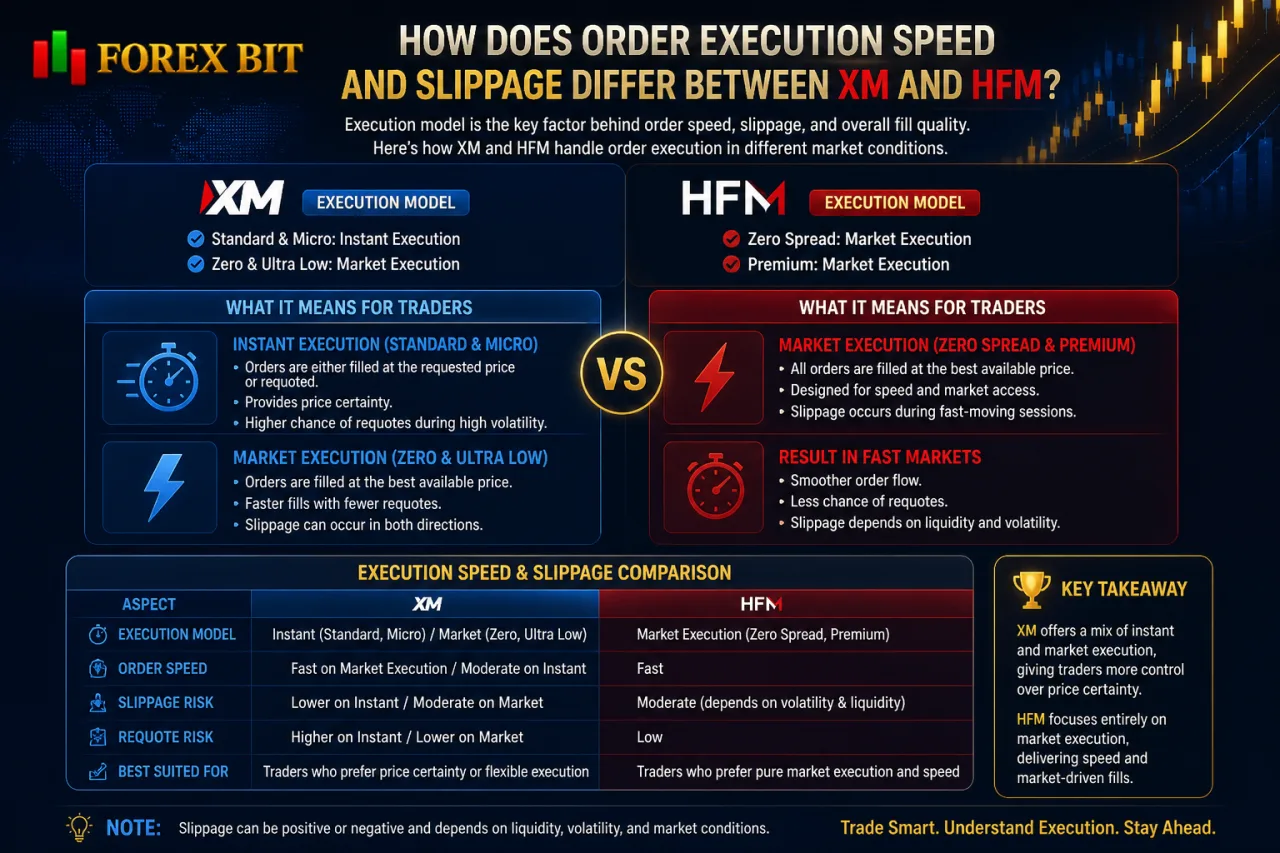
XM operates primarily on instant execution for its Standard and Micro accounts alongside market execution on its Zero and Ultra Low tiers, while HFM applies market execution across its Zero Spread and Premium accounts, producing different fill behavior during fast-moving sessions. This distinction in execution model shapes how each broker handles order requests, slippage, and fill quality across normal and high-volatility conditions.
Instant execution either fills an order at the requested price or rejects it through a requote, whereas market execution fills at the next available price without requoting but allows the fill price to shift from what was requested. XM’s Zero and Ultra Low accounts and HFM’s Zero Spread and Premium accounts all use this market execution model, positioning both brokers similarly for traders who prioritize consistent order acceptance over guaranteed pricing.
Average order execution times and slippage patterns for both brokers during normal versus high-volatility periods are not consistently published in a verifiable way, so traders should test live execution directly through each broker’s demo or live account before relying on either for time-sensitive strategies.
Does XM or HFM Use Market Execution or Instant Execution on Their Accounts?
XM applies instant execution on its Standard and Micro accounts while using market execution on its Zero and Ultra Low accounts, and HFM applies market execution across its Zero Spread and Premium accounts, meaning only XM offers a dealing-desk-style instant execution model. This split in execution type shapes whether an order request faces a requote or fills automatically at the next available price.
Instant execution on XM’s Standard and Micro accounts either confirms the trade at the quoted price or triggers a requote when the market moves before the order reaches the server. Market execution, used on XM’s Zero and Ultra Low accounts and across HFM’s Zero Spread and Premium accounts, removes the requote step entirely by filling at the best available price once the order arrives.
Traders who value guaranteed pricing over guaranteed fills lean toward XM’s instant-execution accounts, while those prioritizing order acceptance during fast markets align more closely with the no-dealing-desk model both brokers apply on their commission-based tiers.
Which Broker Shows Less Slippage During High-Impact News Events, XM or HFM?
Neither XM nor HFM discloses verifiable, broker-specific slippage data for high-impact news events, so no direct comparison of which broker shows less slippage during these periods can be confirmed from publicly available sources. This question about slippage under volatility during news releases depends heavily on server infrastructure and liquidity provider setup, and neither broker publishes detailed technical breakdowns of these systems for independent verification.
XM references a multi-server infrastructure and multiple liquidity providers feeding its pricing engine, while HFM similarly states it aggregates pricing from multiple liquidity sources, though neither broker publishes comparative benchmark figures for slippage during scheduled news events such as non-farm payrolls or central bank rate decisions.
Both brokers apply market execution on their Zero-type accounts, which fills orders at the next available price during fast-moving conditions rather than rejecting them outright. This execution model reduces requotes but does not eliminate price gaps when liquidity thins around major announcements.
Traders concerned with news-driven slippage test both brokers’ live or demo environments during an actual high-impact release, since real-time fill behavior varies by broker-side liquidity conditions at that moment rather than by published specifications alone.
How Do XM and HFM Account Conditions Compare for Minimum Deposit, Leverage, and Account Types?
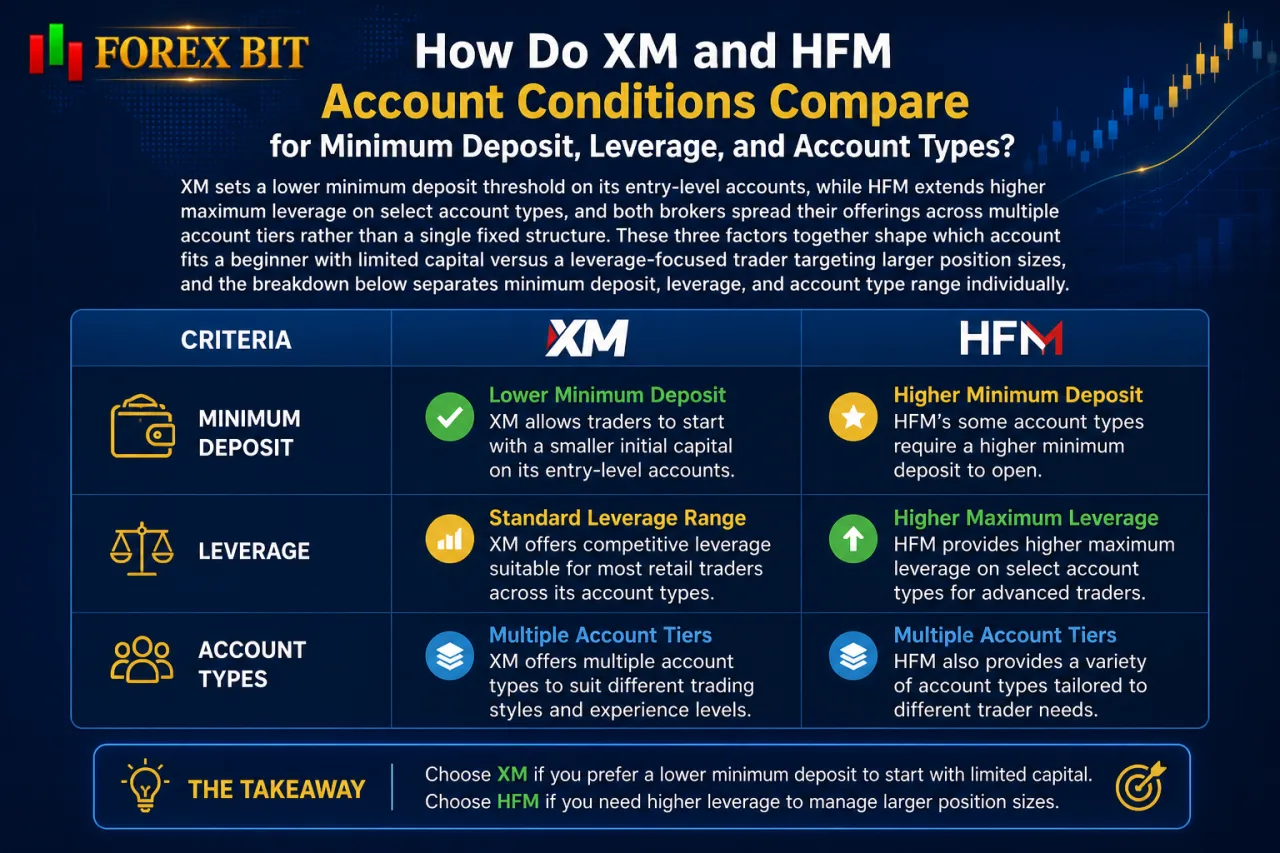
XM sets a lower minimum deposit threshold on its entry-level accounts, while HFM extends higher maximum leverage on select account types, and both brokers spread their offerings across multiple account tiers rather than a single fixed structure. These three factors together shape which account fits a beginner with limited capital versus a leverage-focused trader targeting larger position sizes, and the breakdown below separates minimum deposit, leverage, and account type range individually.
What Is the Minimum Deposit Required to Open an Account with XM vs HFM?
XM sets its Micro and Standard account minimum deposit at a low entry threshold suited to beginners, while HFM applies a comparable low-entry minimum on its Zero and Premium account tiers, though exact figures should be confirmed directly on each broker’s official website, as these thresholds can change.
This comparison of minimum deposit requirements between XM and HFM depends heavily on account type and base currency selected at signup.
- Deposit currency affects the effective minimum, since converting to USD, EUR, or another supported base currency shifts the local-equivalent amount required.
- Payment method matters, as certain deposit channels such as bank transfer carry higher practical minimums or processing fees compared to e-wallets or card payments.
- Account tier drives the baseline figure, since entry-level Micro or Standard tiers require less capital than commission-based Zero-type accounts on either broker.
Traders confirm current minimum deposit figures and accepted payment methods directly through each broker’s official account-opening page before funding, since both currency options and payment-related conditions are updated periodically.
What Is the Maximum Leverage Offered by XM vs HFM, and Does It Vary by Region?
XM caps leverage lower under its EU-regulated entity while offering higher leverage through its offshore-regulated entities, and HFM follows the same regulatory-driven split, so the maximum leverage available to a trader depends on which entity and jurisdiction the account falls under rather than a single fixed figure. This regional variation in leverage directly shapes how much margin a position requires under each broker.
XM’s EU-regulated entity restricts leverage to the standard retail cap applied across that jurisdiction, while its offshore-regulated entities offer considerably higher leverage for eligible clients, though exact figures should be confirmed directly on XM’s official website, as they can change over time.
HFM applies a comparable structure, with its more strictly regulated entity limiting leverage to the retail cap set by that regulator and its offshore entities permitting considerably higher leverage for eligible clients, though exact figures should be confirmed directly on HFM’s official website, as they can change over time.
Higher leverage under either broker’s offshore entity lowers the margin required to open a given position size, while the stricter EU/UK-style caps raise the margin needed for the same trade. Traders confirm which entity their account registers under and the applicable leverage cap directly through each broker’s account verification process, since this determines actual margin requirements rather than the headline leverage figure advertised broadly.
Which Broker’s Account Conditions Suit Different Trader Profiles: Beginners, Scalpers, and High-Volume Traders?
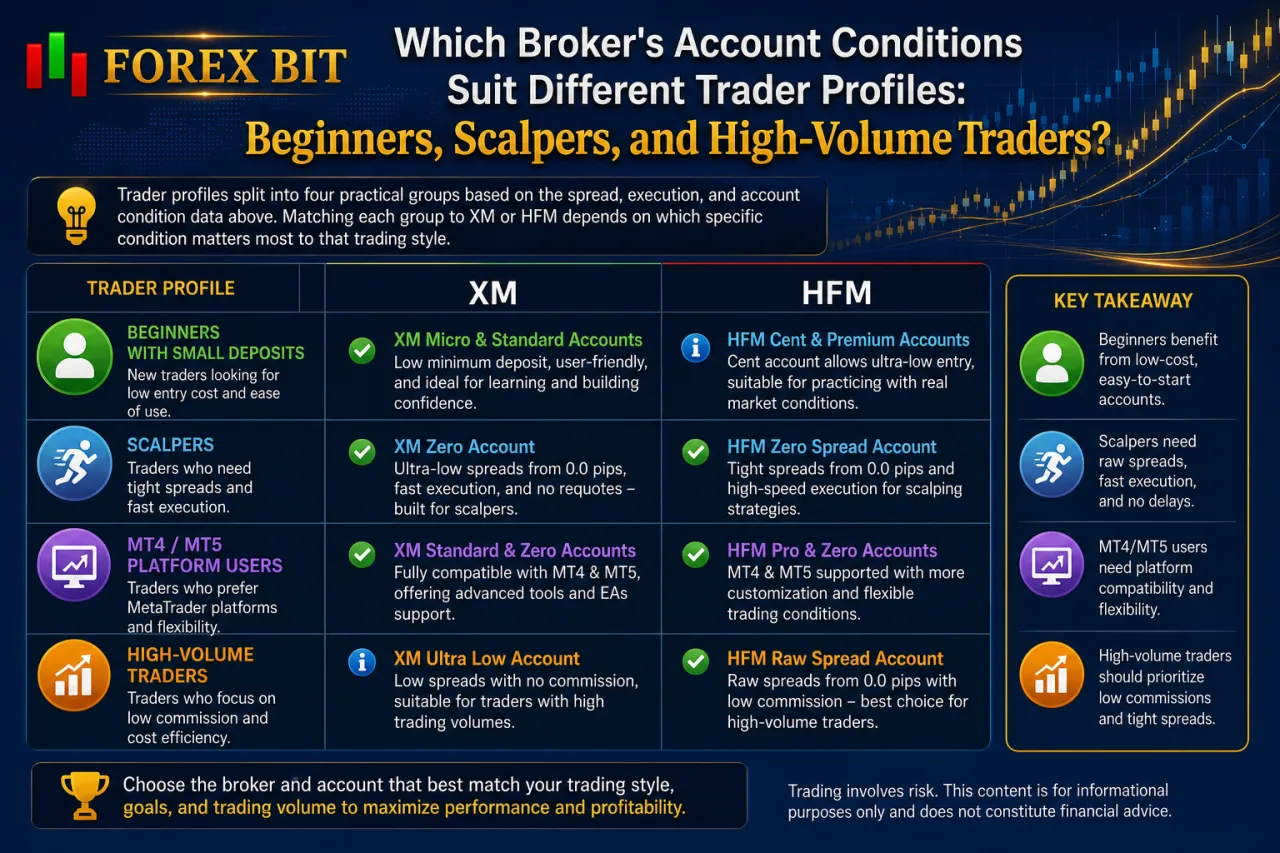
Trader profiles split into four practical groups based on the spread, execution, and account condition data above: beginners with small deposits, scalpers needing tight spreads and fast execution, MT4/MT5 platform users, and high-volume traders focused on low commission costs. Matching each group to XM or HFM depends on which specific condition matters most to that trading style.
- Beginners with small deposits fit XM’s Micro or Standard accounts, since these tiers carry a low entry threshold and commission-free spread pricing suited to smaller position sizes.
- Scalpers needing tight spreads and fast execution fit XM’s Zero account or HFM’s Zero Spread account, since both use market execution with near-raw pricing on major pairs, though live testing during volatile sessions confirms actual fill quality.
- MT4/MT5 platform users fit either broker equally, since XM and HFM both support these platforms across their commission-based and commission-free account tiers.
- High-volume, active traders seeking low commission costs fit whichever broker quotes the lower confirmed per-lot rate at the time of signup, since neither broker’s Zero-type commission consistently beats the other across published sources.
Confirming current account terms directly on each broker’s official website remains the deciding step before funding any of these account types.
What Unique Account Features and Trading Tools Set XM and HFM Apart Beyond Basic Conditions?
XM differentiates through its loyalty program and negative balance protection details, while HFM differentiates through its copy trading service and proprietary analysis tools, marking a split beyond spreads, execution, and account conditions already covered. These features shape day-to-day trading experience rather than pricing or fill quality, and the breakdown below separates XM’s rewards-based tools from HFM’s social and proprietary trading additions.
Does XM or HFM Offer Built-In Copy Trading or Social Trading Tools?
No, XM does not run a native copy trading platform, while HFM does through its HFcopy service and a broader social trading partnership, marking a clear split between the two brokers on this feature. This copy/social trading distinction affects account setup rather than spread or commission structure already covered above.
HFM’s HFcopy operates directly on its standard account tiers, letting clients allocate funds toward selected strategy providers without switching to a separate account type. XM instead relies on third-party MT4/MT5 signal or social platforms outside its own infrastructure, so replicating trades requires connecting an external service to an XM account rather than using a built-in tool.
- Provides native copy trading: HFM (HFcopy), not XM
- Requires external platform integration: XM, since no in-house copy trading system exists
- Integrates with standard account conditions: HFM’s copy trading works within its existing account tiers without a dedicated account type
Copy traders lean toward HFM for direct, built-in access, while XM users pursue copy trading only through outside platforms layered onto a standard account.
How Do XM’s and HFM’s Loyalty or Cashback Programs Differ?
XM runs a loyalty points program called XM Loyalty Programme that converts trading activity into redeemable points, while HFM does not operate a comparable points-based rewards system tied to standard trading volume. This marks a distinct split between the two brokers on ongoing trading rewards beyond account-level pricing already covered above.
XM’s loyalty points accrue automatically on eligible account types and get redeemed for cash credited to the trading account, giving frequent traders a secondary return alongside their spread or commission costs. Eligibility for XM’s loyalty program depends on account type, with certain tiers historically excluded from points accrual, though current eligibility rules should be confirmed directly on XM’s official website.
HFM instead promotes cashback or rebate-style offerings tied to specific promotions rather than a permanent points structure, and availability of these offers varies by region and account type. Traders comparing ongoing rewards value confirm current terms directly through each broker’s client portal, since promotional structures on both sides change periodically.
Conclusion
XM and HFM split their advantages across distinct trading priorities rather than one broker dominating every category. XM suits beginners through lower entry deposits, commission-free Standard and Micro accounts, and a loyalty points program that rewards ongoing activity. HFM appeals to traders seeking built-in copy trading through HFcopy and higher leverage ceilings on select offshore-regulated tiers.
For spreads and execution, both brokers price their Zero-type accounts similarly close to raw market rates, with actual commission figures and slippage during volatile sessions requiring live testing rather than relying on published specifications. Scalpers and high-volume traders benefit from comparing real-time conditions on both platforms before committing capital to either broker.
As a Financial Analyst with over 5 years of experience, I focus on analyzing financial data to provide actionable insights and recommendations for investment strategies. My expertise in forecasting and financial modeling has helped businesses optimize their financial performance and mitigate risks.
Email: [email protected]

Best Brokers

Trade with the world’s largest retail broker and benefit from better - than - market conditions.

We offer a superior trading environment that puts traders in the best position to profit.

Trade with the best trading conditions. WIN THE BEST TRADING ACCOUNT AWARD.

Trade global markets with Interactive Brokers – a highly regulated multi-asset broker built for active and professional investors.






Forex Bit provides in-depth analysis of commodities, forex, and stock markets to help traders make informed investment decisions.
Best Brokers
Metatrader 5 Brokers
Metatrader 4 Brokers
Lowest Spread Forex Broker
Regulated Forex Brokers
Forex Copy Trading
Ctrader Brokers
Best Forex Broker For Beginners