
Exness vs IC Markets compared on spreads, execution speed & regulation—see which broker suits scalpers and cost-conscious traders best.
Exness vs IC Markets: Spreads, Execution & Regulation

Exness and IC Markets differ mainly in spread structure, execution speed, and regulatory strength, making the choice depend on trading style and priority. Exness leans toward flexible account types with high leverage caps in offshore jurisdictions, while IC Markets focuses on raw ECN pricing under tighter oversight, a contrast that shapes overall trading conditions for both beginners and active traders.
IC Markets generally offers tighter raw spreads on its Raw Spread account, often starting near 0.0 pips plus commission, compared to Exness’s Raw Spread and Zero accounts. Both brokers remain competitive for cost-sensitive traders, but the exact pricing gap depends on account type and trading session.
IC Markets’ ECN infrastructure and data center proximity are generally associated with fast order execution, which can suit scalping and high-frequency strategies. Exness also supports rapid execution, though results vary by server location and account model.
IC Markets and Exness are each regulated by multiple financial authorities, and the specific licenses held can affect deposit safety differently depending on a trader’s region. Exness operates under multiple regulatory entities as well, though the strength of oversight differs by the specific entity a trader signs up with.
This Forex Bit comparison breaks down these differences step by step, starting with how Exness and IC Markets stack up on overall trading conditions before examining spreads and execution speed in detail.
Exness vs IC Markets: Which Broker Offers Better Overall Trading Conditions?
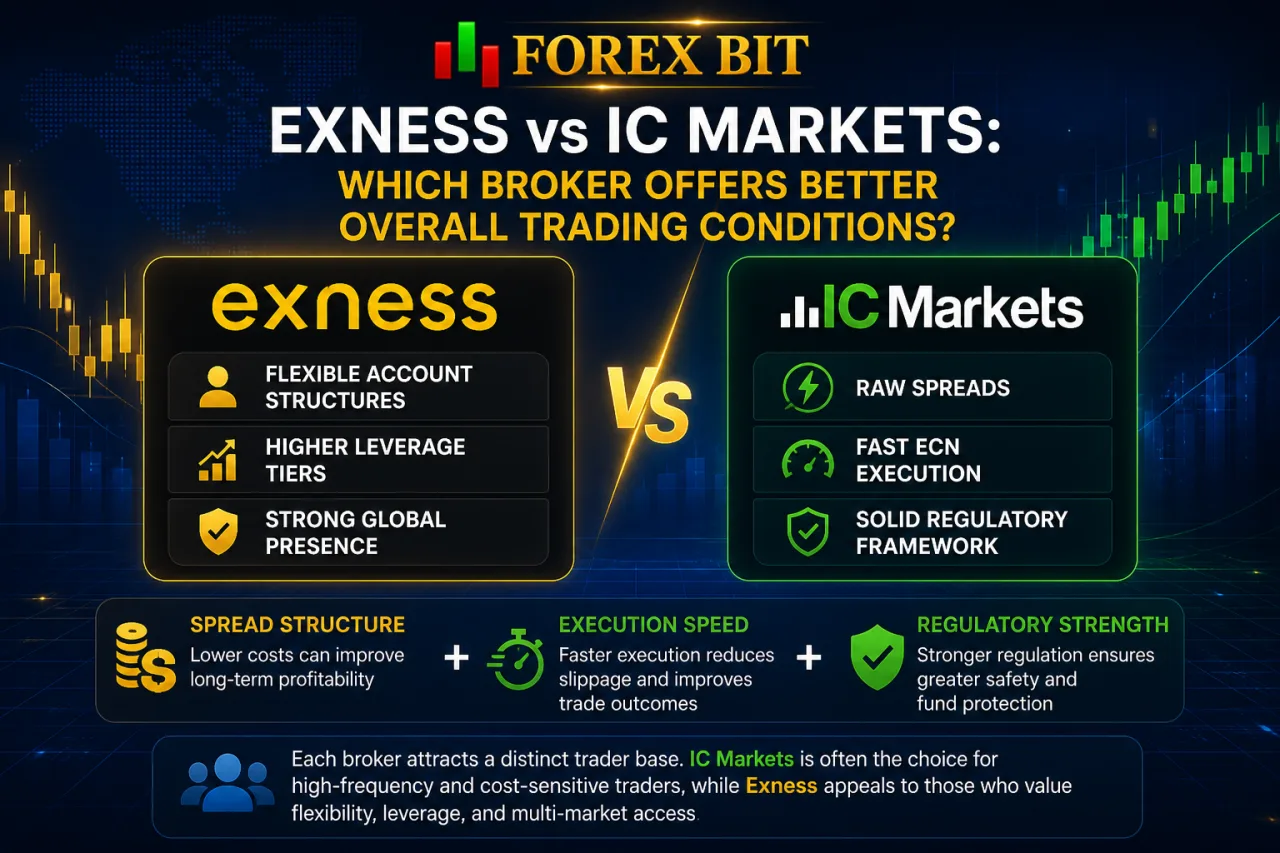
IC Markets suits traders prioritizing raw spreads and fast ECN execution, while Exness suits traders wanting flexible account structures and higher leverage tiers, with both differing again on regulatory depth. This framing sets the scope for the three pillars this comparison addresses: spread structure, execution speed, and regulatory strength, without repeating the general profiles already outlined for other broker pairings on Forex Bit.
Each broker attracts a distinct trader base. IC Markets draws scalpers, algorithmic traders, and volume-driven accounts that depend on consistent raw pricing and low-latency order routing. Exness draws a broader mix of beginners and active traders who value account variety and simplified deposit-to-leverage flexibility.
The next sections examine spreads, execution quality, and regulatory oversight individually, since each pillar affects a different type of trader outcome rather than one broker being uniformly stronger across all three.
Which Broker Has Tighter Spreads: Exness or IC Markets?
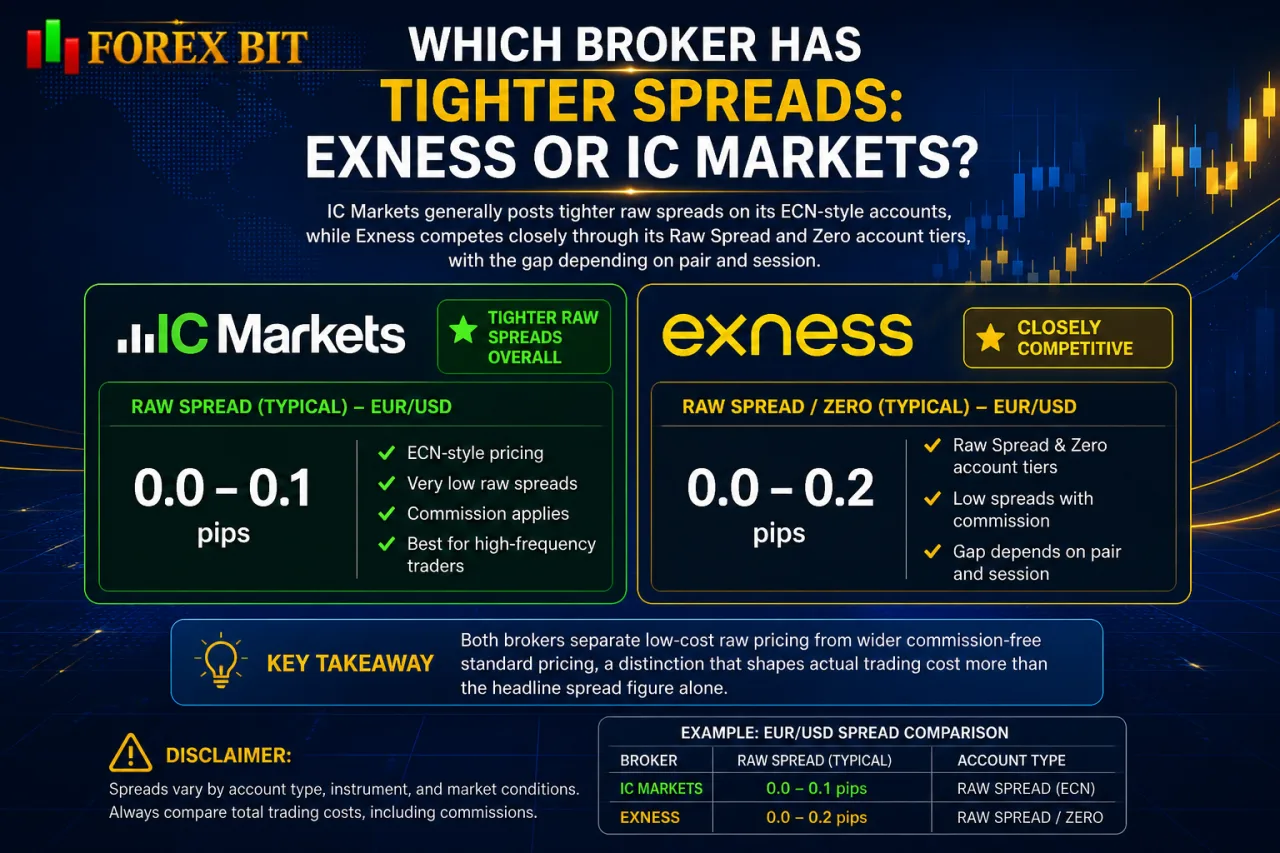
IC Markets generally posts tighter raw spreads on its ECN-style accounts, while Exness competes closely through its Raw Spread and Zero account tiers, with the gap depending on pair and session. Both brokers separate low-cost raw pricing from wider commission-free standard pricing, a distinction that shapes actual trading cost more than the headline spread figure alone.
The following breakdown looks at typical EUR/USD spread behavior and how account type and market volatility change the real cost of trading with each broker.
How Do Exness and IC Markets Account Types Affect Spread Levels?
Account type determines whether spread cost sits entirely in the pip price or splits between a lower spread and a separate commission, and this structure differs across each broker’s tiers. This connects directly to the raw-versus-standard pricing gap raised above, since the account chosen sets the baseline before session or pair volatility comes into play.
Exness Standard and Standard Cent accounts tend to carry wider, commission-free spreads, while Exness Pro, Zero, and Raw Spread accounts shift toward tighter spreads paired with a per-lot commission on Zero and Raw Spread.
IC Markets follows a similar split, with its Standard account carrying commission-free spreads and its Raw Spread and cTrader Raw accounts offering tighter spreads paired with a fixed commission per lot.
In both cases, commission-based accounts generally suit high-volume and scalping strategies, while commission-free accounts suit traders who prefer simplified, all-in pricing without tracking separate fees.
Which Broker Charges Lower Commissions on Raw Spread Accounts?
Neither broker is flatly cheaper, since the lower all-in cost depends on combining spread and commission rather than commission alone. This ties directly into the commission structure raised for Zero and Raw Spread accounts above, since the fee model splits cost between pip spread and a fixed charge per traded lot.
IC Markets charges a commission on its Raw Spread account, while Exness charges a comparable per-lot fee on its Raw Spread and Zero accounts.
Calculating true cost requires adding the average spread on a pair like EUR/USD to the commission charged on a standard lot round turn, since neither figure alone reflects the actual expense of a trade. Traders comparing the two brokers on cost typically check this combined figure rather than the commission rate in isolation.
On raw-type accounts, the split generally favors:
- Traders running high lot volumes, where a slightly lower commission per lot compounds into meaningful savings.
- Scalpers and algorithmic strategies, where tight raw spreads paired with a known fixed commission simplify cost forecasting.
The lower-cost broker on a per-trade basis varies by pair and session, since spread compression during peak liquidity hours changes the all-in total even when the commission rate stays fixed.
Which Broker Offers Faster Order Execution for Scalping and Active Trading?
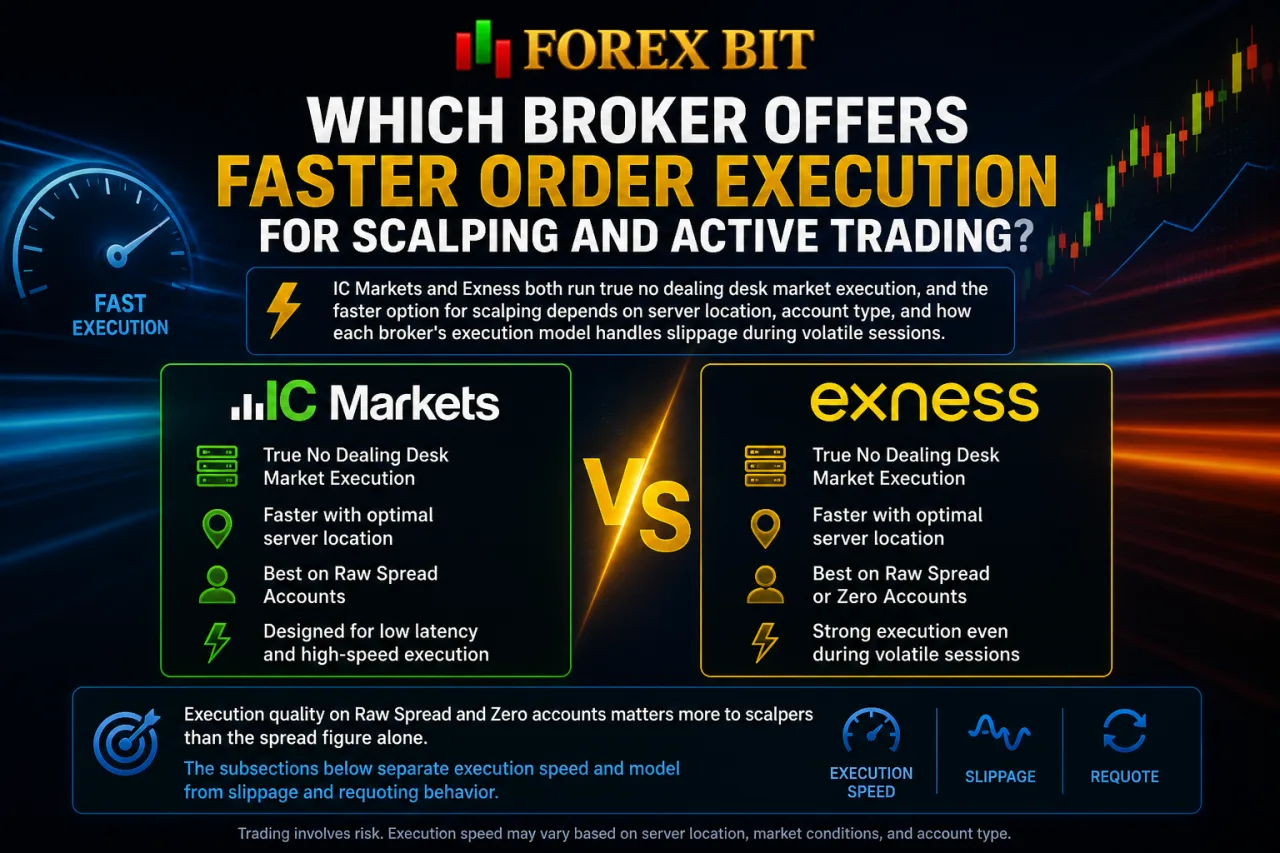
IC Markets and Exness both run true no dealing desk market execution, and the faster option for scalping depends on server location, account type, and how each broker’s execution model handles slippage during volatile sessions. This connects to the raw-versus-standard pricing split covered earlier, since execution quality on Raw Spread and Zero accounts matters more to scalpers than the spread figure alone. The subsections below separate execution speed and model from slippage and requoting behavior, since each factor affects scalping outcomes differently.
Does Exness or IC Markets Allow Scalping and High-Frequency Trading Strategies?
Yes, both Exness and IC Markets officially permit scalping, expert advisors, and high-frequency trading strategies without restriction on strategy type. This confirms the broker-level policy behind the execution model discussed for Raw Spread and Zero accounts, since both firms position their infrastructure specifically around strategies that depend on speed and order volume.
IC Markets states its ECN environment runs through data centers colocated near liquidity providers, which helps minimize latency for algorithmic and high-frequency orders.
Exness likewise confirms no restrictions on scalping or EA usage across its account types, supporting automated trading through MT4, MT5, and its own execution infrastructure.
Neither broker imposes a minimum holding time or penalizes rapid order placement, unlike some market-maker style firms that restrict scalping. Traders running EAs or high-frequency systems generally choose the raw-spread account tiers on either broker, since the commission-based pricing pairs more predictably with high trade frequency than commission-free spreads.
How Does Server Location and Infrastructure Impact Execution Speed for Each Broker?
Server location and infrastructure shape execution reliability by determining how far a trade order travels before reaching a liquidity provider, with IC Markets’ Equinix-based servers and Exness’s multiple regional data centers producing different latency profiles. This factor connects directly to the no dealing desk execution model both brokers run, since routing distance affects fill speed regardless of account type.
IC Markets states that its trading servers are hosted in data centers colocated near major liquidity providers, which helps reduce round-trip latency for orders sent from nearby regions.
Exness operates trading servers across several regional locations, allowing traders to select a server closer to their own geographic position or to the broker’s liquidity pool.
Both brokers offer free VPS hosting to qualifying accounts. This places the trading terminal physically closer to the broker’s servers and lowers the latency gap caused by a trader’s own internet connection.
Traders located far from IC Markets’ New York infrastructure or from Exness’s nearest regional server generally see more consistent execution reliability when using a hosted VPS rather than a home connection. VPS hosting removes local network variability from the execution chain, keeping order routing more stable across different geographic distances.
Which Broker Is More Strictly Regulated: Exness or IC Markets?
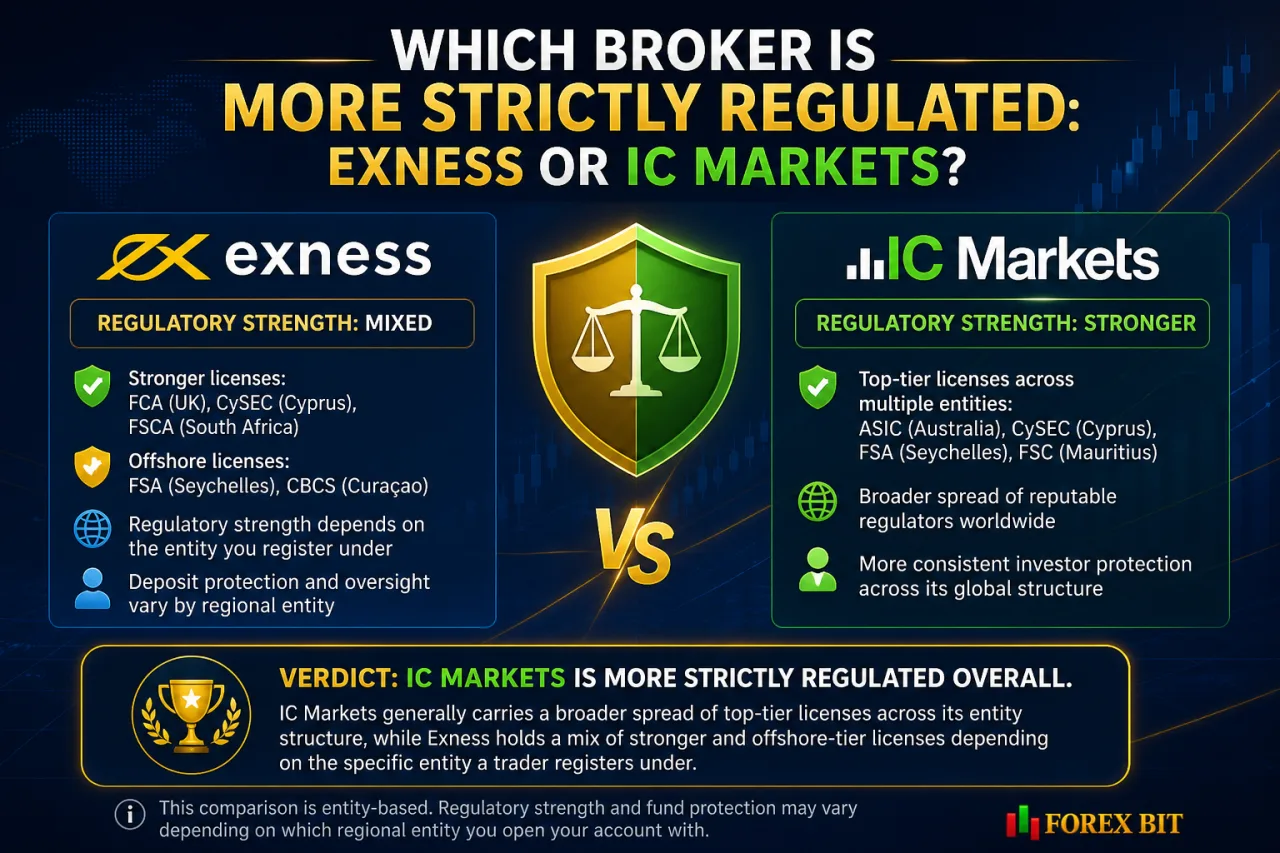
IC Markets generally carries a broader spread of top-tier licenses across its entity structure, while Exness holds a mix of stronger and offshore-tier licenses depending on the specific entity a trader registers under. This distinction builds on the entity-based regulatory split raised earlier in this comparison, since deposit protection and oversight strength shift depending on which regional arm of each broker onboards the trader. The sections below separate the license comparison from fund segregation and compensation scheme differences, since each factor affects trader protection in a distinct way.
Are Client Funds Safer with Exness or IC Markets?
Client funds carry stronger protection under IC Markets’ top-tier entities and Exness’s EU/UK entities. Both brokers apply segregated accounts and negative balance protection, though compensation scheme access differs by entity. This builds on the license comparison raised for each broker’s entity structure, since fund safety depends on which regional arm holds the trader’s account rather than the brand as a whole.
IC Markets states that it segregates client funds from company operating capital across its regulated entities and applies negative balance protection to retail accounts.
Exness likewise states that it segregates client funds from company operating capital and applies negative balance protection across its account types, though eligibility for any compensation scheme depends on which regulator licenses a given entity.
Compensation scheme coverage attaches to the specific entity and regulator involved. Entities licensed under the UK’s FCA fall under the Financial Services Compensation Scheme (FSCS), while entities licensed under CySEC in Cyprus fall under the Investor Compensation Fund (ICF). Offshore entities of either broker typically fall outside these schemes.
Traders concerned with fund safety check which specific entity holds their account rather than assuming brand-wide protection.
Which Regulatory Entity Applies to Traders in Different Regions?
Regional entities determine which rulebook applies, since IC Markets and Exness each register separate legal entities for the EU, UK, Australia, and offshore jurisdictions, and the entity onboarding a trader sets both leverage caps and dispute protections. This groups directly with the fund-safety distinction raised above, since entity choice rather than brand name decides which regulator has authority over a given account.
IC Markets generally operates through separate regional entities:
- IC Markets Australia Pty Ltd, licensed by ASIC, serving clients under local licensing arrangements.
- IC Markets (EU) Ltd, regulated by CySEC, covering traders based in the EU.
- IC Markets Global (Seychelles Financial Services Authority), covering clients in other regions outside top-tier jurisdictions.
Exness likewise assigns clients to distinct entities:
- Exness (EU) Ltd, subject to CySEC regulatory standards.
- Exness (UK) Ltd, operating under FCA licensing terms.
- A broader set of offshore entities registered under jurisdictions such as Seychelles and Mauritius, with leverage limits and product access varying by which entity registers the account.
Traders based in the EU or UK generally face lower leverage caps under either broker’s top-tier entity, while offshore entities of both firms typically allow higher leverage tiers alongside reduced regulatory recourse. Checking which specific entity an account falls under remains the only way to confirm the exact leverage limit and protection level that applies in a given region.
What Other Trading Conditions Set Exness and IC Markets Apart?
Exness and IC Markets separate themselves through platform lineup and niche trading tools rather than pricing alone, with cTrader availability and specialized add-ons marking the clearest gaps. This distinction sits outside the spread, execution, and regulatory comparisons already covered, focusing instead on tools that shape day-to-day platform experience. The subsections below break this down into platform selection and unique broker-specific features.
Does Exness or IC Markets Support cTrader for Algorithmic Execution?
Yes, both Exness and IC Markets support cTrader as an alternative to MT4 and MT5, though platform availability differs by account type and entity. This directly answers the platform gap raised above, since cTrader access shapes which broker fits algorithmic and copy-trading setups more naturally.
IC Markets offers a dedicated cTrader Raw account alongside its MT4 and MT5 offerings, giving traders access to cTrader Automate for algorithmic strategy building and cTrader Copy for copy-trading execution.
Exness also lists cTrader among its supported platforms, though its account lineup centers more heavily on MT4 and MT5, with cTrader positioned as a secondary option rather than a core offering.
Traders relying on cTrader’s built-in algorithmic and social trading tools generally find IC Markets’ cTrader Raw account better integrated into its broader ECN pricing structure.
How Does Exness’s Unlimited Leverage Option Compare to IC Markets’ Leverage Tiers?
Exness offers an unlimited leverage option on select account types in eligible jurisdictions, while IC Markets applies fixed leverage tiers capped by entity and regulator, making Exness the more aggressive structure for margin-driven strategies. This niche leverage design connects to the entity-based regulatory split covered earlier in this comparison, since unlimited leverage only applies where the onboarding entity’s jurisdiction permits it.
Exness offers unlimited leverage on certain account types under its offshore-regulated entities, with eligibility generally tied to equity thresholds and risk management conditions set by the broker.
IC Markets instead caps leverage according to tiered limits that scale down as account equity or position size increases, with lower ceilings applying under top-tier regulated entities such as ASIC and CySEC compared to its offshore entity. The exact tier thresholds vary by entity and are subject to change, so traders should confirm current limits directly on IC Markets’ official platform before opening a position.
Aggressive traders using high leverage face greater execution risk during volatile sessions, since wider price swings against a highly leveraged position trigger margin calls faster regardless of which broker holds the account.
Traders prioritizing capital efficiency over regulatory depth generally lean toward Exness’s unlimited leverage tiers, while those prioritizing predictable margin requirements under stricter oversight lean toward IC Markets’ fixed structure.
Conclusion
The spreads, execution, and regulation comparison points to two brokers built for different priorities rather than one holding a clear overall edge. IC Markets fits scalpers and algorithmic traders who value tighter raw pricing, Equinix-based low-latency infrastructure, and a broader set of top-tier licensed entities. Exness fits traders wanting account flexibility, unlimited leverage options under offshore entities, and competitive Zero and Raw Spread pricing without demanding the strictest regulatory tier.
Cost-sensitive high-volume traders should compare combined spread-plus-commission figures on both platforms directly, while regulation-focused traders should confirm the exact onboarding entity before opening an account, since fund protection and leverage caps shift entirely on that detail rather than on brand reputation alone.
As a Financial Analyst with over 5 years of experience, I focus on analyzing financial data to provide actionable insights and recommendations for investment strategies. My expertise in forecasting and financial modeling has helped businesses optimize their financial performance and mitigate risks.
Email: [email protected]

Best Brokers

Trade with the world’s largest retail broker and benefit from better - than - market conditions.

We offer a superior trading environment that puts traders in the best position to profit.

Trade with the best trading conditions. WIN THE BEST TRADING ACCOUNT AWARD.

Trade global markets with Interactive Brokers – a highly regulated multi-asset broker built for active and professional investors.





Forex Bit provides in-depth analysis of commodities, forex, and stock markets to help traders make informed investment decisions.
Best Brokers
Metatrader 5 Brokers
Metatrader 4 Brokers
Lowest Spread Forex Broker
Regulated Forex Brokers
Forex Copy Trading
Ctrader Brokers
Best Forex Broker For Beginners