
Comparing MT4 vs MT5? See how features, tools, and asset access differ to pick the right MetaTrader platform for your trading style.
MT4 vs MT5: Key Differences Every Trader Should Know

MetaTrader 4 (MT4) and MetaTrader 5 (MT5) differ mainly in asset coverage, order types, timeframes, and programming language. MT4 focuses on forex and CFD trading, while MT5 supports a broader range of markets and tools.
MT4 uses the MQL4 programming language, which offers fewer built-in order types and timeframes compared to MT5’s MQL5 framework. MT5 also includes an integrated economic calendar and a built-in Depth of Market feature not available on MT4.
MT4 remains better suited for forex-only trading and simpler algorithmic strategies, while MT5 is designed for multi-asset trading and more advanced automated systems. MT4 fits traders who prefer a straightforward setup focused on currency pairs and CFDs. MT5 fits traders who run complex Expert Advisors or trade stocks and futures alongside forex.
Not all brokers support both platforms, and some limit account types to only MT4 or only MT5. Forex Bit tracks these platform availability differences across brokers to help traders confirm compatibility before opening an account.
These distinctions in features, trading focus, and broker support set the stage for a deeper look at how MT4 and MT5 actually compare, starting with their key differences.
MT4 vs MT5: What Are the Key Differences?
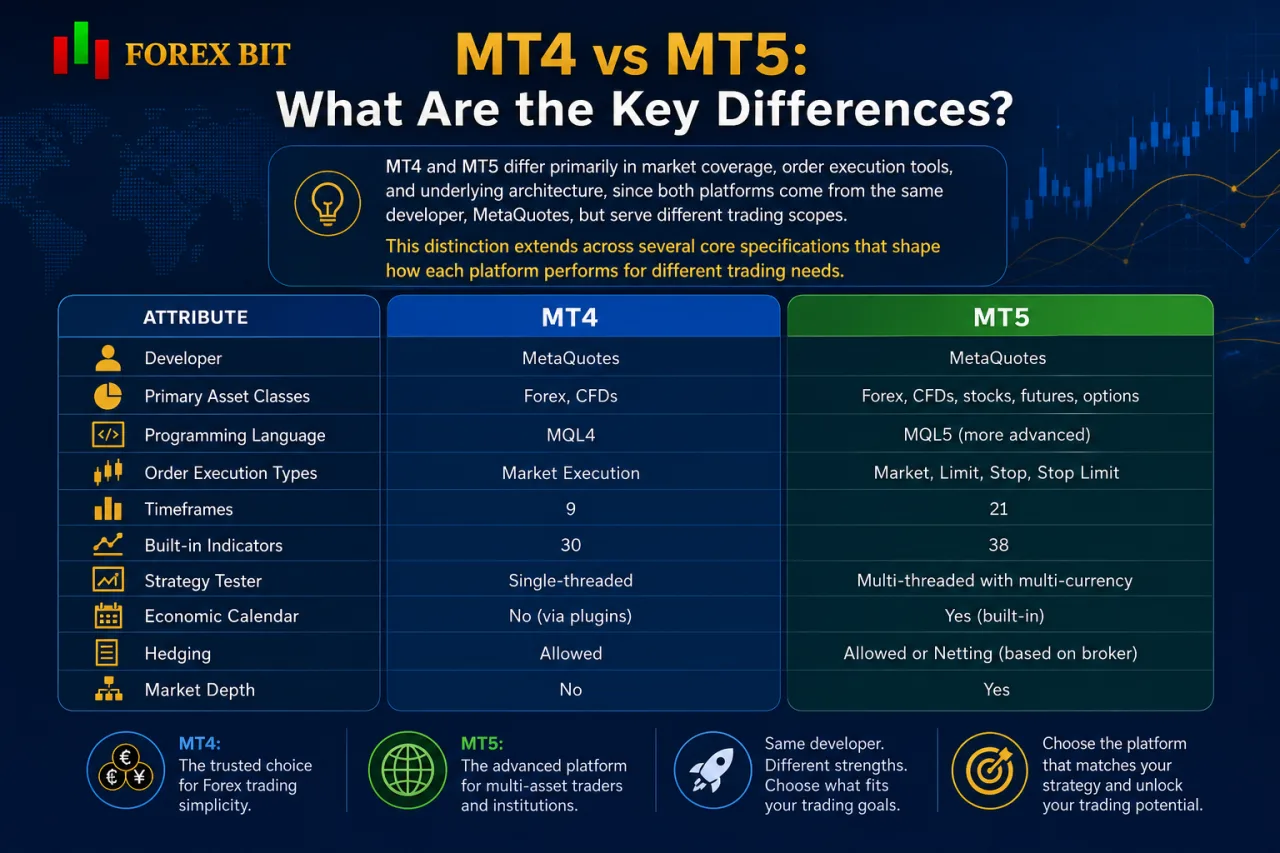
MT4 and MT5 differ primarily in market coverage, order execution tools, and underlying architecture, since both platforms come from the same developer, MetaQuotes, but serve different trading scopes.
This distinction extends across several core specifications that shape how each platform performs for different trading needs.
| Attribute | MT4 | MT5 |
|---|---|---|
| Developer | MetaQuotes | MetaQuotes |
| Primary Asset Classes | Forex, CFDs | Forex, CFDs, stocks, futures, options |
| Programming Language | MQL4 | MQL5 |
| Order Types | Fewer built-in types | Expanded order types |
| Architecture | Single-threaded strategy tester | Multi-threaded strategy tester |
MT4 keeps a narrower architecture built around forex and CFD execution, while MT5 runs on a multi-threaded system designed for broader asset coverage and faster backtesting. These structural differences carry over into asset access, coding language, and testing capabilities, forming the basis for the more detailed comparisons that follow.
What Is MT4?
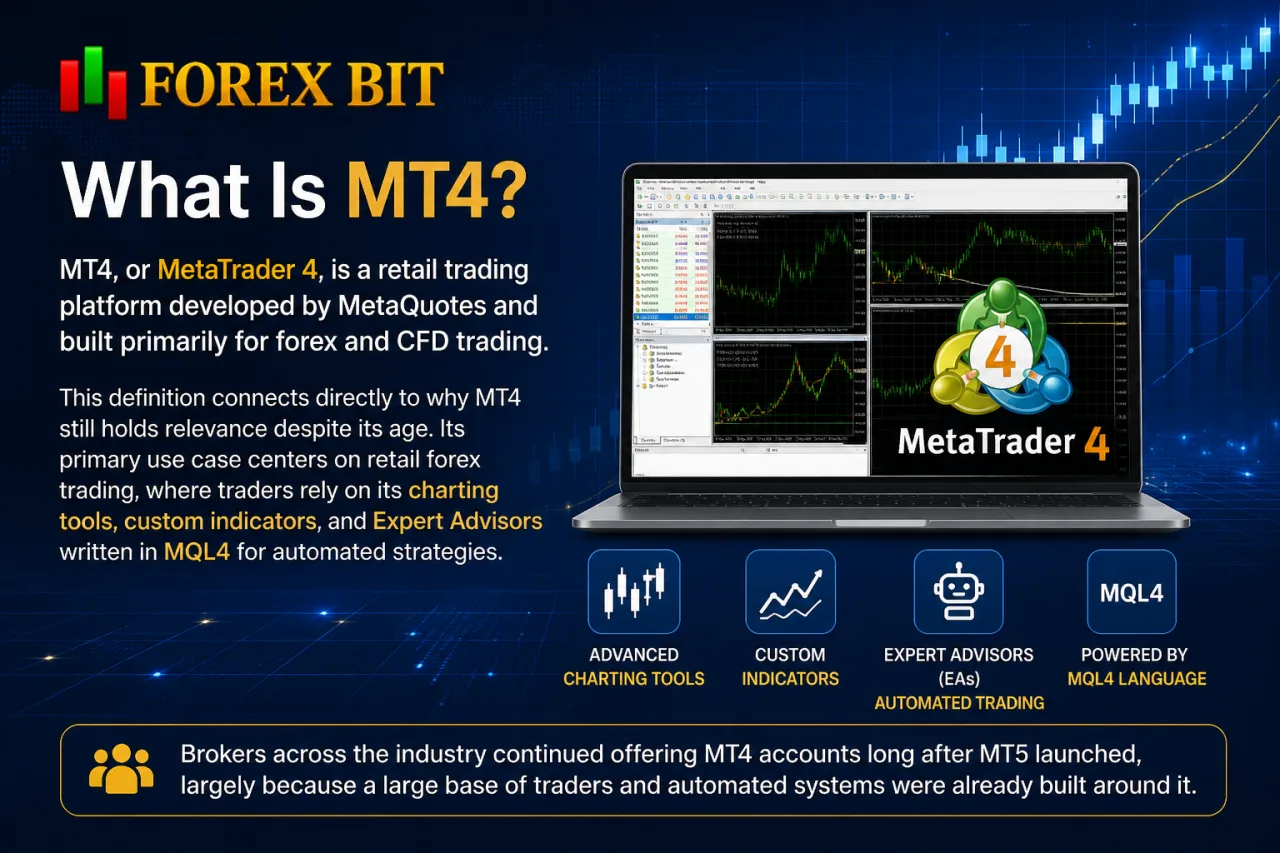
MT4, or MetaTrader 4, is a retail trading platform developed by MetaQuotes and built primarily for forex and CFD trading.
This definition connects directly to why MT4 still holds relevance despite its age. Its primary use case centers on retail forex trading, where traders rely on its charting tools, custom indicators, and Expert Advisors written in MQL4 for automated strategies. Brokers across the industry continued offering MT4 accounts long after MT5 launched, largely because a large base of traders and third-party tool developers built their workflows around MQL4-based systems. This established ecosystem, combined with a simpler interface focused on forex and CFD markets, keeps MT4 in active use among retail traders who do not require the multi-asset scope that MT5 provides.
What Is MT5?
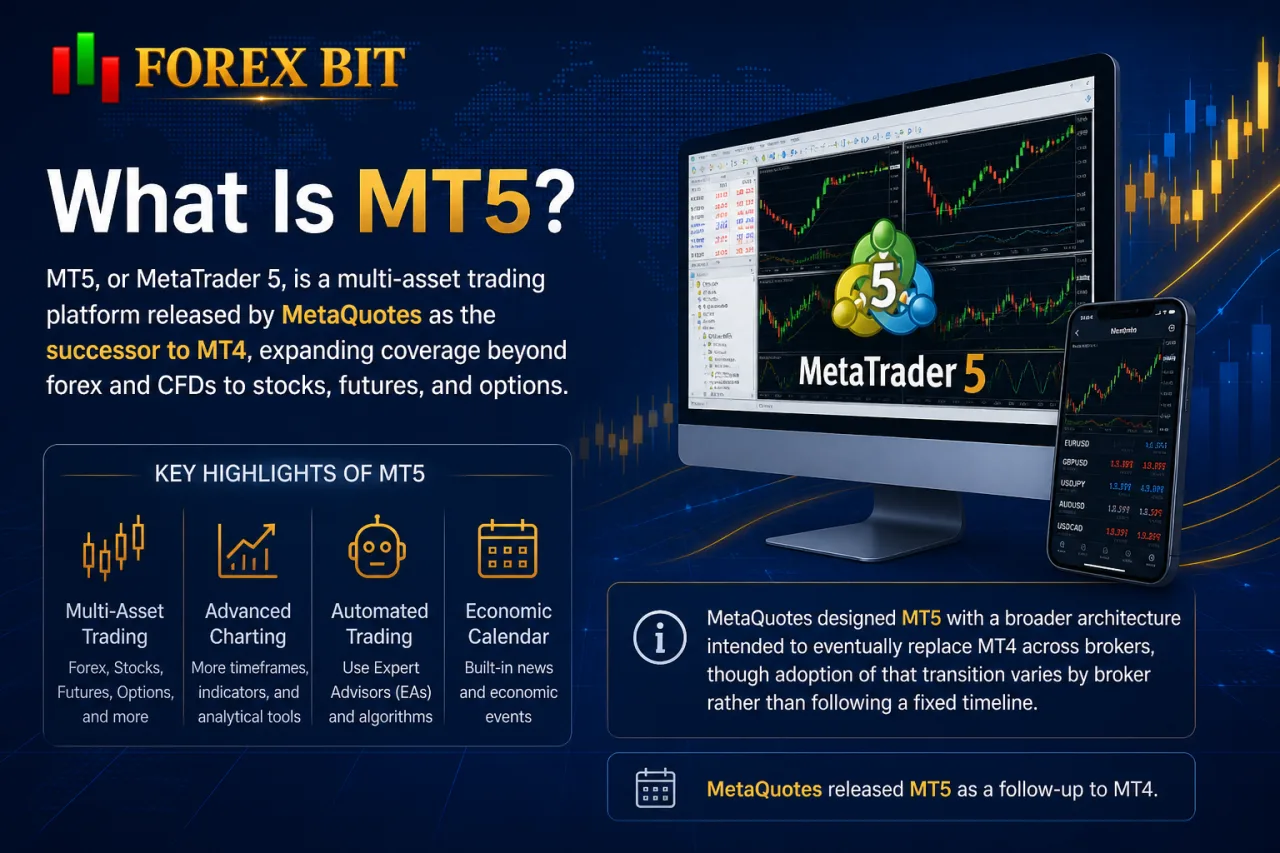
MT5, or MetaTrader 5, is a multi-asset trading platform released by MetaQuotes as the successor to MT4, expanding coverage beyond forex and CFDs to stocks, futures, and options.
This definition answers what MT5 covers and how it relates to the platform discussed earlier. MetaQuotes designed MT5 with a broader architecture intended to eventually replace MT4 across brokers, though adoption of that transition varies by broker rather than following a fixed timeline. Its multi-asset design reflects a shift toward traders who need access to markets beyond forex and CFDs within a single platform, using MQL5 for coding Expert Advisors and custom tools. Despite this expanded scope, MT5 has not fully displaced MT4, since many brokers and traders continue supporting both platforms based on differing account needs.
What Are the Main Feature and Technical Differences Between MT4 and MT5?
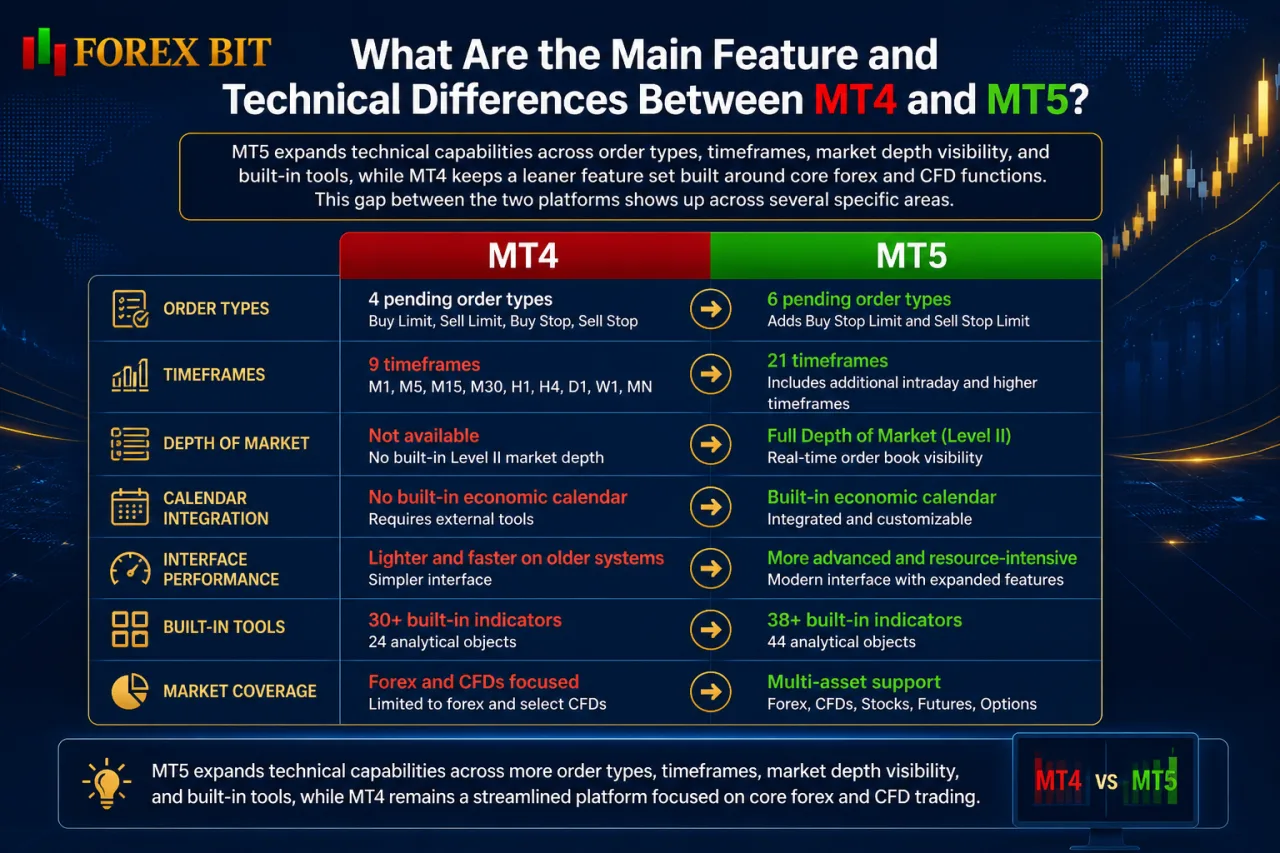
MT5 expands technical capabilities across order types, timeframes, market depth visibility, and built-in tools, while MT4 keeps a leaner feature set built around core forex and CFD functions. This gap between the two platforms shows up across several specific areas rather than in a single isolated feature.
The technical differences worth examining include order execution options, chart timeframe count, Depth of Market access, calendar integration, and overall interface performance. Each of these areas reflects a broader design choice MetaQuotes made when building MT5 as a more expansive successor to MT4, and the following breakdown covers how order types, timeframes, Depth of Market, economic calendar tools, and interface behavior differ between the two platforms.
How Do Order Types Differ Between MT4 and MT5?
MT5 supports more pending order types than MT4, including stop-limit orders, giving traders extra tools for entering trades at predefined price levels.
This gap in order execution options directly affects how traders plan entries and exits on each platform. MT4 offers Buy Limit, Sell Limit, Buy Stop, and Sell Stop orders, covering the basic needs of most forex and CFD strategies. MT5 adds Buy Stop Limit and Sell Stop Limit orders on top of the four standard types, allowing a stop order to convert into a limit order once price reaches a trigger level.
This stop-limit functionality on MT5 gives traders tighter control over entry price during volatile market conditions, since the trade only fills within a specified price range rather than at the first available price. Traders relying on breakout strategies or precise entry zones benefit from this added flexibility, while MT4 users manage similar scenarios through manual order adjustment or Expert Advisor logic instead of a native order type.
How Do Timeframes Differ Between MT4 and MT5?
MT5 offers more chart timeframes than MT4, giving traders far more granularity when analyzing price action across different time horizons.
This gap in timeframe count shapes how effectively traders conduct multi-timeframe analysis on each platform. MT4’s 9 timeframes cover standard intervals ranging from 1-minute charts up to monthly charts, sufficient for traders who rely on a few core timeframes to confirm trend direction and entry points.
MT5 fills in additional intervals between those standard options, including extra minute-based and hour-based charts not present on MT4. This expanded range benefits traders who cross-reference multiple timeframes to filter out market noise, since finer gradations allow closer alignment between entry timing and broader trend context. Scalpers and day traders who rely on tighter timeframe combinations gain more precision on MT5, while traders using only a few standard intervals find MT4’s 9 timeframes adequate without needing the extra granularity.
MQL4 vs MQL5: What Is the Programming Language Difference?
MQL5 functions as a more object-oriented language closer to C++, while MQL4 keeps a simpler, more procedural structure geared toward basic Expert Advisor logic. This gap in coding architecture affects how developers build and migrate trading tools between the two platforms.
MQL5 introduces classes, structures, and enhanced object-oriented programming support that MQL4 lacks in its original form, giving developers more structured ways to organize Expert Advisor code and custom indicators.
Backward compatibility presents a practical limitation for traders switching platforms. Expert Advisors written in MQL4 do not run natively on MT5, and MQL5 code does not run on MT4, requiring developers to rewrite or convert scripts rather than transfer them directly between the two environments.
Which Platform Is Better for Forex-Only Trading vs Multi-Asset Trading?
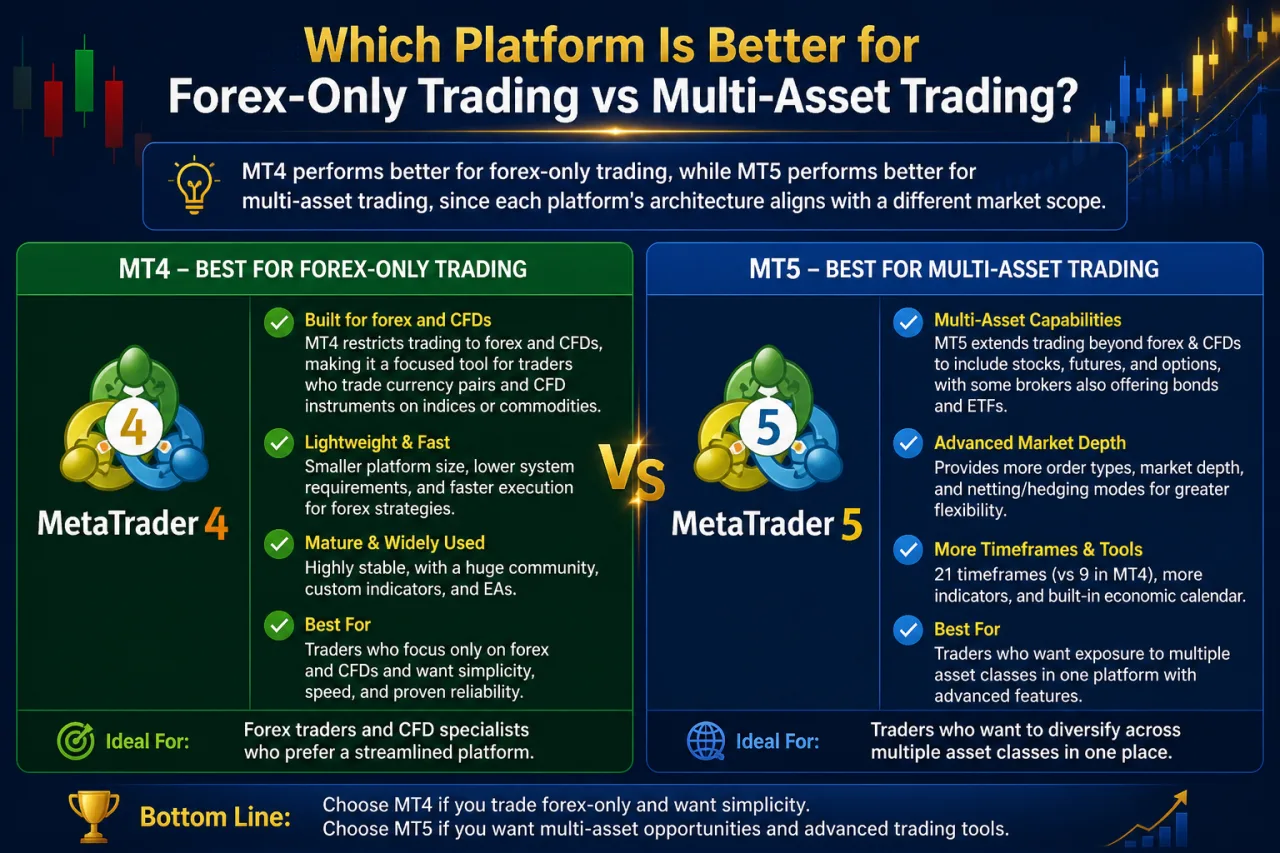
MT4 performs better for forex-only trading, while MT5 performs better for multi-asset trading, since each platform’s architecture aligns with a different market scope.
This distinction ties directly to the asset class coverage each platform was built around. MT4 restricts trading to forex and CFDs, making it a focused tool for traders who never venture beyond currency pairs and CFD instruments on indices or commodities. MT5 extends that scope to stocks, futures, and options, with some brokers also offering bonds through MT5 accounts, giving traders a single platform for tracking and executing across multiple markets at once.
Trader profile determines which platform fits better in practice:
- Forex-only traders relying on a lean interface without unused asset tabs favor MT4.
- Multi-asset traders holding stocks, futures, or options alongside currency positions favor MT5.
- Portfolio traders consolidating cross-market exposure into one terminal favor MT5’s broader coverage.
Since not every broker enables the full range of MT5’s asset classes, traders should confirm actual instrument availability with their specific broker before assuming multi-asset access applies.
Which Platform Is Better for Algorithmic and Automated Trading?
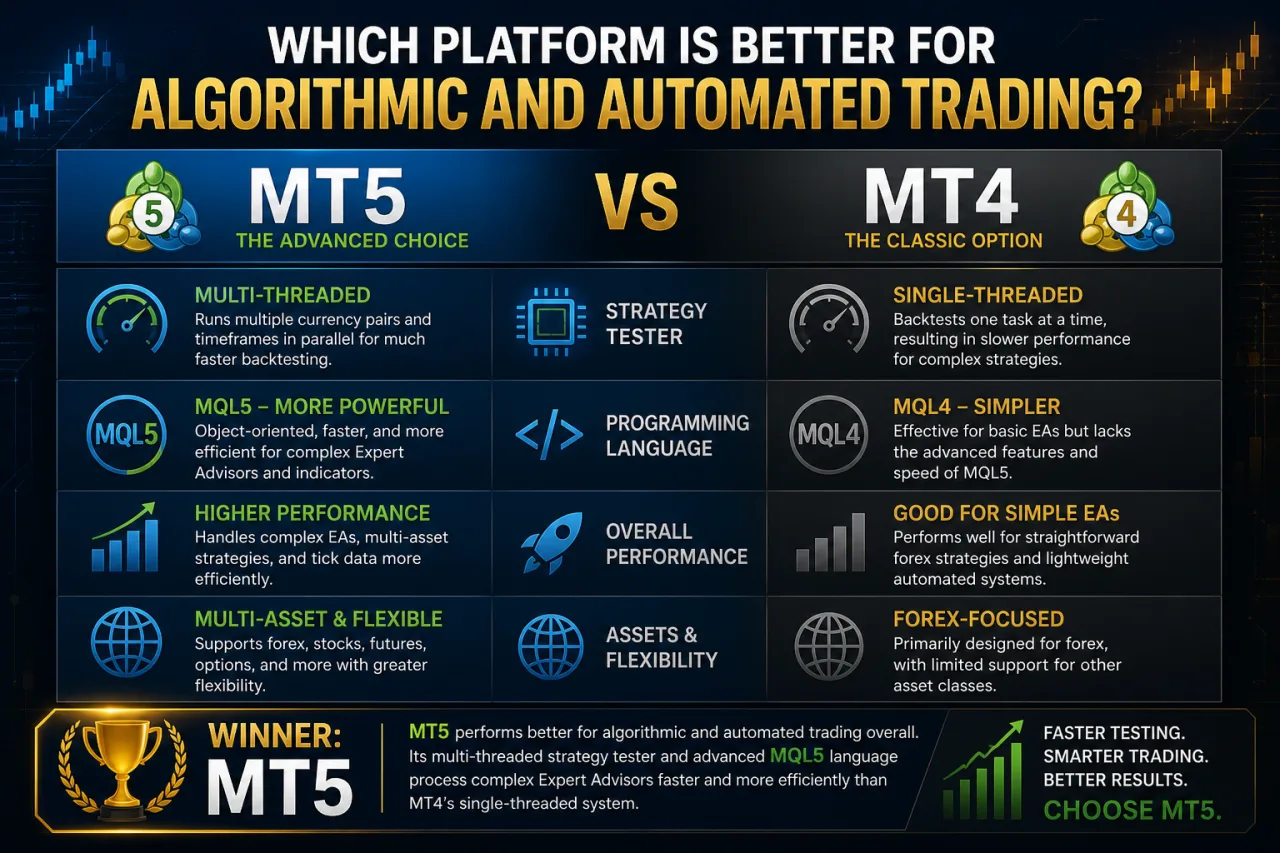
MT5 performs better for algorithmic and automated trading overall, since its multi-threaded strategy tester and expanded MQL5 language process complex Expert Advisors faster than MT4’s single-threaded system, though MT4 still handles simpler forex-focused EAs efficiently.
This performance gap ties directly to how each platform’s architecture handles backtesting and execution demands for algo traders.
- MT5’s strategy tester runs multiple currency pairs and timeframes in parallel using multi-threaded processing.
- MT4’s strategy tester processes backtests sequentially on a single thread, extending run time for large historical datasets.
- MT5’s MQL5 language supports object-oriented programming structures that organize complex EA logic more efficiently than MQL4.
- MT4’s simpler MQL4 syntax keeps basic EA development straightforward for traders running single-pair forex strategies.
Execution speed for live order placement depends primarily on broker infrastructure and server proximity rather than the platform itself, so neither MT4 nor MT5 holds an inherent execution-speed advantage in live trading conditions. Traders running multi-symbol or computationally heavy EAs can benefit from MQL5’s multi-threaded execution, which allows certain strategy tester tasks to run faster than in MQL4. Copy traders and algo developers focused solely on forex pairs find MT4’s EA ecosystem, built on years of MQL4 tool development, still fully functional for that narrower scope.
Do Forex Brokers Support MT4, MT5, or Both?
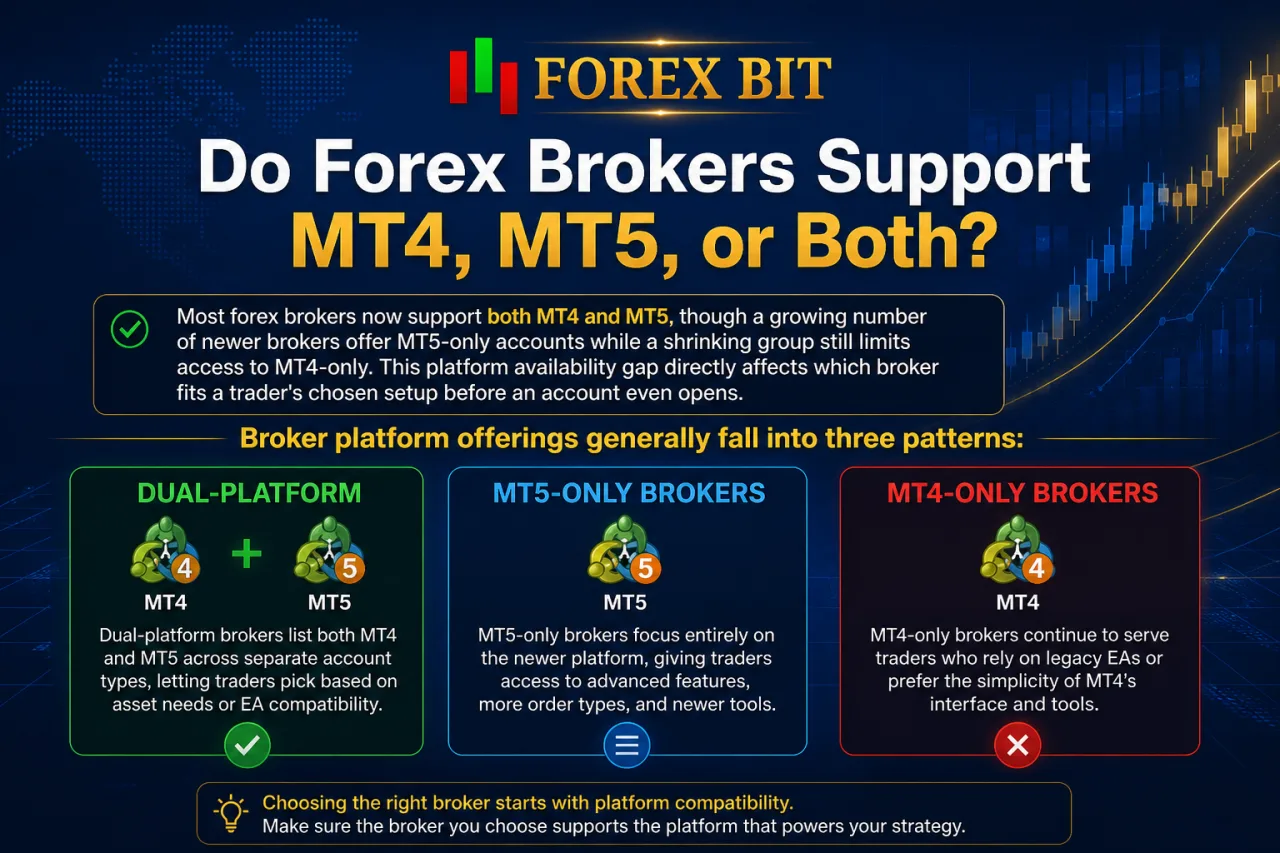
Most forex brokers now support both MT4 and MT5, though a growing number of newer brokers offer MT5-only accounts while a shrinking group still limits access to MT4-only. This platform availability gap directly affects which broker fits a trader’s chosen setup before an account even opens.
Broker platform offerings generally fall into three patterns:
- Dual-platform brokers list both MT4 and MT5 across separate account types, letting traders pick based on asset needs or EA compatibility.
- MT5-only brokers, often newer entrants to the market, skip MT4 entirely and build their account structure around MetaQuotes’ current platform.
- MT4-only brokers represent a shrinking segment, typically firms that built long-standing infrastructure around MQL4-based tools and haven’t transitioned clients to MT5.
Some newer brokerages entering the market since MT5’s release skip MT4 support altogether, offering MT5-only account structures instead.
Traders confirm a broker’s specific platform list, including which account types pair with MT4 versus MT5, before opening an account, since platform support varies by broker rather than following an industry-wide standard.
How to Choose Between MT4 and MT5 Based on Your Trading Style?
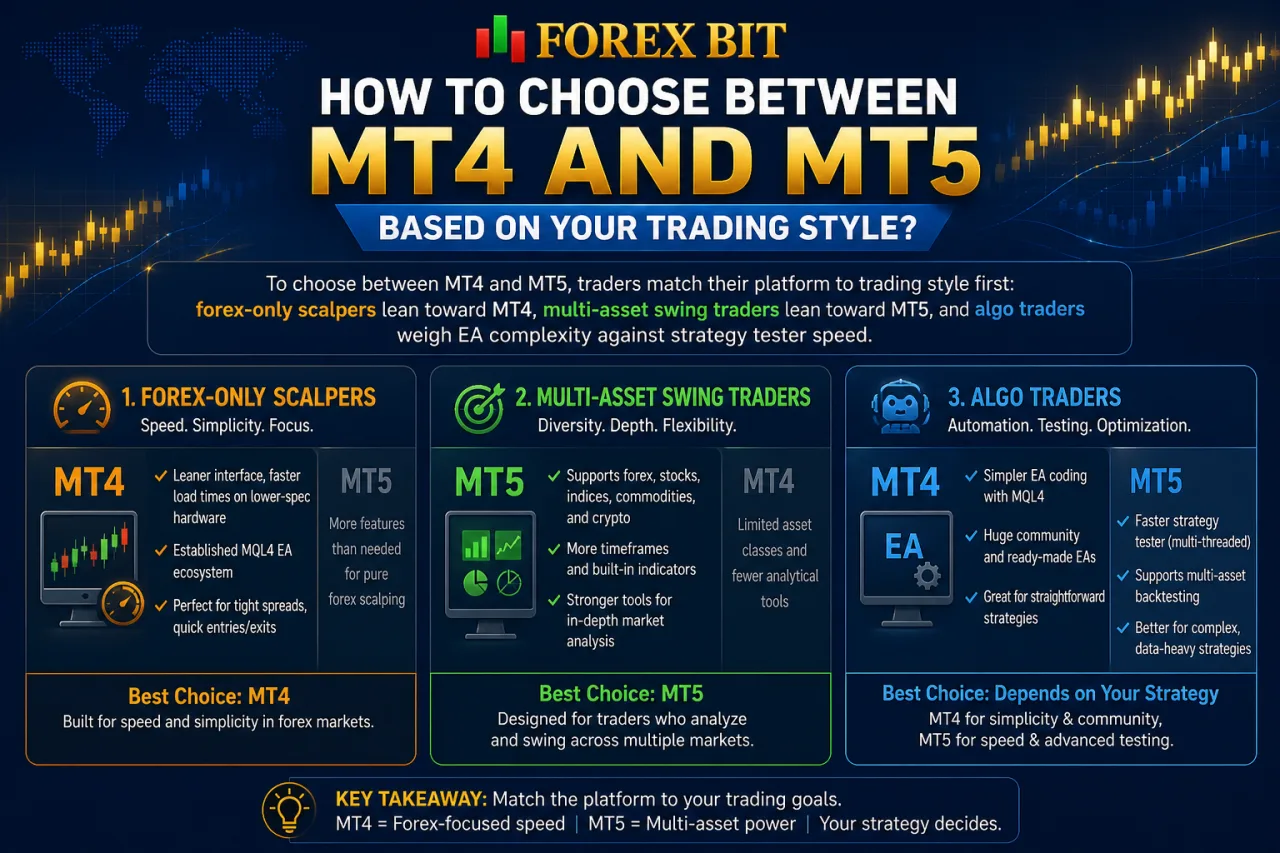
To choose between MT4 and MT5, traders match their platform to trading style first: forex-only scalpers lean toward MT4, multi-asset swing traders lean toward MT5, and algo traders weigh EA complexity against strategy tester speed. This decision framework builds on the platform selection criteria already outlined and narrows the choice down to three trader profiles.
- Forex-only scalpers favor MT4 for its leaner interface, faster load times on lower-spec hardware, and an established MQL4 EA ecosystem built for fast currency-pair execution.
- Multi-asset swing traders favor MT5 for its access to stocks, futures, and options alongside forex, plus extra timeframes suited to holding positions across longer analysis windows.
- Algo traders running multi-symbol or computationally heavy Expert Advisors favor MT5’s multi-threaded strategy tester, while those maintaining single-pair MQL4 systems keep MT4 without needing to rebuild existing code.
Traders who fall between these profiles, such as a forex trader occasionally adding index CFDs, weigh whether MT5’s broader order types and Depth of Market justify moving away from a familiar MT4 setup. Confirming that a chosen broker actually supports the target platform and account type remains the final step before committing to either terminal.
What Other Technical Distinctions Exist Between MT4 and MT5?
MT4 and MT5 diverge on several niche technical points beyond order types and timeframes, covering position accounting modes, market depth visibility, and account migration paths between the two platforms. These distinctions matter less for casual traders but shape decisions for advanced users running hedged strategies, depth-based execution, or transitioning existing accounts. The following areas cover hedging versus netting support, Depth of Market access, and how brokers handle migration between the two terminals.
What Is the Difference Between Hedging and Netting Modes in MT4 vs MT5?
MT4 supports only hedging mode, while MT5 supports both hedging and netting, giving traders a choice in how opposing positions on the same symbol get recorded. This gap in position accounting shapes how each platform handles multiple trades on one instrument.
Hedging mode allows a trader to hold a buy and a sell position on the same symbol simultaneously, with each position tracked separately alongside its own profit or loss. MT4 runs exclusively on this hedging model, which suits strategies that intentionally offset exposure rather than close out an existing position before opening an opposite one.
MT5 adds netting mode as an alternative, where opposing trades on the same symbol combine into a single net position instead of staying separate. Traders switch between these two modes on MT5 depending on account settings, while MT4 users remain locked into hedging as the only available structure. This distinction affects margin usage on FIFO-based accounts, since hedging and netting rules determine whether offsetting positions can reduce required margin or must be held as separate exposures.
Can You Migrate an MT4 Account or EA to MT5?
Migrating an MT4 account or EA to MT5 works only through manual rebuilding, since MetaQuotes never built native compatibility between MQL4 and MQL5 code. This limitation ties directly into the migration question, since traders cannot simply copy files across platforms and expect them to run.
Practical considerations shape how traders handle this transition:
- Converting an MQL4 Expert Advisor to MQL5 requires rewriting the code manually or using a conversion tool, then testing the output for logic errors before live use.
- Transferring historical trade records between platforms stays limited, since MT4 and MT5 store account history in separate formats that don’t merge automatically.
- Opening a new MT5 account alongside an existing MT4 account lets traders run both terminals in parallel rather than forcing a full switch.
- Keeping MT4 running for existing strategies while testing rebuilt EAs on MT5 reduces disruption to live trading during the transition period.
Brokers offering both platforms typically treat MT4 and MT5 accounts as separate entities requiring individual setup and funding.
Conclusion
The choice between MT4 and MT5 comes down to trading scope and technical needs rather than one platform being universally superior. MT4 remains the sharper tool for forex-only traders and scalpers who value a lean interface and a mature MQL4 EA ecosystem, while MT5 fits multi-asset traders, swing traders, and algo developers who need broader instrument access, extra timeframes, netting mode, and faster multi-threaded backtesting.
Traders running hedged strategies or single-pair EAs have no pressing reason to leave MT4, whereas those expanding into stocks, futures, or options gain clear functional advantages on MT5. Confirming broker support for the target platform and account type remains the deciding factor before committing to either terminal.
Michael Smith is a Forex Broker Comparison Specialist at Forex Bit, focusing on comparing brokers, trading platforms, account types, fees, spreads, commissions, and trading conditions. His work helps readers understand the key differences between providers so they can evaluate brokers based on their own trading needs and preferences.
Email: [email protected]
Best Brokers

Trade with the world’s largest retail broker and benefit from better - than - market conditions.

We offer a superior trading environment that puts traders in the best position to profit.

Trade with the best trading conditions. WIN THE BEST TRADING ACCOUNT AWARD.

Trade global markets with Interactive Brokers – a highly regulated multi-asset broker built for active and professional investors.






Forex Bit provides independent forex broker reviews, comparisons, guides, and industry news to help traders make informed decisions.
Best Brokers
Metatrader 5 Brokers
Metatrader 4 Brokers
Lowest Spread Forex Broker
Regulated Forex Brokers
Forex Copy Trading
Ctrader Brokers
Best Forex Broker For Beginners