
cTrader vs MT5: see which platform wins on interface design, order execution speed, and algo trading tools like cBots and Expert Advisors.
cTrader vs MT5: Interface, Execution & Algo Trading

cTrader and MT5 differ most in three core areas: interface design, order execution, and algorithmic trading tools. cTrader offers a more modern, chart-centric interface with built-in Depth of Market, while MT5 relies on a more traditional multi-window layout familiar to long-time MetaTrader users. Each platform serves different trading priorities, from execution transparency to automation flexibility.
cTrader generally provides more transparent order execution through its native Depth of Market and ECN-style order book visibility. MT5’s execution speed depends heavily on the broker’s server infrastructure and execution model rather than the platform itself.
cTrader is generally considered better suited for algorithmic trading, as its cAlgo platform and cBots are built using the C# programming language. MT5 instead relies on Expert Advisors written in MQL5, a language with a larger existing library of pre-built trading robots than cTrader’s C#-based cBots.
MT5 tends to feel more approachable for beginners due to its widespread broker support and abundance of tutorials, while cTrader’s cleaner design appeals more to advanced traders focused on execution detail. Both platforms cater to different skill levels rather than one being universally superior.
Forex Bit breaks down these differences in detail, starting with how cTrader vs MT5 compares on overall platform performance before diving into interface design, which is examined next.
cTrader vs MT5: Which Platform Wins on Interface, Execution, and Algo Trading?
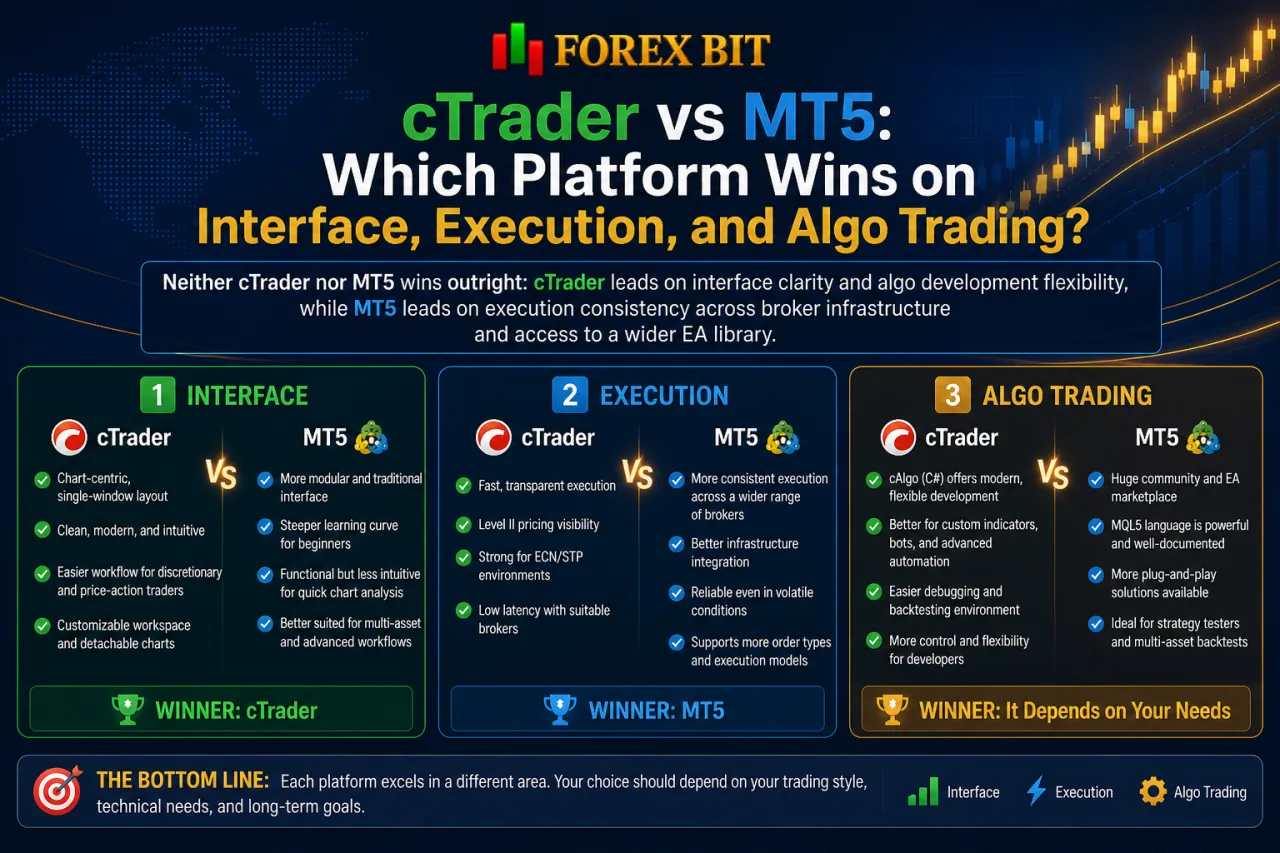
Neither cTrader nor MT5 wins outright: cTrader leads on interface clarity and algo development flexibility, while MT5 leads on execution consistency across broker infrastructure and access to a wider EA library. This comparison revisits the same three axes framed earlier: interface design, order execution, and algorithmic trading tools.
Each axis favors a different type of trader rather than pointing to one universal winner.
- Interface: cTrader’s chart-centric, single-window layout suits traders who prioritize visual clarity and built-in Depth of Market.
- Execution: cTrader’s ECN-style order book adds transparency, though MT5’s actual execution speed depends more on the broker’s servers than the platform itself.
- Algo trading: cTrader’s C#-based cBots appeal to developers wanting modern coding tools, while MT5’s MQL5 ecosystem offers a larger existing library of ready-made Expert Advisors.
No single broker-agnostic verdict applies to every trader, since platform choice ultimately depends on whether interface comfort, execution transparency, or automation depth matters most.
How Do the cTrader and MT5 Interfaces Compare for Traders?
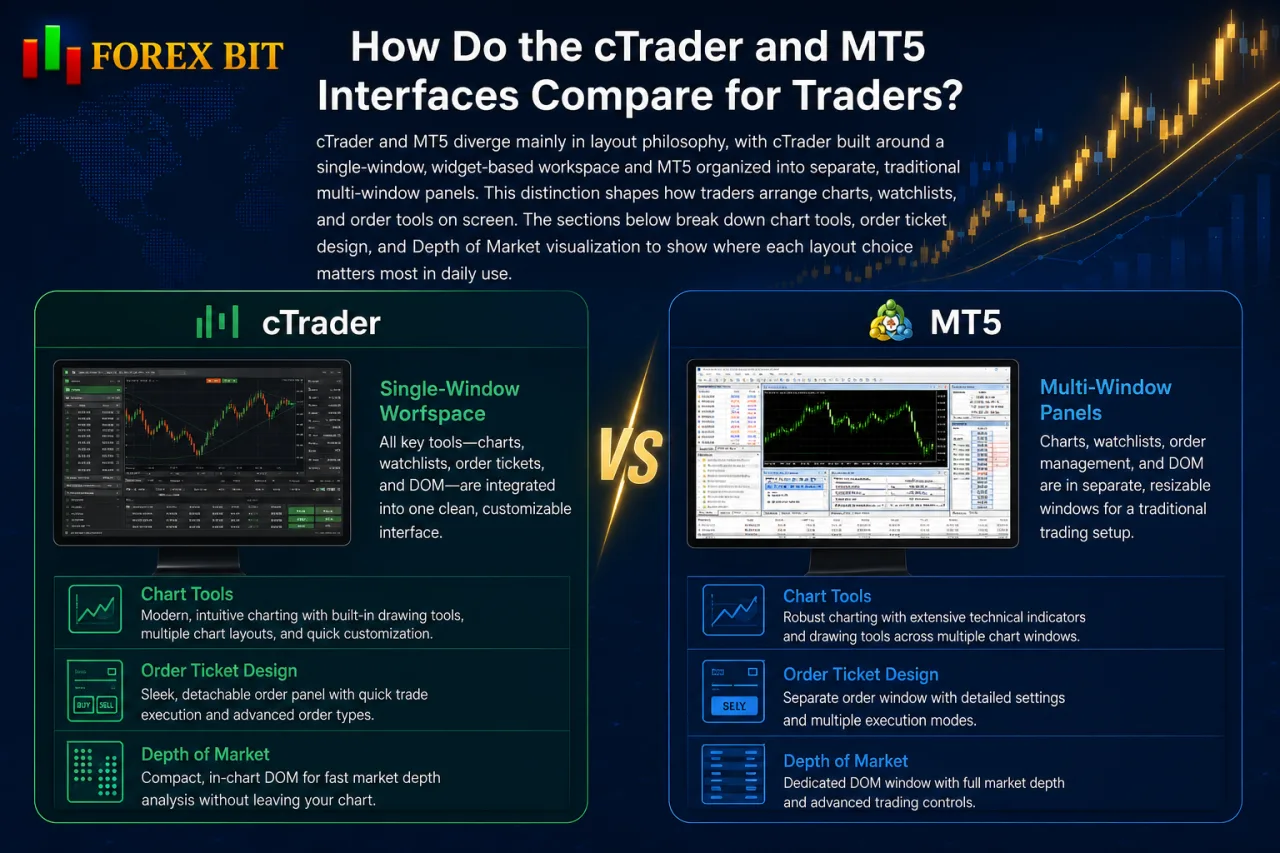
cTrader and MT5 diverge mainly in layout philosophy, with cTrader built around a single-window, widget-based workspace and MT5 organized into separate, traditional multi-window panels. This distinction shapes how traders arrange charts, watchlists, and order tools on screen. The sections below break down chart tools, order ticket design, and Depth of Market visualization to show where each layout choice matters most in daily use.
Is cTrader More Beginner-Friendly Than MT5?
MT5 is generally more beginner-friendly than cTrader for new traders, mainly due to its familiar layout, wider broker adoption, and larger pool of learning resources. This question of ease of use ties directly into the interface differences already outlined between the two platforms.
Several factors explain why MT5 tends to feel easier for newcomers:
- Onboarding: MT5 ships with default templates and pre-set workspace layouts that mirror MT4, reducing setup time for traders switching between MetaTrader versions.
- Learning resources: MT5’s long-standing presence across brokers means new traders find more tutorials, forums, and video guides covering its menus and order types.
- Visual clarity: cTrader’s single-window, chart-centric design presents fewer cluttered panels, which experienced traders read faster but which can feel sparse to someone unfamiliar with Depth of Market tools.
Experienced traders often prefer cTrader once they understand order flow, since its cleaner layout removes navigation steps needed in MT5’s multi-window structure. Beginners without prior MetaTrader exposure may still find cTrader’s interface approachable, but MT5’s broader tutorial base and default templates lower the initial learning curve more consistently across skill levels.
How Does Chart Customization Differ Between cTrader and MT5?
cTrader offers fewer built-in indicators but deeper drawing tool flexibility, while MT5 ships with a larger default indicator library and more multi-chart layout presets. This charting comparison builds on the earlier layout differences between cTrader’s single-window design and MT5’s multi-window structure.
Both platforms cover the core charting needs of most traders, but the depth and organization of tools differ in a few key ways:
- Indicators: MT5 includes a broader set of built-in technical indicators out of the box, while cTrader relies more on its cTDN marketplace for extended indicator variety.
- Timeframes: MT5 offers more preset timeframe options by default, whereas cTrader supports custom timeframes that traders can define beyond the standard presets.
- Multi-chart layouts: MT5’s multi-window structure makes arranging several chart templates across separate windows more straightforward for traders managing multiple instruments.
- Drawing tools: cTrader’s drawing tool set includes flexible object styling and layering options that suit traders who annotate charts extensively.
Traders who value a large stock of ready-made indicators tend to favor MT5, while those who prioritize precise chart annotation and custom timeframe control often prefer cTrader.
cTrader vs MT5: Which Offers Better Order Execution?
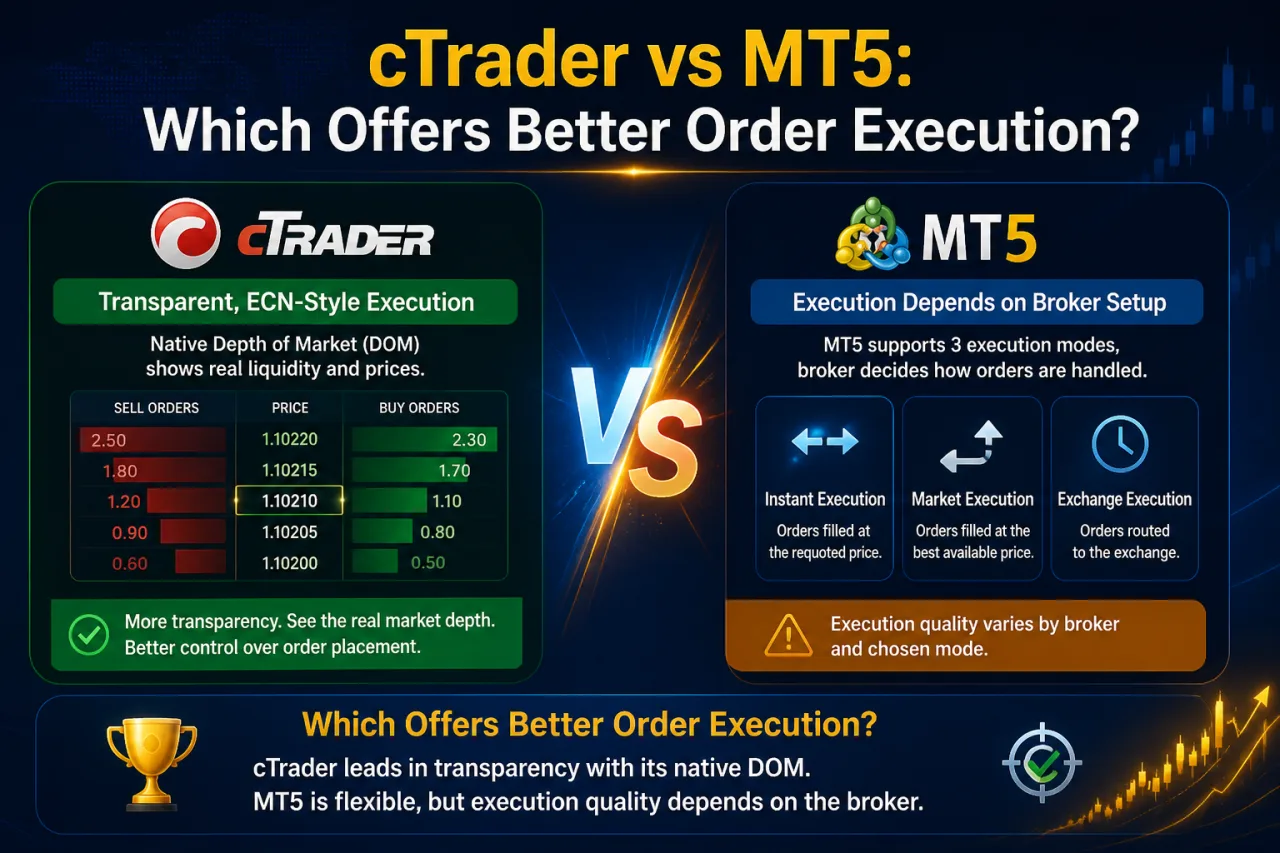
cTrader generally offers more transparent order execution through its native ECN-style Depth of Market, while MT5’s execution quality depends on which of its three execution modes the broker configures. This execution comparison extends the interface differences already discussed, moving now from screen layout into how each platform actually routes and fills orders.
cTrader and MT5 approach execution transparency from different angles rather than sharing one identical model. The distinction covers how Depth of Market functions and how MT5’s execution modes vary by broker setup.
- Depth of Market: cTrader displays Level II pricing natively, letting traders see aggregated bid and ask volumes across price levels before placing an order.
- Order book visibility: cTrader’s DOM feature exposes liquidity depth directly on the trading interface without requiring third-party plugins.
- Execution modes: MT5 supports Instant Execution, Market Execution, and Exchange Execution, with the broker selecting which mode applies to a given account type.
- Slippage handling: MT5’s slippage behavior varies by execution mode and broker infrastructure, while cTrader’s order book transparency lets traders assess liquidity conditions before submitting an order.
Because MT5’s execution outcome hinges largely on broker-side server configuration rather than the platform’s own design, comparing execution quality between the two platforms requires accounting for the specific broker offering each one.
What Order Types Are Available on cTrader and MT5?
cTrader and MT5 both support five core order types (market, limit, stop, stop-limit, and trailing stop), though cTrader adds guaranteed stop loss protection on select instruments while MT5’s order set stays limited to its standard configurations. This order type comparison follows directly from the execution differences already outlined between the two platforms.
Both platforms cover the same fundamental order categories traders rely on for entries, exits, and risk management, but the protective features layered on top differ:
- Market orders: both platforms fill at the current available price with no pending conditions.
- Limit orders: both platforms let traders set a target entry or exit price better than the current market rate.
- Stop orders: both platforms trigger a market order once price reaches a specified level.
- Stop-limit orders: both platforms combine a trigger price with a defined limit price for more controlled execution.
- Trailing stop: both platforms adjust the stop level automatically as price moves favorably.
Some brokers offer guaranteed stop loss on certain instruments through cTrader, locking in an exit price regardless of slippage or gapping conditions. MT5 does not include a native guaranteed stop loss feature, leaving standard stop orders exposed to slippage during volatile market moves.
Does cTrader Provide More Transparent Depth of Market Than MT5?
Yes, cTrader provides more transparent Depth of Market than MT5, since DOM ships as a native, standardized feature across every cTrader broker, while MT5’s DOM depth and availability shift with each broker’s liquidity setup. This transparency question follows directly from the execution modes and order types already outlined for both platforms.
The gap comes down to how each platform sources and displays order book data:
- Consistency: cTrader’s Level II DOM appears the same way across brokers, since the platform itself renders the order book rather than relying on broker-side add-ons.
- Variability: MT5’s DOM feature exists in the platform, but the actual liquidity depth shown depends on which liquidity providers a broker connects to the account.
- Access: cTrader traders see aggregated bid and ask volumes by default, while MT5 traders sometimes find DOM disabled or limited on certain account types.
- Configuration: brokers offering MT5 on a dealing-desk or hybrid model often restrict DOM visibility, whereas cTrader’s ECN-oriented design keeps the order book exposed by default.
Traders comparing liquidity transparency between the two platforms find cTrader’s DOM behaves predictably regardless of broker, while MT5’s DOM transparency requires checking each broker’s specific liquidity arrangement beforehand.
cTrader cAlgo vs MT5 Expert Advisors: Which Is Better for Algo Trading?
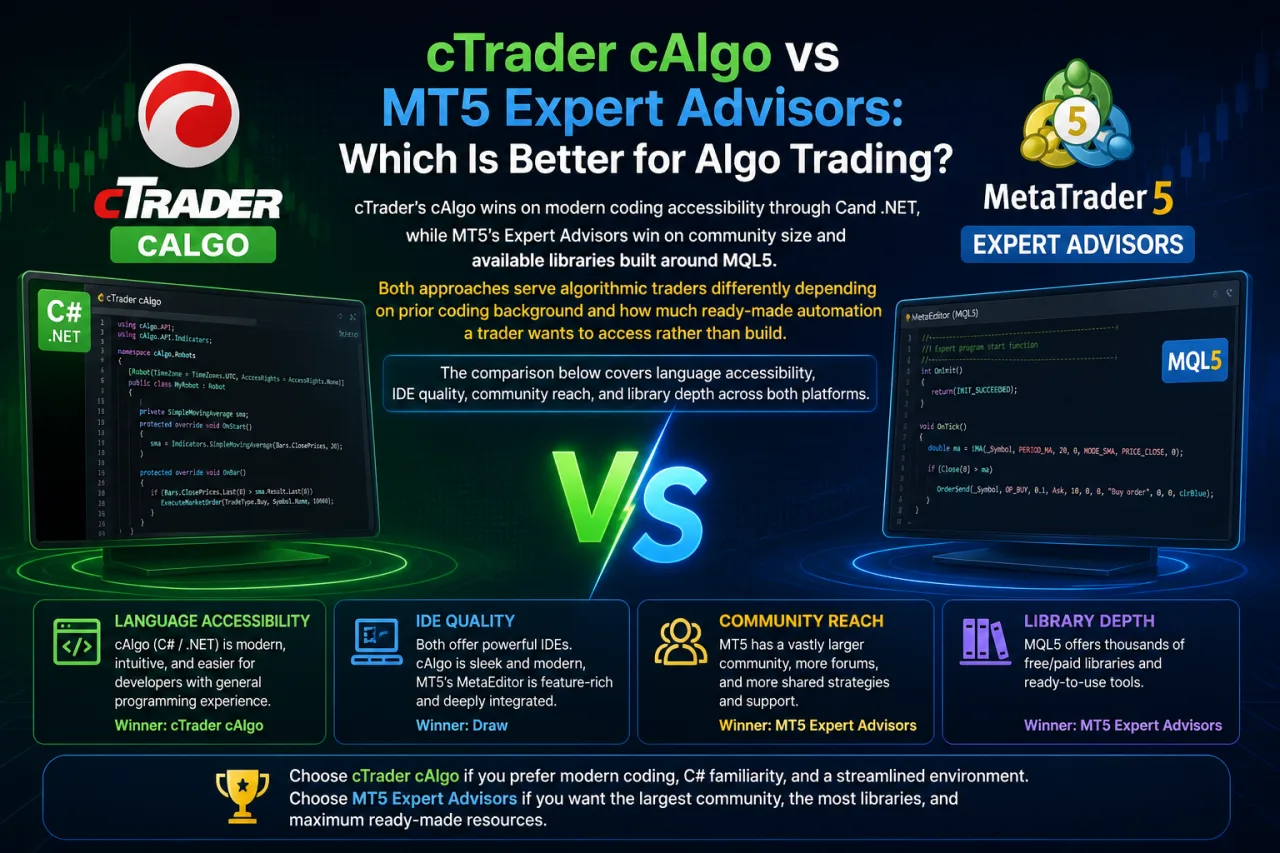
cTrader’s cAlgo wins on modern coding accessibility through C# and .NET, while MT5’s Expert Advisors win on community size and available libraries built around MQL5. Both approaches serve algorithmic traders differently depending on prior coding background and how much ready-made automation a trader wants to access rather than build. The comparison below covers language accessibility, IDE quality, community reach, and library depth across both platforms.
What Programming Language Do cTrader and MT5 Use for Automated Trading?
cAlgo runs on C# within the .NET framework, while MT5’s Expert Advisors run on MQL5, a language built with C++-like syntax. This language distinction shapes how each platform’s automated trading tools are built and who finds them easier to pick up.
The barrier to entry differs between the two languages in a few key ways:
- Accessibility: C# counts as a widely taught general-purpose language, so developers with prior programming background in web, desktop, or enterprise software transition into cAlgo development without learning a trading-specific syntax first.
- Specialization: MQL5 stays purpose-built for trading, meaning traders without coding experience learn only what applies to Expert Advisor logic rather than a broader language ecosystem.
- Tooling: cAlgo’s C# base connects to standard .NET development environments and debugging tools already familiar to mainstream software developers.
- Ecosystem: MQL5’s syntax borrows from C++, giving traders with prior C-family coding experience a shorter learning curve toward writing EAs.
Developers with existing general-purpose programming skills find C# in cAlgo more transferable outside trading, while traders focused solely on Expert Advisor development often adapt to MQL5’s narrower, trading-specific scope just as quickly.
Is Backtesting More Accurate on cTrader or MT5?
cTrader generally delivers more accurate backtesting than MT5 for strategies sensitive to fill quality, since cAlgo’s backtesting engine applies tick-by-tick historical data by default while MT5’s Strategy Tester requires manual configuration to reach comparable precision. This backtesting question follows directly from the execution and algo trading differences already outlined between cAlgo and MT5’s Expert Advisors.
Accuracy differences between the two engines come down to how each sources and processes historical price data:
- Data granularity: cAlgo’s backtester runs on real tick data pulled from the broker’s historical feed, reducing the gap between simulated and live fills.
- Configuration effort: MT5’s Strategy Tester reaches similar tick-level accuracy only when set to “Every tick based on real ticks” mode, since lower modes rely on generated or interpolated ticks.
- Optimization tools: MT5 includes a built-in genetic optimization algorithm for testing parameter ranges across large datasets, a feature cAlgo does not offer natively.
- Historical depth: MT5’s available historical data range depends on the broker’s server retention policy rather than a fixed platform limit.
Traders optimizing large parameter sets often lean on MT5 for its genetic algorithm, while those prioritizing realistic fill simulation typically favor cAlgo’s default tick-data approach.
Which Platform Is Better Suited for Different Types of Traders?
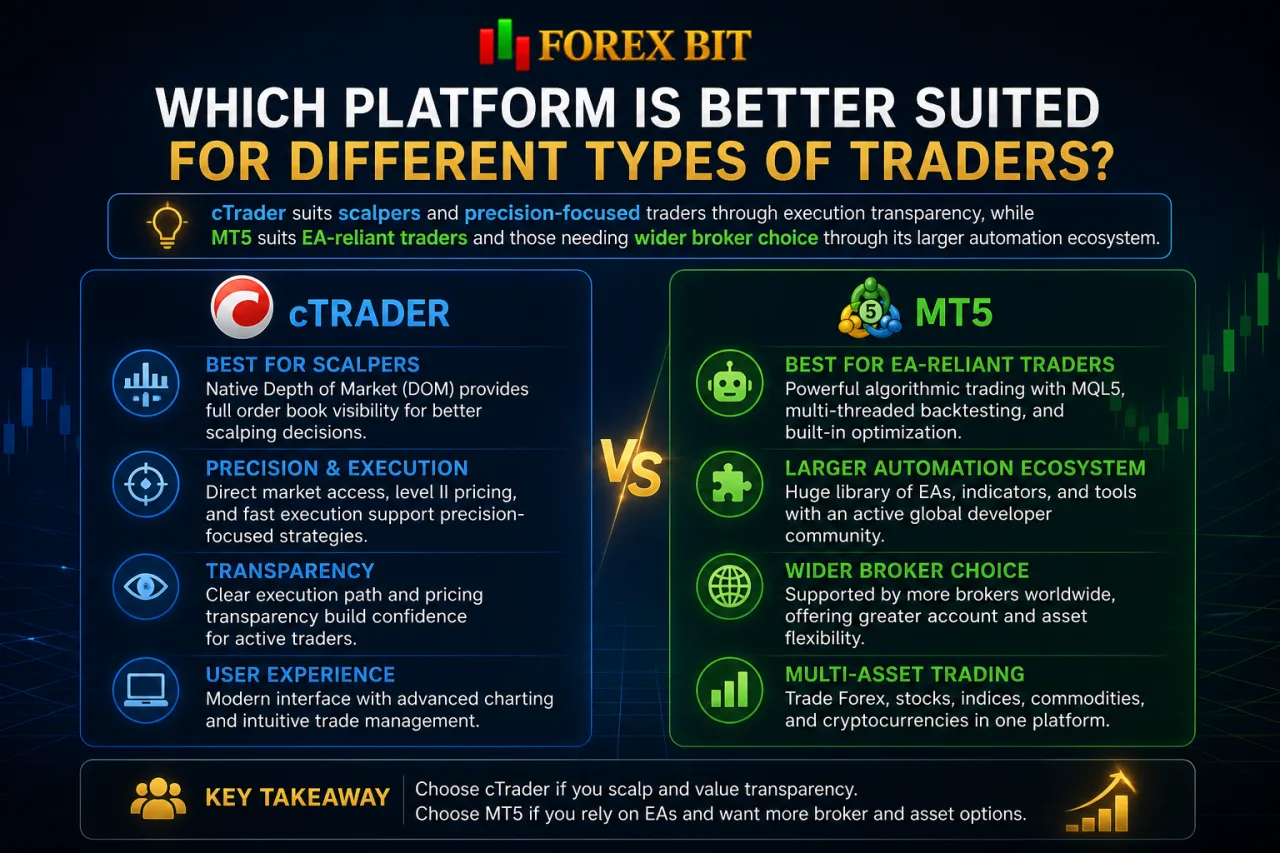
cTrader suits scalpers and precision-focused traders through execution transparency, while MT5 suits EA-reliant traders and those needing wider broker choice through its larger automation ecosystem. This suitability question pulls together the interface, execution, and algo trading differences already outlined for cTrader and MT5.
Trader type shapes which platform fits best more than any single feature comparison:
- Scalpers benefit from cTrader’s native Depth of Market, since order book visibility supports the fast entry and exit decisions scalping strategies depend on.
- Precision traders gravitate toward cTrader’s ECN-style transparency, which exposes liquidity conditions before order placement rather than after.
- EA-reliant traders lean toward MT5, since its MQL5 ecosystem carries a larger existing library of ready-made Expert Advisors than cTrader’s cBots.
- Traders needing broad broker access favor MT5, given its wider adoption across brokers compared to cTrader’s more limited broker footprint.
- Algo developers with general-purpose coding backgrounds prefer cAlgo’s C# and .NET tooling, while developers seeking a purpose-built, trading-specific syntax adapt more easily to MQL5.
No single trader profile fits both platforms equally, since execution transparency and automation depth pull toward different priorities.
What Additional Factors Beyond Interface and Execution Should Traders Consider?
Beyond interface and execution, cTrader and MT5 also diverge on broker availability, copy trading integration, and marketplace ecosystem for indicators and bots. These ecosystem factors shape day-to-day usability just as much as chart layout or order routing once a trader settles on a broker offering either platform. The subsections below cover how broker adoption, social trading tools, and add-on marketplaces differ across cTrader and MT5.
How Does Broker Availability Differ Between cTrader and MT5?
MT5 counts far broader broker adoption than cTrader, since most retail and multi-asset brokers worldwide list MT5 among their platform options, while cTrader remains concentrated among a smaller, ECN-focused set of brokers. This distribution gap connects directly to the algo trading and ecosystem differences already outlined for both platforms.
The practical impact plays out in a few clear ways:
- Choice: traders comparing brokers find MT5 offered nearly everywhere, giving wider flexibility in selecting account types, regulatory jurisdictions, and promotional terms.
- Positioning: cTrader brokers skew toward ECN and raw-spread pricing models, appealing to traders who already prioritize execution transparency over broad broker selection.
- Switching: traders moving between brokers encounter MT5 consistently, whereas relocating to a cTrader-only broker sometimes narrows the available list of regulated options.
- Specialization: cTrader’s smaller broker footprint reflects its focus on transparent order execution rather than mass-market distribution.
Traders prioritizing broker variety and regulatory choice generally find MT5 easier to access, while traders who value ECN-style execution accept a narrower broker list by choosing cTrader.
Which Platform Has a Stronger Copy Trading and Bot Marketplace Ecosystem?
MT5’s ecosystem carries a larger combined footprint through Signals and MQL5 Market, while cTrader’s ecosystem stays smaller but concentrated around cTrader Copy and the cAlgo bot store. This ecosystem comparison follows directly from the broker adoption gap already outlined between the two platforms.
The two ecosystems differ in reach and monetization structure rather than core functionality:
- Copy trading: cTrader Copy connects strategy providers and followers directly within the platform, while MT5 Signals distributes strategies through a subscription model tied to the broader MetaQuotes network.
- Bot marketplace: cAlgo’s bot store lists cBots built in C#, while MQL5 Market and Code Base host a wider stock of Expert Advisors and indicators built in MQL5.
- Monetization: MT5 developers earn through paid listings on MQL5 Market or subscription fees from Signals providers, while cAlgo developers monetize primarily through direct sales on the cTrader ecosystem’s smaller storefront.
- Reach: MQL5’s larger existing developer base gives MT5 products more exposure than cAlgo’s more limited marketplace audience.
Traders seeking a wider selection of ready-made bots and signal providers generally find MT5’s ecosystem deeper, while developers targeting a smaller, execution-focused audience often choose cTrader’s marketplace instead.
Conclusion
Interface, execution, and algo trading form three separate battlegrounds rather than one clear verdict between cTrader and MT5. cTrader’s chart-centric layout, native Depth of Market, and C#-based cAlgo tools favor scalpers, precision traders, and developers with general-purpose coding backgrounds.
MT5 answers with a familiar multi-window layout, broader broker adoption, and a larger MQL5 library of ready-made Expert Advisors, making it the stronger fit for beginners and EA-reliant traders. Choosing between the two ultimately depends on whether a trader values execution transparency and modern automation flexibility or values ecosystem depth and broker-side accessibility more heavily.
As a Financial Analyst with over 5 years of experience, I focus on analyzing financial data to provide actionable insights and recommendations for investment strategies. My expertise in forecasting and financial modeling has helped businesses optimize their financial performance and mitigate risks.
Email: [email protected]
Best Brokers

Trade with the world’s largest retail broker and benefit from better - than - market conditions.

We offer a superior trading environment that puts traders in the best position to profit.

Trade with the best trading conditions. WIN THE BEST TRADING ACCOUNT AWARD.

Trade global markets with Interactive Brokers – a highly regulated multi-asset broker built for active and professional investors.




Forex Bit provides in-depth analysis of commodities, forex, and stock markets to help traders make informed investment decisions.
Best Brokers
Metatrader 5 Brokers
Metatrader 4 Brokers
Lowest Spread Forex Broker
Regulated Forex Brokers
Forex Copy Trading
Ctrader Brokers
Best Forex Broker For Beginners