
Confused about ECN vs STP? See how spreads, commissions & execution differ so you can pick the right forex account type today.
ECN vs STP: Key Differences Every Forex Trader Must Know

ECN and STP execution models differ mainly in how orders reach the market and who sets the price. ECN brokers route orders directly into a shared liquidity pool where prices come from multiple participants, while STP brokers pass client orders straight to liquidity providers without an internal dealing desk.
ECN accounts typically charge a fixed commission per lot alongside near-zero raw spreads, whereas STP accounts often use wider spreads with no separate commission. This structural difference changes total trading cost depending on trade frequency and volume.
ECN execution suits scalping and high-frequency trading better because it generally offers faster order matching and tighter spreads during high liquidity periods. STP remains workable for lower-frequency strategies but may introduce slightly more slippage under fast market conditions.
Well-known brokers operating ECN or STP models process orders differently at the execution layer, affecting fill speed and price transparency. Forex Bit outlines these distinctions to help traders match execution style with their strategy before opening an account. The breakdown below starts with the core difference ECN vs STP execution models.
What Is the Difference Between ECN and STP Execution Models?
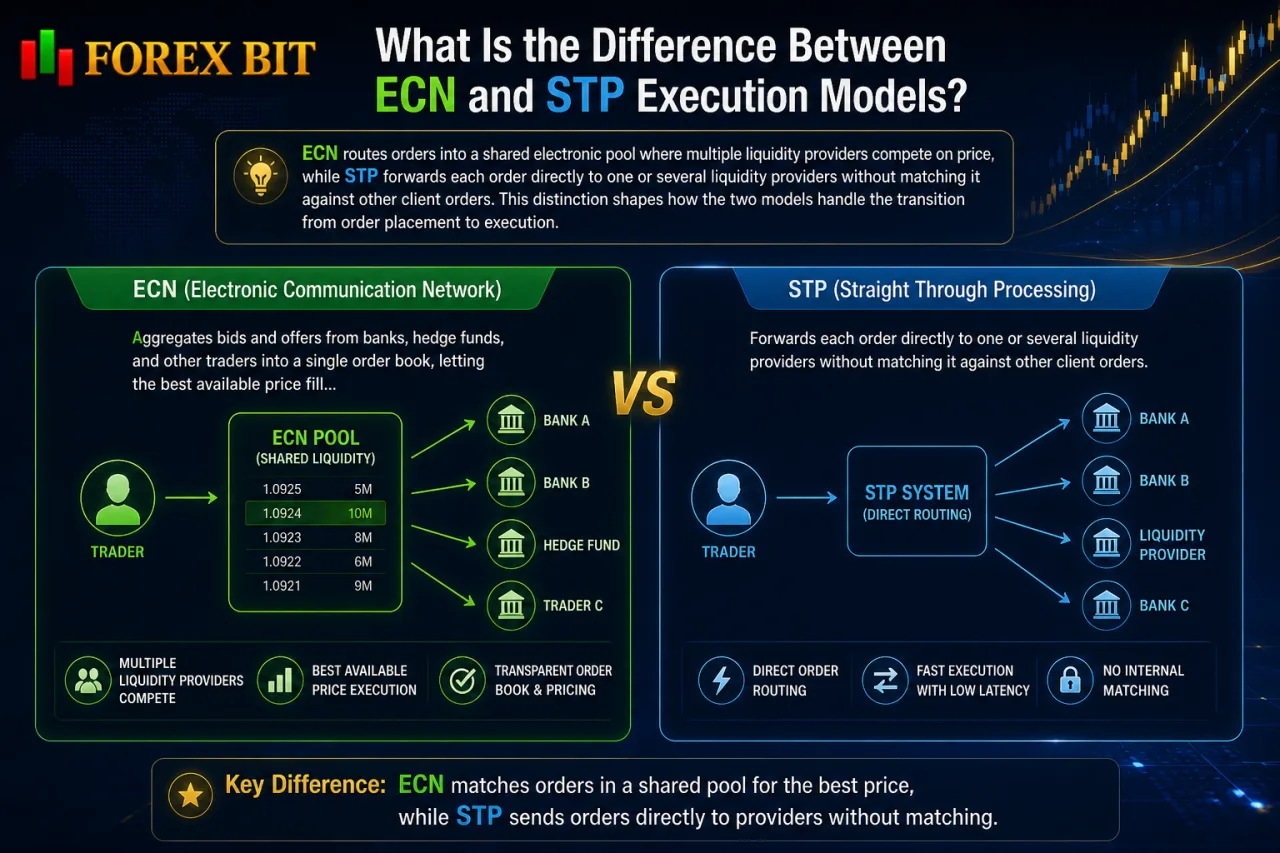
ECN routes orders into a shared pool where multiple providers compete on price, while STP forwards orders directly to one or more providers without matching against other clients. This distinction shapes how the two models handle the transition from order placement to execution.
ECN (Electronic Communication Network) aggregates bids and offers from banks, hedge funds, and other traders into a single order book, letting the best available price fill the trade. STP (Straight Through Processing) forwards orders electronically from the trading platform straight to a liquidity provider or a small group of providers, bypassing any dealing desk intervention. Both models remove manual order handling, but ECN builds price from a competitive pool while STP passes it along from whichever provider the broker connects to. The following sections break down how execution speed, cost structure, and pricing behavior differ between the two.
What Is an ECN Broker?
An ECN broker is a forex broker that connects traders directly to a network of liquidity providers, banks, hedge funds, and other traders through an open electronic order book rather than an internal dealing desk. This structure carries forward the pooled-pricing concept described above.
Orders placed on an ECN account enter a shared marketplace where buy and sell interest from multiple participants matches automatically based on price and volume. The broker acts as a connector rather than a counterparty, displaying real depth-of-market data that shows available liquidity at different price levels.
Because pricing comes from a competitive pool rather than a single source, ECN brokers typically quote raw spreads that can narrow to near zero during active trading sessions and widen when liquidity thins out. Traders using ECN accounts see the same order book that liquidity providers see, which supports transparent price discovery. This model contrasts with STP, where orders route to one or several providers without being matched against a broader open book.
What Is an STP Broker?
An STP broker is a forex broker that forwards client orders directly to one or several liquidity providers electronically, without an internal dealing desk intervening in the fill. This structure keeps order handling automated but changes how price transparency works compared with the pooled book described above.
STP (Straight Through Processing) sends each order from the trading platform to whichever liquidity provider the broker has connected, and that provider fills the trade at its quoted price. The broker does not take the opposite side of the trade, but it also does not display an open order book showing competing bids and offers from multiple participants at once.
This means STP traders see only the price streamed from their broker’s provider network, not the wider depth-of-market view available on an ECN account. Spreads on STP accounts move with the underlying liquidity providers’ pricing but lack the same level of transparency into how that price was formed. The absence of a shared order book is the main structural gap separating STP from the ECN model covered earlier.
How Does Order Execution Work in ECN vs STP?
Order execution differs at the routing level: ECN matches orders anonymously inside a shared book, while STP forwards orders to liquidity providers. The broker selects those providers in advance, and this gap in routing mechanics shapes how a trade actually gets filled once it leaves the trading platform.
On an ECN account, an incoming order enters the electronic order book and matches against the best available counter-order from any connected participant, whether that is a bank, a hedge fund, or another trader. No single provider owns the fill, since price and volume matching happen algorithmically across the whole pool.
On an STP account, the broker’s system picks a destination from its provider network and sends the order there directly, so the fill depends on that specific provider’s quote and available size at the moment of execution. STP does not match orders against other clients, it simply relays them onward. This difference means ECN fills reflect competing interest from many sources, while STP fills reflect the pricing and liquidity of whichever provider handles that particular order.
How Do Spreads, Commissions and Trading Costs Compare Between ECN and STP?
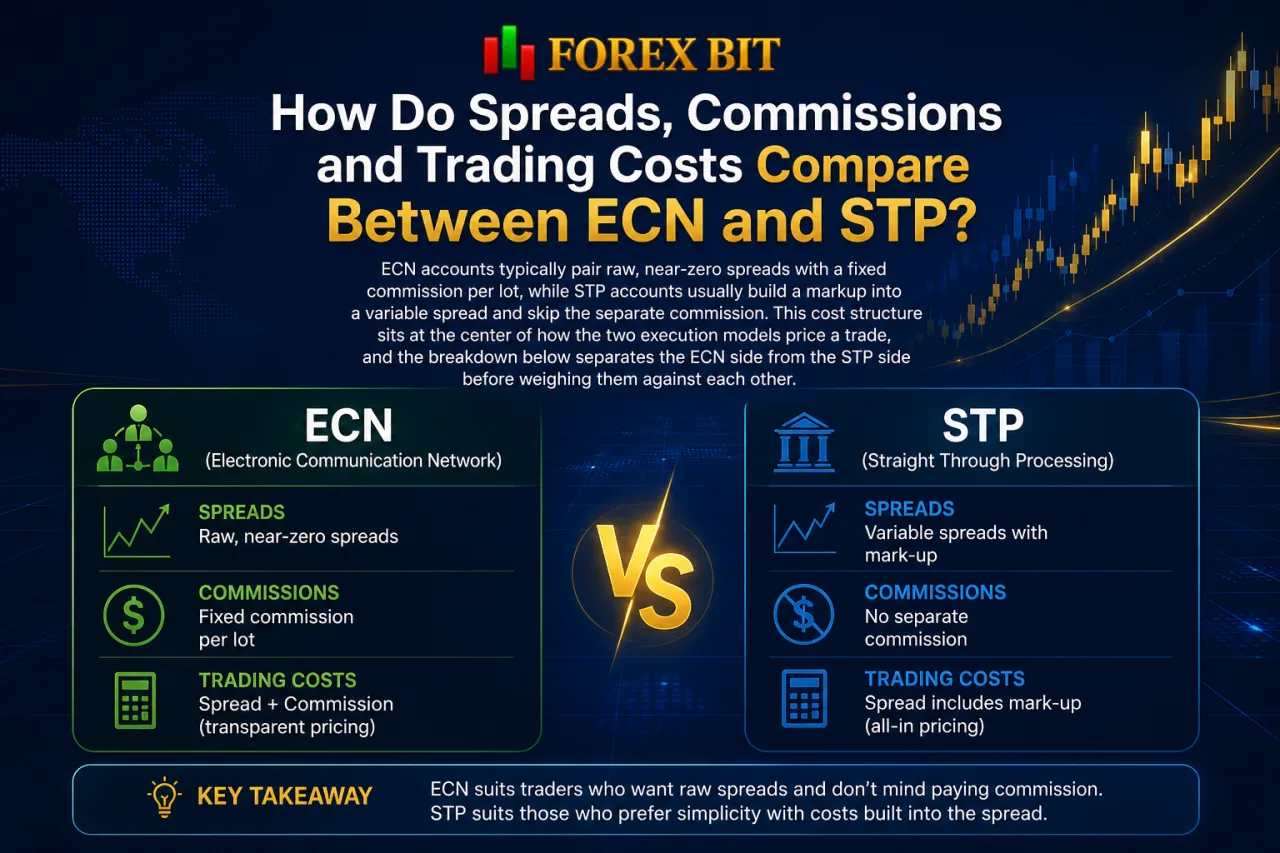
ECN accounts typically pair raw, near-zero spreads with a fixed commission per lot, while STP accounts usually build a markup into a variable spread and skip the separate commission. This cost structure sits at the center of how the two execution models price a trade, and the breakdown below separates the ECN side from the STP side before weighing them against each other.
Which Model Has Lower Spreads, ECN or STP?
ECN typically holds the edge on raw spread size, with major pairs trading near zero pips during liquid hours. This happens because its pooled order book draws on multiple liquidity providers, while STP spreads stay wider since the broker adds a markup on top of the liquidity provider’s quote. This gap in spread size traces directly back to how each model sources and prices liquidity.
ECN spreads compress during high-liquidity trading sessions when multiple providers compete for order flow.
STP spreads rarely reach that same floor, since the provider’s raw price already carries a built-in margin before it even streams to the trader’s platform. That markup replaces the separate commission ECN charges, so STP spread width reflects both market liquidity and the broker’s revenue model at once.
Spread behavior also shifts differently between the two during volatile or low-liquidity periods. ECN spreads can widen sharply when the order book thins out, at times matching or surpassing STP pricing, while STP spreads tend to move more gradually since the provider smooths pricing before it reaches the trader.
Does ECN or STP Charge a Commission?
Yes, ECN charges a commission. Its raw spread model needs a separate fee to cover broker revenue, while STP typically skips a standalone commission and embeds cost into the spread markup instead. This commission structure sits at the core of how each model recovers cost on every trade.
An ECN account charges a fixed fee per lot traded, applied regardless of the instrument’s underlying spread. This per-lot commission on ECN accounts varies from one broker to another, so traders should check the specific pricing schedule published by their broker rather than assume a standard rate.
STP accounts avoid that separate line item, since the liquidity provider’s markup already sits inside the quoted spread before it reaches the trader. This makes STP pricing appear simpler on a trade confirmation, even though the cost still exists within the spread.
Total cost comparison depends on trade size and frequency. Smaller, less frequent trades often land closer in total cost between the two models, while high-volume traders running many lots per day tend to feel the ECN commission more directly, since it scales per lot rather than blending into a spread that may or may not widen.
Which Execution Model Is Better for Scalping and High-Frequency Trading?
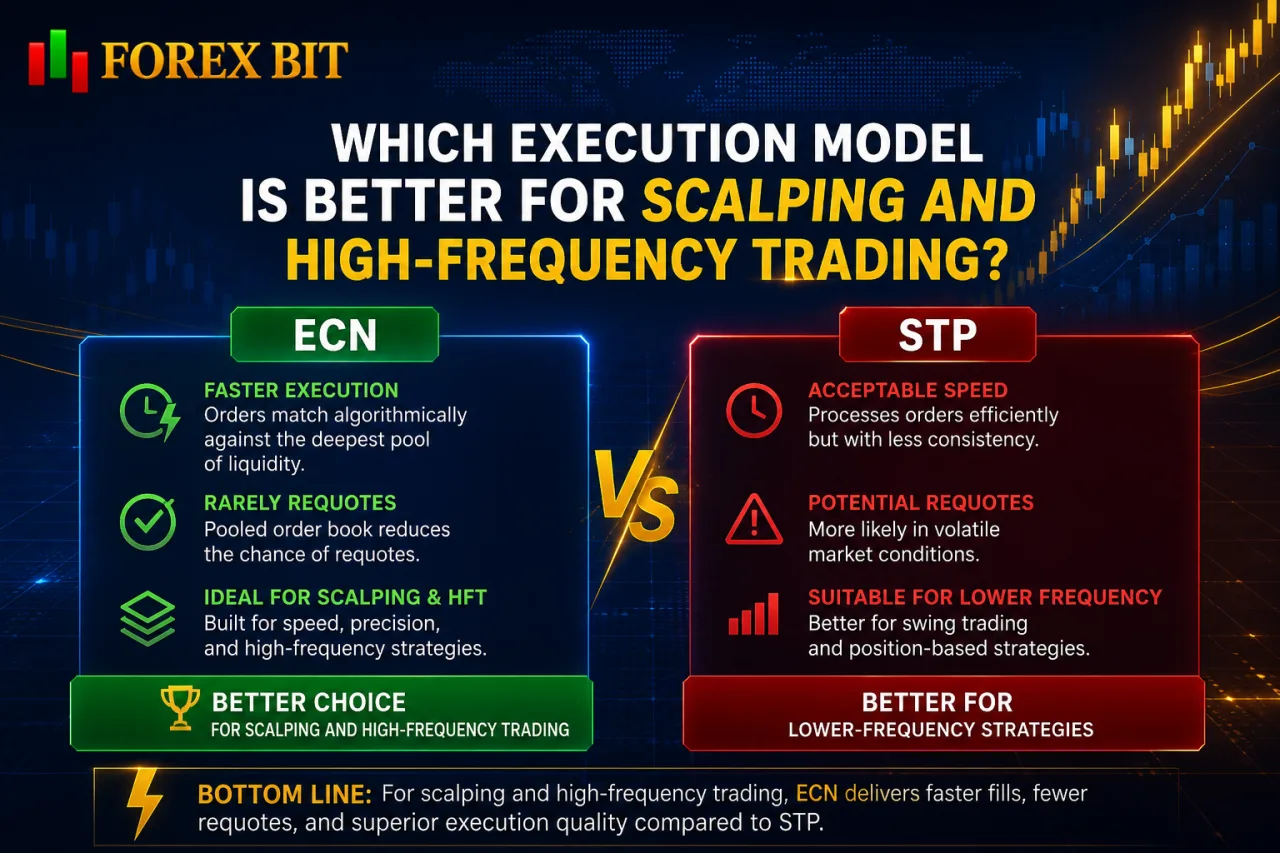
ECN performs better for scalping and high-frequency trading because its pooled order book fills orders faster and rarely triggers requotes. STP handles lower-frequency strategies with acceptable but less consistent speed. This suitability gap connects directly to the execution mechanics and cost structure already outlined for each model.
Execution speed favors ECN since orders match algorithmically against the deepest available pool of counter-orders rather than waiting on a single provider’s quote. Order book depth also plays a role, as ECN’s visible liquidity at multiple price levels lets high-volume strategies gauge fill probability before submitting an order, something STP’s single-stream pricing does not expose.
Requotes and slippage behavior separate the two further:
- ECN rarely issues requotes, since the shared book automatically matches at the next best available price instead of rejecting the order.
- STP produces more frequent requotes or slippage when its connected liquidity provider cannot fill the requested size at the streamed price.
- ECN slippage still occurs during thin liquidity, but the pooled book tends to absorb fast-moving markets more smoothly than a single-provider STP feed.
Scalpers running many trades per day generally value this execution consistency over the STP’s simpler, commission-free pricing.
Is ECN Better Suited for Scalping Than STP?
Yes, ECN suits scalping better than STP because its pooled liquidity, tighter spreads, and fewer requotes handle rapid order flow more consistently. This directly extends the execution and cost gaps already outlined between the two models.
Deep liquidity from multiple providers lets an ECN book absorb frequent small orders without the price gaps that single-provider STP feeds sometimes produce. Tight raw spreads on major pairs during active sessions also keep per-trade cost predictable for a strategy that depends on many small price movements.
Some brokers add a further distinction beyond execution quality: Some STP account terms explicitly prohibit or restrict scalping, while ECN accounts generally permit it without added conditions.
This restriction stems from how STP brokers manage exposure with their liquidity providers, since rapid in-and-out orders on a markup-based spread can strain that relationship. ECN’s commission-based, pooled-book structure avoids that conflict, making it the more accommodating model for scalpers.
How Does Slippage and Order Speed Differ Between ECN and STP?
ECN delivers lower latency and fewer requotes than STP. STP carries higher slippage risk during high volatility because its single-provider feed cannot always match the streamed price. This gap in speed and slippage behavior builds directly on the requote pattern already outlined between the two models.
Latency stays lower on ECN because the order matches instantly against whichever counter-order sits in the pooled book, without waiting on one provider to confirm size and price. STP latency depends on the responsiveness of the specific liquidity provider handling that order, which adds a step the ECN book skips entirely.
News events and volatility spikes widen this gap further:
- ECN spreads stretch during thin liquidity but the pooled book still absorbs sudden order flow without rejecting trades outright.
- STP feeds face a higher chance of slippage when the connected provider cannot fill the requested size at the quoted price during a fast-moving release.
- STP requote frequency rises in these moments since the single-provider stream has less depth to draw from than ECN’s multi-source book.
Traders active around scheduled news releases generally see more consistent fill behavior on ECN than on STP.
What Are Examples of ECN and STP Brokers?
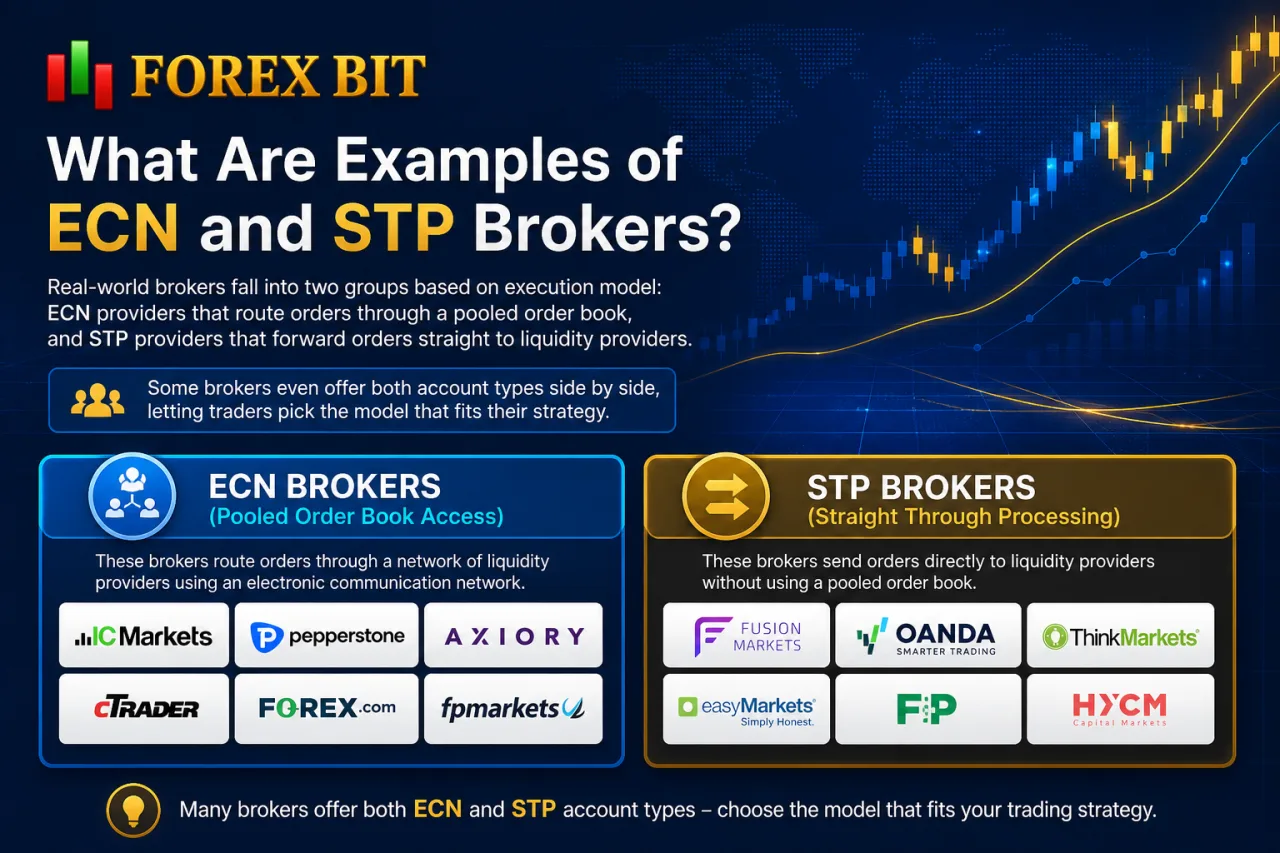
Real-world brokers fall into two groups based on execution model: ECN providers that route orders through a pooled order book, and STP providers that forward orders straight to liquidity providers. This grouping builds directly on the execution and cost differences already outlined between the two models. Some brokers even offer both account types side by side, letting traders pick the model that fits their strategy. The examples below separate brokers generally associated with ECN-style execution from those generally associated with STP-style execution.
| Execution Model | Example Brokers |
|---|---|
| ECN | Pepperstone, IC Markets |
| STP | XM, FXTM |
The broker names above are commonly cited in the industry as representative of each execution model, based on their published account specifications. Offerings and licensing change over time, and account naming does not always match the underlying model exactly, since some brokers label a hybrid ECN/STP account under a single product name.
For this reason, traders are advised to confirm the current execution model, licensing status, and account specifications directly on each broker’s official website before opening an account. This single check remains the most reliable way to categorize a specific broker offering.
Which Brokers Offer ECN Accounts?
Brokers known for ECN account offerings include a group of firms that route orders through a pooled liquidity book rather than an internal dealing desk, though specific broker names should be verified directly with each provider before trading.
This grouping extends the earlier example table into named firms, along with their regulatory backing and account minimums where that data holds up to verification. Firms such as IC Markets and Pepperstone are commonly cited in this ECN grouping. Regulatory status and minimum deposit requirements vary broker to broker even within the ECN grouping, since each firm sets its own licensing jurisdiction and account entry threshold.
IC Markets operates under multiple regulatory licenses across different jurisdictions, and its ECN account minimum deposit is published directly on its official account page. Pepperstone similarly holds regulatory licensing in more than one jurisdiction, with its own published ECN account minimum. Exact figures for both firms shift over time, so the published account page for each broker remains the accurate reference point.
Traders confirming a specific firm’s ECN classification typically cross-check three details before opening an account:
- Reviewing the account specification page for confirmation of raw spread and per-lot commission pricing.
- Verifying the broker’s regulatory license number against the relevant financial authority’s public register.
- Checking the published minimum deposit figure directly on the broker’s official ECN account page.
Account minimums and licensing details shift over time, so confirming current figures directly with each broker remains the most reliable step before funding an ECN account.
Which Brokers Offer STP Accounts?
Brokers known for STP account offerings include a group of firms that forward orders directly to liquidity providers rather than matching them through a pooled book, though traders should verify current regulatory status and minimum deposit details directly with each provider before opening an account.
This grouping extends the earlier example table into named firms. XM operates its STP-style accounts under multiple regulatory licenses, including oversight from established financial authorities in different jurisdictions, and publishes a minimum deposit figure that sits at an accessible entry level for retail traders. FXTM likewise offers an STP account variant under its own regulatory licenses, with a published minimum deposit positioned to suit traders starting with a smaller capital base.
Regulatory status and minimum deposit requirements vary broker to broker even within the STP grouping, since each firm sets its own licensing jurisdiction and account entry threshold, so traders should verify current details directly with each provider before opening an account.
Traders confirming a specific firm’s STP classification typically cross-check three details before opening an account:
- Reviewing the account specification page for confirmation of variable spread pricing and the absence of a separate commission line.
- Verifying the broker’s regulatory license number against the relevant financial authority’s public register.
- Checking the published minimum deposit figure directly on the broker’s official STP account page.
Account minimums and licensing details shift over time, so confirming current figures directly with each broker remains the most reliable step before funding an STP account.
Which Model Should You Choose: ECN or STP?
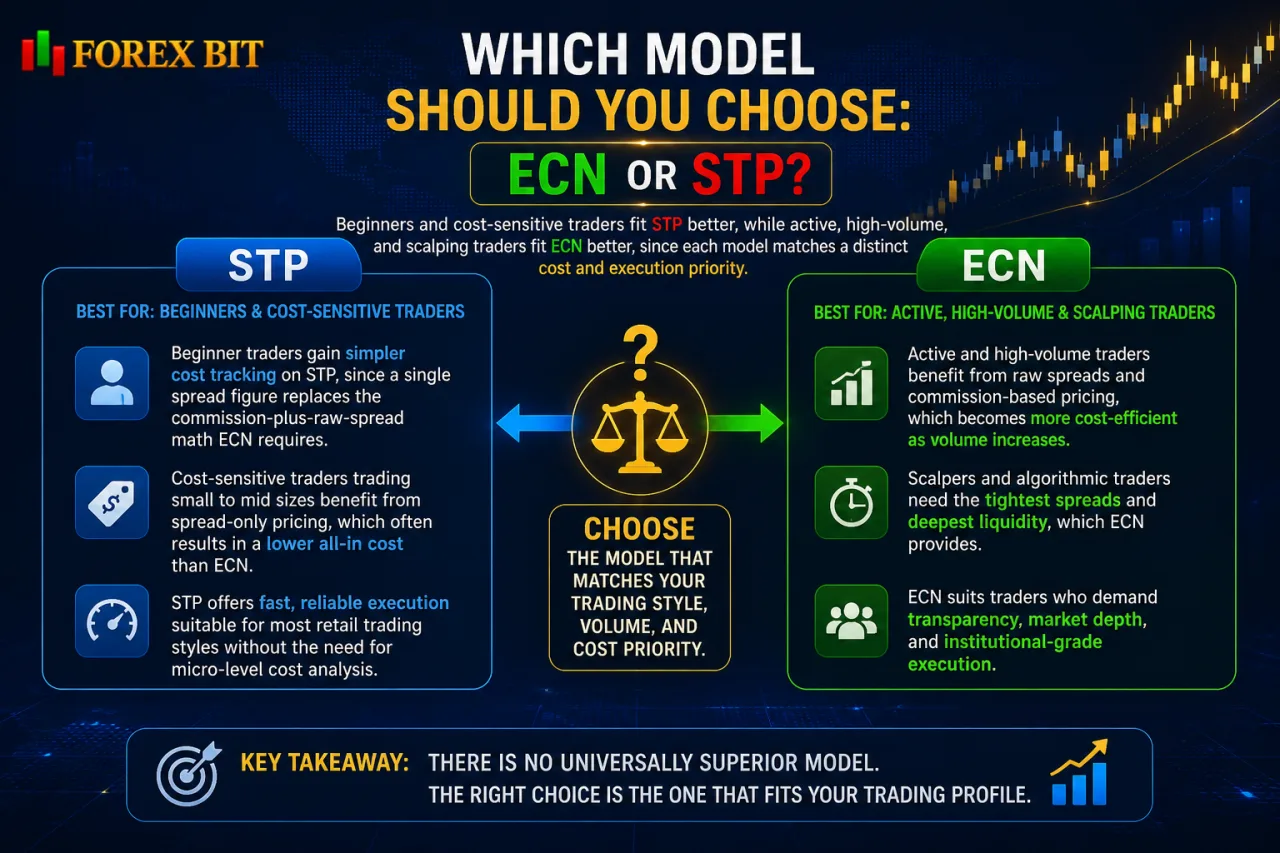
Beginners and cost-sensitive traders fit STP better, while active, high-volume, and scalping traders fit ECN better. Each model matches a distinct cost and execution priority. This closes out the ECN versus STP comparison by matching trader profile to execution model rather than declaring one universally superior.
- Beginner traders gain simpler cost tracking on STP, since a single spread figure replaces the commission-plus-raw-spread math ECN requires.
- Cost-sensitive traders trading small, infrequent volumes often find STP’s blended spread cost comparable to ECN’s combined spread-plus-commission total.
- Active traders and scalpers gain more from ECN’s pooled liquidity, tighter raw spreads during peak sessions, and lower requote frequency.
- High-volume traders running many lots per day benefit from ECN’s per-lot commission structure, which stays predictable regardless of spread widening.
Traders working around scheduled news releases also lean toward ECN, given its more consistent fill behavior under fast-moving conditions already outlined earlier. The final choice still depends on confirming a specific broker’s account terms, licensing, and minimum deposit before funding either account type.
What Other Factors Extend the ECN vs STP Comparison?
The ECN vs STP comparison extends into three additional areas. These are hybrid ECN/STP account models, the bridge and liquidity-aggregation technology behind execution, and how regulatory disclosure rules affect execution transparency. These layers sit beneath the spread, commission, and speed differences already outlined and shape how reliably a broker’s stated execution model matches its actual order handling. The sections below break down each area in turn.
What Is a Hybrid ECN/STP Model?
A hybrid ECN/STP model is a broker execution setup that matches orders inside a pooled book when depth allows, then routes overflow or thin-liquidity orders straight to a liquidity provider the way STP does. This blend combines ECN’s competitive pricing with STP’s fallback routing rather than relying on a single execution path.
Brokers running this hybrid typically switch execution method based on instrument liquidity, order size, or time of day. A major pair during peak hours may fill through the pooled book while an exotic pair or an off-hours order routes through a single provider instead.
Identifying such an account requires checking the broker’s execution disclosure or account specification page rather than assuming from the account name alone. Some brokers label a hybrid ECN/STP account under a single product name without separating the two execution paths in marketing material, so traders should review each broker’s execution disclosures directly before assuming which model applies.
How Does Liquidity Aggregation Technology Affect ECN vs STP Execution Quality?
Liquidity aggregation technology improves ECN and STP execution quality by pooling live quotes from multiple providers through a bridge, which narrows effective spreads and reduces the chance of a rejected or slipped order. This bridge layer sits underneath the account label already discussed and often matters more to fill quality than whether a broker markets the account as ECN or STP.
A bridge connects the trading platform to several banks and non-bank liquidity providers at once, then feeds the best composite price back to the trader in real time. More connected providers behind the bridge generally produce tighter effective pricing and deeper available volume at each price level, since the system always selects from a wider pool rather than a single feed.
Traders verifying execution quality behind the marketing label typically check:
- Requesting the broker’s number of connected liquidity providers.
- Reviewing published execution statistics such as average slippage or fill rate, where a broker discloses them.
- Testing fill behavior on a live or demo account during high-volatility periods to observe requote frequency.
Some regulatory frameworks require brokers to publish execution quality reports, and where such reports exist they offer a useful window into how aggregation technology performs in practice.
Conclusion
The core distinction between ECN and STP comes down to how each model sources price and fills an order: a pooled book matching multiple participants versus a direct line to one or several liquidity providers. That structural gap explains why ECN pairs raw spreads with a per-lot commission and delivers faster, more consistent fills for scalping and high-frequency strategies, while STP embeds cost into a wider spread and offers simpler, commission-free pricing suited to beginners and lower-frequency trading. Neither model wins outright; the right choice depends on trade volume, strategy speed, and cost preference, confirmed against each broker’s actual account terms before funding.
Michael Smith is a Forex Broker Comparison Specialist at Forex Bit, focusing on comparing brokers, trading platforms, account types, fees, spreads, commissions, and trading conditions. His work helps readers understand the key differences between providers so they can evaluate brokers based on their own trading needs and preferences.
Email: [email protected]

Best Brokers

Trade with the world’s largest retail broker and benefit from better - than - market conditions.

We offer a superior trading environment that puts traders in the best position to profit.

Trade with the best trading conditions. WIN THE BEST TRADING ACCOUNT AWARD.

Trade global markets with Interactive Brokers – a highly regulated multi-asset broker built for active and professional investors.






Forex Bit provides independent forex broker reviews, comparisons, guides, and industry news to help traders make informed decisions.
Best Brokers
Metatrader 5 Brokers
Metatrader 4 Brokers
Lowest Spread Forex Broker
Regulated Forex Brokers
Forex Copy Trading
Ctrader Brokers
Best Forex Broker For Beginners