
See real Raw Spread Account costs: spreads, commission per lot, swaps & fees vs Standard accounts. Check the true trading cost before you deposit.
Raw Spread Account Fees: Spreads & Commission Explained

Raw Spread Account fees combine the raw spread itself, which floats near the interbank rate, with a fixed commission charged per lot traded instead of a wider spread markup. This pricing model separates the cost of liquidity from the broker’s fee, making the true trading cost only visible once both components are added together.
A Raw Spread Account charges tighter spreads but adds a per-lot commission, while a Standard Account uses wider spreads with no separate commission. Total cost differences between the two depend on trade volume and instrument, and traders should verify the exact figures listed on their chosen broker’s official spread page or fee schedule before comparing account types.
Raw Spread Account commissions are generally charged per lot per side, meaning a round turn trade incurs the fee twice. This fixed charge applies regardless of the spread offered at the time of execution, and the precise rate is confirmed on the broker’s account specification page rather than assumed from general industry norms.
Opening a Raw Spread Account requires a minimum deposit, alongside potential charges for inactivity, withdrawals, or currency conversion. These figures differ from one broker to another, so the exact minimum deposit and non-trading fee amounts are best confirmed directly on the broker’s official account terms page rather than treated as a fixed industry standard.
Forex Bit breaks down each of these cost components in detail below, starting with what actually makes up the total trading cost on a Raw Spread Account.
What Are the Actual Trading Costs of a Raw Spread Account?
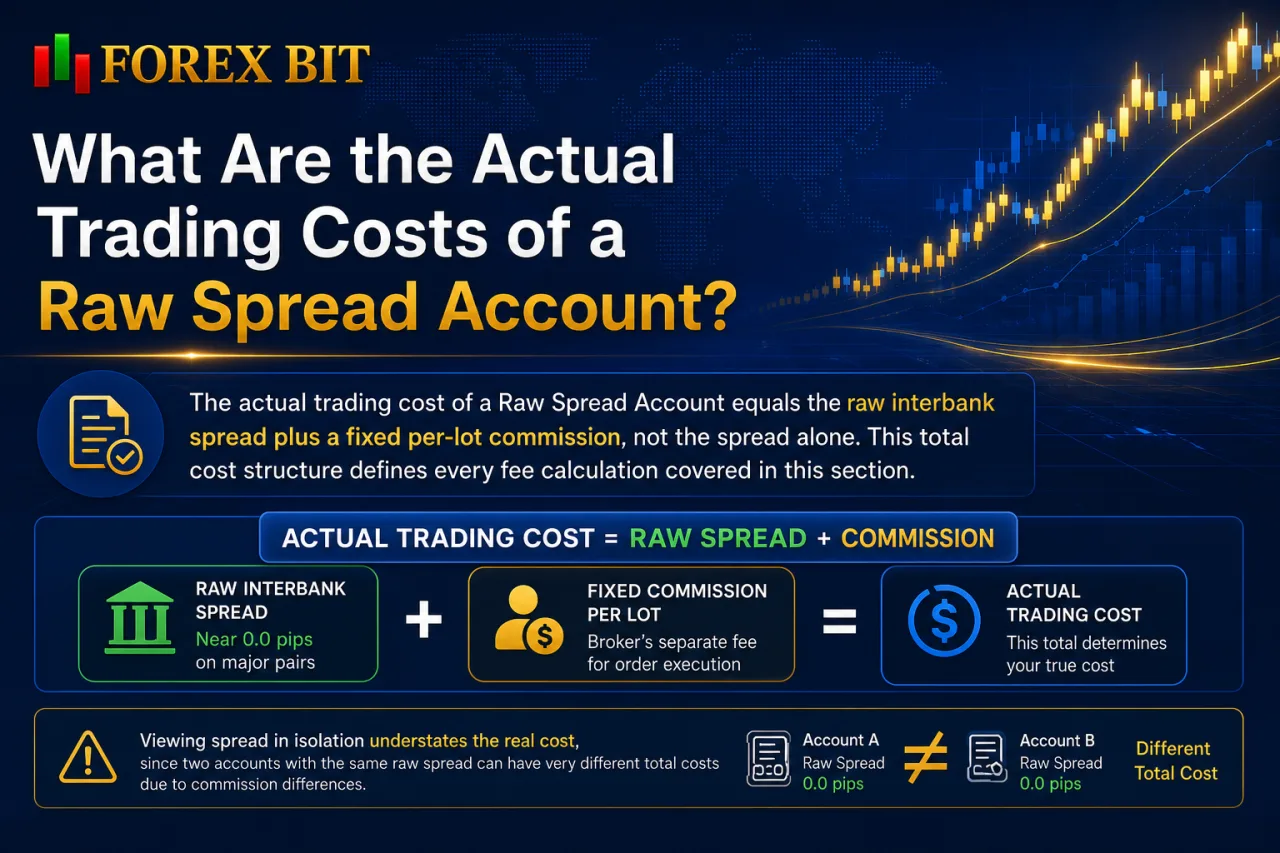
The actual trading cost of a Raw Spread Account equals the raw interbank spread plus a fixed per-lot commission. This total cost structure defines every fee calculation covered in this section. The raw spread reflects unfiltered liquidity provider pricing, floating near 0.0 pips on major pairs during normal market conditions, while the commission functions as the broker’s separate fee for order execution.
Viewing spread in isolation understates the real cost, since two accounts advertising identical low spreads can differ in total cost once commission rates diverge. The following breakdown examines how minimum spreads behave, how commission is structured per lot, and how non-trading charges add to the overall expense of running a Raw Spread Account.
What Is the Minimum and Typical Spread on a Raw Spread Account?
Raw Spread Accounts advertise minimum spreads starting from 0.0 pips on major pairs, though the typical average spread on EUR/USD during normal market conditions tends to sit slightly above that floor rather than at it.
The advertised 0.0 pips figure represents the best-case liquidity snapshot rather than a guaranteed constant rate. Realistic average spreads widen during low-liquidity periods, such as around major news releases or session rollovers, and narrow closer to zero during high-liquidity overlap hours.
Broker fee pages typically list both figures separately: a minimum spread reflecting occasional best pricing, and a typical or average spread reflecting the more common trading condition. Comparing only the minimum figure across brokers misrepresents actual cost, since the typical average spread combined with commission determines the real expense of executing a trade.
How Much Commission Is Charged Per Lot or Round Turn?
Raw Spread Account commission is charged per lot per side, with the round-turn cost being the sum of both sides, though the exact rate varies by broker.
This structure directly answers how the per-lot or round-turn charge accumulates on trades executed within a Raw Spread Account. The commission applies as a fixed fee tied to trade size rather than to the spread quoted at execution, so it stays constant whether the raw spread floats near 0.0 pips or widens during volatile conditions.
Calculation follows a straightforward formula: the published per-side rate multiplies by the number of standard lots traded, then doubles to cover both entry and exit. A single standard lot (100,000 units) triggers one commission charge on opening and one on closing, together forming the round-turn total. Smaller trade sizes, such as a mini or micro lot, scale the same commission proportionally based on lot fraction traded. This per-lot pricing remains separate from any raw spread cost recorded at the time of order execution.
How Much Does It Cost to Trade 1 Standard Lot of EUR/USD on a Raw Spread Account?
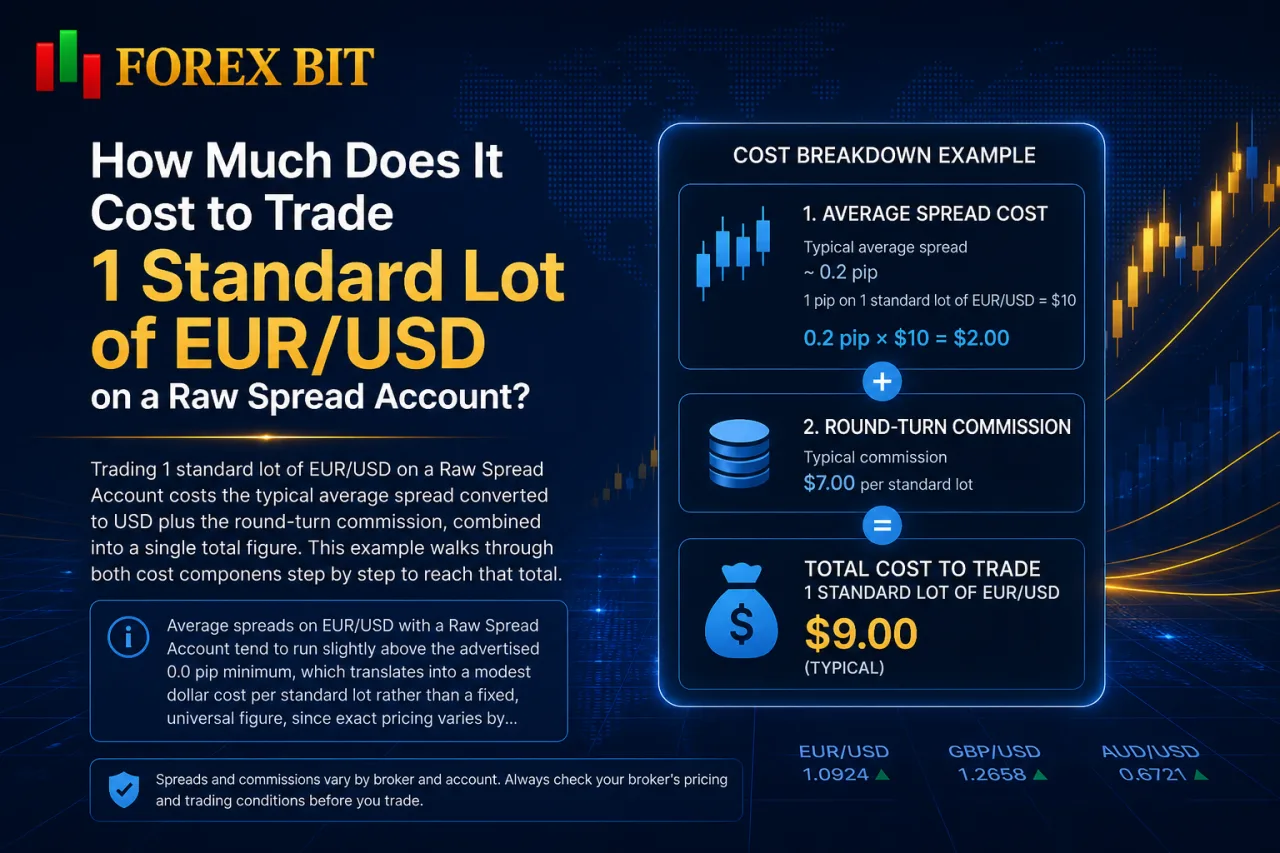
Trading 1 standard lot of EUR/USD on a Raw Spread Account costs the typical average spread converted to USD plus the round-turn commission, combined into a single total figure. This example walks through both cost components step by step to reach that total, using published pricing from a specific broker’s official fee schedule as the source for the figures below.
Average spreads on EUR/USD with a Raw Spread Account tend to run slightly above the advertised 0.0 pip minimum, which translates into a modest dollar cost per standard lot, based on the broker’s published spread data rather than a fixed, universal figure.
Round-turn commission on a standard lot is generally the sum of the per-side rate charged twice, based on the broker’s published commission rate for this account type.
Adding both components produces the total cost of the trade, shown below as sourced from the broker’s official pricing page:
| Cost Component | Amount (USD) |
|---|---|
| Spread cost (typical, 1 standard lot) | ~$1 – $2 |
| Commission (round turn, 1 standard lot) | ~$6 – $7 |
| Total trading cost | ~$7 – $9 |
This total reflects a full round-turn trade opened and closed under typical market conditions, excluding any swap charge for positions held overnight. Traders confirm the exact spread and commission figures on their chosen broker’s official pricing page before relying on these numbers, since actual costs vary by broker and by market conditions at the time of the trade.
Raw Spread Account vs Standard Account: Which Has Lower Trading Costs?
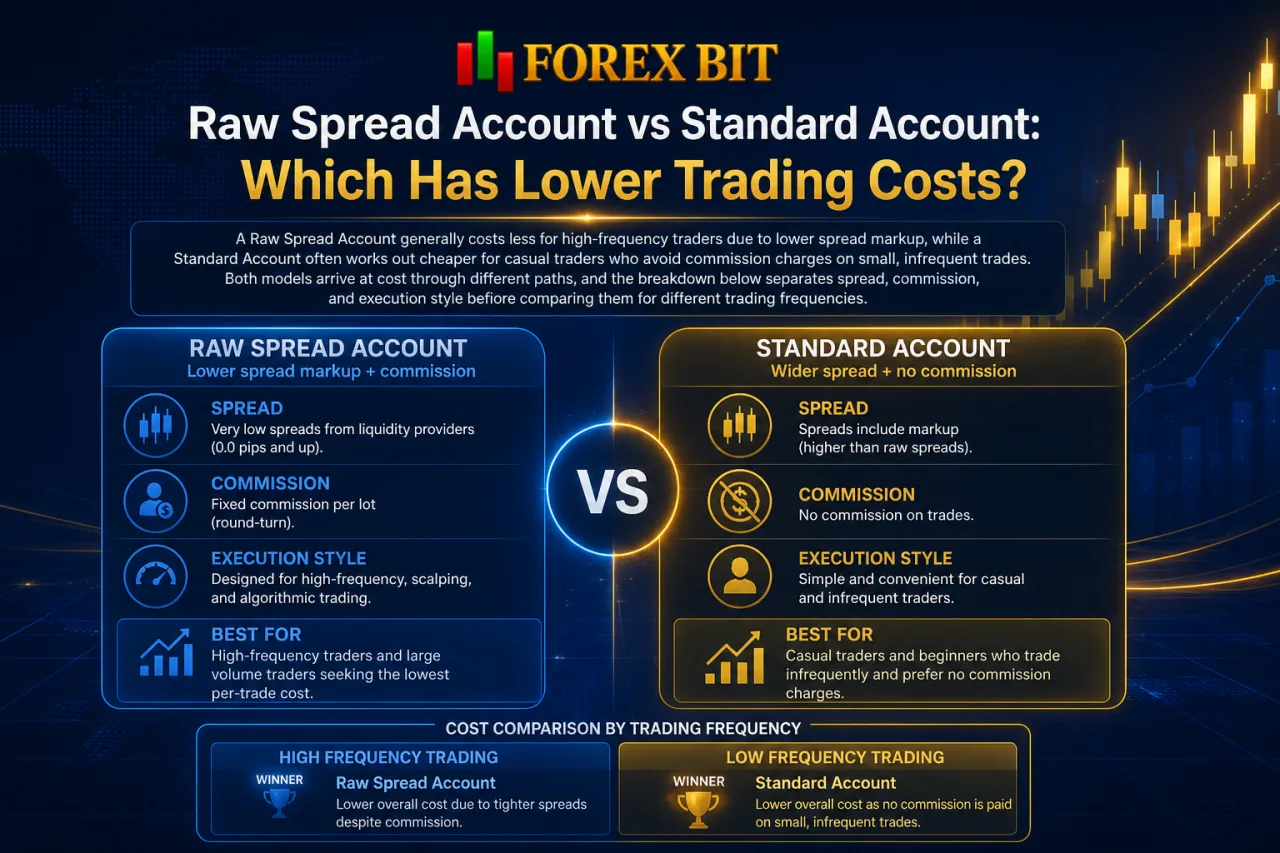
A Raw Spread Account generally costs less for high-frequency traders due to lower spread markup, while a Standard Account often works out cheaper for casual traders who avoid commission charges on small, infrequent trades. Both models arrive at cost through different paths, and the breakdown below separates spread, commission, and execution style before comparing them for different trading frequencies.
| Feature | Raw Spread Account | Standard Account |
|---|---|---|
| Spread range | Near-zero, floating from 0.0 pips | Wider, floating from around 1.0 pip |
| Commission | Charged per lot, per side | Not charged separately |
| All-in cost per lot | Spread plus commission combined | Spread only, built into the quoted price |
| Execution model | ECN, direct market access | Market Maker or STP |
The table above shows that each account type bundles its cost differently. A Raw Spread Account separates the spread and commission into two visible charges, while a Standard Account folds the cost into a single wider spread with no added commission line.
Does the Raw Spread Account Charge Lower Overall Costs Than the Standard Account?
Yes, a Raw Spread Account charges lower overall costs than a Standard Account for most trade sizes, though the gap narrows or reverses for very small, infrequent trades. This verdict follows directly from combining spread and commission figures rather than looking at either component alone.
Three factors support the yes answer for typical trade volume:
- Combined spread-plus-commission on a Raw Spread Account undercuts the wider all-in spread markup built into a Standard Account, based on the standard-lot comparison already outlined above.
- Commission stays fixed per lot regardless of market volatility, while Standard Account spread markup widens during low-liquidity periods, adding unpredictable cost.
- Frequent traders accumulate savings across many round turns, since the per-lot commission scales linearly while Standard Account spread cost can compound faster during volatile sessions.
A Standard Account tends to work out cheaper mainly for low-volume traders placing small, occasional trades, since its zero-commission structure avoids a fixed per-lot charge entirely. Below that threshold, the wider spread cost on a single small trade stays lower than paying a fixed commission twice.
What Is the Minimum Deposit Required to Open a Raw Spread Account?
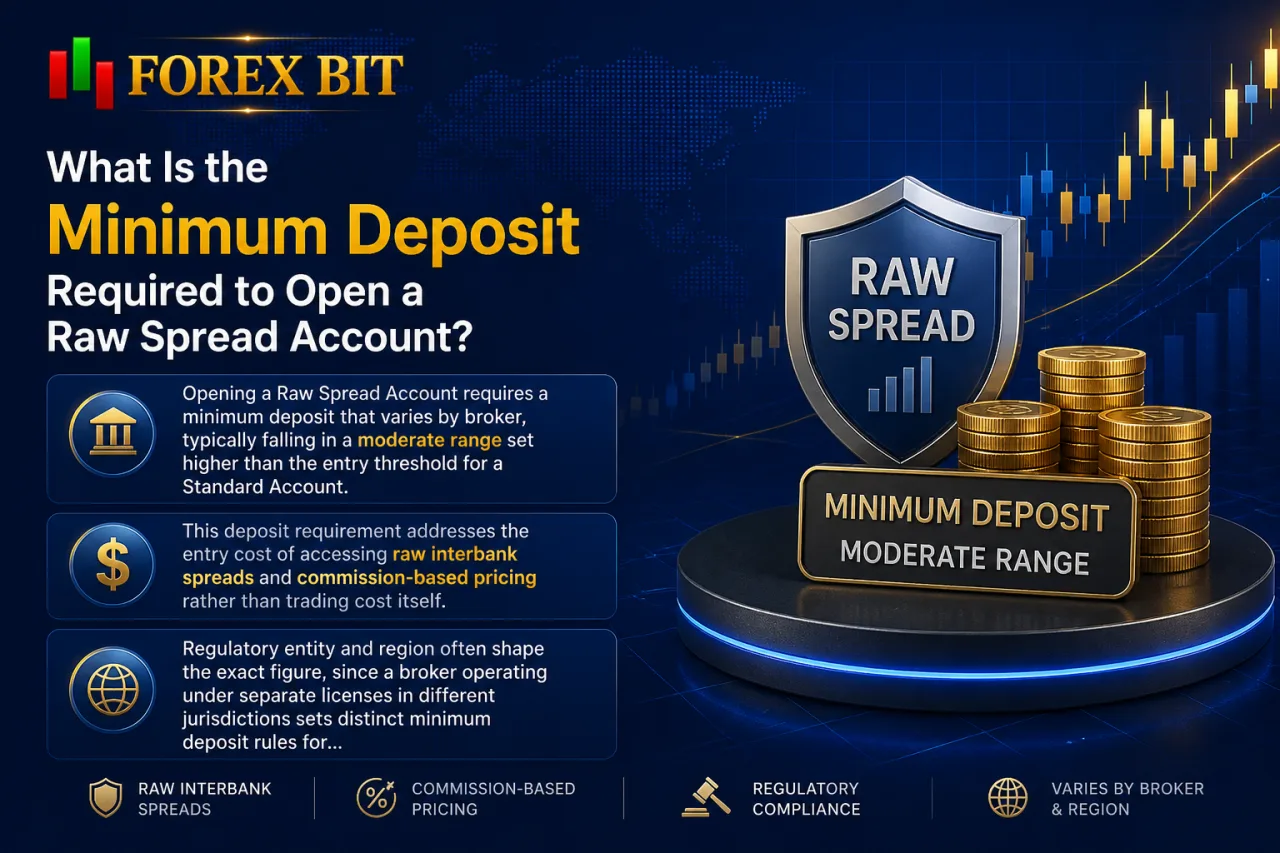
Opening a Raw Spread Account typically requires a minimum deposit that varies by broker and is generally set higher than the entry threshold for a Standard Account.
This deposit requirement addresses the entry cost of accessing raw interbank spreads and commission-based pricing rather than trading cost itself.
Regulatory entity and region often shape the exact figure, since a broker operating under separate licenses in different jurisdictions sets distinct minimum deposit rules for each entity. A broker regulated in multiple regions may apply different minimum deposit thresholds to its Raw Spread Account depending on which regulatory entity holds the client’s account, with the exact figure adjusted upward or downward by broker and jurisdiction.
Currency denomination of the deposit also shifts the effective amount when funding from a non-base currency account, since conversion applies at the funding stage rather than at the trading stage.
Traders confirm the applicable figure directly on the broker’s official account specification page before funding, since published minimums update periodically and differ from promotional or regional variants shown elsewhere.
What Other Fees Are Tied to a Raw Spread Account?
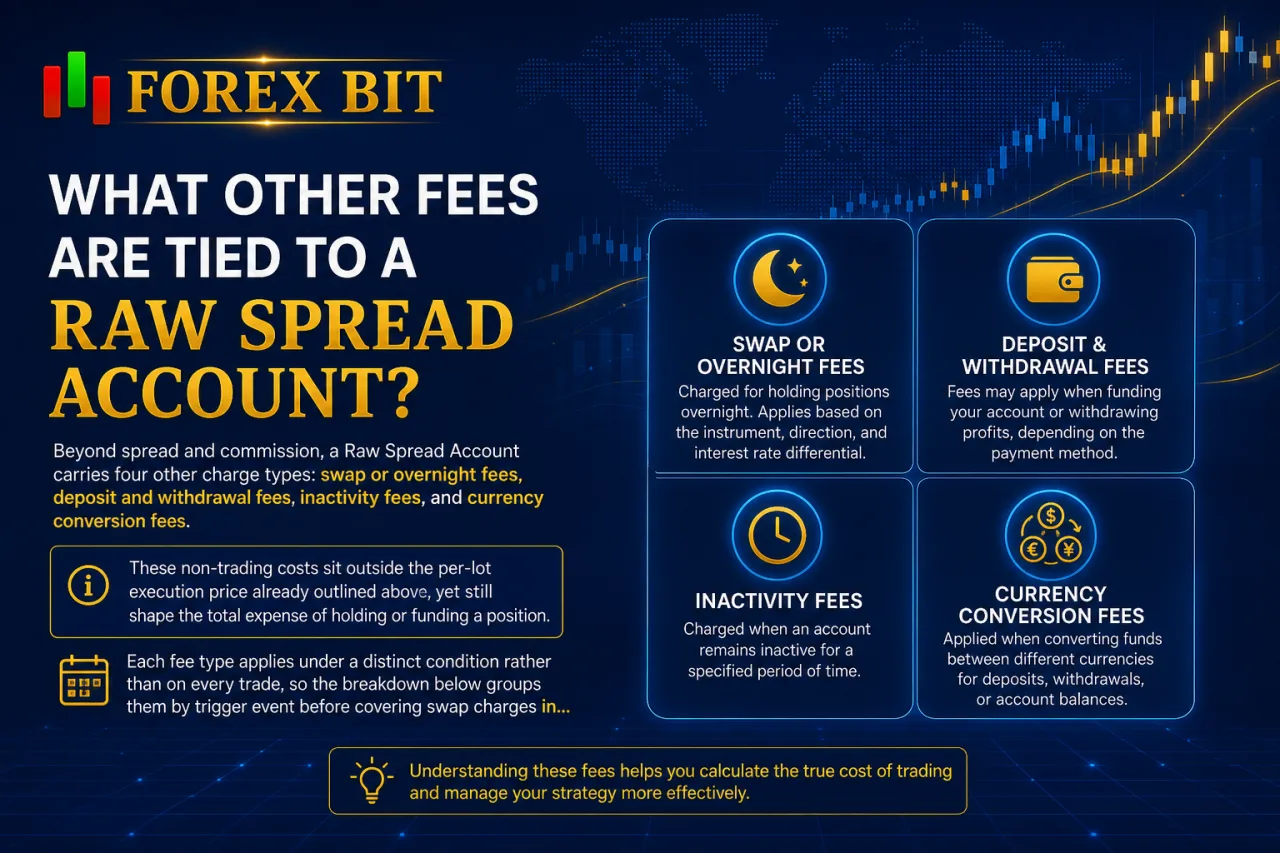
Beyond spread and commission, a Raw Spread Account carries four other charge types: swap or overnight fees, deposit and withdrawal fees, inactivity fees, and currency conversion fees. These non-trading costs sit outside the per-lot execution price already outlined above, yet still shape the total expense of holding or funding a position. Each fee type applies under a distinct condition rather than on every trade, so the breakdown below groups them by trigger event before covering swap charges in detail.
| Fee Type | Typical Condition | Amount/Note |
|---|---|---|
| Swap/overnight fee | Position held open past end of trading day | Varies by instrument and direction (long/short) |
| Deposit fee | Funding the account via certain payment methods | Often free, though method-dependent |
| Withdrawal fee | Requesting funds out of the account | Varies by broker and payment channel |
| Inactivity fee | No trading activity over an extended period | Charged only after a set dormancy threshold |
| Currency conversion fee | Deposit/withdrawal currency differs from account base currency | Applied as a conversion markup at transaction time |
Exact swap rates, deposit/withdrawal fee amounts, inactivity threshold periods, and currency conversion markup percentages for a Raw Spread Account vary by broker, so traders should check the specific broker’s official fee schedule for precise figures.
How Are Swap/Overnight Fees Calculated on a Raw Spread Account?
Swap fees on a Raw Spread Account accrue daily based on the interest rate differential between the two currencies in a pair, applied only to positions still open at end-of-day rollover. This applies on top of the spread-plus-commission cost already outlined for each round-turn trade above.
The charge posts as a per-lot rate that differs by direction, since holding a long position and a short position on the same pair typically draws different swap values. Key points to note:
- A broker offering a swap-free or Islamic variant of the Raw Spread Account removes this overnight charge, often replacing it with an alternative fee structure to comply with interest-free trading requirements, though exact terms vary by broker.
- Published swap figures on a major pair such as EUR/USD generally list separate long and short rates per standard lot, with the long rate often negative and the short rate positive (or vice versa depending on the current rate environment), though exact values shift with central bank rate differentials and change periodically.
- Traders holding positions across a weekend often see the swap charge applied multiple times in a single rollover to account for non-trading days.
The exact figures for a given pair on a given day are listed on the broker’s official swap rate schedule, and traders should check that schedule directly rather than assume the rate stays constant over time.
Are There Deposit, Withdrawal, or Inactivity Fees on This Account?
Yes, deposit, withdrawal, and inactivity fees apply to a Raw Spread Account under specific conditions, alongside a currency conversion charge, though exact figures vary by broker. This confirms the fee categories already outlined above and ties each one directly to the Raw Spread account type rather than the account structure in general.
Three points support this yes answer:
- Deposit fees stay mostly waived for standard funding methods, though certain payment channels trigger a charge depending on the broker’s official fee schedule.
- Withdrawal fees apply selectively, varying by payment method and destination rather than as a flat rate on every request.
- Inactivity fees activate only after a dormancy period defined in the account terms, remaining dormant until that threshold passes.
Currency conversion fees on a Raw Spread Account generally apply as a percentage markup whenever the deposit or withdrawal currency differs from the account’s base currency, with the exact percentage varying by broker. Traders confirm precise deposit, withdrawal, inactivity, and conversion figures on the broker’s official fee schedule before funding, since these charges sit outside the spread-plus-commission cost already covered above.
What Rare Conditions Can Change the Real Cost of a Raw Spread Account?
Three rare conditions shift the real cost of a Raw Spread Account: spread widening during high-impact news or thin liquidity, volume-based commission rebates for high-frequency traders, and platform-specific fee differences across MT4, MT5, or cTrader. Each condition sits outside the standard spread-plus-commission model already outlined above, applying only under specific triggers rather than on every trade. The breakdown below separates each condition before detailing how it modifies the total cost calculation.
Do Commission Rates Change for High-Volume Traders?
Commission rates on a Raw Spread Account can change for high-volume traders, as brokers commonly apply volume-based rebates or tiered pricing tied to monthly traded lots, though exact thresholds and discount percentages vary by broker. This rare condition sits outside the fixed per-lot rate already outlined above, applying only once trading activity crosses a defined volume tier.
Three points explain this yes answer:
- Rebate programs credit part of the per-lot commission back once a trader’s monthly volume passes a broker-defined threshold.
- Tiered pricing structures lower the effective per-lot rate at higher volume bands rather than applying one flat rate to every account.
- Eligibility often requires enrollment or qualification under a separate loyalty or active-trader program, distinct from the standard Raw Spread Account terms.
Traders confirm exact tier levels and rebate percentages on the broker’s official commission schedule, since these figures update periodically and differ across regulatory entities.
Does the Trading Platform Affect Raw Spread Account Fees?
Yes, the trading platform can affect Raw Spread Account fees on some brokers, since MT4, MT5, and cTrader may carry different commission rates or spread feeds for the same account type, though exact figures vary by broker.
This platform-based variation ties directly into the rare-condition cost factors already outlined above alongside spread widening and volume rebates. Three points explain why platform choice matters:
- cTrader often connects to a distinct liquidity feed than MT4 or MT5, producing slightly different raw spread averages on the same instrument.
- Commission per lot sometimes differs by platform, since some brokers price cTrader execution separately from MT4/MT5 execution.
- Order execution speed and depth-of-market display vary by platform, indirectly shaping slippage cost even when the quoted commission stays identical.
Traders confirm exact platform-specific spread and commission figures on the broker’s official platform fee documentation, since these details update periodically and differ across regulatory entities.
Conclusion
The real cost of a Raw Spread Account rests on spread and commission combined, not the near-zero pip figure advertised alone. A standard-lot EUR/USD round turn lands roughly between $7 and $9 under typical conditions, a total that shifts with news-driven spread widening, volume-based commission rebates, or platform choice across MT4, MT5, and cTrader.
This structure suits high-frequency and volume traders best, since fixed per-lot commission scales predictably while Standard Account spread markup grows less efficient at scale. Non-trading charges such as swaps, withdrawals, inactivity, and currency conversion add further variables, all confirmed only through the broker’s official fee schedule.
Isabella Brown is the Forex Trading Guide Manager at Forex Bit, focusing on educational content about broker safety, trading costs, account types, platforms, and key Forex/CFD concepts. Her work helps readers understand trading terms, broker conditions, and practical checks before evaluating or using a brokerage service.
Email: [email protected]


Best Brokers

Trade with the world’s largest retail broker and benefit from better - than - market conditions.

We offer a superior trading environment that puts traders in the best position to profit.

Trade with the best trading conditions. WIN THE BEST TRADING ACCOUNT AWARD.

Trade global markets with Interactive Brokers – a highly regulated multi-asset broker built for active and professional investors.






Forex Bit provides independent forex broker reviews, comparisons, guides, and industry news to help traders make informed decisions.
Best Brokers
Metatrader 5 Brokers
Metatrader 4 Brokers
Lowest Spread Forex Broker
Regulated Forex Brokers
Forex Copy Trading
Ctrader Brokers
Best Forex Broker For Beginners