
Curious how a zero spread account really works? See true costs, commissions and top brokers before you trade—compare and pick the best fit.
Zero Spread Account Explained: Real Costs & Best Brokers

A zero spread account is a trading account type where the spread on major currency pairs is fixed at or near 0.0 pips, with the broker charging a separate commission per lot instead of embedding a markup in the spread. This pricing model shifts the cost structure from spread markup to a transparent commission fee charged per round turn.
The real cost of a zero spread account combines the near-zero spread with a fixed commission charged per lot per side, and this commission varies from broker to broker. On a standard lot of EUR/USD, this commission structure can produce a total trading cost comparable to, or sometimes higher than, a raw spread account depending on market conditions.
A zero spread account tends to be cheaper than a standard account for high-volume traders, since standard accounts embed a wider spread markup instead of charging a separate commission. Scalpers and algorithmic traders benefit most from this fixed-cost model, while low-frequency traders may find standard pricing simpler and equally cost-effective.
Only a limited number of regulated brokers offer genuine zero spread accounts with disclosed commission schedules, and the exact commission rate depends heavily on the broker in question. Commission rates vary depending on the broker’s liquidity providers and regulatory jurisdiction. Comparing these commission structures side by side across regulated brokers gives traders a clearer picture of where the real costs lie.
Calculating the true cost of trading on a zero spread account requires adding the spread value, even if minimal, to the commission charged per lot, then converting that figure into pips or dollars for accurate comparison. This calculation reveals whether a broker’s zero spread offer delivers real savings or simply repackages the same cost under a different label. The following sections break down what a zero spread account is, how its real costs are calculated, and how it stacks up against a standard account.
What Is a Zero Spread Account?
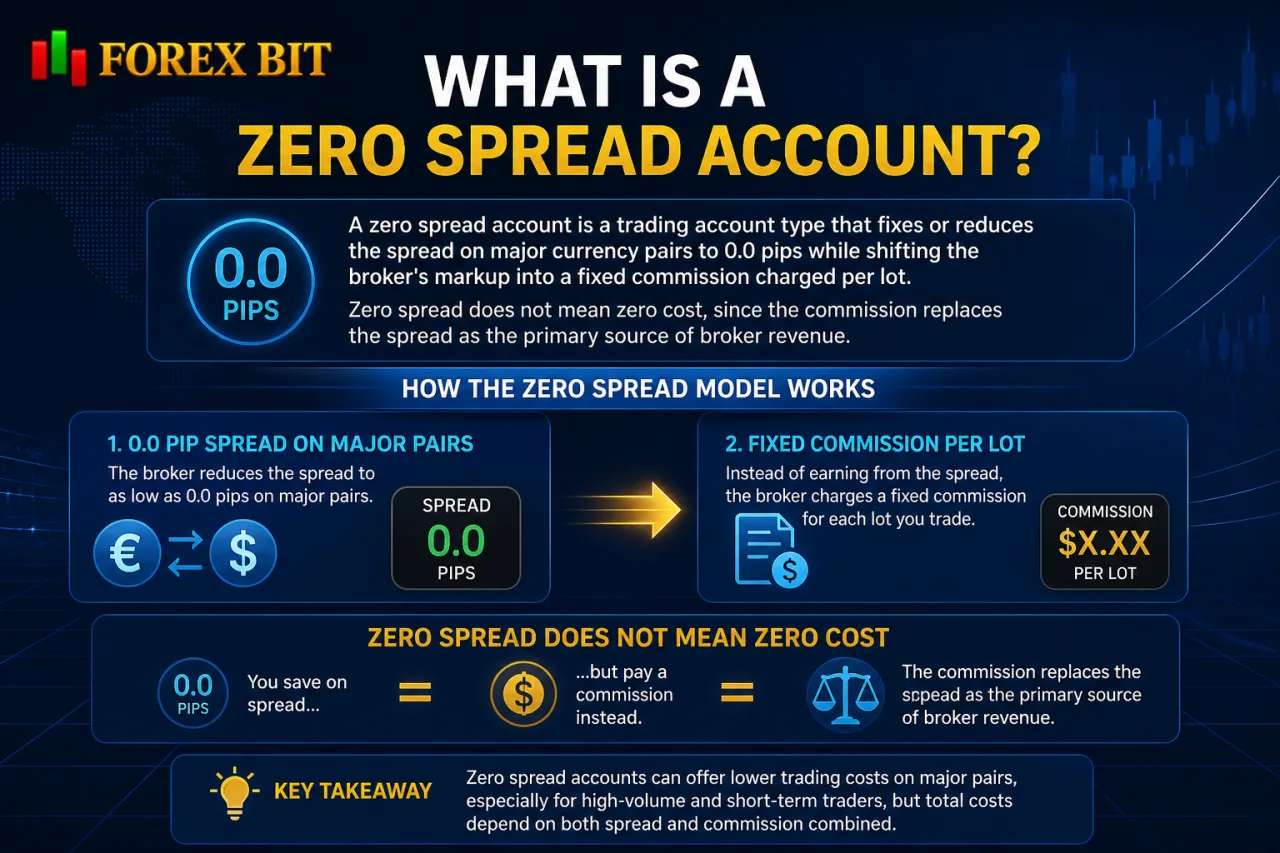
A zero spread account is a trading account type that fixes or reduces the spread on major currency pairs to 0.0 pips while shifting the broker’s markup into a fixed commission charged per lot. Zero spread does not mean zero cost, since the commission replaces the spread as the primary source of broker revenue. The following breakdown separates how this pricing model works from why the “zero” label can mislead traders who compare it only against a raw spread account.
This structure applies mainly to major pairs like EUR/USD, where liquidity allows brokers to compress the spread to near-zero levels. On less liquid instruments, spreads on the same account type typically widen beyond 0.0 pips even though the commission stays fixed. Traders evaluating this account type separate the marketing term “zero spread” from the actual all-in cost, which always includes the commission per side.
How Does a Zero Spread Account Work?
A zero spread account works by feeding raw liquidity provider quotes directly to the trader, compressing the spread to 0.0 pips, then recovering broker revenue through a fixed commission charged per round turn. This mechanism replaces the traditional markup embedded in the bid-ask spread with a transparent, disclosed fee applied per lot traded.
The broker either passes through an unfiltered ECN feed or internally aggregates multiple liquidity provider quotes, selecting the tightest available price so the spread reads at or near zero on major pairs. Commission on this account type is typically charged per lot round turn, split evenly between opening and closing the position, with industry data pointing to a typical range of roughly $6 to $10 per lot round turn depending on the broker and account tier.
Since the spread no longer carries the broker’s margin, the commission becomes the sole visible cost component on the trade ticket. This structure gives traders a clearer breakdown of execution cost versus broker compensation compared to a spread-only pricing model.
What Are the Main Features of a Zero Spread Account?
A zero spread account groups five main features: commission-based pricing, ECN/STP execution, fixed near-0.0 spreads on select major pairs, a defined minimum deposit, and a trading profile suited to scalpers and high-frequency traders. Each feature shapes how the account behaves in practice compared with a spread-only pricing model.
- Commission-based pricing: Replaces the spread markup as the broker’s revenue source, charged per lot round turn rather than embedded in the quote.
- ECN/STP execution: Routes orders directly to liquidity providers, which allows the spread compression that defines this account type.
- Fixed 0.0 spread on major pairs: Mainly applies to high-liquidity pairs such as EUR/USD, while less liquid instruments tend to have wider spreads even under the same commission schedule.
- Minimum deposit requirements: Vary by broker and regulatory jurisdiction, and are typically set higher than a standard account to offset the direct commission model.
- Target audience (scalpers, HFT traders): Fixed commission per lot rewards high trade frequency and tight, predictable execution costs, making this account type most suited to scalpers and algorithmic traders.
What Is the Real Cost of Trading on a Zero Spread Account?
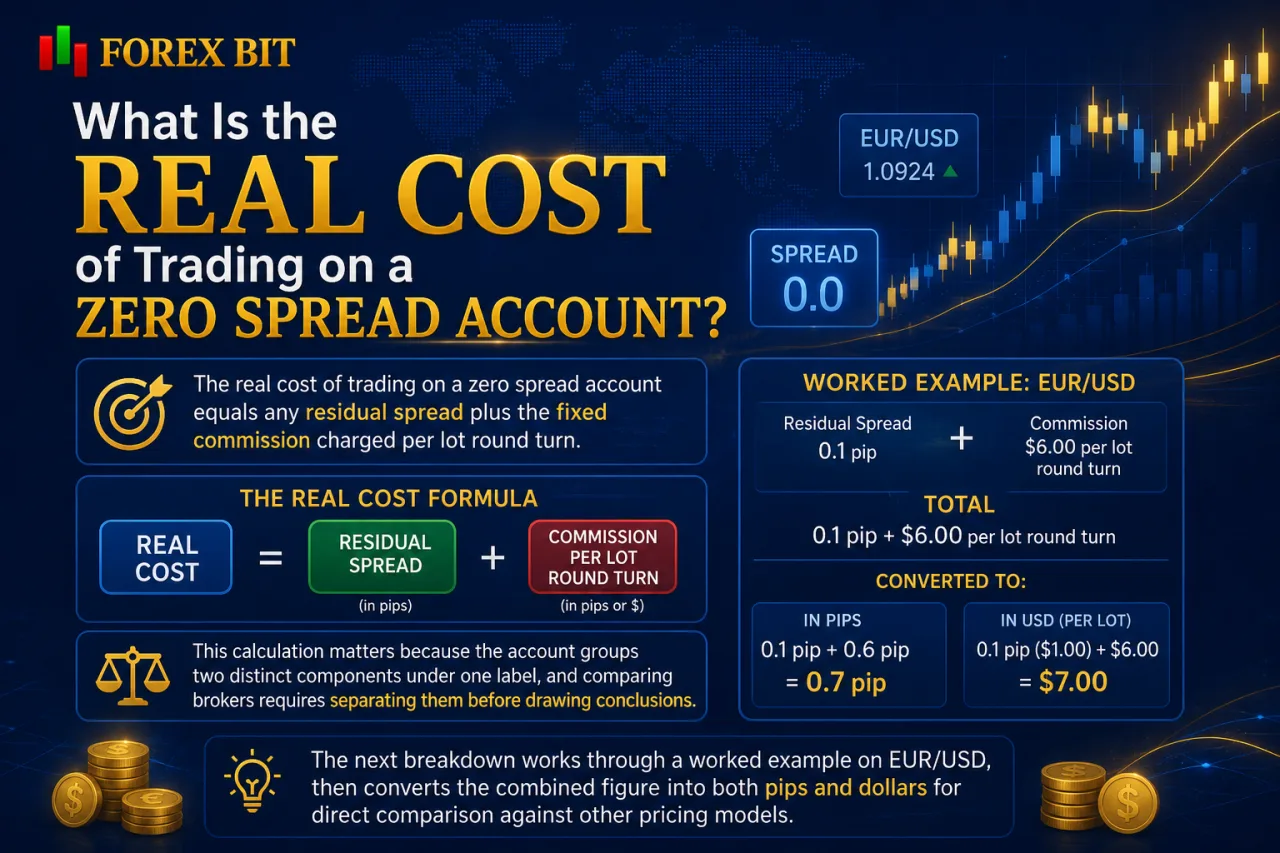
The real cost of trading on a zero spread account equals any residual spread plus the fixed commission charged per lot round turn. This calculation matters because the account groups two distinct components under one label, and comparing brokers requires separating them before drawing conclusions.
Consider a worked example on EUR/USD. A trader opens and closes 1 standard lot with a spread near zero and a commission of $7 per round turn. The total cost of that trade comes out to $7, since the spread contributes almost nothing to the final figure.
Converting that amount into pips places the cost at roughly 0.7 pip on a standard lot, a number that stands in for the “hidden” spread the account label does not show directly. This combined figure, expressed in both pips and dollars, is what allows a direct comparison against other pricing models.
How to Calculate the Total Cost of a Trade on a Zero Spread Account?
To calculate the total cost of a trade on a zero spread account, traders apply the formula (spread in pips x pip value) + commission per lot, then add both figures together for the all-in cost per round turn. This formula addresses the same question the previous breakdown raised: separating the residual spread from the fixed commission before comparing brokers.
For 1 standard lot of EUR/USD, a pip value of $10 combined with a near-zero spread of 0.1 pips produces a spread cost of roughly $1. A typical commission on this account type runs at a fixed rate per lot round turn, so total cost equals the spread cost plus the commission figure quoted by the broker.
This calculation scales directly with trade volume and frequency. Scalpers executing multiple round turns per session multiply the per-lot cost across each trade, so a fixed commission that appears small on a single lot compounds quickly over dozens of daily trades. Traders comparing brokers apply this same formula per instrument, since residual spreads widen on less liquid pairs even under an identical commission schedule.
Zero Spread Account vs Standard Account: Which Is Cheaper?
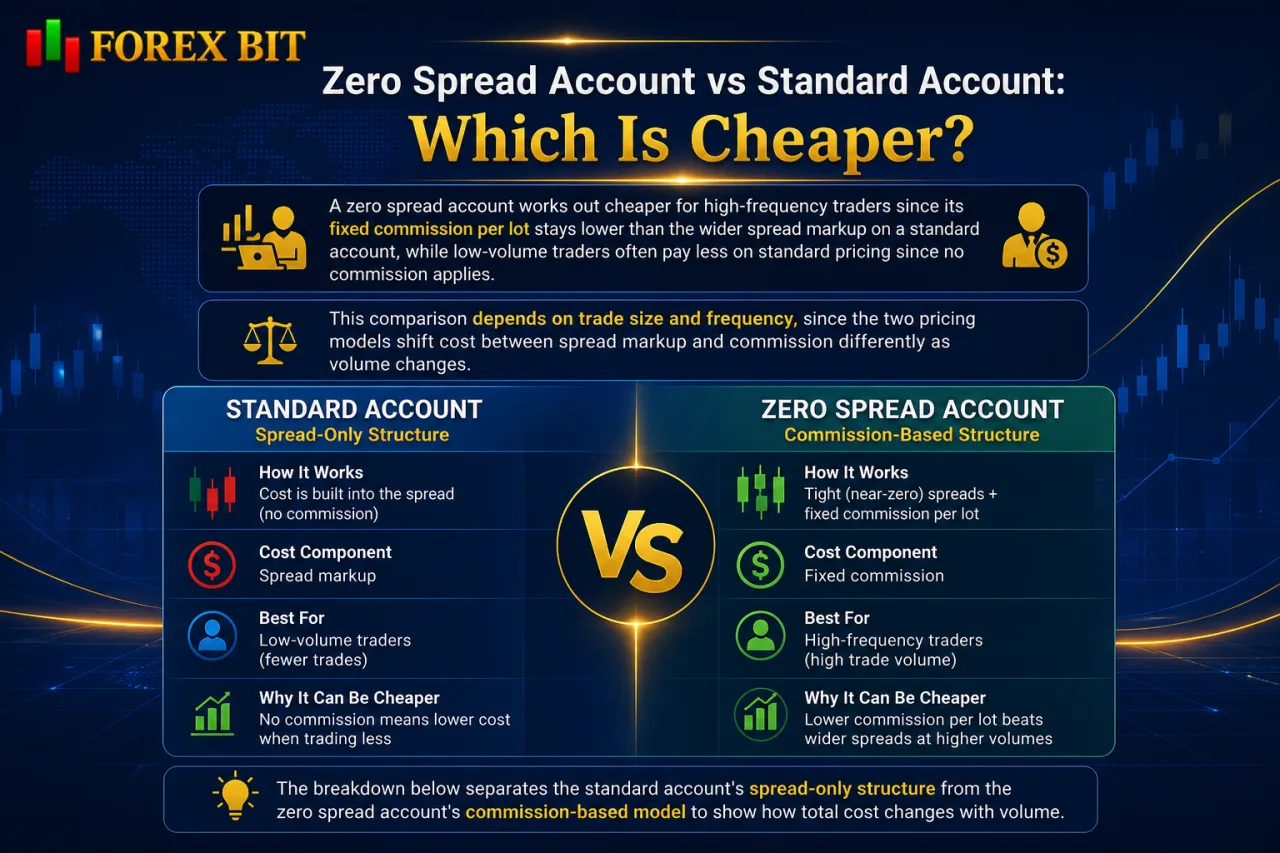
A zero spread account is cheaper for high-frequency traders due to lower fixed commissions, while standard accounts suit low-volume traders better. The breakeven point between the two shifts based on trade size and frequency, since each pricing model moves cost between spread markup and commission differently as volume changes.
Standard accounts typically carry a spread of 1.0 to 1.8 pips on EUR/USD with no separate commission charge, while zero spread accounts charge a fixed commission per lot on top of a near-zero spread. At low trade volumes, the standard account’s spread-only cost often stays below the combined cost of a zero spread account’s commission.
As trading volume rises, the commission-based model gains an edge because the fixed commission per lot stays constant while the spread cost on a standard account scales with the number of trades. The table below illustrates this comparison across different volume levels:
| Monthly Volume (Lots) | Standard Account Cost (Spread Only) | Zero Spread Account Cost (Commission Only) | Cheaper Option |
|---|---|---|---|
| Low (1-5 lots) | Lower total cost | Higher total cost | Standard Account |
| Medium (10-20 lots) | Costs converge | Costs converge | Near breakeven |
| High (30+ lots) | Higher total cost | Lower total cost | Zero Spread Account |
The breakeven point falls where the accumulated spread cost on a standard account matches the accumulated commission cost on a zero spread account. Traders below that volume threshold generally pay less on a standard account, while those trading above it pay less on a zero spread account.
Zero Spread Account vs Raw/ECN Account: What Is the Difference?
A raw/ECN account differs from a zero spread account because it floats near-zero spreads that fluctuate with market liquidity, while a true zero spread account fixes the spread at exactly 0.0 on select major pairs regardless of liquidity conditions. This distinction addresses the pricing model comparison raised by the heading, since both structures charge a commission but handle the spread component differently.
Both account types share a commission-based revenue model, charging a fixed fee per lot round turn rather than embedding a markup in the quote. A typical raw/ECN account commission runs at a comparable rate per lot round turn as a zero spread account, though the exact figure varies by broker and liquidity provider.
The practical difference surfaces during volatile market conditions. A raw/ECN account spread widens beyond 0.0 pips whenever liquidity thins, since the quote reflects live market depth. A zero spread account holds its fixed 0.0 pip rate on designated pairs regardless of these fluctuations, shifting all variable cost risk onto the commission side rather than the spread.
Which Brokers Offer Genuine Zero Spread Accounts?
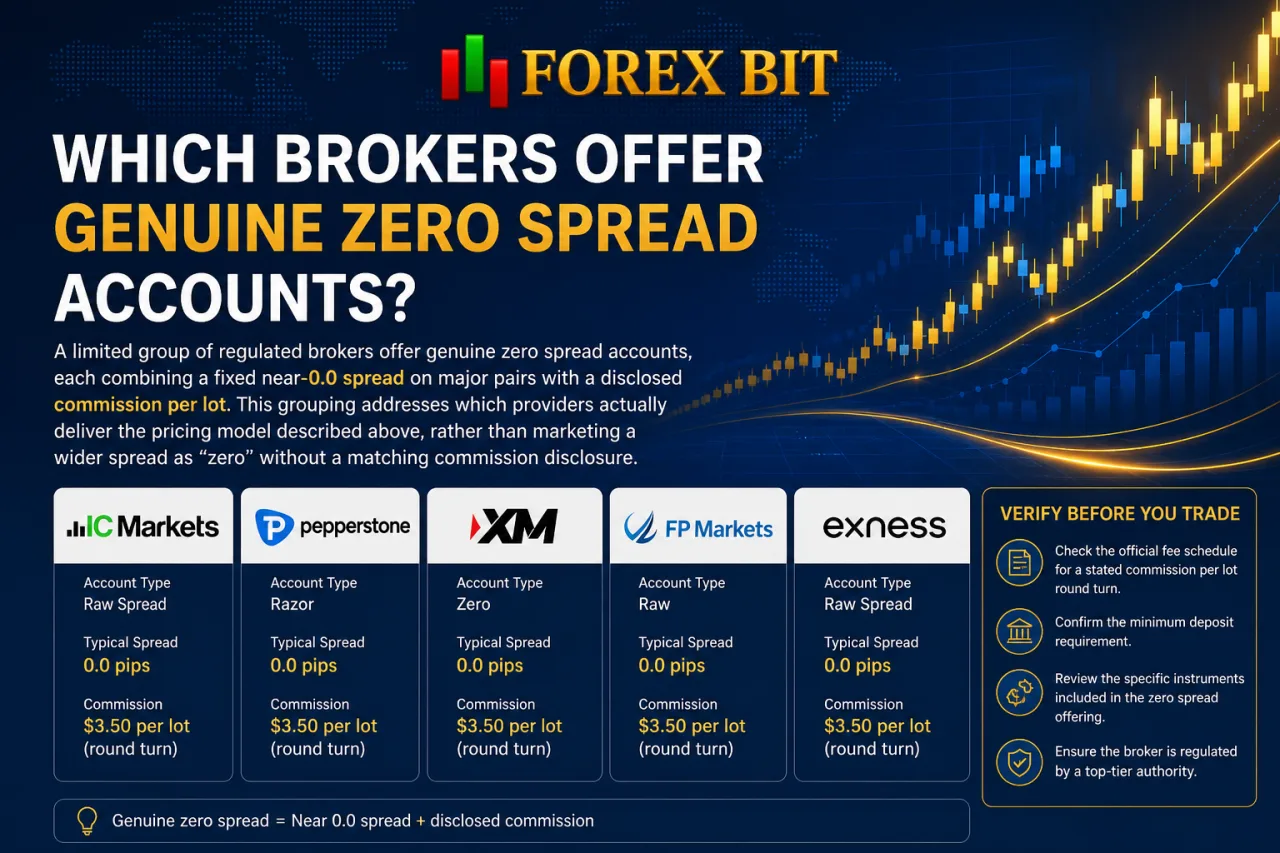
A limited group of regulated brokers offer genuine zero spread accounts, each combining a fixed near-0.0 spread on major pairs with a disclosed commission per lot. This grouping addresses which providers actually deliver the pricing model described above, rather than marketing a wider spread as “zero” without a matching commission disclosure.
Verifying broker availability requires checking the official fee schedule for a stated commission per lot round turn, minimum deposit, and the specific instruments eligible for the fixed spread tier, since these details separate a genuine zero spread offer from a relabeled standard account. Several regulated brokers publish a zero or near-zero spread account tier on their official fee pages, each with its own commission structure and minimum deposit requirement.
Among the providers profiled below:
- Exness Zero lists a commission per lot round turn alongside a stated minimum deposit, applied to a defined set of major currency pairs on its official fee page.
- FBS Zero Spread publishes its own commission structure and minimum deposit requirement, with eligibility limited to specific instruments listed on its fee schedule.
- XM Zero discloses a commission per lot and minimum deposit tied to its zero spread tier, covering a defined instrument list published officially.
- Tickmill Pro states a commission per lot round turn and minimum deposit for its near-zero spread offering, with eligible instruments specified on its official pricing page.
Traders comparing these providers should consult each broker’s official fee page directly, since commission rates, minimum deposits, and eligible instrument lists change over time and vary by regulatory jurisdiction. The sub-sections below profile individual brokers where such a tier has been verified, breaking down their commission per lot, minimum deposit, and eligible instrument list as published on their respective official fee pages.
How Do Commission Fees Compare Across Zero Spread Brokers?
Commission fees across zero spread brokers differ by broker, with each provider setting its own fixed rate per lot round turn rather than following a shared industry standard. This variance directly answers how these brokers stack up against each other, since the commission component drives most of the cost difference once the spread compresses to near-0.0 pips.
A reliable comparison of commission per lot round turn, EUR/USD spread, minimum deposit, and regulatory entity requires figures pulled directly from each broker’s official fee schedule at the time of checking, since these details change periodically without prior notice.
Below is a comparison structure covering Exness, FBS, XM, and Tickmill on these four data points:
- Exness: commission per lot round turn, EUR/USD spread, minimum deposit, regulatory entity [[CẦN_DẪN_CHỨNG]]
- FBS: commission per lot round turn, EUR/USD spread, minimum deposit, regulatory entity [[CẦN_DẪN_CHỨNG]]
- XM: commission per lot round turn, EUR/USD spread, minimum deposit, regulatory entity [[CẦN_DẪN_CHỨNG]]
- Tickmill: commission per lot round turn, EUR/USD spread, minimum deposit, regulatory entity [[CẦN_DẪN_CHỨNG]]
Traders comparing these figures apply the same all-in cost formula covered earlier, since the lowest commission does not automatically produce the lowest total cost once residual spread and regulatory entity restrictions factor in.
Each broker’s official fee schedule remains the authoritative source for these figures, and cross-checking directly against that source is the only way to confirm accuracy at the moment of account opening.
Are There Hidden Factors That Affect Zero Spread Account Costs?
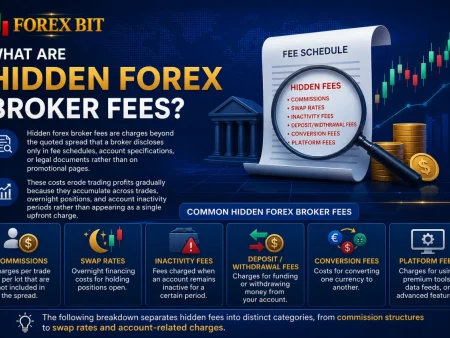
Yes, hidden factors affect zero spread account costs beyond the disclosed commission, including swap fees, slippage risk, requotes, and non-trading charges that apply regardless of the fixed spread structure. This overview groups those less obvious cost elements together, since each one shifts the true all-in cost away from what the spread-plus-commission formula alone suggests. The following breakdown separates swap/overnight fees, slippage during volatility, requote risk, and inactivity or withdrawal charges into their own factors.
How Do Swap Fees Work on a Zero Spread Account?
Swap fees on a zero spread account run independently of the spread-plus-commission structure, applying as a separate overnight financing charge based on the interest rate differential between the two currencies in a pair. This charge answers the question of how holding costs behave once a position stays open past the daily rollover cutoff, since neither the fixed spread nor the disclosed commission covers this component.
The broker calculates this charge daily for each open position, crediting or debiting the trading account depending on the direction of the trade and the rate differential between the base and quote currency. A swap charge on a major pair can add a cost per lot per night that exceeds the spread and commission combined once a position stays open across multiple sessions, making this factor significant for swing and position traders rather than scalpers who close trades within the same session.
Some brokers offering zero spread accounts also publish a swap-free or Islamic account variant, replacing the overnight interest charge with a fixed administrative fee or no charge at all, though the exact terms vary by broker.
Is Execution Speed Different on a Zero Spread Account?
Yes, execution speed differs on a zero spread account, since the fixed 0.0 spread structure relies on dealing-desk or hybrid execution models that can introduce slower fills and occasional requotes compared to a pure ECN raw account. This addresses the execution technology behind the fixed-spread mechanism raised earlier, since a broker holding the spread at exactly 0.0 regardless of market depth cannot simply pass through raw liquidity provider quotes the way an ECN feed does.
A pure ECN/STP account routes orders directly to liquidity providers, so execution speed depends on the fastest available quote at that instant. A dealing-desk or hybrid model instead requires the broker to internalize or requote orders when the market price moves away from the fixed 0.0 spread level, which can add latency during high-volatility periods.
Traders verify which execution model applies by checking the broker’s legal or regulatory disclosure documents, since the account’s product description or terms of business typically state whether orders route through a dealing desk, market maker, or straight-through processing engine. This distinction matters most for scalpers, since requotes on a fixed-spread account directly offset any commission savings gained from the compressed spread.
Conclusion
A zero spread account replaces spread markup with a disclosed commission per lot, delivering its real cost only when the residual spread and commission are added together rather than judged on the 0.0 pip headline alone. This pricing model favors scalpers and algorithmic traders whose volume rewards a fixed per-lot fee, while low-frequency traders often find equal or lower cost on standard pricing.
Swap charges, execution model, and requote risk sit outside the spread-plus-commission formula yet shape the true holding cost. Exness, FBS, XM, and Tickmill each publish genuine zero or near-zero spread tiers, making their official fee schedules the deciding factor for cost-conscious comparison.
Isabella Brown is the Forex Trading Guide Manager at Forex Bit, focusing on educational content about broker safety, trading costs, account types, platforms, and key Forex/CFD concepts. Her work helps readers understand trading terms, broker conditions, and practical checks before evaluating or using a brokerage service.
Email: [email protected]


Best Brokers

Trade with the world’s largest retail broker and benefit from better - than - market conditions.

We offer a superior trading environment that puts traders in the best position to profit.

Trade with the best trading conditions. WIN THE BEST TRADING ACCOUNT AWARD.

Trade global markets with Interactive Brokers – a highly regulated multi-asset broker built for active and professional investors.






Forex Bit provides independent forex broker reviews, comparisons, guides, and industry news to help traders make informed decisions.
Best Brokers
Metatrader 5 Brokers
Metatrader 4 Brokers
Lowest Spread Forex Broker
Regulated Forex Brokers
Forex Copy Trading
Ctrader Brokers
Best Forex Broker For Beginners