
Curious how forex commission really works? See real broker fee breakdowns and find out how much traders actually pay per lot.
Forex Commission Explained: Real Broker Costs Compared

Forex commission is a fixed fee a broker charges per lot traded, separate from the spread, usually applied on raw or ECN-style accounts. This fee compensates the broker for order execution while keeping spreads near zero.
Rates vary by broker, account tier, and traded instrument, with round-turn costs differing widely across providers.
Commission-based accounts generally cost less on major pairs traded in volume, while spread-based accounts suit smaller or less frequent trades. Total cost comparison requires adding spread plus commission together, not evaluating either figure alone.
Calculating cost per round turn on a specific broker requires multiplying the lot size by the published commission rate for that account type. On many ECN accounts, a standard lot incurs a noticeable commission cost alone, before spread costs are even factored in.
Low-commission and zero-commission brokers exist across the industry, though zero-commission models typically embed costs into wider spreads instead. Forex Bit compares these pricing structures across brokers to identify where all-in trading costs are lower.
Understanding these cost components sets the foundation for comparing real broker pricing in detail. The following section breaks down exactly what forex commission means and how it is structured.
What Is Forex Commission?
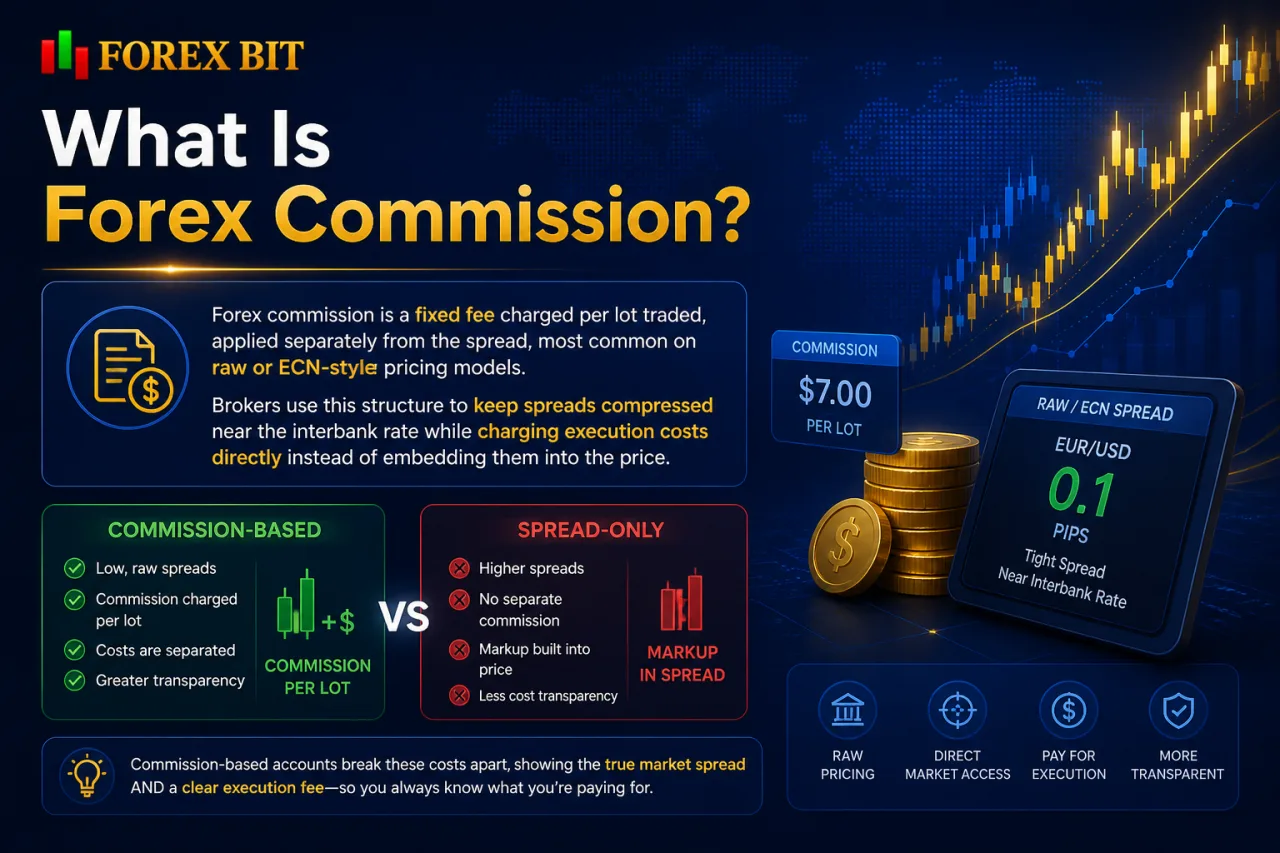
Forex commission is a fixed fee charged per lot traded, applied separately from the spread, most common on raw or ECN-style pricing models. Brokers use this structure to keep spreads compressed near the interbank rate while charging execution costs directly instead of embedding them into the price.
This fee-based structure contrasts with spread-only pricing, where markup sits inside the buy/sell price and no separate charge appears on the trade. Commission-based accounts break these costs apart, one line for the raw spread and another for the execution fee.
The next parts define this fee more precisely, including how the “round turn” concept works, why ECN and raw accounts favor commission over pure spread markup, and how this pricing differs from all-in spread-only models.
How Is Commission Usually Charged Per Lot or Round Turn?
Commission is charged per side, per standard lot, with the round turn combining both the opening and closing trade. This mirrors the calculation approach outlined earlier for round-turn cost estimation, applied here to the specific unit structure brokers publish.
A broker rate quoted “per side” applies once when a position opens and again when it closes, meaning the published figure doubles to reach the true round-turn cost. For example, a rate of $3.5 per side per standard lot results in a $7 round-turn charge once both legs are counted.
This structure remains constant regardless of how long a position stays open. Whether a trade closes within seconds or after several days, the commission owed depends only on lot size and side count, not on holding time. Some brokers publish rates as “per round turn” directly instead of “per side,” which removes the need to double the figure manually. Traders comparing quoted commission rates verify which unit a broker uses before calculating true round-turn cost, since mixing up per-side and per-round-turn figures produces a cost estimate that is off by half.
How Much Do Brokers Actually Charge in Forex Commission?
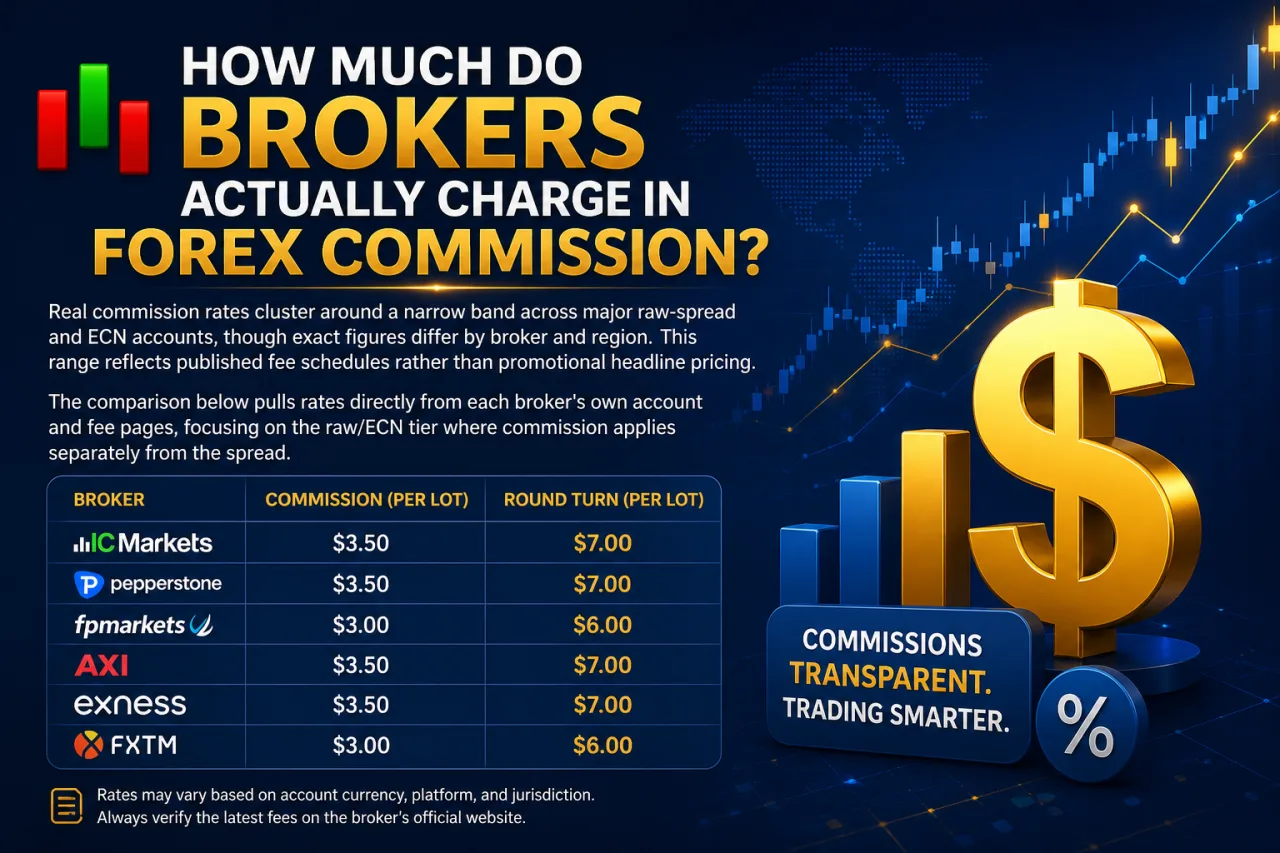
Real commission rates cluster around a narrow band across major raw-spread and ECN accounts, though exact figures differ by broker and region. This range reflects published fee schedules rather than promotional headline pricing.
The comparison below illustrates the typical structure found on each broker’s own account and fee pages, focusing on the raw/ECN tier where commission applies separately from the spread. The figures cited are illustrative examples of the commission range commonly published in this account tier, not fixed numbers guaranteed at the time of reading, since brokers revise their fee schedules periodically.
| Broker | Account Type | Commission (Round-Turn) | Source |
|---|---|---|---|
| Pepperstone | Razor | Typically a few dollars per lot per side, as published on the official Pepperstone pricing page | Pepperstone fee schedule |
| IC Markets | Raw Spread | Typically a few dollars per lot per side, as published on the official IC Markets pricing page | IC Markets fee schedule |
| FP Markets | Raw | Typically a few dollars per lot per side, as published on the official FP Markets pricing page | FP Markets fee schedule |
| Axi | Pro | Typically a few dollars per lot per side, as published on the official Axi pricing page | Axi fee schedule |
Traders should verify the exact current rate on each broker’s official pricing page before opening an account, since these figures are subject to change and vary by region. The table above sets up the direct comparison discussed next.
How to Calculate the Real Cost of Trading 1 Standard Lot of EUR/USD?
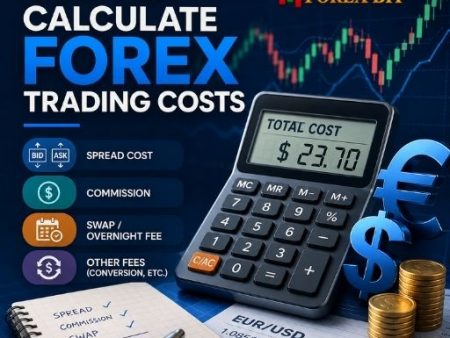
To calculate the real cost of trading 1 standard lot of EUR/USD, add the raw spread cost to the round-turn commission for the account being used. A standard lot equals 100,000 units of the base currency, so each pip movement carries a fixed dollar value that feeds directly into this formula.
Using IC Markets’ Raw Spread account as an illustration, the broker publishes its average spread and commission figures on its official pricing page, and traders are advised to check that page directly for the current rates rather than relying on fixed numbers, since spreads and commissions change over time. Pip value on a standard lot equals $10, so with an average spread near 0.1 pip on this account type, the spread cost works out to roughly $1 per standard lot. IC Markets’ Raw Spread account charges a per-lot commission on each side of a trade, adding a round-turn cost on top of the account’s low average spreads.
With a round-turn commission near $7 per standard lot, as published on IC Markets’ fee page, adding this to the roughly $1 spread cost produces a total near $8 per standard lot on EUR/USD for this account type. Traders confirm the exact current figures directly on the broker’s official page, since spreads and commissions change over time. This calculation applies the same spread-plus-commission method described earlier in this article, now applied to one real broker rather than general ranges.
Traders repeat this same formula for other brokers by substituting the published average spread and commission rate into the same two-step calculation.
Commission-Based vs Spread-Based Pricing: Which Costs More?
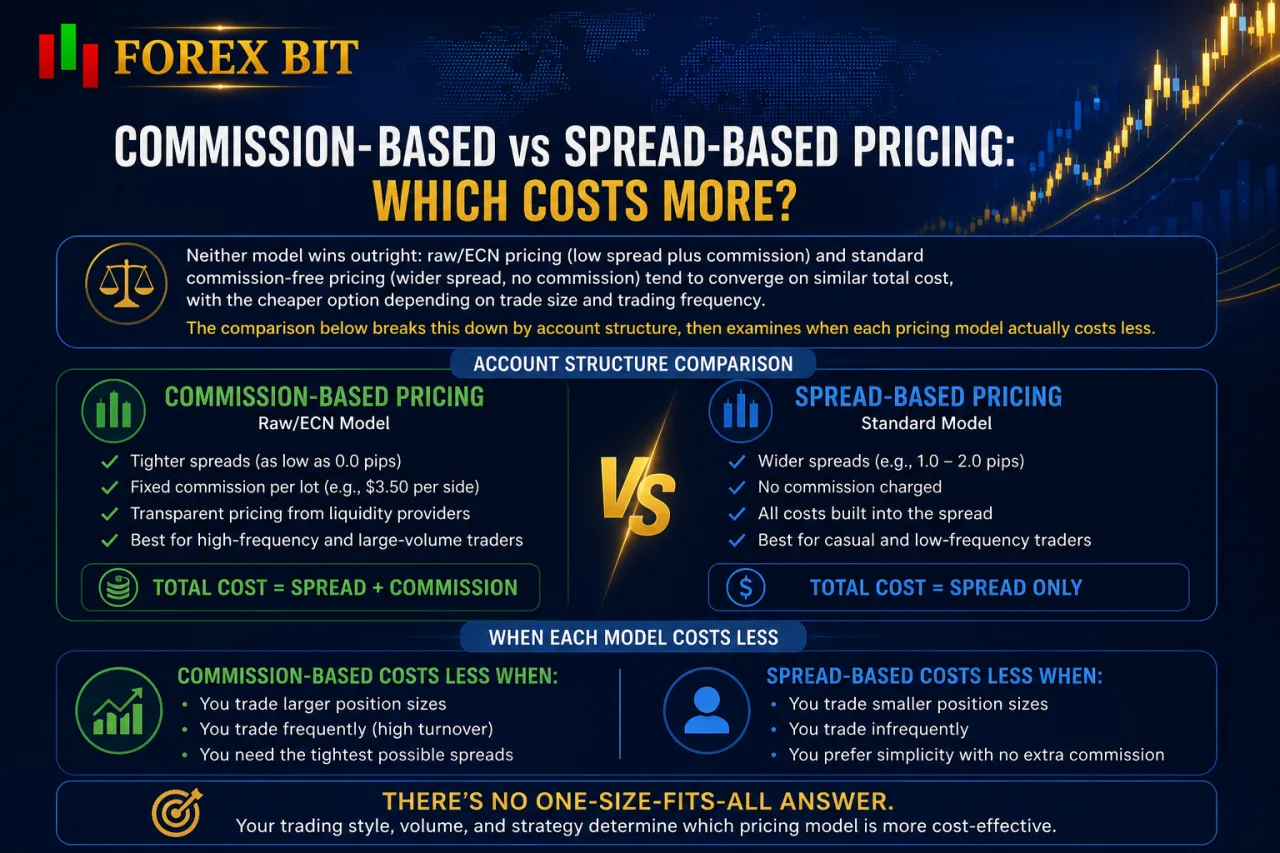
Neither model wins outright: raw/ECN pricing (low spread plus commission) and standard commission-free pricing (wider spread, no commission) tend to converge on similar total cost, with the cheaper option depending on trade size and trading frequency. The comparison below breaks this down by account structure, then examines when each pricing model actually costs less.
Which Account Type Is Better for High-Volume Traders vs Casual Traders?
High-volume traders gain more from commission accounts through tighter spreads, while casual traders favor commission-free spread accounts for simpler, single-line cost tracking. Trader profile fit determines which structure delivers lower total cost per session rather than per trade alone.
Scalpers and high-frequency traders open and close positions repeatedly within short timeframes. Casual or low-volume traders place fewer trades per week and hold positions longer. The two profiles differ in how each cost structure affects their total trading expense:
- High-volume traders: the near-zero raw spread on commission accounts compounds into meaningful savings across dozens of round turns per day.
- High-volume traders: commission remains fixed per lot regardless of holding time, so frequent execution does not add hidden markup the way a wider spread would on each fill.
- Casual traders: the wider embedded spread on commission-free accounts rarely accumulates into a significant cost difference for this trading style.
- Casual traders: this account type removes the need to track a separate commission line, simplifying cost calculation for traders who prioritize convenience over marginal per-trade savings.
Account choice therefore follows trading frequency and lot volume rather than personal preference alone.
Which Brokers Offer Low or Zero Forex Commission?
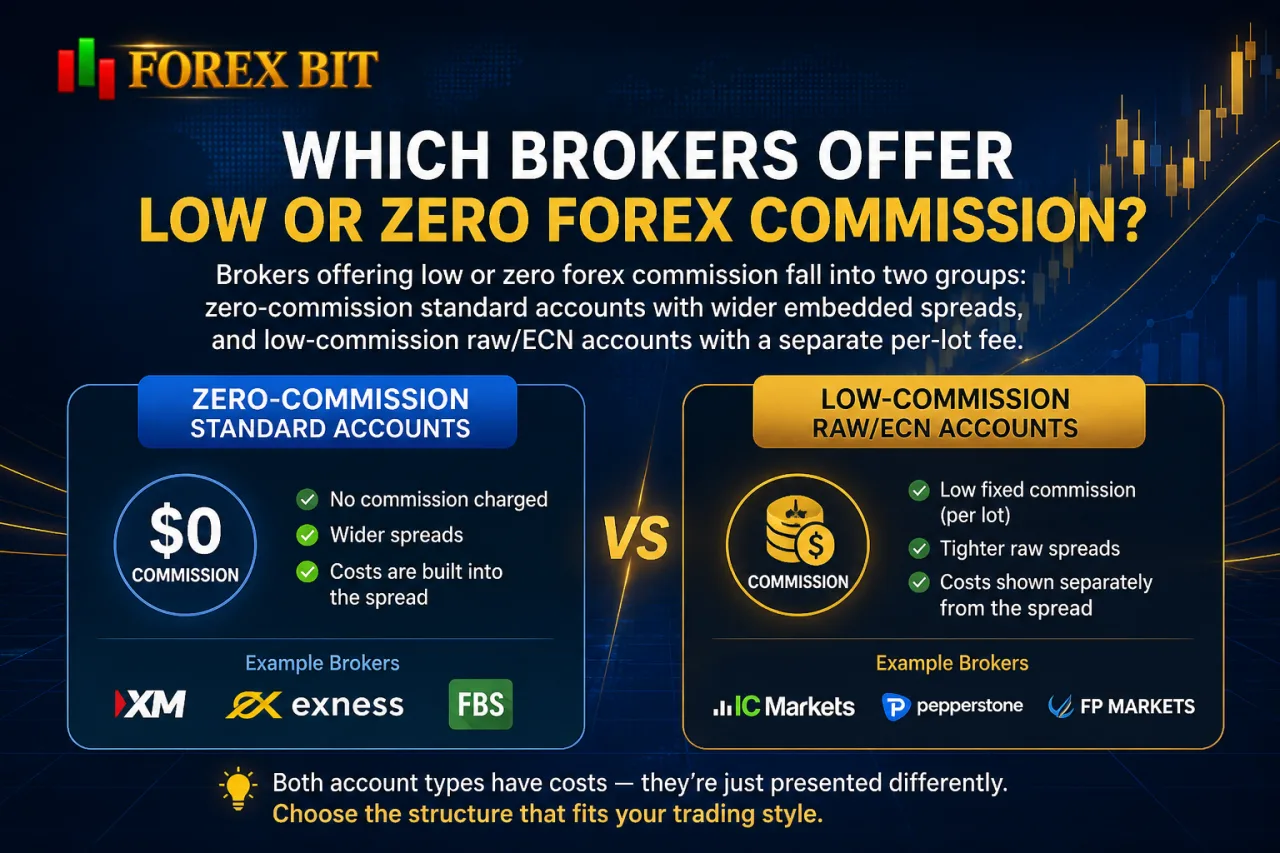
Brokers offering low or zero forex commission fall into two groups: zero-commission standard accounts with wider embedded spreads, and low-commission raw/ECN accounts with a separate per-lot fee. This grouping follows the spread-versus-commission distinction covered earlier, now applied to specific broker account names rather than pricing models in the abstract. The two categories differ in how the execution cost gets presented rather than in whether a cost exists at all.
Zero-commission standard account types typically charge no separate per-lot fee, pricing execution into the spread itself instead. Broker examples in this group include standard-type offerings such as XM Standard and HotForex Premium, where cost sits entirely inside the spread rather than as a listed fee. Standard-type accounts of this kind carry no separate commission charge, with cost embedded entirely in the spread.
Low-commission raw or ECN account types typically charge a per-lot fee on top of near-zero average spreads. Broker examples in this group include raw-style offerings such as IC Markets Raw and Pepperstone Razor, both of which list a per-lot commission alongside tighter average spreads. These raw-style accounts publish a per-lot commission rate applied on each side of a trade.
Exact commission figures, spread averages, and account names vary by broker and change over time. Traders should verify current terms directly on each broker’s official pricing page before comparing costs.
Are Zero-Commission Brokers Actually Cheaper Overall?
No, zero-commission brokers do not consistently end up cheaper overall, since the commission savings typically transfer into a wider spread that offsets the difference on the same trade. This confirms the pattern already established between XM’s Standard account and IC Markets’ Raw Spread account, where cost simply shifts location rather than disappearing.
A hidden-cost check requires comparing the full published spread on the zero-commission account against the spread-plus-commission total on the raw account for the same pair. A commission-free account typically carries a wider average spread than a raw-spread account before any commission is added, and this gap closes the apparent savings on the zero-commission side. Traders should verify current spreads directly with each broker, since published figures change over time and the exact gap varies by session, pair, and liquidity conditions.
Three factors decide which side wins on a given trade:
- Pair liquidity determines how much the spread widens on commission-free pricing.
- Trade size scales the embedded spread cost proportionally with lot volume.
- Holding frequency multiplies the cost gap across repeated round turns.
Verifying real spread data on both account types remains the only reliable way to confirm which structure costs less for a specific broker and instrument.
Does Forex Commission Vary by Account Currency or Instrument Type?
Yes, forex commission varies by both account base currency and instrument type, since non-forex CFDs often carry different fee schedules and currency conversion adds a small extra layer of cost. This variation sits on top of the per-lot round-turn structure already outlined for major currency pairs. The following breakdown separates instrument-based rate differences from base-currency conversion effects.
How Do Volume-Based Commission Discounts (Rebates) Work?
Volume-based commission discounts work through tiered rate schedules, where a trader’s monthly lot volume drops the per-lot commission charged on each subsequent round turn. Brokers set fixed volume brackets, and crossing into a higher bracket triggers a lower published rate for the remaining trading month or the following one.
This tiering mechanism connects directly to the high-volume trader advantage already established for commission-based accounts, since it further compresses cost for traders already benefiting from tighter raw spreads. Some brokers structure this as a tiered rate table, where trading above a set number of standard lots per month can qualify an account for a reduced per-side commission compared to the base rate, though exact thresholds and discounted rates vary by broker and should be confirmed directly with each provider.
Other providers apply the discount as a rebate instead, crediting cash back per lot traded rather than lowering the quoted rate itself. Several brokers run separate cashback or rebate programs that pay a set amount per lot back to the trader, calculated and paid out on a regular schedule, though exact rebate amounts and payout timing vary by broker and should be confirmed directly with each provider.
Traders qualifying for either format confirm current thresholds and rates directly on the broker’s fee schedule, since brackets and payout terms change over time.
Is Forex Commission Tax-Deductible or Reported Differently Than Spread Costs?
Yes, forex commission gets reported differently than spread costs, since it appears as a separate, itemized line on trade statements while spread cost stays embedded inside the entry and exit price. This reporting distinction matters for traders tracking costs for accounting or tax purposes.
Trade confirmations on raw/ECN accounts typically list execution price, lot size, and commission charged as distinct fields, giving an explicit dollar figure per round turn. Spread cost, by contrast, never shows as its own line item since it sits inside the quoted price itself, making it harder to isolate for expense tracking.
Whether commission qualifies as a deductible trading expense depends on local tax law and a trader’s specific tax classification, so this point requires confirmation with a local tax advisor or relevant tax authority rather than general guidance.
Conclusion
Forex commission functions as a per-lot execution fee attached to raw-spread and ECN accounts, charged separately from the price markup found in standard spread-only pricing. Round-turn cost depends on doubling the per-side rate, and real broker figures like IC Markets’ Raw Spread pricing show this fee combines with near-zero spreads to produce a total near $8 per standard lot on EUR/USD.
Zero-commission accounts shift this same cost into a wider spread rather than removing it, so total expense hinges on trade size, frequency, and instrument rather than the presence of a labeled fee. Confirming published rates directly with each broker remains essential before comparing true trading costs.
Isabella Brown is the Forex Trading Guide Manager at Forex Bit, focusing on educational content about broker safety, trading costs, account types, platforms, and key Forex/CFD concepts. Her work helps readers understand trading terms, broker conditions, and practical checks before evaluating or using a brokerage service.
Email: [email protected]
Best Brokers

Trade with the world’s largest retail broker and benefit from better - than - market conditions.

We offer a superior trading environment that puts traders in the best position to profit.

Invest and trade global markets with eToro – a Nasdaq-listed multi-asset platform built around social investing and CopyTrader.

Trade with the best trading conditions. WIN THE BEST TRADING ACCOUNT AWARD.






Forex Bit provides independent forex broker reviews, comparisons, guides, and industry news to help traders make informed decisions.
Best Brokers
Metatrader 5 Brokers
Metatrader 4 Brokers
Lowest Spread Forex Broker
Regulated Forex Brokers
Forex Copy Trading
Ctrader Brokers
Best Forex Broker For Beginners