
Curious how segregated client funds actually protect your money? See what real fund segregation means and how to verify it before you trade.
Segregated Client Funds: What Forex Traders Must Know

Segregated client funds refer to trader deposits held in bank accounts that are legally separate from a broker’s own operating capital. This structure prevents a broker from using client money to cover business expenses, trading losses, or debts.
Fund segregation blocks a broker from mixing trader deposits with company revenue, but it does not automatically cover trading losses. Negative balance protection is a separate mechanism that limits losses to the funds in a trading account, and both protections depend on the specific rules set by the broker’s regulator. Negative balance protection rules vary by regulator, with some jurisdictions mandating that brokers cover any negative balance on a client’s account while others leave this as an optional broker policy.
Segregation reduces the risk of client money being lost in an insolvency, but it does not guarantee a full refund in every case. Recovery speed and outcome depend on how strictly the broker followed segregation rules enforced by its regulator. Traders should also check whether an investor compensation scheme applies, as the level of protection and payout conditions in the event of broker insolvency vary depending on the regulatory jurisdiction.
Traders verify segregation by checking the broker’s legal entity, regulatory license number, and official disclosure documents published by the regulator. Cross-referencing this information directly on the regulator’s public register confirms whether the claim is accurate. Forex Bit breaks down these verification steps further below, starting with what segregated client funds actually mean in practice.
What Are Segregated Client Funds?
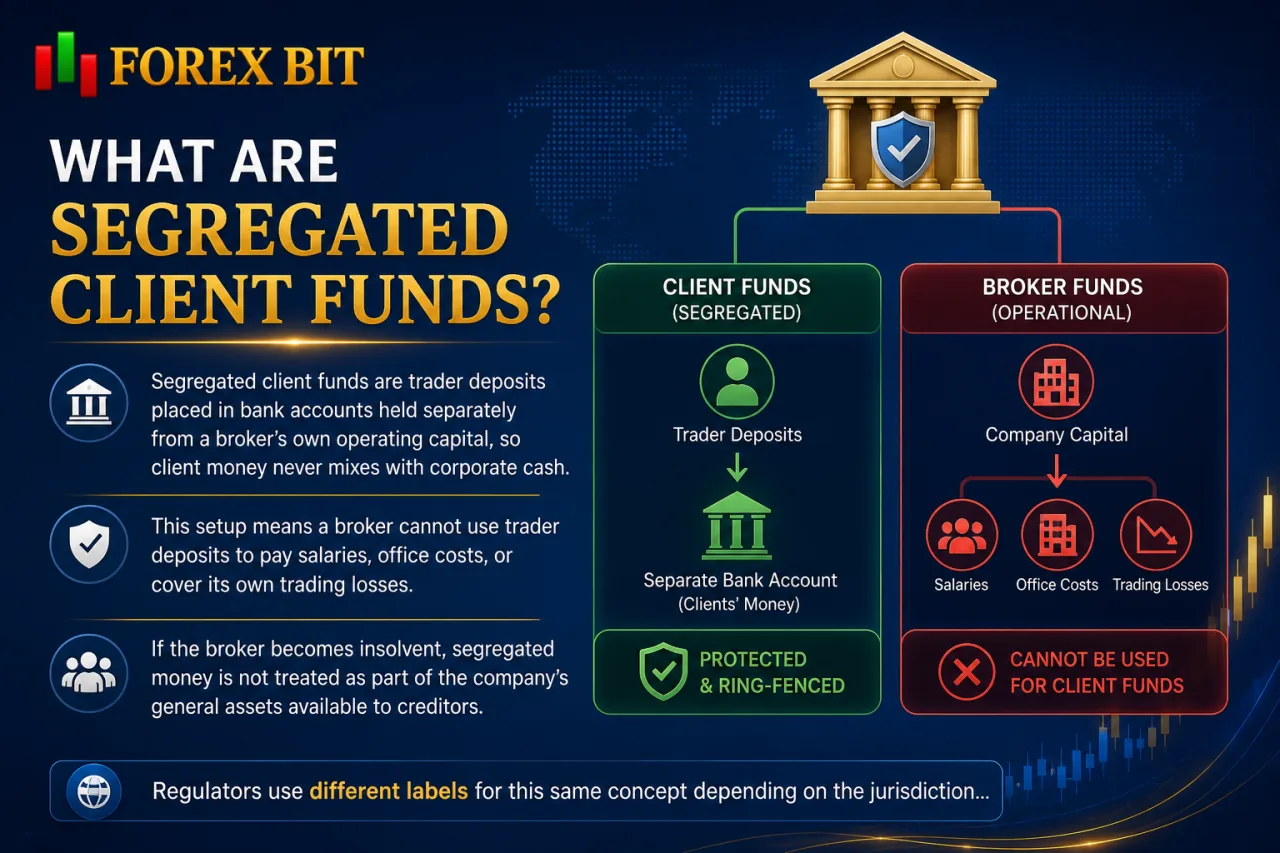
Segregated client funds are trader deposits placed in bank accounts held separately from a broker’s own operating capital, so client money never mixes with corporate cash. This setup means a broker cannot use trader deposits to pay salaries, office costs, or cover its own trading losses. If the broker becomes insolvent, segregated money is not treated as part of the company’s general assets available to creditors.
Regulators use different labels for this same concept depending on the jurisdiction. Common terminology includes:
- Client money rules describing how deposits are held and accounted for separately from firm funds.
- Trust accounts designating bank accounts legally owned in trust for clients rather than the broker.
- Custodial accounts referring to third-party banking arrangements where a custodian bank holds client balances.
The exact terminology, oversight, and enforcement strength attached to these terms differ by regulator, so a broker’s segregation claim only holds weight once the underlying legal entity and license are confirmed.
How Does Fund Segregation Protect Trader Money?
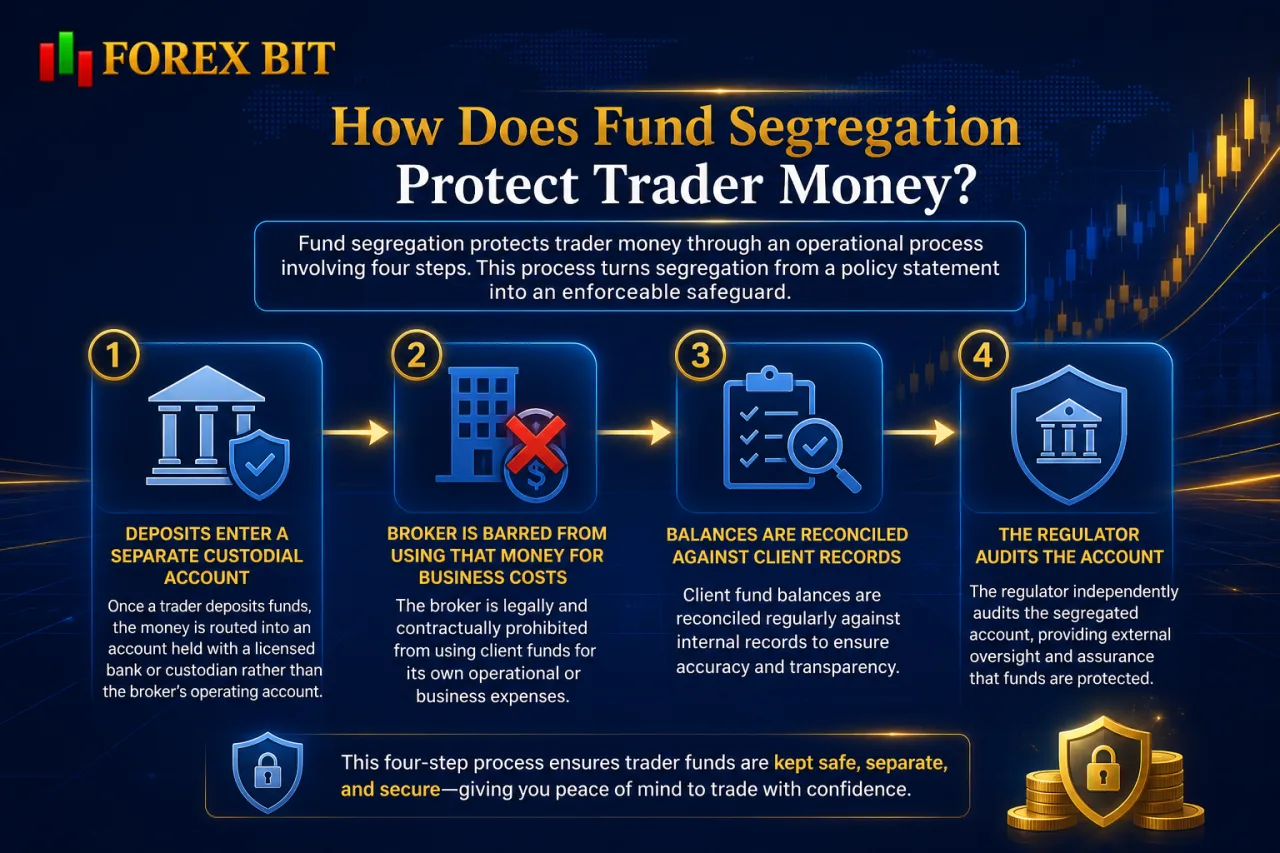
Fund segregation protects trader money through an operational process involving four steps: deposits enter a separate custodial account, the broker is barred from using that money for business costs, balances are reconciled against client records, and the regulator audits the account. This process is what turns segregation from a policy statement into an enforceable safeguard.
Once a trader deposits funds, the money is routed into an account held with a licensed bank or custodian rather than the broker’s corporate account. The broker retains operational access to process withdrawals and trades but holds no legal ownership over the balance. Reconciliation checks then confirm that the segregated account total matches what clients are owed across all trading accounts, catching discrepancies before they grow.
Regulators periodically request these reconciliation records or conduct direct audits of the custodian account, depending on the supervisory regime set by the regulator. This layered process reduces the risk of a broker misappropriating client money for its own use, since deposits are procedurally kept out of reach.
It does not eliminate misappropriation risk entirely, since fraud can still occur if a broker falsifies reconciliation records or if audits happen infrequently. The strength of this protection ultimately depends on how rigorously the responsible regulator enforces the segregation and audit requirements.
Segregated Accounts vs Broker Operating Funds: What Is the Difference?
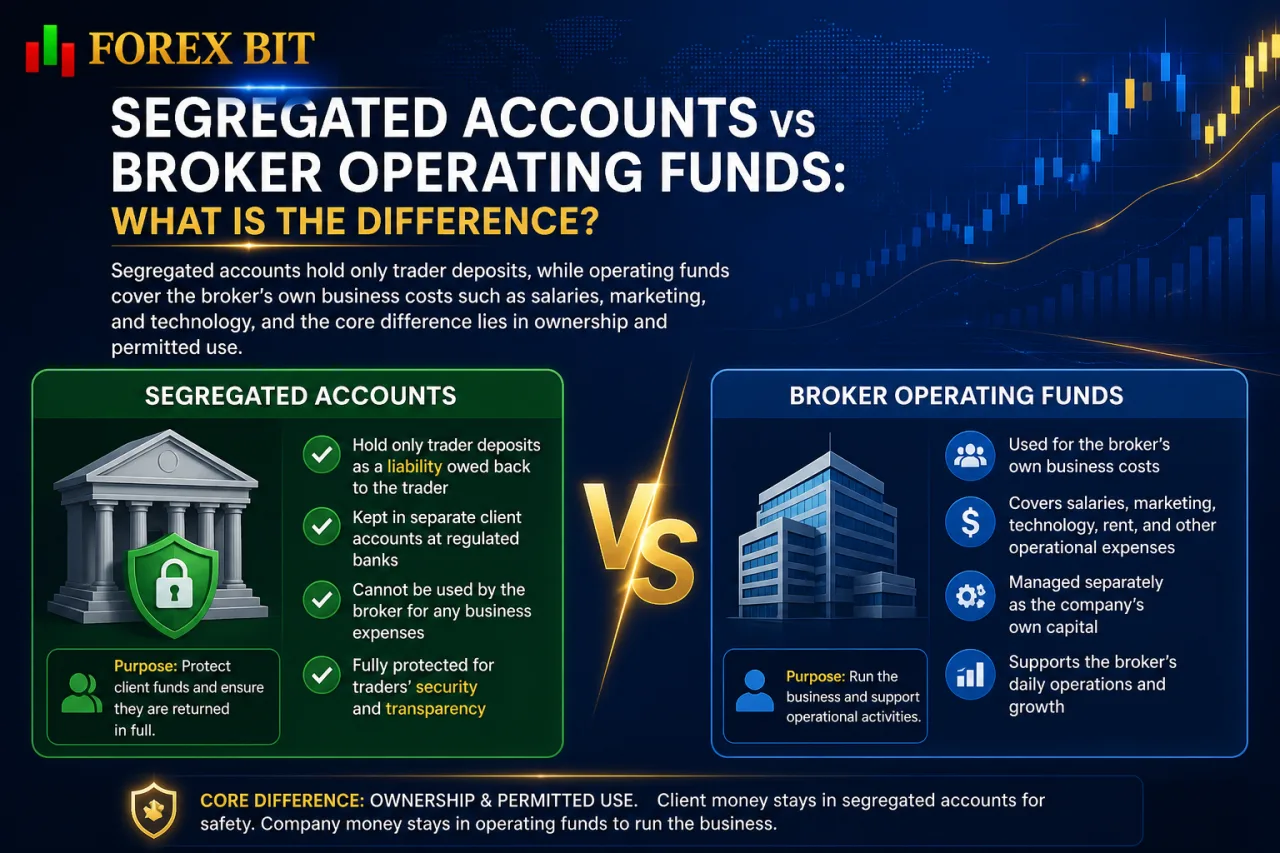
Segregated accounts hold only trader deposits, while operating funds cover the broker’s own business costs such as salaries, marketing, and technology, and the core difference lies in ownership and permitted use. This distinction shapes how a broker’s daily finances actually work behind the segregation label already discussed.
A client segregated account exists purely to hold trader money as a liability owed back to that trader, not as company revenue. The broker cannot draw from this pool to pay staff, fund advertising campaigns, upgrade trading platforms, or settle its own debts. Operating funds, by contrast, come from the broker’s revenue streams such as spreads, commissions, and fees, and this pool legitimately covers every routine business expense.
Segregation rules exist specifically to stop these two pools from mixing. If a broker draws client deposits into its operating account to cover a cash shortfall, that action typically breaches the client money rules set by the broker’s regulator, since it exposes trader funds to the same insolvency risk as the company’s general assets. Verifying that a broker maintains this separation in practice, rather than just claiming it, remains the trader’s responsibility.
Segregated Funds vs Negative Balance Protection: How Are They Different?

Segregated funds protect trader deposits from broker misuse or insolvency, while negative balance protection stops an account from falling below zero during extreme market moves, and neither mechanism substitutes for the other. This distinction matters because each safeguard addresses a separate risk within the same trading account.
Fund segregation deals with custody risk, keeping deposited capital out of the broker’s operating pool so it stays recoverable if the broker fails financially. Negative balance protection deals with market risk, capping losses at the account balance when a sudden price gap or spike triggers slippage beyond a trader’s margin.
A trader could hold funds in a fully segregated account and still owe money after a volatile move if the broker’s legal entity does not apply negative balance protection. Conversely, negative balance protection offers no benefit if the broker never separated client deposits from company funds in the first place, since insolvency could still wipe out the deposit itself.
Both protections depend on rules set by the broker’s regulator, and traders confirm which apply by checking the specific legal entity holding their account rather than assuming coverage across a broker’s entire brand.
Does Fund Segregation Guarantee Traders Will Get Their Money Back If a Broker Becomes Insolvent?
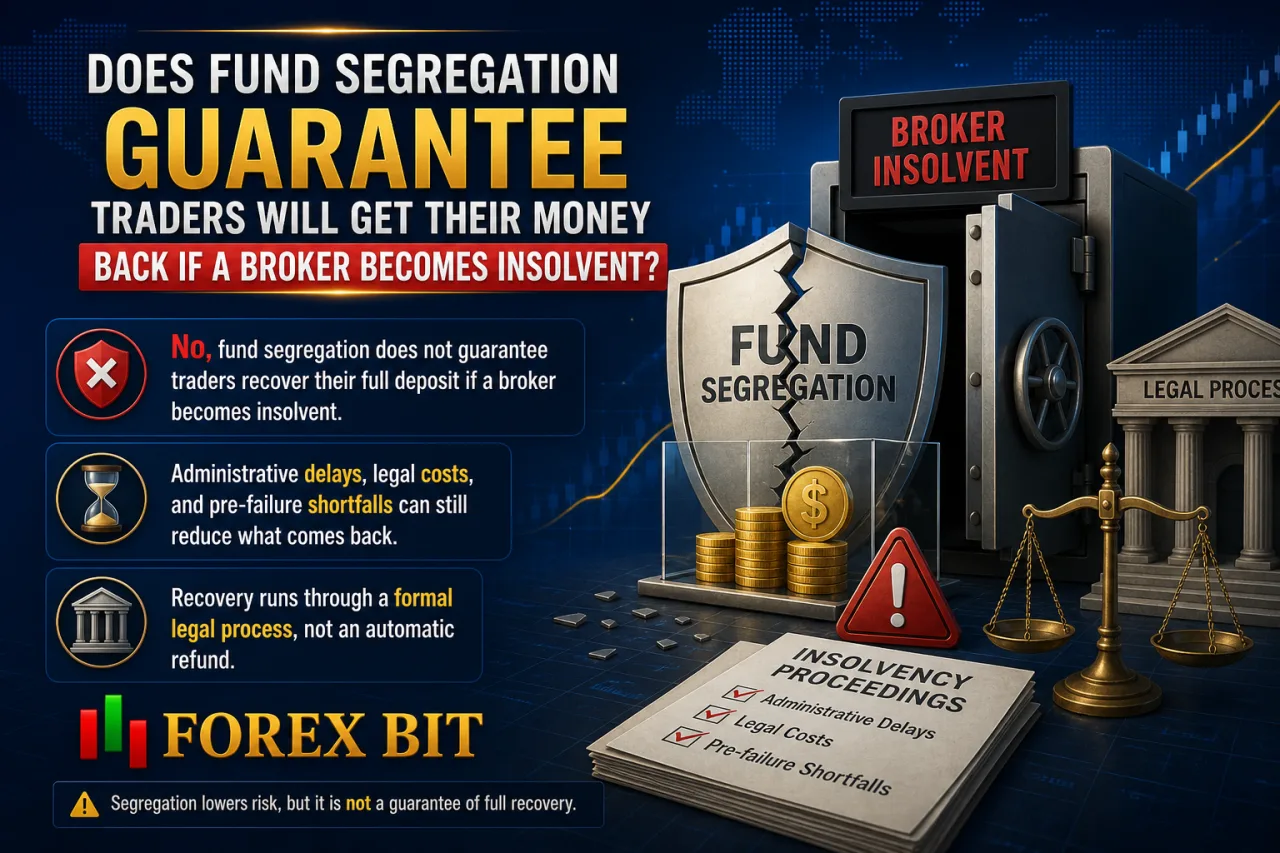
No, fund segregation does not guarantee traders recover their full deposit if a broker becomes insolvent, since administrative delays, legal costs, and pre-failure shortfalls can still reduce what comes back. This limitation follows directly from how segregated accounts function once insolvency proceedings actually begin.
Segregation lowers the risk of client money disappearing into a broker’s general assets, but recovery still runs through a formal legal process rather than an automatic refund. Several factors shape the outcome:
- Liquidators take control of the insolvent broker’s assets and verify segregated account balances against client records before releasing anything.
- Administrative delays stretch this verification process over weeks or months depending on how organized the broker’s records were before failure. The process of liquidators identifying, verifying, and releasing segregated client funds after a broker’s insolvency can take a considerable amount of time, and traders should not expect immediate access to their funds during this period.
- Legal costs tied to the liquidation process sometimes get deducted from the pooled client funds before distribution.
- Shortfalls appear if the broker mismanaged or partially misused segregated funds prior to collapse, leaving less than what clients are owed.
Because these variables depend heavily on jurisdiction and how strictly the regulator enforced segregation rules beforehand, segregation reduces risk without functioning as a 100% guarantee of full repayment.
What Compensation Schemes Exist If Segregation Fails or a Broker Collapses?

Investor compensation schemes exist in some jurisdictions, tied to specific regulators, reimbursing clients up to a set limit only when the licensed entity holding the account actually collapses. This differs from fund segregation itself, since compensation schemes act as a secondary backstop once segregation and liquidation have already run their course.
Coverage groups into a few recognized frameworks, each attached to a particular regulator rather than to a broker brand as a whole:
- **FSCS (Financial Services Compensation Scheme)**This scheme covers eligible clients of UK-regulated firms authorized by the FCA, subject to specific eligibility rules and payout limits that traders should verify directly with the scheme before relying on it.
- **ICF (Investor Compensation Fund)**An Investor Compensation Fund also applies to firms licensed in Cyprus and certain other EU jurisdictions under MiFID-based rules, reimbursing eligible claims up to a defined cap, though traders should confirm the current cap and eligibility rules directly with the relevant scheme before relying on it.
Not every regulator operates a compensation fund, and offshore or lightly regulated jurisdictions frequently offer no equivalent scheme at all. Coverage attaches strictly to the legal entity named on the trading account, so a trader onboarded under an offshore branch of an internationally known broker may hold no claim to a scheme that protects a separately licensed entity of the same brand.
How Can Traders Verify If a Specific Broker Actually Segregates Client Funds?

Traders verify segregation through a practical checklist covering the broker’s legal documents, account entity, regulator status, license register, and audit disclosures. Each step below narrows down whether a segregation claim holds up under direct verification rather than marketing language alone.
Why Does the Broker’s Legal Entity and Regulator Matter for Segregation Rules?
Yes, the broker’s legal entity and regulator matter for segregation rules, since the same broker brand can register multiple entities that each follow different client money requirements. This distinction directly follows from the entity-level checklist introduced above, since verification only means something once the correct legal entity is identified.
A well-known broker brand frequently splits its operations across separate legal entities, such as one licensed within the EU and another registered offshore. Each entity holds its own license, answers to a distinct regulator, and operates under separate segregation obligations, so opening an account under one entity does not automatically extend the protections applied to a sibling entity under the same brand name.
This split affects traders in three concrete ways:
- Segregation requirements differ in how strictly client money must stay separated from operating capital.
- Enforcement strength varies depending on how actively the assigned regulator audits and penalizes violations.
- Compensation eligibility applies only to the specific entity covered by a scheme such as FSCS or ICF, not to the broker brand as a whole.
Traders confirm which entity holds their account before assuming any segregation or compensation protection carries over from the brand’s reputation.
What Are Some Lesser-Known Facts About Segregated Fund Rules Across Regulators?
Segregated fund rules differ across regulators in several less obvious ways, including reconciliation frequency, pooled account structures, and limited exceptions allowing temporary use of client money. These nuances explain why “segregated” carries different practical meaning depending on which regulator oversees the broker’s legal entity.
Reconciliation frequency varies by jurisdiction, with some regulators requiring daily reconciliation reports while others accept weekly or less frequent checks between segregated balances and client records. Some regulators require brokers to submit periodic reconciliation reports confirming that segregated account totals match client balances.
Account structure also differs. Certain regulators permit brokers to hold client money in pooled omnibus accounts covering multiple traders together, rather than requiring individually named accounts for each client. Omnibus structures simplify banking operations but rely more heavily on the broker’s internal record-keeping to allocate the correct balance back to each trader.
A further exception involves limited, regulator-approved use of client funds. In some jurisdictions, brokers may be permitted to temporarily draw on one client’s segregated balance to cover another client’s shortfall, though such arrangements are only allowed under strict, clearly defined conditions. This exception does not apply universally, and traders confirm whether it exists under their specific legal entity’s rules rather than assuming uniform protection across brokers.
Do Offshore or Unregulated Entities Follow the Same Segregation Standards as Tier-1 Regulators?
No, offshore or unregulated entities do not follow the same segregation standards as tier-1 regulators, since oversight bodies like the FCA, ASIC, and CySEC mandate audits and reporting that many offshore jurisdictions simply do not require. This gap in enforcement carries directly forward from the entity-level checks discussed above, since the regulator attached to a broker’s legal entity determines how a segregation claim can actually be verified.
Tier-1 regulators build enforcement into the license itself, so segregation is not a voluntary policy but a supervised requirement. This shows up in three practical differences:
- Auditing happens on a scheduled basis under tier-1 regulators, while many offshore authorities conduct little to no independent verification.
- Reporting obligations require brokers under tier-1 oversight to submit reconciliation data, whereas offshore entities often disclose nothing publicly.
- Penalties for breaching client money rules carry real regulatory consequences under bodies like the FCA or ASIC, while enforcement in loosely regulated jurisdictions is frequently inconsistent or absent.
A website statement claiming “segregated accounts” carries different weight depending on which of these regimes actually applies to the account-holding entity.
Conclusion
Segregated client funds keep trader deposits separate from a broker’s operating capital, blocking misuse for business expenses while reducing, but not eliminating, exposure during insolvency. This safeguard works alongside distinct mechanisms like negative balance protection and investor compensation schemes, each governed by rules that differ across regulators and legal entities.
Real protection depends on verified enforcement, not marketing claims, meaning traders confirm the exact entity, license, and regulator behind an account before assuming any level of fund safety. Tier-1 oversight bodies enforce audits and reporting that offshore jurisdictions frequently skip, making entity-level verification the deciding factor in how much segregation actually protects a trader’s money.
Isabella Brown is the Forex Trading Guide Manager at Forex Bit, focusing on educational content about broker safety, trading costs, account types, platforms, and key Forex/CFD concepts. Her work helps readers understand trading terms, broker conditions, and practical checks before evaluating or using a brokerage service.
Email: [email protected]



Best Brokers

Trade with the world’s largest retail broker and benefit from better - than - market conditions.

We offer a superior trading environment that puts traders in the best position to profit.

Trade with the best trading conditions. WIN THE BEST TRADING ACCOUNT AWARD.

Trade global markets with Interactive Brokers – a highly regulated multi-asset broker built for active and professional investors.






Forex Bit provides independent forex broker reviews, comparisons, guides, and industry news to help traders make informed decisions.
Best Brokers
Metatrader 5 Brokers
Metatrader 4 Brokers
Lowest Spread Forex Broker
Regulated Forex Brokers
Forex Copy Trading
Ctrader Brokers
Best Forex Broker For Beginners