
Wondering how much a forex inactivity fee costs? See typical charges, trigger periods, and simple steps to avoid or waive it.
Forex Inactivity Fee Explained: Costs & How to Avoid It

A forex inactivity fee is a periodic charge deducted from a trading account after a set period of no trading activity. Brokers typically apply inactivity fees only after an extended period without trading activity, with the exact threshold varying from one broker to another. Brokers apply this charge to offset the administrative cost of maintaining dormant accounts.
Inactivity fees typically cost between $5 and $15 per month once triggered. Inactivity fees are commonly charged on a monthly basis, though some brokers charge a one-time flat fee instead. The exact amount often depends on account currency, base deposit size, and the broker’s regulatory jurisdiction.
Inactivity fee policies differ significantly across forex and CFD brokers. Some brokers waive the charge entirely and others apply tiered fees based on dormancy length. Comparing these terms side by side reveals which providers favor infrequent or long-term traders.
Avoiding an inactivity fee usually requires placing at least one trade within the broker’s defined activity window or formally closing the account. Some brokers also waive the fee for accounts holding a minimum balance or enrolled in specific account tiers.
Verifying a specific broker’s inactivity fee terms means checking the official fee schedule and account agreement published on that broker’s website. Terms can change and vary by regulated entity. Forex Bit compiles this cost information across brokers to simplify that verification process.
Understanding these charges starts with defining exactly what qualifies as an inactive account and how brokers measure it.
What Is a Forex Inactivity Fee?
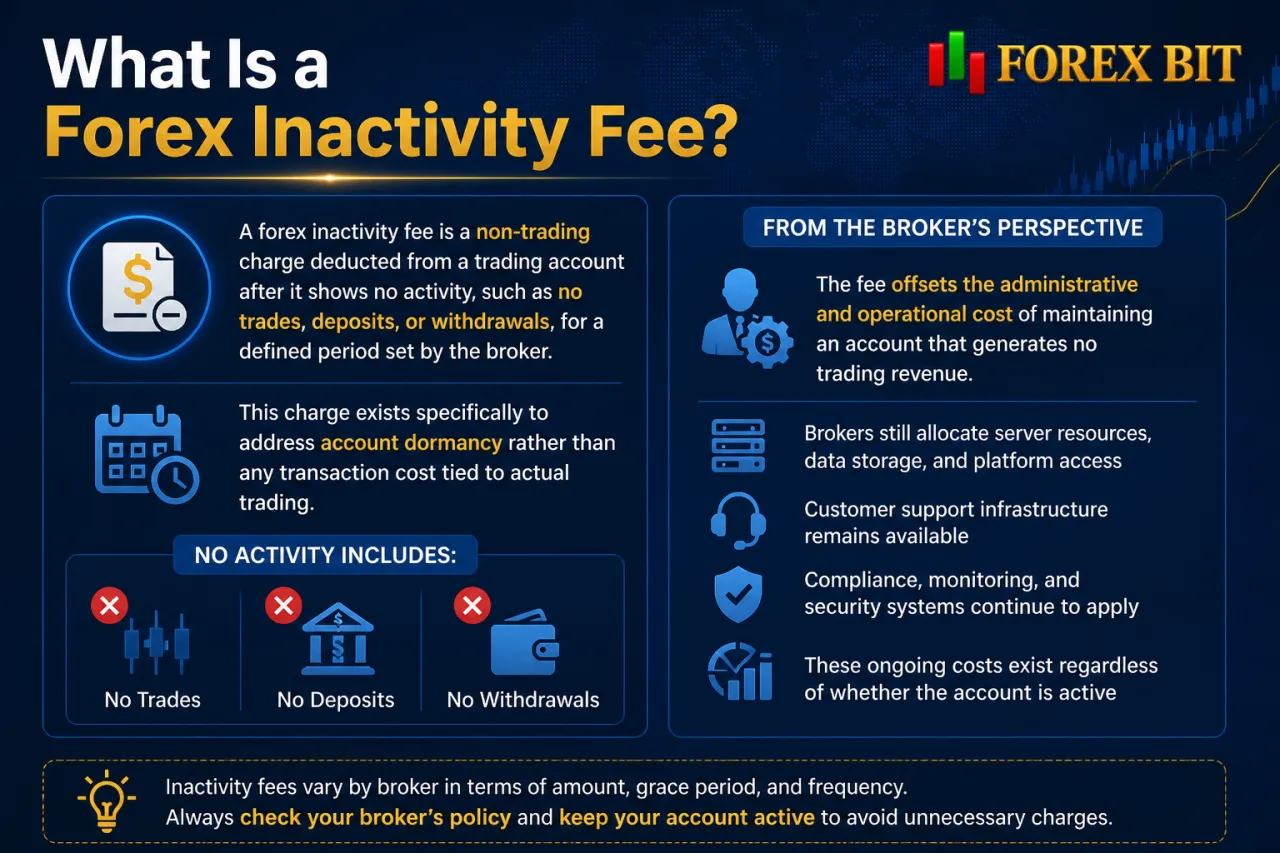
A forex inactivity fee is a non-trading charge deducted from a trading account after it shows no activity, such as no trades, deposits, or withdrawals, for a defined period set by the broker. This charge exists specifically to address account dormancy rather than any transaction cost tied to actual trading.
From the broker’s perspective, the fee offsets the administrative and operational cost of maintaining an account that generates no trading revenue. Brokers still allocate server resources, compliance monitoring, and customer support capacity to dormant accounts even when no orders are placed. Because these accounts produce no spread or commission income, the inactivity fee recovers part of that ongoing overhead.
This practice applies broadly across the forex and CFD brokerage industry rather than to a single provider or platform type. Regulated brokers operating under different jurisdictions each define their own dormancy threshold and fee amount in their published terms. The underlying concept remains consistent though: activity, or the lack of it, on the account determines whether the charge applies.
How Much Does a Forex Inactivity Fee Typically Cost?
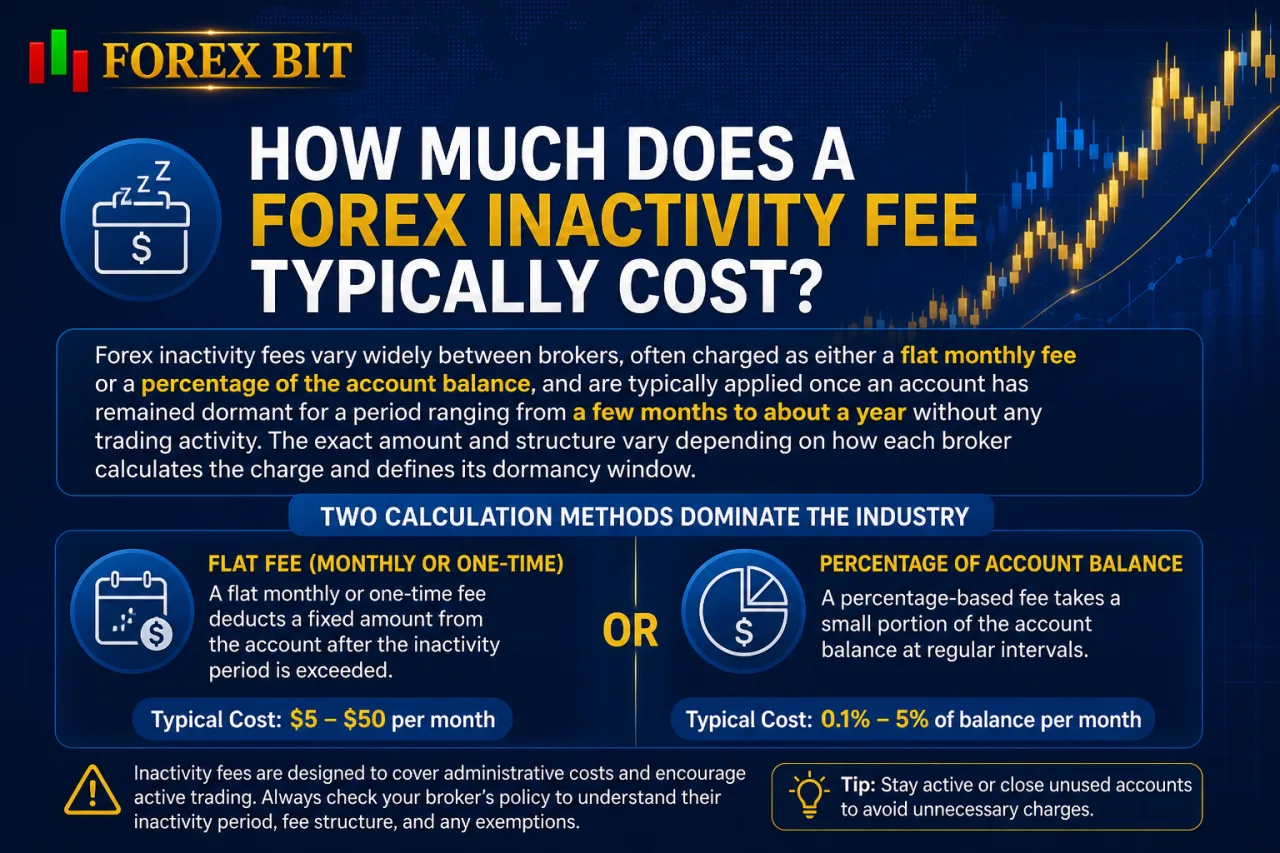
Forex inactivity fees vary widely between brokers, often charged as either a flat monthly fee or a percentage of the account balance, and are typically applied once an account has remained dormant for a period ranging from a few months to about a year without any trading activity. The exact amount and structure vary depending on how each broker calculates the charge and defines its dormancy window, so these figures reflect general patterns observed across the industry rather than fixed universal rates.
Two calculation methods dominate the industry. A flat monthly or one-time fee deducts a fixed amount regardless of account size, while a percentage-based fee scales the charge relative to the remaining balance.
Dormancy thresholds also differ by provider:
- Short-term thresholds apply the fee after roughly 3 months of no trades, deposits, or withdrawals.
- Mid-term thresholds set the trigger point around 6 months of inactivity.
- Longer thresholds delay the charge until an account has been inactive for around 12 months.
These timeframes represent common patterns seen across various brokers rather than an industry-wide standard. Some brokers apply the shorter 3-month window, others favor the 6-month mark, and a smaller group waits closer to a full year before charging anything. The specific cutoff depends entirely on each broker’s internal policy.
Percentage-based models reduce the proportional impact of the fee on larger account balances. This happens because the deducted amount stays proportionally smaller against a bigger balance.
Traders confirm the precise threshold and calculation method through each broker’s published fee schedule. These figures are not standardized across the industry, so checking the terms directly with the broker remains the only reliable way to know the exact cost.
What Triggers the Inactivity Period Countdown?
The inactivity countdown starts from the last recorded trading action on the account, most commonly the last opened or closed position, though many brokers also count deposits and withdrawals as qualifying activity. This trigger point determines when the dormancy clock begins ticking toward the fee threshold discussed above.
Brokers generally recognize a limited set of actions as valid activity that resets the countdown:
- Opening a new trade position
- Closing an existing trade position
- Depositing funds into the account
- Withdrawing funds from the account
Some brokers extend this definition to include simply logging into the trading platform or client portal, though this criterion applies less consistently across the industry. Logging in alone typically does not qualify as activity under broker policies, since it generates no trading or transactional record on the account.
Each qualifying action resets the countdown to zero, restarting the dormancy period from that date. Traders confirm which specific actions count as activity by reviewing the broker’s published account terms, since this definition varies by provider and regulatory entity.
What Happens If the Account Balance Runs Out?
Brokers generally stop deducting the inactivity fee once the account balance reaches zero, since a negative balance would create a liability the broker cannot legally collect from a dormant account. This zero-balance point marks a shift in how the account is classified rather than an escalation of charges.
The inactivity fee question ties directly to what happens once dormant deductions exhaust the remaining funds. Most brokers operating under negative balance protection rules halt further charges at zero rather than pushing the account into debt.
- Stopping fee deductions once the balance hits zero, under standard negative balance protection policies
- Reclassifying the account as dormant or zero-balance rather than immediately closing it
- Retaining the account in the broker’s system for a further period before formal closure
- Requiring a new deposit to reactivate the account if the trader wants to resume trading
Whether a broker automatically closes a zero-balance account or simply leaves it dormant indefinitely depends on that broker’s specific account maintenance policy. Traders confirm this distinction, along with any reactivation requirements, in the broker’s published terms and conditions.
How Do Inactivity Fee Policies Compare Across Forex Brokers?
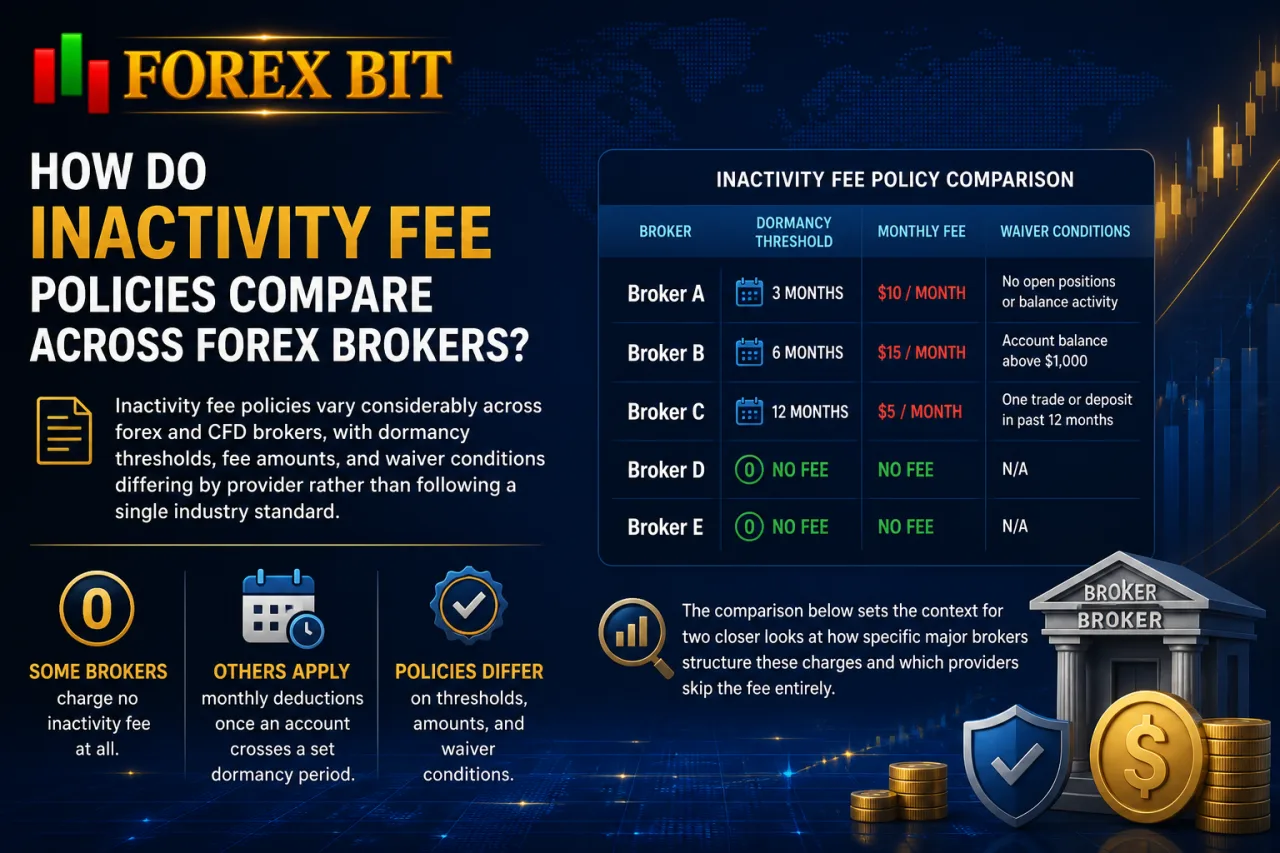
Inactivity fee policies vary considerably across forex and CFD brokers, with dormancy thresholds, fee amounts, and waiver conditions differing by provider rather than following a single industry standard. Some brokers charge no inactivity fee at all, while others apply monthly deductions once an account crosses a set dormancy period.
The table below compares how several well-known brokers structure this charge:
| Broker | Inactivity Period | Fee Amount | Conditions |
|---|---|---|---|
| IG | Applies after an extended period of no trading activity | A recurring monthly charge | Waived if the account holds an open position or meets the broker’s exemption criteria |
| XM | Applies after an extended period of no login or trading activity | A monthly maintenance-style charge | Deducted from available balance until the account is reactivated or funds are exhausted |
| Pepperstone | Does not charge a fee for dormant accounts | Not applicable | No inactivity fee under its standard account terms |
| IC Markets | Does not charge a fee for dormant accounts | Not applicable | No inactivity fee under its standard account terms |
| OANDA | Applies after an extended period of no trading activity | A recurring monthly charge | Waived in certain regions or account types depending on local regulatory requirements |
Exact thresholds, fee amounts, and waiver terms differ by entity and jurisdiction, so traders should verify current terms directly with each broker before assuming a policy applies to their account type. The comparison sets the context for two closer looks at how specific major brokers structure these charges and which providers skip the fee entirely.
Which Brokers Charge No Inactivity Fee?
Certain broker categories waive inactivity fees entirely, including many ECN/raw-spread brokers that rely on commission volume rather than dormant-account charges, plus brokers regulated in jurisdictions that restrict such fees. This grouping helps traders identify where dormancy carries no cost risk at all.
ECN-style brokers built around high-volume, low-margin commission models sometimes skip inactivity charges since their revenue structure depends on active trading turnover rather than account maintenance fees. Brokers such as Pepperstone and IC Markets, known for raw-spread ECN account types, are often cited in trader discussions as examples that do not charge inactivity fees on their core trading accounts. This example is illustrative rather than a guarantee, since fee policies change over time and vary by account type and region. Traders confirm the current policy directly on each broker’s official fee schedule page before opening an account.
Regulatory regions also shape whether inactivity fees exist at all. Brokers licensed under EU MiFID II rules face restrictions on non-trading fees, which pushes many EU-regulated entities to waive or cap inactivity charges rather than impose them freely.
Brokers that waive the fee typically fall into a few recognizable groups:
- Commission-based ECN brokers, prioritizing trading volume over dormancy charges (verify current policy on the broker’s own fee page)
- Brokers licensed under frameworks like EU MiFID II, where consumer protection rules limit non-trading fees
- Brokers offering promotional fee-free policies as a standard account feature
Traders confirm exemption status directly through each broker’s fee schedule, since waiver policies are not universal even within the same regulatory category.
How to Avoid or Waive a Forex Inactivity Fee?

Avoiding a forex inactivity fee requires taking one of several actions before the broker’s dormancy threshold is reached, such as placing a trade, moving funds, or closing the account outright. Waiving a fee already applied typically depends on contacting customer support directly, since automated deductions rarely reverse on their own.
The methods below address both prevention and after-the-fact waiver requests, since traders face this issue at different stages of the dormancy timeline.
- Placing a small periodic trade resets the countdown before the threshold triggers a charge.
- Making a minor deposit or withdrawal counts as qualifying activity under most broker policies.
- Closing the account formally before the dormancy period elapses removes any risk of deduction.
- Requesting a fee waiver from customer support sometimes reverses a charge already applied, particularly for accounts with a documented reason for dormancy.
- Selecting a broker with no inactivity fee policy from the outset eliminates the risk entirely.
Each option suits a different situation: active traders prevent the fee proactively, while dormant-account holders rely more heavily on the waiver request or account closure route.
How to Request a Fee Waiver from Your Broker?
Requesting a fee waiver starts with contacting the broker’s customer support team directly through live chat, email, or a support ticket, then explaining the circumstances behind the account’s dormancy. This approach applies after a charge has already posted, since the request works as a reversal appeal rather than a prevention step.
Support teams typically ask for the account number and a brief explanation of why the account went inactive before reviewing the request. Traders who reference a documented reason, such as a temporary account restriction, a platform access issue, or a first-time dormancy occurrence, tend to receive a faster response.
Brokers commonly grant one-time waivers under a few recognizable conditions:
- Holding a long account history with the broker before the dormant period began
- Requesting the waiver shortly after the fee posts rather than months later
- Presenting a documented reason tied to a platform or account access problem
- Committing to resume trading activity or make a deposit soon after reactivation
A waiver approval remains discretionary and is not guaranteed under any broker’s published policy. Traders confirm the broker’s specific stance on waiver requests through the account terms or by asking support directly before assuming a reversal will apply.
How to Check a Specific Broker’s Inactivity Fee Terms?
Verifying a specific broker’s inactivity fee terms requires checking that broker’s official fee schedule, terms and conditions, and account agreement pages before opening an account. These published documents outline the exact dormancy threshold, deduction amount, and applicable currency for that provider, since none of these figures apply universally across the industry.
Confirming these terms before funding an account addresses the comparison and prevention points already covered above.
- Locating the fee schedule page, typically listed under a “Fees,” “Pricing,” or “Costs” section on the broker’s website
- Reviewing the account agreement or client terms document for the exact dormancy period and waiver conditions
- Checking whether the disclosed fee amount differs by account currency, account type, or regulatory entity
- Contacting customer support directly when the published documents leave the threshold or amount unclear
Regulated entities operating under the same broker brand can publish different inactivity fee terms, since each entity is typically governed by the regulatory framework of its own jurisdiction. Traders confirm which entity holds their account before relying on any single version of the published fee schedule.
Are There Regulatory Rules That Limit Inactivity Fees?
Yes, regulatory rules limit inactivity fees in certain jurisdictions, with the EU and UK imposing disclosure or fairness requirements while offshore-regulated brokers face fewer restrictions. This regulatory question ties directly into the broker comparison covered above, since jurisdiction shapes whether a fee applies at all. The distinction generally splits into two regulatory environments, examined separately below.
How Does Inactivity Fee Regulation Differ Between EU/UK and Offshore Brokers?
EU/UK regulated entities disclose inactivity fee terms under stricter fairness and transparency rules, while offshore entities licensed in Cayman, Vanuatu, or Seychelles face fewer restrictions on fee size or disclosure clarity. This regional gap in inactivity fee regulation shapes both the amount charged and how clearly that charge appears in account documentation.
EU and UK frameworks generally push brokers toward clearer fee disclosure and, in some cases, caps on non-trading charges relative to account balance. Some regulatory frameworks also impose conditions on how inactivity fees are structured, such as limiting the amount relative to the remaining account balance or requiring advance notice before any deduction is made.
Offshore entities operating under Cayman, Vanuatu, or Seychelles licenses typically publish inactivity terms with fewer standardized disclosure requirements. This regulatory gap sometimes results in higher fee amounts or less prominent placement of the fee schedule within account documentation. Traders confirm which entity holds their account before assuming EU/UK-level protections apply, since the same broker brand can operate multiple regulated entities with different inactivity fee terms.
Conclusion
A forex inactivity fee amounts to a dormancy charge, typically $5 to $15 per month or a balance-based percentage, triggered once an account sits untouched for a broker-defined window ranging from roughly 3 to 12 months. The countdown resets with a trade, deposit, or withdrawal, and deductions stop at a zero balance under negative balance protection.
Policies differ sharply across providers, with some ECN and offshore-restricted brokers waiving the charge entirely. Prevention comes down to periodic activity, formal account closure, or choosing a fee-free broker upfront, while an already-applied charge sometimes reverses through a direct waiver request to customer support.
Michael Smith is a Forex Broker Comparison Specialist at Forex Bit, focusing on comparing brokers, trading platforms, account types, fees, spreads, commissions, and trading conditions. His work helps readers understand the key differences between providers so they can evaluate brokers based on their own trading needs and preferences.
Email: [email protected]


Best Brokers

Trade with the world’s largest retail broker and benefit from better - than - market conditions.

We offer a superior trading environment that puts traders in the best position to profit.

Trade with the best trading conditions. WIN THE BEST TRADING ACCOUNT AWARD.

Trade global markets with Interactive Brokers – a highly regulated multi-asset broker built for active and professional investors.






Forex Bit provides independent forex broker reviews, comparisons, guides, and industry news to help traders make informed decisions.
Best Brokers
Metatrader 5 Brokers
Metatrader 4 Brokers
Lowest Spread Forex Broker
Regulated Forex Brokers
Forex Copy Trading
Ctrader Brokers
Best Forex Broker For Beginners