
Wondering about demo vs live forex account differences? See how execution, emotions & risk change—find out when you’re ready to trade live.
Demo vs Live Forex Account: Key Differences Explained

A demo forex account uses virtual funds under simulated market conditions, while a live account trades real money with actual market execution. This distinction affects order fills, pricing, and the financial consequences of every trade decision.
A trader is generally considered ready to move from demo to live trading after achieving consistent profitability across multiple market conditions over an extended period of demo performance. A stable risk management routine and clear trading plan are equally necessary before committing real capital.
Slippage, requotes, and execution delays tend to occur more often on live accounts than on demo platforms, where fills are usually instant and precise. These execution gaps directly affect entry prices and overall trade outcomes.
Demo accounts remove financial risk, making them suitable for beginners still learning strategy and platform mechanics, while live accounts suit traders ready to manage real capital and emotional pressure. Experienced traders often use live accounts to refine execution under genuine market stress.
Understanding these distinctions helps traders on Forex Bit choose the right stage for their development before risking real funds. The next section examines what actually separates a demo and a live forex account in practice.
What Is the Difference Between a Demo and a Live Forex Account?
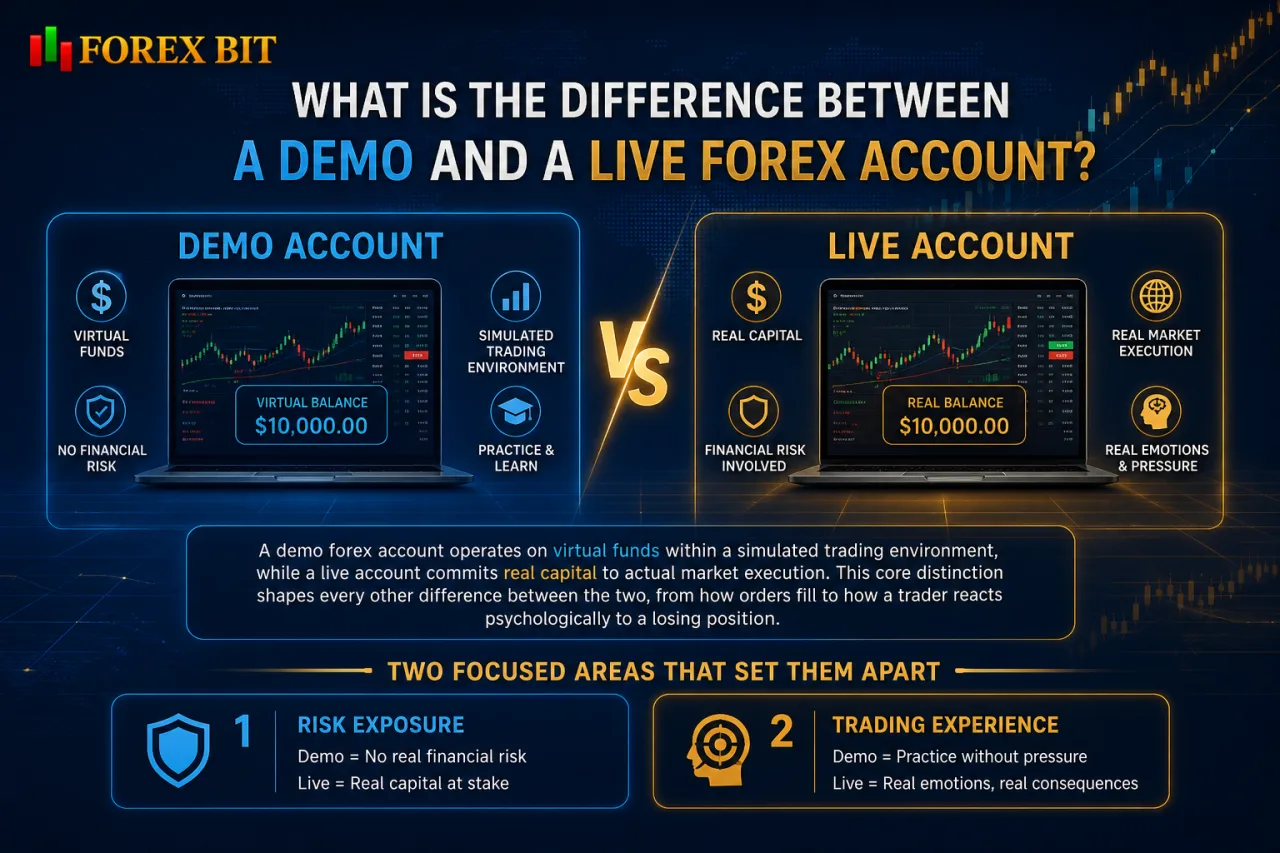
A demo forex account operates on virtual funds within a simulated trading environment, while a live account commits real capital to actual market execution. This core distinction shapes every other difference between the two, from how orders fill to how a trader reacts psychologically to a losing position.
The following breakdown separates this difference into two focused areas: how each account type defines risk exposure, and how that risk exposure changes the trading experience itself.
What Is a Demo Forex Account?
A demo forex account is a practice trading account funded with virtual balance instead of real money, operating under simulated market conditions that mirror live pricing and execution. It exists specifically for practice and platform familiarization before any real capital is at stake.
This account type replicates the trading interface, charting tools, and order types of a live setup, but every trade placed carries no financial consequence. The virtual balance can be reset or reloaded, letting a trader test strategies repeatedly without depleting real funds. Since pricing and execution attempt to simulate live market behavior, a demo account also serves as the primary tool for learning how a specific broker’s platform handles order placement, stop-loss settings, and chart navigation.
Its core purpose remains twofold: building strategy confidence and reducing the learning curve associated with unfamiliar trading software before transitioning to real-money execution.
What Is a Live Forex Account?
A live forex account requires a deposit of real funds and executes trades under actual market conditions, generating genuine profits or losses tied to real capital. This structure separates it entirely from the risk-free simulation of a demo setup.
The practical mechanics behind this definition matter directly for how a trader engages with the market.
- Deposits real money before opening any position, exposing that capital to gains or losses.
- Executes orders through actual broker infrastructure, subject to real liquidity and market depth.
- Reflects genuine spreads, commissions, and swap charges rather than simulated approximations.
- Carries real financial consequences for every entry, exit, and risk management decision.
Because pricing and order fills pass through the broker’s live execution environment, factors such as slippage and requotes appear more frequently than in a simulated setting. This makes the live account the stage where strategy performance meets actual market conditions and real financial outcomes.
What Are the Key Trading Condition Differences Between Demo and Live Accounts?
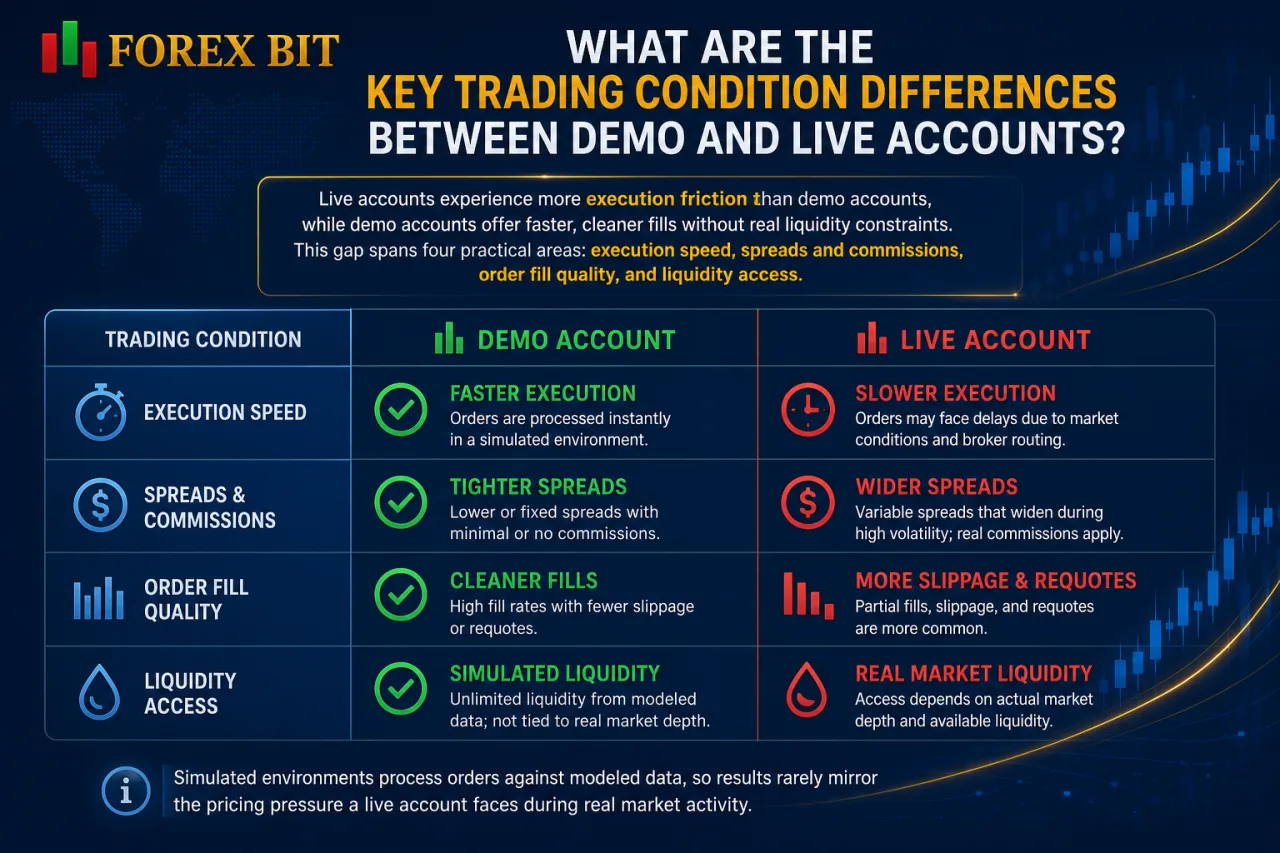
Live accounts experience more execution friction than demo accounts, while demo accounts offer faster, cleaner fills without real liquidity constraints. This gap spans four practical areas: execution speed, spreads and commissions, order fill quality, and liquidity access.
Simulated environments process orders against modeled data, so results rarely mirror the pricing pressure a live account faces during real market activity. The comparison below outlines how each parameter typically diverges between the two setups.
| Parameter | Demo Account | Live Account |
|---|---|---|
| Execution Speed | Near-instant, simulated processing | Subject to broker infrastructure and network conditions |
| Spreads/Commissions | Often fixed or idealized values | Variable, reflects real market pricing |
| Order Fill Quality | Consistently fills at requested price | May include slippage or partial fills |
| Liquidity Access | Simulated, unaffected by real order flow | Tied to actual market depth and liquidity providers |
The sections that follow examine execution speed, spreads and commissions, order fill quality, and liquidity access individually to clarify how each factor behaves differently once real capital and real market conditions replace a simulated environment.
How Does Order Execution Differ Between Demo and Live Trading?
Demo servers process orders instantly against modeled prices, while live servers depend on real liquidity providers and market depth, producing execution that often differs from the simulated result. This gap in order execution stems directly from how each server sources pricing and processes trade requests.
A demo environment fills orders at the exact requested price because no real counterparty or liquidity pool stands behind the trade. A live environment routes each order through the broker’s actual liquidity network, where available volume, spread conditions, and market volatility determine the final fill price.
- Demo execution: instant, idealized fills detached from real order flow.
- Live execution: dependent on liquidity provider depth and prevailing market conditions.
- Demo pricing: modeled to approximate live feeds without guaranteeing identical behavior.
- Live pricing: reflects real bid-ask dynamics tied to actual market participants.
This distinction explains why a strategy performing consistently on a demo account can produce different fill outcomes once real liquidity and market depth enter the execution process on a live account.
Do Slippage and Requotes Occur Differently in Demo vs Live Accounts?
Yes, slippage and requotes occur differently between demo and live accounts, since simulated fills stay minimal or absent on demo while live trading absorbs real slippage during volatility or news events. This gap in Root Attribute – Slippage behavior stems from how each environment sources its pricing and processes execution.
A demo server matches orders against modeled data without routing through real liquidity, so a requested price and the filled price rarely diverge. A live server routes each order through actual liquidity providers, where price gaps widen sharply the moment volume surges or a scheduled news release hits the market.
- Demo fills: price gaps stay minimal since no real order flow competes for execution.
- Live fills: price gaps widen during volatility, producing measurable slippage against the requested entry.
- Demo requotes: occur rarely, as simulated liquidity does not reject orders for pricing conflicts.
- Live requotes: appear more often when liquidity thins or spreads spike around major events.
This difference explains why a strategy holding tight entries on demo can face wider execution costs once real market stress enters a live account.
How Do Emotions and Psychology Differ Between Demo and Live Trading?
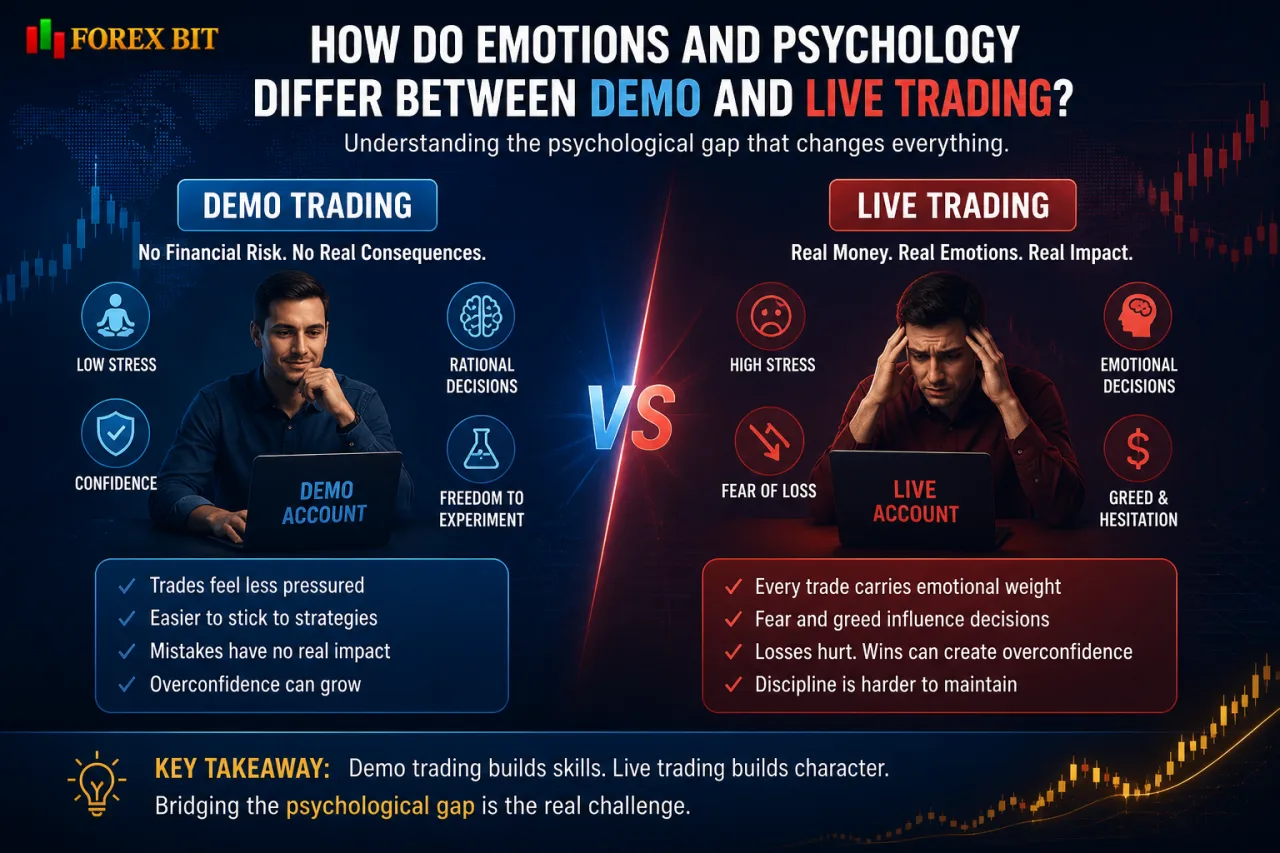
Demo trading removes financial risk entirely, which lowers stress and emotional decision-making, while live trading ties every position to real money and triggers fear, greed, and hesitation. This psychological gap explains why strategies that perform well in simulation often falter once real capital enters the equation.
The following breakdown separates this difference into two focused areas: how the absence of risk shapes decision-making on demo accounts, and how real losses and gains alter behavior once a trader moves to live execution.
Why Does Trading with Real Money Feel Different from Demo Trading?
Real money trading feels different because actual capital loss triggers loss aversion, a psychological response that is largely absent from simulated demo trades. This shift in risk perception changes how a trader reacts to the same chart pattern or setup once real funds replace virtual balance.
On a demo account, a losing trade carries no financial weight, so decisions stay purely analytical. On a live account, the same losing trade threatens actual capital, activating fear and hesitation that did not exist during simulated practice.
This altered risk perception produces measurable behavioral changes:
- Closing profitable positions too early out of fear of losing unrealized gains.
- Holding losing positions longer than planned, hoping price reverses before accepting a real loss.
- Increasing position size or trade frequency after a loss in an attempt to recover capital quickly.
- Hesitating on valid entry signals due to anxiety over committing real funds.
These reactions rarely surface on a demo platform, since the absence of real capital removes the emotional stakes tied to loss aversion. Once real money enters the equation, the same strategy that performed consistently in simulation can produce inconsistent execution driven by fear and emotional interference rather than by market conditions alone.
When Should a Trader Move from a Demo to a Live Forex Account?
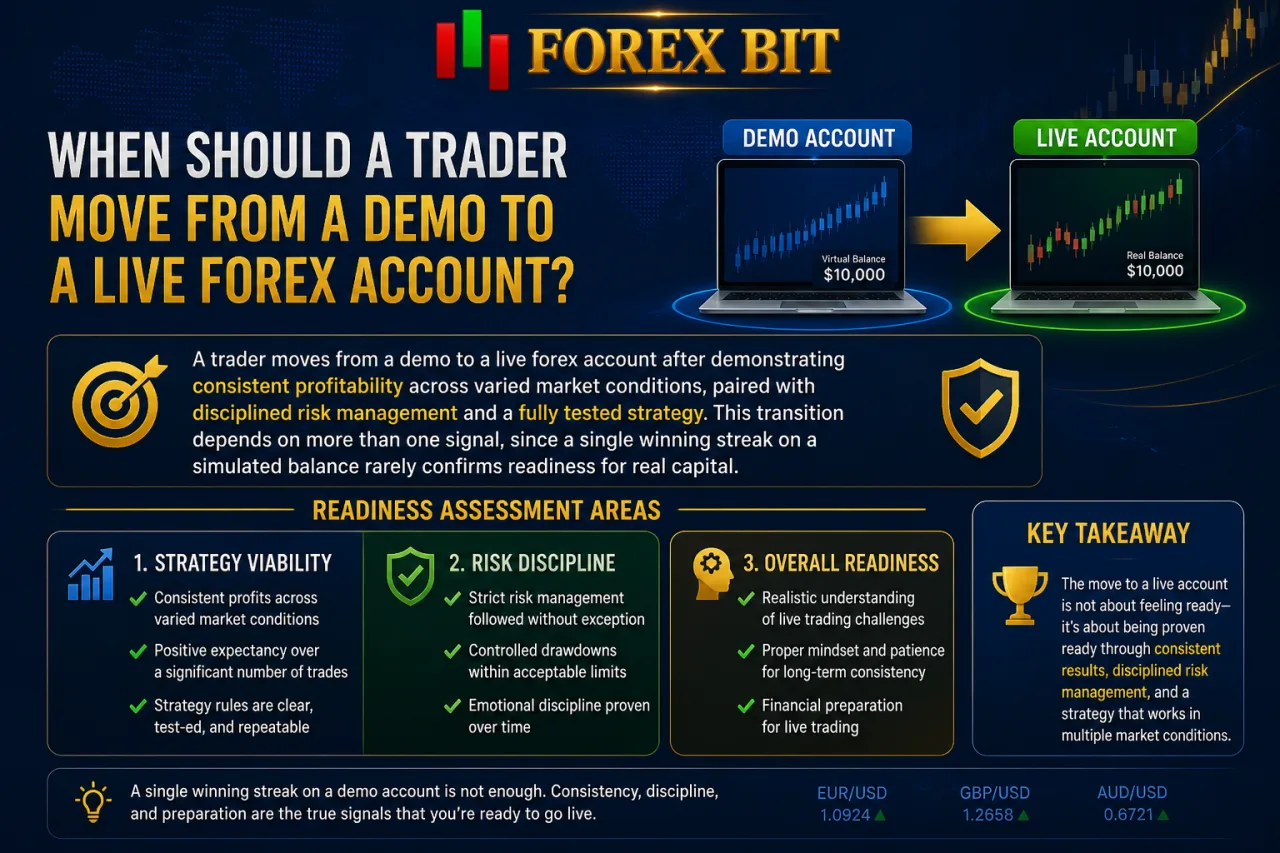
A trader moves from a demo to a live forex account after demonstrating consistent profitability across varied market conditions, paired with disciplined risk management and a fully tested strategy. This transition depends on more than one signal, since a single winning streak on a simulated balance rarely confirms readiness for real capital.
The readiness assessment separates into distinct areas: how demo results confirm strategy viability, how risk discipline holds under repeated testing, and how emotional preparedness gets evaluated before funds go live. The subsections that follow examine each of these criteria individually to clarify what a trader verifies before switching from simulated to real-money execution.
What Signs Indicate a Trader Is Ready to Switch to a Live Account?
Four measurable signs confirm readiness: consistent profitable results over time, a clearly defined strategy, disciplined risk-per-trade sizing, and the ability to follow a trading plan without deviation. These indicators together separate a trader who tests random setups from one who has developed a repeatable process.
This checklist gives a concrete answer to when a demo trader qualifies for live execution, expanding on the readiness criteria already outlined for strategy viability and risk discipline.
- Demonstrating consistent profitability across multiple weeks or months rather than a single winning streak.
- Following a clearly defined strategy with fixed entry, exit, and stop-loss rules instead of discretionary guesswork.
- Applying proper risk-per-trade discipline, keeping losses within a small, fixed percentage of account balance on every position.
- Executing the trading plan without deviation, even when a setup tempts impulsive adjustment.
A trader missing any single indicator from this list typically benefits from extending demo practice rather than committing real capital prematurely. Meeting all four together confirms that a strategy holds up under repeated testing and that behavior stays disciplined regardless of outcome, which forms the practical basis for transitioning to a live forex account with realistic expectations.
How to Transition from a Demo Account to a Live Account Step by Step?
Transitioning from a demo to a live forex account follows four sequential steps: funding with a small live deposit, trading minimum trade sizes, scaling position size gradually, and monitoring emotional response to real losses. This sequence rebuilds confidence with real money incrementally rather than exposing full capital immediately after simulated practice.
Each step targets a specific gap between demo and live trading covered earlier, particularly the execution differences and psychological pressure that surface once real funds replace virtual balance.
- Funding the live account with a small deposit limits exposure while confirming the broker’s actual execution matches demo expectations.
- Trading minimum trade sizes tests order fills, spreads, and slippage under real conditions without risking significant capital.
- Scaling position size gradually only after consistent results at minimum size confirms the strategy holds under increasing exposure.
- Monitoring emotional response to real losses reveals whether fear or hesitation interferes with the disciplined execution built during demo practice.
A trader repeats this sequence at each stage before increasing size further, since skipping steps reintroduces the same risk of undercapitalized decision-making that demo practice was meant to prevent.
Which Account Type Is Suitable for Beginners vs Experienced Traders?
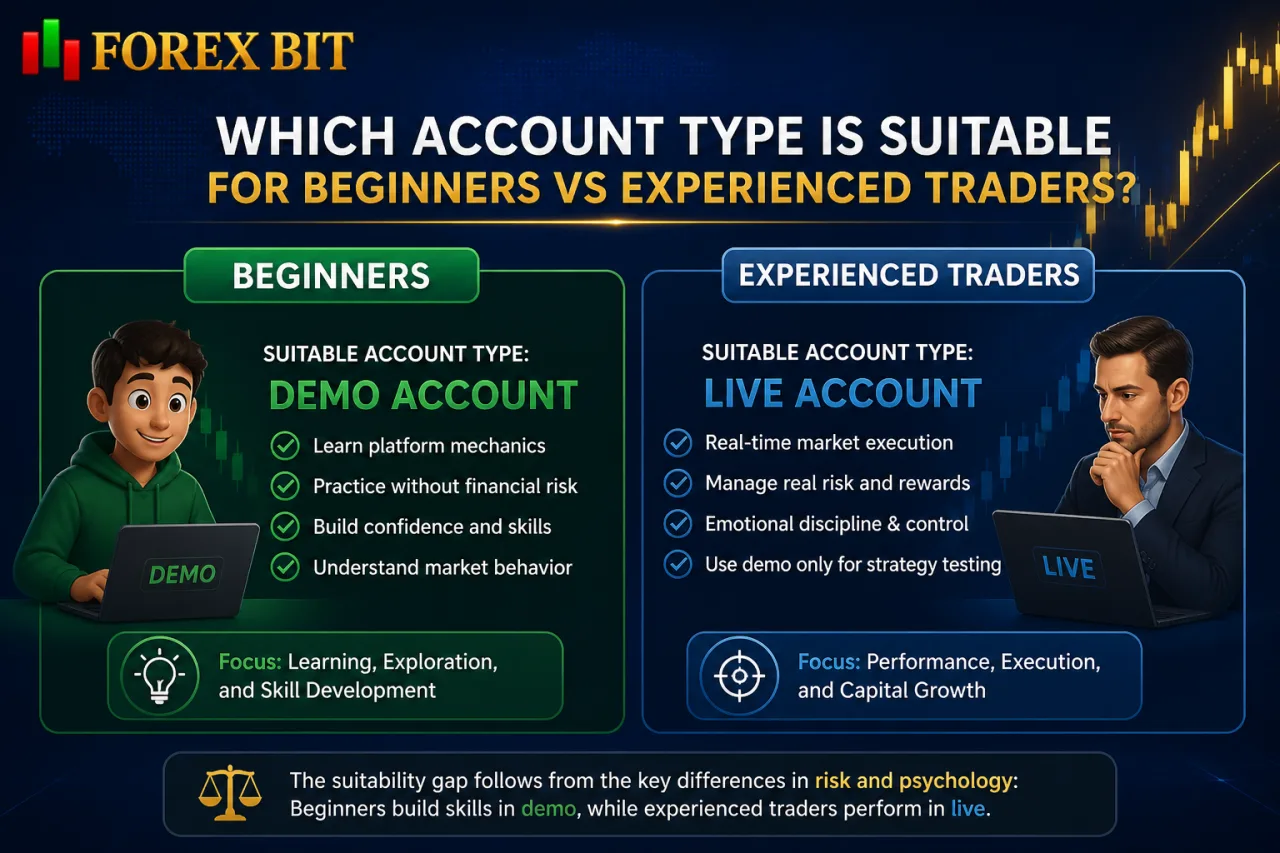
Beginners suit demo accounts for learning platform mechanics, while experienced traders suit live accounts for direct execution, reserving demo use for strategy testing. This suitability gap follows directly from the risk and psychology differences already covered between the two account types.
The two groups approach the demo-to-live decision from opposite starting points, which the following breakdown separates by experience level.
Is a Demo Account Better for Beginner Traders?
Yes, a demo account benefits beginner traders more than a live account, since it removes financial risk while a beginner learns order types, platform navigation, and strategy testing. This suitability question ties directly to the beginner-versus-experienced comparison already established between the two account types.
A beginner starting on a demo account faces no consequence for a misplaced order or a misunderstood stop-loss setting, which lowers the pressure to master mechanics under real-money stakes. This risk-free environment allows repeated practice with entry types, position sizing, and chart tools until the workflow becomes familiar.
Three reasons support this advantage:
- Practicing order types and stop-loss placement without risking real capital.
- Navigating the broker’s platform interface before committing actual funds.
- Testing strategies repeatedly through account resets without financial penalty.
A beginner who skips this practice stage typically faces both unfamiliar platform mechanics and real financial risk at the same time, a combination that increases the likelihood of costly execution mistakes.
Why Do Experienced Traders Still Use Demo Accounts?
Yes, experienced traders still use demo accounts for three specific purposes: backtesting new strategies, testing Expert Advisors, and evaluating a new broker’s platform before risking capital. This use case pattern differs from beginner usage, since an experienced trader already understands order types and platform navigation and turns to demo trading for targeted testing instead of basic skill-building.
- Backtesting a new strategy against fresh market conditions before allocating real capital to it.
- Testing an Expert Advisor’s automated logic for execution errors, unexpected trade triggers, or coding flaws.
- Evaluating a new broker’s platform speed, order fill behavior, and interface before funding a live account there.
Each use case isolates one variable, whether a strategy edge, an automated script, or an unfamiliar execution environment, without exposing existing trading capital to untested risk. This targeted application separates experienced demo use from the foundational, skill-building purpose it serves for a beginner.
What Limitations Should Traders Consider When Relying on a Demo Account?
Demo accounts carry three notable limitations: unrealistic liquidity during high-impact news, inflated or unrealistic starting balances, and broker-imposed time limits or periodic resets. These constraints sit outside the core execution and psychology differences already covered, yet they shape how reliable a demo account stays as a testing tool.
The subsections that follow separate each limitation individually, covering how liquidity behaves during news events, how demo balances distort risk perception, and how account expiration policies affect long-term testing.
Do Demo Accounts Have Time Limits or Balance Resets?
Yes, demo accounts often carry time limits or balance reset conditions, since many brokers cap validity at a fixed period and require reactivation, while others permit unlimited use with manual balance resets. This expiry and reset policy varies by broker rather than following a single industry standard.
Some brokers restrict demo account validity to a limited window before the account expires or requires renewal.
A trader facing this limit typically reopens a new demo account or contacts support to extend access once the original period lapses.
Other brokers take a different approach, allowing indefinite demo use without an expiration date. These setups often include a self-service reset option, letting a trader restore the virtual balance to its starting value after depleting it through testing, without opening a new account entirely.
Because reset and expiry rules differ this widely, a trader confirms the specific policy directly with the broker before relying on a demo account for extended strategy testing.
Can Unrealistic Demo Balances Lead to Poor Habits in Live Trading?
Yes, unrealistic demo balances lead to poor habits in live trading, since inflated virtual funds encourage oversized position sizing that a smaller live account cannot sustain. This behavioral risk connects directly to the position-sizing discipline required for a successful demo-to-live transition.
A trader practicing on a large virtual balance often risks position sizes that appear reasonable relative to that inflated figure but become disproportionately large once real capital replaces it. This mismatch creates three specific habits:
- Sizing trades as a percentage of an inflated balance rather than the actual live deposit.
- Absorbing drawdowns comfortably in simulation that would breach real risk limits on a smaller account.
- Underestimating margin requirements calibrated to a much larger capital base.
A trader carrying these habits into live execution risks breaching account-appropriate risk-per-trade limits within the first few trades funded with real capital.
Conclusion
Demo and live forex accounts diverge on three fronts: financial exposure, execution quality, and psychological pressure. A demo account isolates strategy learning and platform testing from real consequences, while a live account ties every fill, slippage event, and requote to actual capital and genuine emotional stakes like fear and hesitation.
Beginners gain the most from demo trading while building mechanics and testing strategies, whereas experienced traders rely on live accounts for real execution and turn back to demo only for backtesting, Expert Advisor checks, or evaluating a new broker. Recognizing these gaps confirms readiness before scaling real capital on Forex Bit.
Isabella Brown is the Forex Trading Guide Manager at Forex Bit, focusing on educational content about broker safety, trading costs, account types, platforms, and key Forex/CFD concepts. Her work helps readers understand trading terms, broker conditions, and practical checks before evaluating or using a brokerage service.
Email: [email protected]


Best Brokers

Trade with the world’s largest retail broker and benefit from better - than - market conditions.

We offer a superior trading environment that puts traders in the best position to profit.

Trade with the best trading conditions. WIN THE BEST TRADING ACCOUNT AWARD.

Trade global markets with Interactive Brokers – a highly regulated multi-asset broker built for active and professional investors.






Forex Bit provides independent forex broker reviews, comparisons, guides, and industry news to help traders make informed decisions.
Best Brokers
Metatrader 5 Brokers
Metatrader 4 Brokers
Lowest Spread Forex Broker
Regulated Forex Brokers
Forex Copy Trading
Ctrader Brokers
Best Forex Broker For Beginners