
Wondering what is a requote in forex? See why brokers requote prices, how it affects execution, and how to reduce requotes on your trades.
What Is a Requote in Forex? Meaning & Causes Explained

A requote in forex trading occurs when a broker cannot execute an order at the requested price and offers a new price instead. This typically happens on instant execution accounts when the market moves between the moment a trader clicks and the moment the order reaches the server.
Requotes happen mainly due to fast price movements and the execution model used by the broker. Requotes are generally linked to a broker’s execution model, with instant execution systems more prone to requotes than market execution systems, which instead apply slippage to fill orders at the next available price. Brokers using instant execution must confirm the exact quoted price, so any market shift during that short delay triggers a requote instead of automatic price adjustment.
Traders reduce requotes by choosing brokers or platforms that use market execution and by setting appropriate price deviation settings. Trading during stable market hours and avoiding high-impact news releases also lowers the frequency of requotes.
Requotes differ from slippage because a requote asks for trader confirmation before filling the order, while slippage fills the order automatically at a different price. Understanding this distinction helps traders choose the execution type that matches their strategy, a topic Forex Bit covers in detail across its broker and platform guides. The following sections break down what a requote in forex trading actually means, why it happens, and how it can be minimized.
What Is a Requote in Forex Trading?
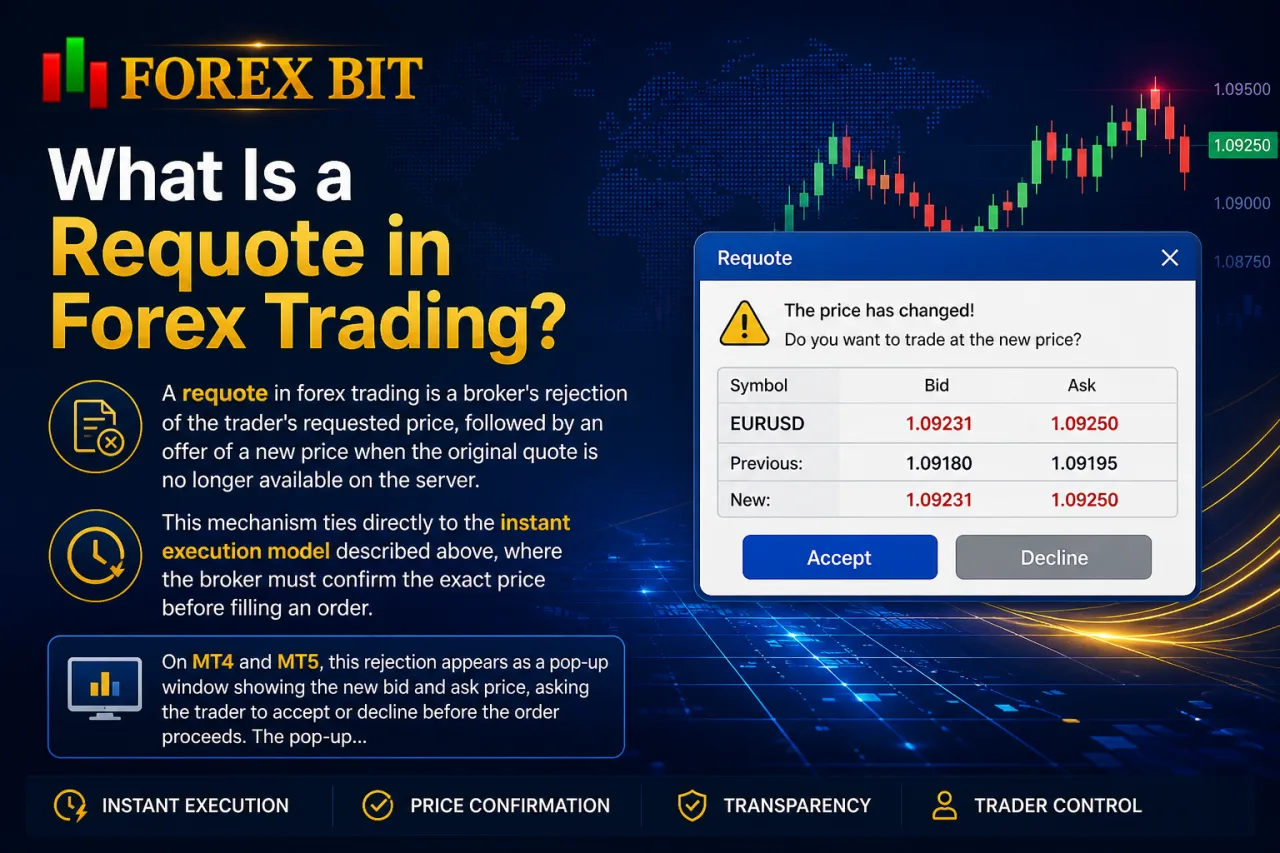
A requote in forex trading is a broker’s rejection of the trader’s requested price, followed by an offer of a new price when the original quote is no longer available on the server. This mechanism ties directly to the instant execution model described above, where the broker must confirm the exact price before filling an order.
On MT4 and MT5, this rejection appears as a pop-up window showing the new bid and ask price, asking the trader to accept or decline before the order proceeds. The pop-up interrupts execution entirely, meaning the order does not fill until the trader responds or the platform times out and cancels the request. During volatile conditions, this delay can force traders to manually resend the order at a different price, which may itself trigger another requote if the market keeps moving.
Requotes are exclusive to instant execution accounts, since market execution accounts route orders through slippage rather than a confirmation prompt.
What Are the Main Elements of a Requote Message?
A requote message contains three main elements: the original requested price, the new bid/ask price offered by the broker, and an accept/decline option presented to the trader. This structure repeats the pop-up notification described earlier for MT4 and MT5, breaking it down into its individual components.
- Original requested price: the exact rate the trader clicked to buy or sell appears first on the window.
- New bid/ask price: the platform displays the new bid and ask price currently available on the broker’s server, reflecting the market movement that caused the rejection. This price pair updates continuously if the market keeps shifting while the pop-up remains open.
- Accept/decline option: the confirmation choice, typically presented as two buttons on MT4 and MT5. Clicking accept fills the order at the new quoted price, while declining cancels the request entirely, leaving the trader to resend the order manually.
Some platforms include a countdown timer on this window, automatically closing the request if the trader does not respond within the set time.
Why Do Requotes Happen in Forex Trading?
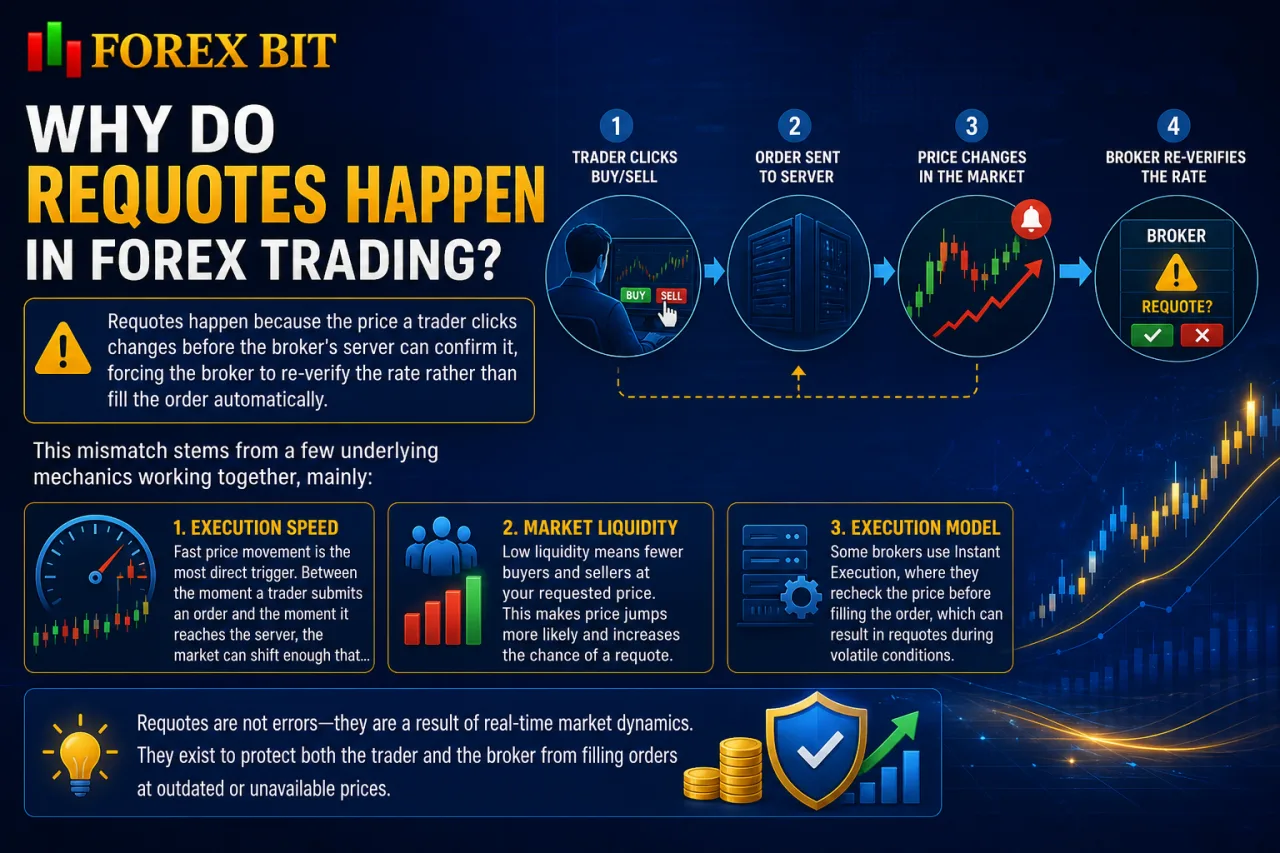
Requotes happen because the price a trader clicks changes before the broker’s server can confirm it, forcing the broker to re-verify the rate rather than fill the order automatically. This mismatch stems from a few underlying mechanics working together, mainly execution speed, market liquidity, and the broker’s chosen execution model.
Fast price movement is the most direct trigger. Between the moment a trader submits an order and the moment it reaches the server, the market can shift enough that the original quote no longer matches available liquidity, prompting the broker to offer a new price instead of filling the old one.
Thin liquidity compounds this issue during off-peak hours or immediately after news releases, when fewer counterparties are available at the requested price and gaps between quotes widen. The broker’s execution model determines what happens next: instant execution systems require exact price re-verification before confirming a trade, so any shift during that gap results in a requote rather than an automatic fill at the next best price.
Does Market Execution vs Instant Execution Affect Requote Frequency?
Yes, execution model directly affects requote frequency, with instant execution producing requotes and market execution eliminating them in favor of slippage. This distinction connects to the mechanics described above, where the broker’s confirmation process determines whether a price mismatch becomes a requote or an automatic fill.
Instant execution operates on a fixed-price model. The broker attempts to fill the order at the exact price clicked, and any market movement before server confirmation forces a requote pop-up rather than a substitute fill.
Market execution operates on a variable-price model. The broker fills the order at the next available price without requesting confirmation, so requotes do not occur, though the trader may receive positive or negative slippage instead.
Most brokers today favor market execution as the standard offering, since it removes the confirmation delay and processes orders without interrupting the trader. Instant execution remains available mainly on classic or fixed-spread account types where exact price confirmation matters more than execution speed.
What Market Conditions Increase the Chance of a Requote?
Five market conditions increase requote frequency: high-impact news releases, low liquidity periods, market open/close gaps, wide spreads, and slow internet or server connections. These conditions share one common effect: they widen the gap between the price a trader clicks and the price still available by the time the order reaches the broker’s server.
- High-impact news releases: trigger sharp, sudden price swings as economic data hits the market, leaving little time for the original quote to remain valid.
- Low liquidity periods: common during off-peak trading hours, reduce the number of counterparties willing to fill orders at the requested price, widening the gap between quotes.
- Market open and close gaps: occur when trading resumes after a break and prices jump to reflect news that accumulated while the market was closed, making the last available quote outdated.
- Wide spreads: signal reduced market depth, often appearing alongside the conditions above and increasing the chance that a requested price falls outside the broker’s current pricing.
- Slow internet or server connections: delay order transmission, giving the market more time to move before the broker’s server processes the request.
How Can Traders Avoid or Reduce Requotes?
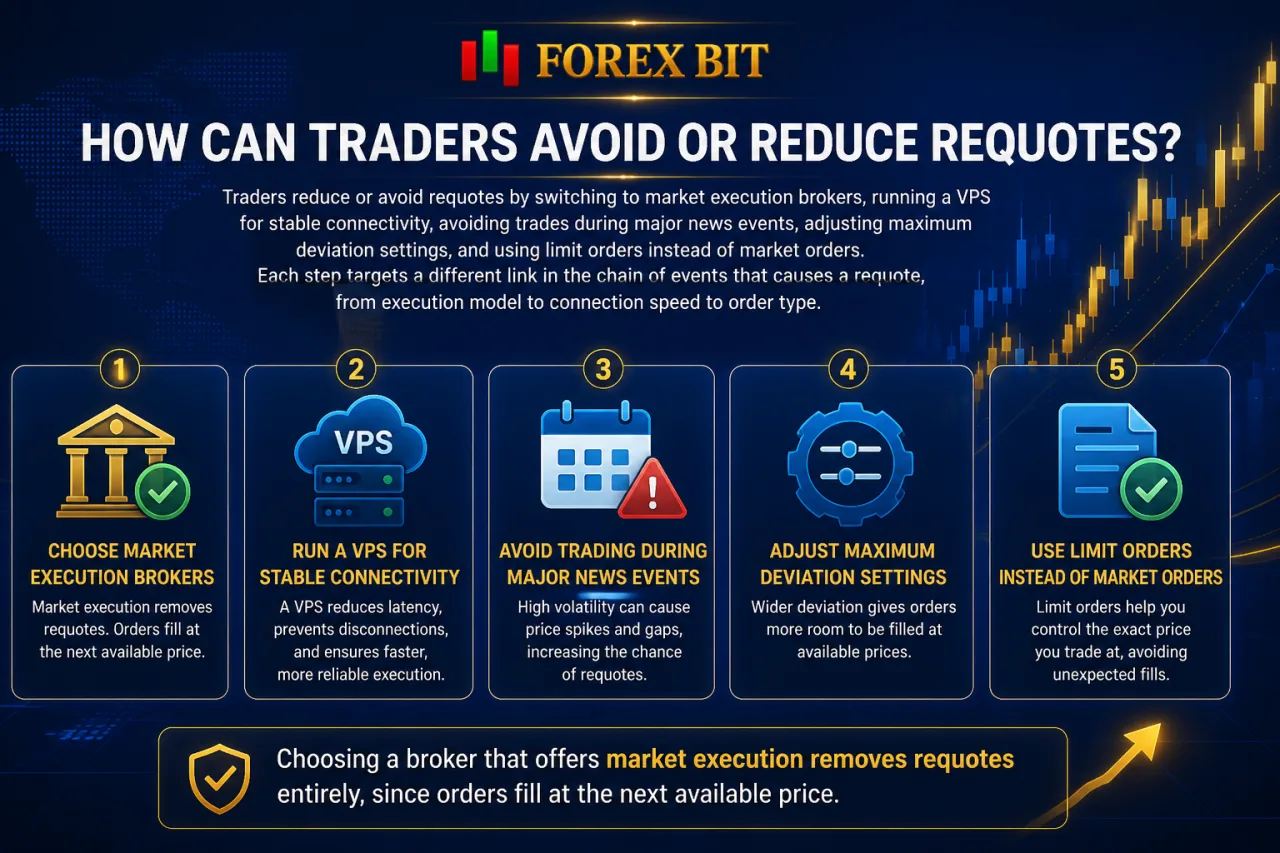
Traders reduce or avoid requotes by switching to market execution brokers, running a VPS for stable connectivity, avoiding trades during major news events, adjusting maximum deviation settings, and using limit orders instead of market orders. Each step targets a different link in the chain of events that causes a requote, from execution model to connection speed to order type.
- Choose a broker that offers market execution. This removes requotes entirely, since orders fill at the next available price through slippage rather than a confirmation prompt.
- Run a VPS close to the broker’s server. This cuts transmission delay, reducing the window in which the market can move between order submission and execution.
- Avoid trades around high-impact news releases. This limits exposure to the sharp price swings that most often trigger requotes.
- Adjust the maximum deviation or slippage setting on MT4 and MT5. This widens the price tolerance the platform accepts before rejecting an order, letting minor market shifts fill automatically instead of prompting a requote.
- Use limit orders instead of market orders. This sets a fixed acceptable price in advance, so the order either fills at that price or waits, bypassing the instant confirmation step that produces requotes on market-type entries.
Requote vs Slippage: What Is the Difference?
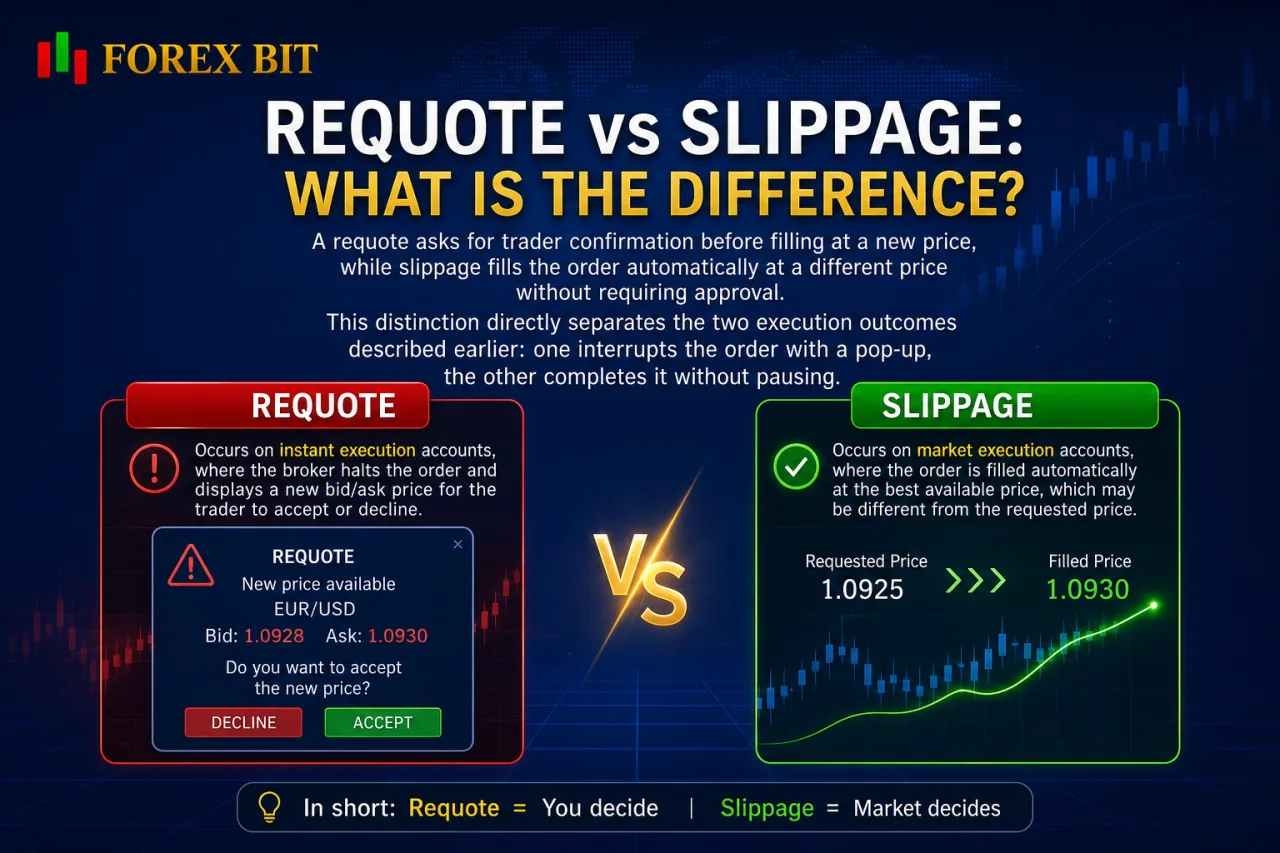
A requote asks for trader confirmation before filling at a new price, while slippage fills the order automatically at a different price without requiring approval. This distinction directly separates the two execution outcomes described earlier: one interrupts the order with a pop-up, the other completes it without pausing.
A requote occurs on instant execution accounts, where the broker halts the order and displays a new bid/ask price for the trader to accept or decline. Slippage occurs on market execution accounts, where the broker fills the order at the next available price without pausing for input, resulting in a fill better or worse than the requested rate.
The core difference lies in trader control. A requote gives the trader a choice to reject the new price and resend the order, while slippage removes that choice entirely, completing the trade regardless of the price difference. Because of this, traders who prioritize price certainty over speed tend to accept requotes on instant execution, while traders who prioritize fast, uninterrupted fills accept slippage on market execution instead.
Do Requotes Still Occur With Modern ECN/STP Brokers?
No, requotes largely do not occur with modern ECN/STP brokers, since no-dealing-desk models route orders through market execution with variable pricing instead of a fixed-price confirmation step. This connects directly to the requote vs slippage distinction covered above, where the execution model determines whether a price mismatch triggers a pop-up or an automatic fill.
ECN/STP brokers pass orders straight to liquidity providers rather than confirming an exact quoted price internally, so a shifted price simply fills at the next available rate through slippage. The requote pop-up window, tied specifically to instant execution’s price re-verification step, has no equivalent in this pass-through structure.
Requotes today remain associated mainly with dealing-desk or fixed-price execution setups, where the broker itself confirms the trade against its own book rather than external liquidity. Classic or fixed-spread account types still using this model account for most reported requote cases.
What Role Does Liquidity Provider Depth Play in Preventing Requotes?
Liquidity provider depth reduces requotes by keeping quoted prices closer to actual executable rates, since a broker connected to multiple providers pulls from a wider pool of bid/ask offers rather than a single fixed book. This directly extends the ECN/STP mechanics described above, where order routing quality determines whether a price mismatch triggers a requote or fills as slippage.
A broker aggregating quotes from several liquidity providers builds a deeper order book, meaning more volume sits available at or near the requested price at any given moment. This depth shortens the price gap that would otherwise force a fixed-price confirmation step, since the server finds a matching rate within the aggregated book instead of rejecting the order outright.
Institutional-grade infrastructure with multiple provider connections therefore favors market execution with tight slippage over requote-based confirmation. Retail brokers relying on a single liquidity source or internal dealing desk show higher requote exposure, since thinner order books leave fewer prices available when the market shifts.
Conclusion
A requote in forex trading is the broker’s price rejection mechanism, tied specifically to instant execution accounts where a fixed quote must be re-verified before the order fills. The mismatch stems from fast market moves, thin liquidity, and connection delays, and it stops entirely once trading shifts to market execution, since that model fills orders via slippage instead of a confirmation pop-up.
Modern ECN/STP brokers with deep liquidity provider connections largely eliminate requotes for this reason. Traders wanting price certainty accept the occasional requote on fixed-price accounts, while those prioritizing uninterrupted fills choose market execution and manage outcomes through deviation settings, VPS use, and limit orders.
Isabella Brown is the Forex Trading Guide Manager at Forex Bit, focusing on educational content about broker safety, trading costs, account types, platforms, and key Forex/CFD concepts. Her work helps readers understand trading terms, broker conditions, and practical checks before evaluating or using a brokerage service.
Email: [email protected]



Best Brokers

Trade with the world’s largest retail broker and benefit from better - than - market conditions.

We offer a superior trading environment that puts traders in the best position to profit.

Trade with the best trading conditions. WIN THE BEST TRADING ACCOUNT AWARD.

Trade global markets with Interactive Brokers – a highly regulated multi-asset broker built for active and professional investors.






Forex Bit provides independent forex broker reviews, comparisons, guides, and industry news to help traders make informed decisions.
Best Brokers
Metatrader 5 Brokers
Metatrader 4 Brokers
Lowest Spread Forex Broker
Regulated Forex Brokers
Forex Copy Trading
Ctrader Brokers
Best Forex Broker For Beginners