
Facing forex broker withdrawal problems? Discover common causes, warning signs, and practical steps to get your funds released safely.
Forex Broker Withdrawal Problems: Causes & Fixes

Forex broker withdrawal problems happen mainly due to unmet trading volume conditions, unresolved KYC verification, bonus terms, or deliberate broker practices designed to delay client payouts. Regulatory gaps and weak financial oversight of certain brokers also increase the risk of withdrawal disputes.
A broker refusing or delaying withdrawals typically shows repeated documentation requests, unexplained processing delays beyond stated timeframes, sudden changes to withdrawal terms, or unresponsive customer support. These recurring patterns are among the clearest early indicators of a payout problem.
Traders verify a broker’s withdrawal reliability before depositing by checking its regulatory license status, reading verified user withdrawal experiences, and testing small withdrawal amounts first. Confirming license validity directly with the relevant financial regulator remains a reliable verification step.
If a withdrawal request is denied or stuck, traders should first request written explanation from the broker, gather all transaction records, and escalate the complaint to the relevant regulatory authority if unresolved. Filing a formal complaint with the licensing regulator can prompt a faster broker response. Forex Bit outlines these situations in detail to help traders assess broker reliability before committing funds.
Understanding these risks starts with knowing exactly why forex broker withdrawal problems happen in the first place.
Why Do Forex Broker Withdrawal Problems Happen?
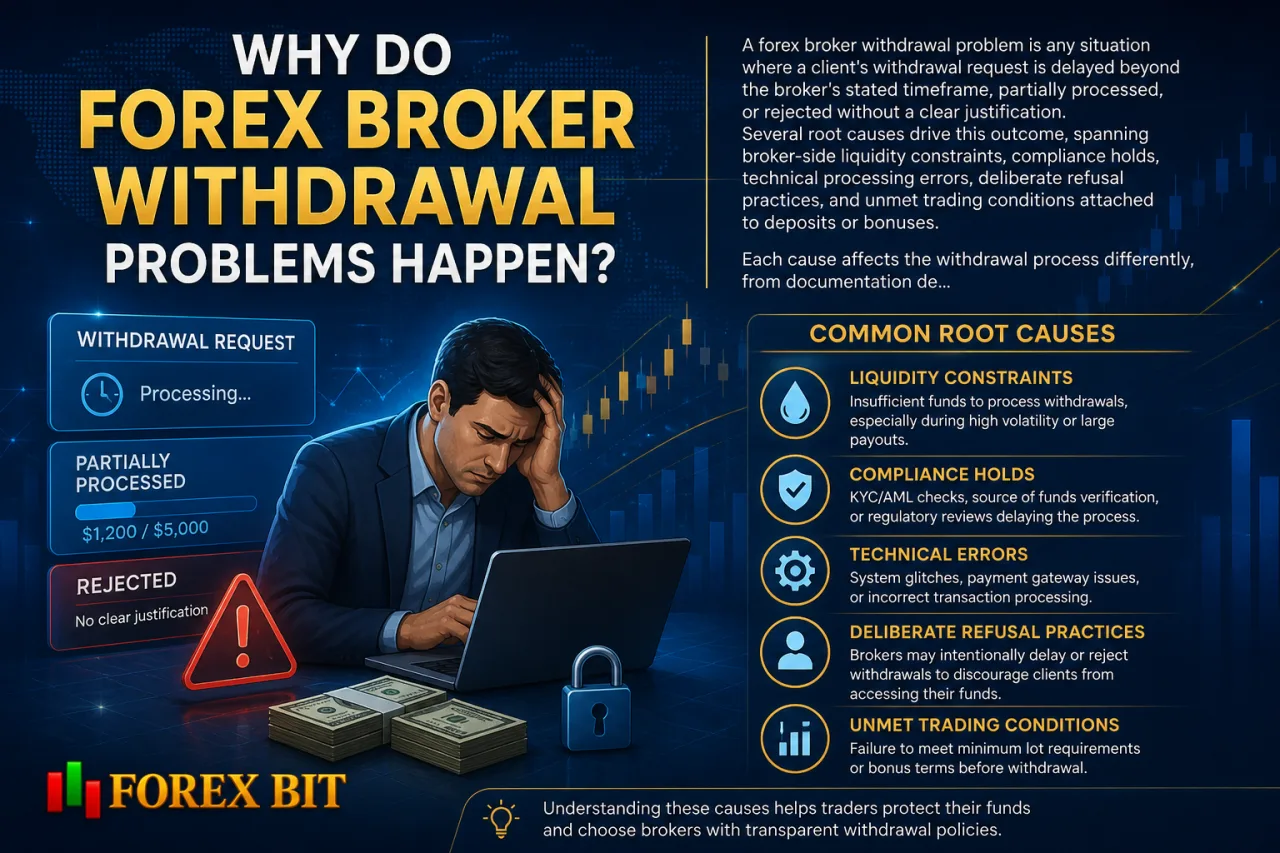
A forex broker withdrawal problem is any situation where a client’s withdrawal request is delayed beyond the broker’s stated timeframe, partially processed, or rejected without a clear justification. Several root causes drive this outcome, spanning broker-side liquidity constraints, compliance holds, technical processing errors, deliberate refusal practices, and unmet trading conditions attached to deposits or bonuses.
Each cause affects the withdrawal process differently, from documentation delays to outright fund retention.
- Liquidity shortages at the broker limit available funds for client payouts.
- Compliance holds trigger additional identity or source-of-funds checks before release.
- Technical errors in payment processing systems interrupt or reverse transactions.
- Deliberate refusal practices involve brokers citing vague policy clauses to withhold funds.
- Unmet trading conditions, such as unfulfilled volume requirements tied to bonuses, block eligibility for withdrawal.
The following sections examine each of these causes individually.
What Are the Common Causes of Withdrawal Delays or Rejections?
Withdrawal delays or rejections group into six main categories: unmet KYC/verification, unfulfilled bonus or turnover requirements, payment method mismatch, technical or banking delays, broker insolvency or fraud, and incorrect account details. Each category points to a different party responsible for the delay, ranging from the client’s paperwork to the broker’s financial health.
Grouping these causes by origin clarifies where a trader should direct a follow-up query first.
- Unmet KYC/verification blocks payout release until identity or address documents pass compliance review.
- Unfulfilled bonus or turnover requirements keep a withdrawal ineligible when a promotional trading-volume condition remains incomplete.
- Payment method mismatch triggers rejection when the withdrawal destination differs from the original deposit source.
- Technical or banking delays interrupt fund transfers through payment processor errors or bank-side clearing steps.
- Broker insolvency or fraud restricts payouts entirely when the firm lacks sufficient operating capital or intends to withhold client funds.
- Incorrect account details cause processing failures when bank or e-wallet information submitted does not match the broker’s records.
Technical and banking delays fall outside the broker’s direct control, while KYC, bonus terms, and account-detail errors originate from incomplete client-side steps. Insolvency and deliberate refusal represent the most serious category, since they stem from the broker’s financial or operational failure rather than a correctable procedural issue.
Is a Slow Withdrawal Always a Sign of Broker Fraud?
No, a slow withdrawal does not always indicate broker fraud, since legitimate processing delays from banks, card issuers, or payment providers differ from intentional withholding by the broker itself. This distinction matters directly when assessing whether a forex broker withdrawal problem signals genuine risk or routine payment friction.
Several factors separate normal delay from deliberate refusal:
- Banking cutoffs and intermediary bank clearing extend transfer times beyond the broker’s own processing window.
- Payment provider verification checks add extra steps outside the broker’s control, particularly for e-wallets and card networks.
- Weekend and holiday schedules pause processing at the banking level, not at the broker’s compliance desk.
- Broker-side refusal appears as vague policy citations, repeated new document requests after prior approval, or complete non-response from support.
A single missed deadline tied to a bank holiday or a payment processor’s internal check rarely confirms fraudulent intent. Recurring unexplained delays combined with unresponsive support and shifting justifications point toward deliberate withholding rather than routine processing lag. Traders separate these two scenarios by tracking whether the broker communicates a clear timeline and cause, or whether it offers no verifiable explanation at all.
What Are the Warning Signs That a Broker Is Refusing or Delaying Withdrawals?
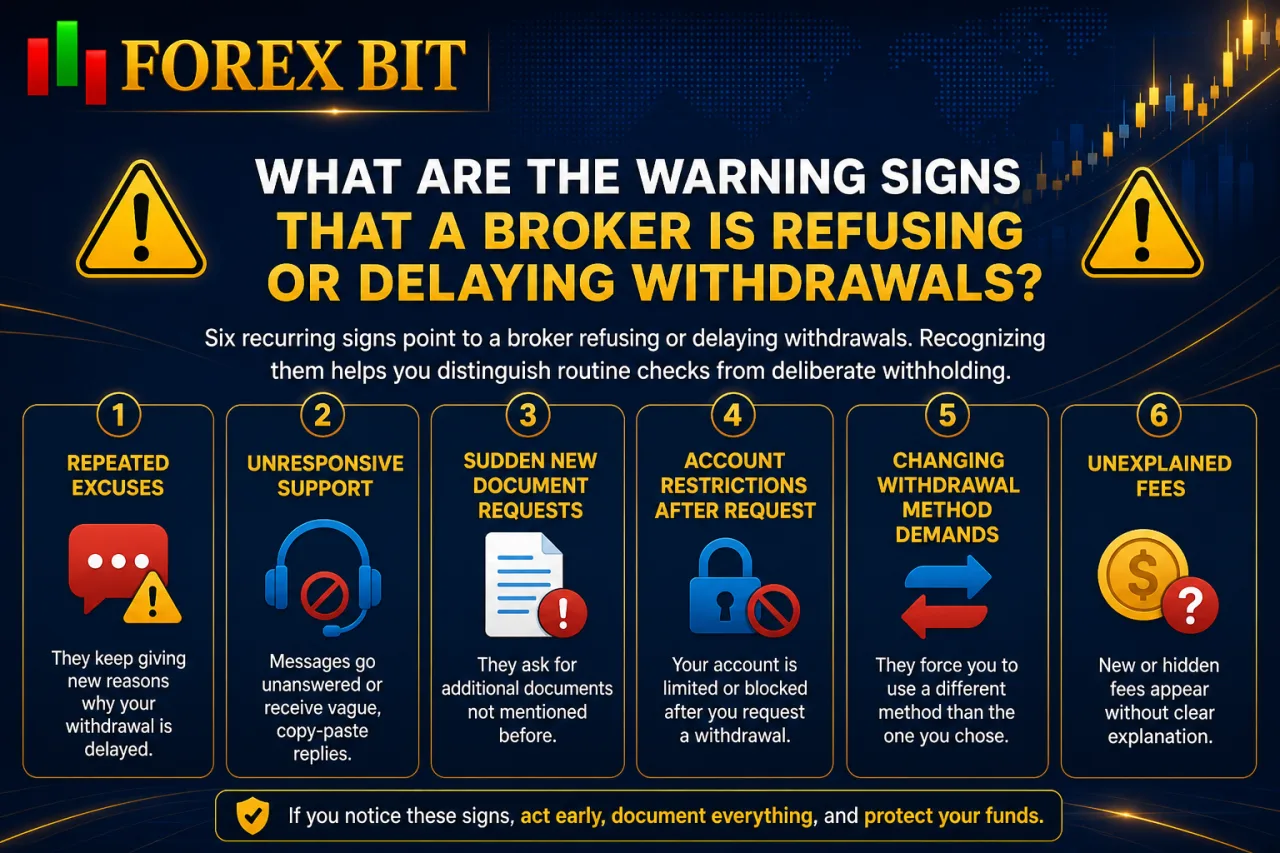
Six recurring signs point to a broker refusing or delaying withdrawals: repeated excuses, unresponsive support, sudden new document requests, account restrictions after a withdrawal request, changing withdrawal method demands, and unexplained fees. Each sign reflects a different stage where the broker deviates from its own stated process, and recognizing them individually helps a trader distinguish routine friction from deliberate withholding. The sections below examine each of these six signs in detail.
How Can Traders Recognize Deliberate Withdrawal Stalling Tactics?
Traders recognize deliberate withdrawal stalling by identifying four practical indicators: a delay pattern that emerges specifically after a profitable trade, requests for documents unrelated to standard KYC checks, silence extending past the broker’s own stated processing window, and contradictory explanations given by different support agents. Each indicator isolates a different stage of the withdrawal interaction where a legitimate broker would normally provide consistent, verifiable information.
A pattern of delay appearing only after account profit, rather than at deposit or during losing periods, points toward selective withholding tied to payout size rather than genuine compliance review. Requests for irrelevant documents, such as unrelated personal records or repeated resubmission of previously approved paperwork, extend the review without adding compliance value.
Silence beyond the broker’s own published processing timeframe, with no status update or escalation offered, distinguishes stalling from routine banking delay. Contradictory information from different support agents on the same case, such as one agent citing compliance review and another citing a technical error, signals inconsistency in the broker’s internal explanation rather than a single verifiable cause.
What Account or Trading Conditions Commonly Trigger Withdrawal Refusal?
Five account or trading conditions commonly trigger withdrawal refusal: unmet bonus turnover requirements, trading rule violations such as arbitrage or hedging abuse, an unverified account, a mismatch between the withdrawal method and the original deposit source, and unresolved negative balance disputes. Each condition originates from a different clause in the broker’s terms and gives rise to a distinct type of refusal.
- Unmet bonus turnover requirements block payout when a promotional trading-volume condition remains incomplete at the time of the withdrawal request.
- Trading rule violations, including arbitrage strategies or hedging abuse across linked accounts, void profit eligibility under the broker’s terms of service.
- An unverified account halts payout release until identity or address documents clear compliance review.
- A mismatch between the withdrawal method and the original deposit source triggers rejection, since brokers generally require funds to return to the same payment channel used for the deposit.
- Unresolved negative balance disputes freeze withdrawal processing until the broker and client agree on the account’s final balance.
Bonus terms and turnover conditions apply mainly to promotional accounts, while third-party payment mismatches affect any client using a different bank card, e-wallet, or account name than the one on file. Negative balance disputes arise most often after high-leverage trades or rapid market swings that push an account below zero. Confirming the broker’s exact turnover and payment-matching policy before depositing reduces the likelihood of a refused withdrawal tied to these conditions.
How Can Traders Verify a Broker’s Withdrawal Reliability Before Depositing?
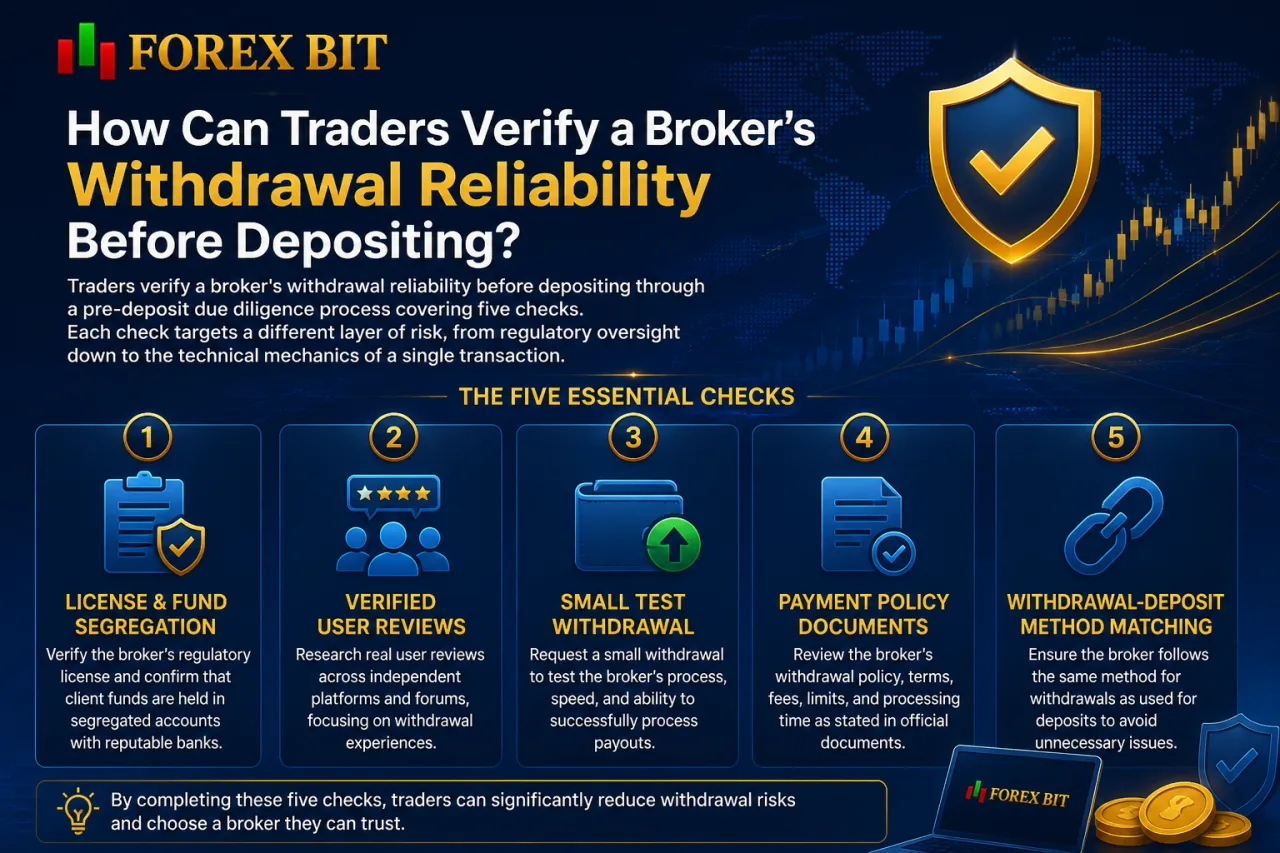
Traders verify a broker’s withdrawal reliability before depositing through a pre-deposit due diligence process covering five checks: license and fund segregation, verified user reviews, a small test withdrawal, payment policy documents, and withdrawal-deposit method matching. Each check targets a different layer of risk, from regulatory oversight down to the technical mechanics of a single transaction. The following breakdown covers each of these five checks individually.
What Should Traders Check in a Broker’s Regulatory Status and Fund Segregation?
Traders check a broker’s regulatory status and fund segregation through three steps: verifying the license number on the regulator’s public register, confirming client funds sit in segregated accounts, and reviewing compensation scheme coverage. These three checks form a sequential process, since a license lookup precedes the segregation question and the compensation review closes the assessment.
The license register check confirms the broker’s registration number, entity name, and permitted activities match what appears on the broker’s own website and legal documents. A mismatch between the registered entity and the trading entity offering the account signals a jurisdiction gap worth flagging before deposit.
Fund segregation confirmation requires locating a direct statement in the broker’s terms or legal documentation that client money sits in accounts separate from the firm’s operating capital, held with a named third-party bank. Segregated accounts are designed to keep client funds separate from broker operating capital, reducing the risk that broker operating losses directly affect client withdrawal availability.
Compensation scheme coverage review identifies whether the regulator operates an investor compensation fund and what claim limit applies if the broker becomes insolvent. Compensation schemes typically cap reimbursement per client at a fixed amount, with the exact limit depending on the specific scheme and regulator involved.
How Can a Small Test Withdrawal Help Assess Broker Reliability?
A small test withdrawal assesses broker reliability through a three-step process: depositing the minimum required amount, completing any mandatory trading activity, then requesting a small withdrawal to observe processing time and support responsiveness before committing larger funds. This test method directly addresses the same withdrawal reliability question a trader faces before depositing larger capital.
The process follows a fixed sequence:
- Depositing the broker’s stated minimum amount limits exposure while opening the account for testing.
- Completing any required minimum trading volume, if the broker’s terms attach a turnover condition to the deposited funds, clears eligibility for withdrawal.
- Submitting a small withdrawal request through the same method used for the deposit tests the broker’s standard payout channel.
- Recording the time between request submission and fund arrival, along with the accuracy of any status updates from support, produces a direct reliability signal.
Consistent communication and a payout that matches the broker’s stated processing window indicate a functioning withdrawal system. Repeated document requests, unexplained silence, or a payout amount inconsistent with the request signal the same warning patterns described for deliberate withholding, and warrant caution before depositing additional funds.
What Steps Should Traders Take If a Withdrawal Request Is Denied or Stuck?
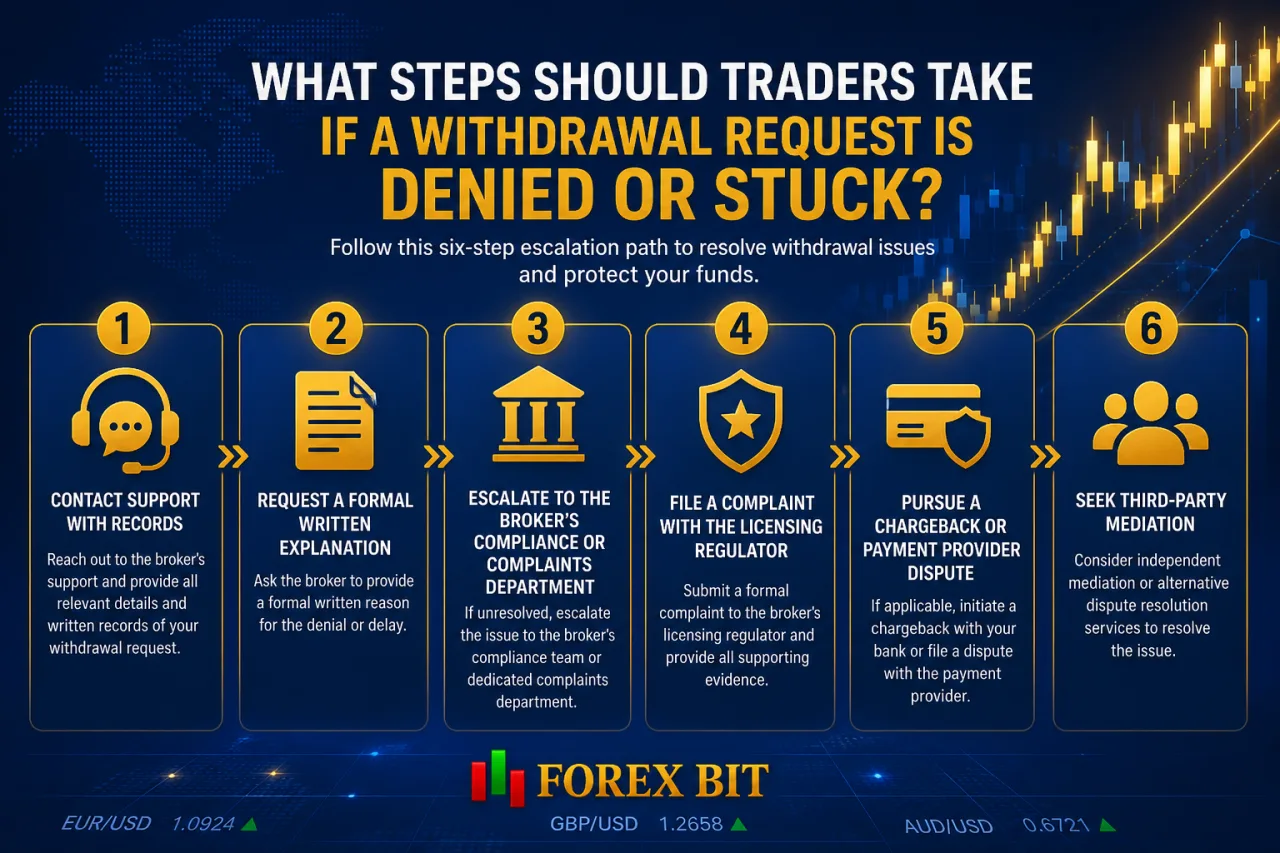
Traders follow a six-step escalation path when a withdrawal request is denied or stuck: contact support with written records, request a formal written explanation, escalate to the broker’s compliance or complaints department, file a complaint with the licensing regulator, pursue a chargeback or payment provider dispute where applicable, and seek third-party mediation. This escalation path directly addresses the dispute resolution process a trader needs once a withdrawal stalls beyond the broker’s stated timeframe. Each step below moves the case to a higher level of authority when the prior step produces no resolution.
How to Escalate a Withdrawal Complaint to a Regulator or Ombudsman?
Traders escalate a withdrawal complaint to a regulator or ombudsman through a two-stage process: compiling documented evidence, then submitting a formal complaint to the broker’s licensing regulator or an applicable dispute resolution body. This escalation step applies once direct contact with the broker’s compliance or complaints department produces no resolution.
The evidence stage requires organizing every record tied to the withdrawal request before filing:
- Screenshots of the withdrawal request, account balance, and any error or rejection messages document the transaction’s status at each stage.
- Transaction IDs, timestamps, and deposit-withdrawal method details establish a verifiable transaction trail.
- Written correspondence with support, including email threads and chat logs, records the broker’s stated explanations and any inconsistencies between them.
- Copies of the broker’s terms of service and withdrawal policy support the claim that the broker deviated from its own published rules.
The submission stage involves identifying the correct regulator or ombudsman tied to the broker’s license, then filing the complaint through that body’s official channel with the compiled evidence attached. Many regulators and financial ombudsman services require a completed internal complaint with the broker before accepting an escalated case, so retaining proof of that earlier step supports the regulatory filing.
Can Traders Recover Funds Through a Chargeback or Payment Dispute?
Chargeback or payment dispute recovery remains possible under limited conditions: the withdrawal was never processed, the deposit method still permits a reversal window, and the funds moved through a card or regulated e-wallet rather than crypto. This condition directly limits the chargeback feasibility a trader can rely on once a withdrawal problem escalates.
Card issuers and e-wallet providers apply their own dispute rules, and these rules interact with timing and payment type in specific ways.
Card issuers generally accept chargeback claims within a set dispute window measured from the transaction date, after which the claim can no longer be filed.
- E-wallet providers review disputes through an internal resolution process rather than a bank-style chargeback, with outcomes depending on the provider’s own terms of service.
- Bank transfers offer limited reversal options once funds clear, since SWIFT and local transfer systems treat completed transfers as final in most cases.
- Cryptocurrency withdrawals carry no reversal mechanism, since blockchain transactions confirm and settle without a central authority able to reverse them.
A dispute filed against a broker for withheld funds, as opposed to funds already paid out, faces additional scrutiny from the payment provider, since the claim addresses a service dispute rather than an unauthorized transaction.
How Do Withdrawal Problems Differ Across Broker Types and Payment Methods?
Withdrawal problems differ mainly by regulatory tier and payment channel, since highly regulated brokers face stricter payout obligations while offshore brokers carry fewer enforceable rules, and each payment channel offers a different level of dispute or reversal protection. This variance in oversight and payment mechanics shapes how quickly a trader recovers funds or escalates a stalled request. The two dimensions below, broker regulation and payment channel, each carry distinct risk patterns worth separating before comparing specific cases.
Are Offshore or Unregulated Brokers More Likely to Have Withdrawal Issues?
Yes, offshore or unregulated brokers carry a higher likelihood of withdrawal issues, since weaker oversight, no mandatory fund segregation, and limited enforcement power reduce the regulatory pressure that forces payout compliance. This correlation between regulatory tier and withdrawal risk connects directly to the licensing checks already outlined for pre-deposit due diligence.
Three structural gaps explain the pattern:
- Weaker oversight allows offshore regulators to impose fewer capital and conduct requirements on licensed brokers.
- Missing segregation rules permit brokers to mix client funds with operating capital, increasing exposure if the firm faces cash-flow strain.
- Limited enforcement power leaves offshore regulators without the authority to fine, suspend, or compel restitution from a broker that withholds payouts.
Traders tend to report withdrawal complaints against offshore-licensed brokers more often than against brokers holding tier-1 licenses.
This gap does not confirm every offshore broker withholds funds, since some maintain segregated accounts voluntarily, but the absence of a regulatory mandate removes a key layer of client protection present under stricter licensing regimes.
Do Crypto Withdrawals Carry Different Risks Than Bank or Card Withdrawals?
Yes, crypto withdrawals carry different risks than bank or card withdrawals, since blockchain transactions settle without a reversal mechanism, chargeback option, or central authority able to intervene once funds move. This irreversibility contrasts directly with the dispute channels available for other payment methods.
- Crypto transactions confirm on the blockchain and offer no chargeback path if a broker sends funds to the wrong wallet or a trader authorizes a withdrawal in error.
- Card withdrawals allow a chargeback claim within the issuer’s dispute window when a transaction was never processed or was unauthorized.
- E-wallet providers review disputes through an internal resolution process, giving traders a formal complaint channel unavailable to crypto users.
- Bank transfers offer limited reversal once cleared, but the transfer still routes through a traceable institutional record that supports a regulator complaint.
Wallet address errors compound crypto risk, since a single incorrect character sends funds to an unrecoverable destination, while traceability on public blockchains still allows transaction verification without enabling fund recovery.
Conclusion
Forex broker withdrawal problems trace back to identifiable causes, unmet KYC or bonus conditions, payment mismatches, banking delays, or deliberate withholding tied to weak regulatory oversight. Distinguishing routine processing lag from genuine refusal rests on consistent broker communication, clear timelines, and stable explanations rather than shifting excuses or silence. Pre-deposit due diligence, license verification, fund segregation checks, and a small test withdrawal, reduces exposure before larger capital moves through an account.
When a request stalls, documented escalation through the broker’s complaints process and, where needed, the licensing regulator remains the structured path toward resolution. Offshore-licensed brokers and irreversible payment channels such as crypto carry measurably higher risk, making method choice and regulatory tier central factors in avoiding withdrawal disputes altogether.
William Johnson is a Forex & Broker News Analyst at Forex Bit, focusing on broker updates, regulatory developments, payment changes, and security-related news. His work helps readers stay informed about important industry developments and understand how these changes may affect broker services and trading conditions.
Email: [email protected]



Best Brokers

Trade with the world’s largest retail broker and benefit from better - than - market conditions.

We offer a superior trading environment that puts traders in the best position to profit.

Trade with the best trading conditions. WIN THE BEST TRADING ACCOUNT AWARD.

Trade global markets with Interactive Brokers – a highly regulated multi-asset broker built for active and professional investors.






Forex Bit provides in-depth analysis of commodities, forex, and stock markets to help traders make informed investment decisions.
Best Brokers
Metatrader 5 Brokers
Metatrader 4 Brokers
Lowest Spread Forex Broker
Regulated Forex Brokers
Forex Copy Trading
Ctrader Brokers
Best Forex Broker For Beginners