
FxPro vs XM 2026: see how execution models, account types, spreads and leverage differ to find the broker that fits your trading style.
FxPro vs XM: Execution Model & Account Comparison 2026

FxPro and XM differ mainly in execution model, account structure, and cost design, with FxPro leaning toward Market Execution/ECN-style trading and XM offering STP-based Instant Execution. These structural differences shape spreads, order handling, and suitability for different trading styles discussed throughout this comparison.
FxPro’s execution model is generally described as Market Execution across its ECN and Instant accounts, with orders routed toward liquidity providers rather than through a dealing desk. XM, in contrast, uses STP-based Instant Execution on its Micro and Standard accounts, prioritizing fixed order confirmation over raw market depth.
FxPro’s account types generally require a higher minimum deposit than XM’s entry-level accounts, while spread and commission structures vary depending on whether traders choose raw spreads with commission or commission-free floating spreads. Both brokers offer multiple account tiers designed for different cost preferences.
Scalpers generally benefit more from FxPro’s ECN-style accounts, while beginners and MT4/MT5 users often find XM’s low minimum deposit and simplified account structure more accessible. Copy traders and cost-sensitive traders may weigh these differences against platform compatibility and support quality.
Forex Bit breaks down these execution and account differences in detail below, starting with a direct look at which broker delivers better overall trading conditions in 2026 before examining execution models and account structures side by side.
FxPro vs XM: Which Broker Offers Better Execution and Account Conditions in 2026?
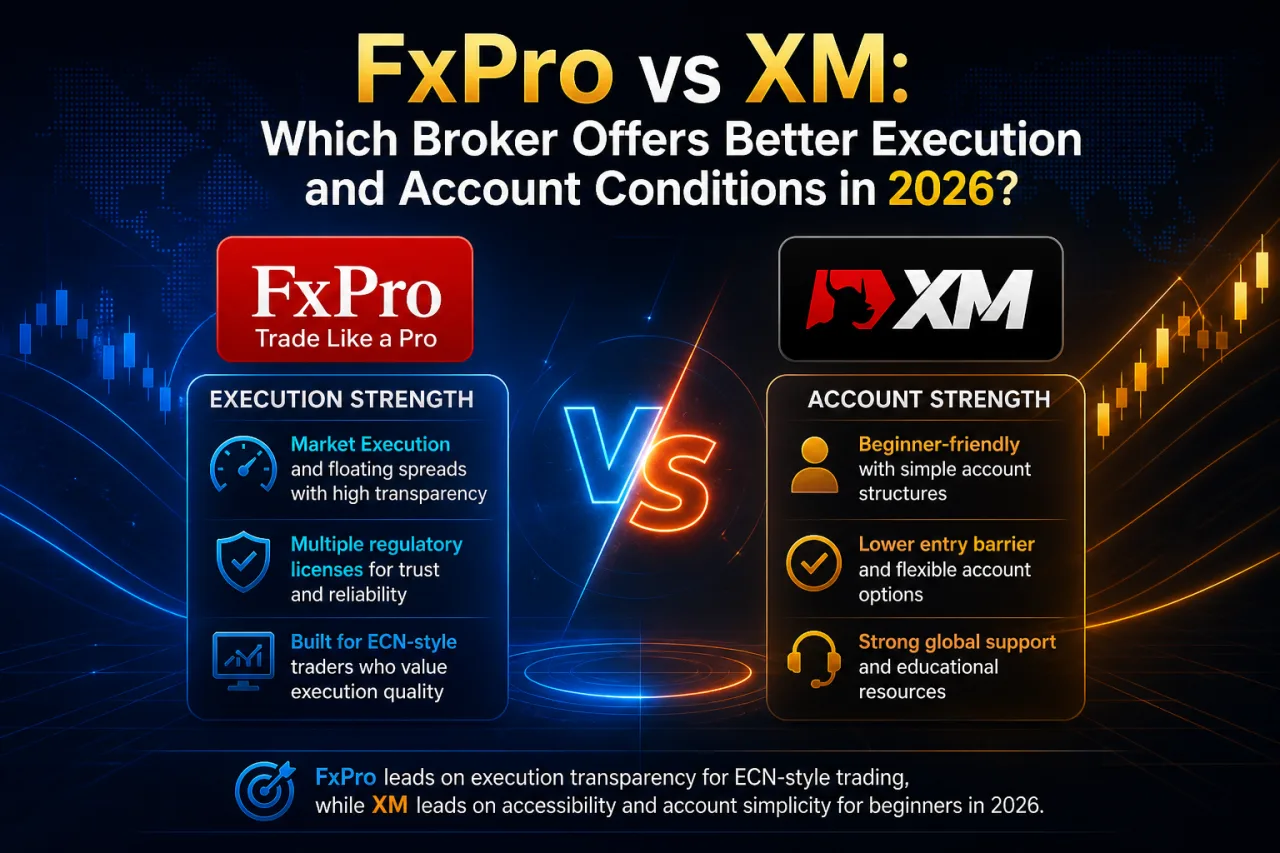
Neither broker holds a universal edge, as FxPro leads on execution transparency for ECN-style trading while XM leads on accessibility and account simplicity for beginners in 2026. This comparison scope stays narrow, focused only on execution model and account offerings rather than a full broad overview of either broker.
FxPro operates under multiple regulatory licenses and has built its reputation around Market Execution and floating spreads over many years of operation.
XM, founded earlier and now serving a large global client base, is regulated across several jurisdictions and is generally positioned as a broker suited to high-volume retail traders using STP execution.
The sections that follow examine execution handling and account structures side by side, without repeating a generic broker-overview format already common to comparisons like exness vs xm.
How Do FxPro’s and XM’s Execution Models Differ?
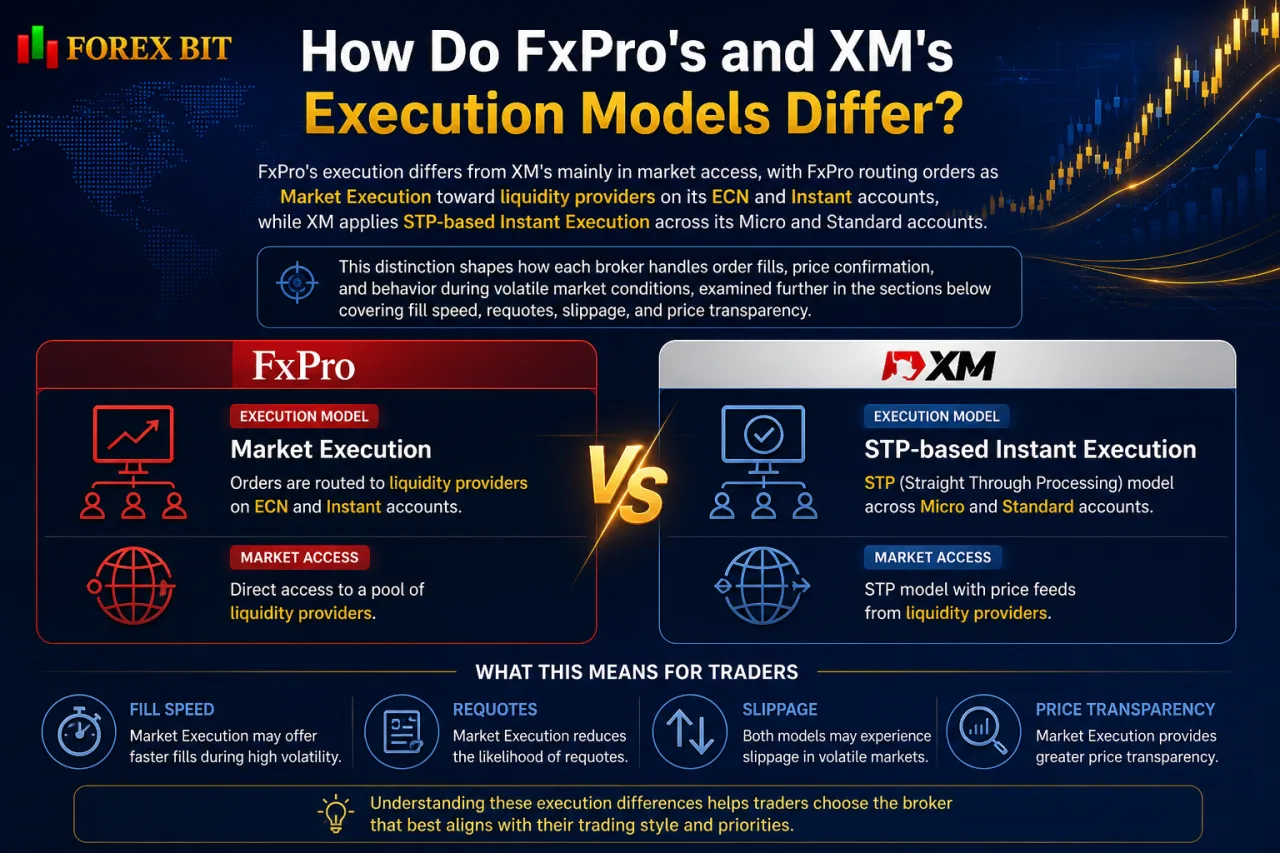
FxPro’s execution differs from XM’s mainly in market access, with FxPro routing orders as Market Execution toward liquidity providers on its ECN and Instant accounts, while XM applies STP-based Instant Execution across its Micro and Standard accounts. This distinction shapes how each broker handles order fills, price confirmation, and behavior during volatile market conditions, examined further in the sections below covering fill speed, requotes, slippage, and price transparency.
What Is Market Execution and How Does FxPro Use It?
Market Execution is an order-processing method that sends trades directly toward liquidity providers without a dealing desk intervening, and FxPro applies this model across its MT4/MT5 Instant and Market accounts, cTrader, and FxPro Direct. This structure shapes how prices confirm and how spreads behave on FxPro’s platforms.
Under Market Execution, FxPro does not guarantee a fixed entry price, since the order fills at the best available price from connected liquidity sources at the moment of execution. This type of routing is generally associated with fewer fixed requotes, meaning orders tend to proceed at prevailing market prices rather than being rejected and resubmitted.
Spreads on these FxPro account types are variable rather than fixed, widening or narrowing based on real-time liquidity and volatility. This variability applies consistently across MT4, MT5, cTrader, and FxPro Direct, distinguishing FxPro’s approach from brokers offering fixed-spread alternatives.
What Is STP/Instant Execution and How Does XM Use It?
STP/Instant Execution routes orders through liquidity providers while confirming a fixed price at the moment of the click, and XM applies this model across its Micro and Standard accounts on MT4 and MT5. This routing method differs from FxPro’s Market Execution structure covered above, since XM’s system prioritizes price confirmation over open-ended fills.
Under XM’s Instant Execution, the platform attempts to fill an order at the exact quoted price. If the market moves beyond a defined tolerance before execution completes, XM generally either requotes the order or rejects it rather than filling at a different price.
Spread behavior on these XM account types is largely fixed relative to FxPro’s floating-spread accounts, though minor variation still occurs depending on liquidity conditions. **This spread structure gives XM’s Micro and Standard accounts more predictable cost expectations, which appeals to traders prioritizing consistency over raw market depth.**XM’s Zero account, by contrast, shifts toward variable spreads with commission, positioning it closer to an ECN-style approach.
How Do FxPro and XM Account Types Compare?
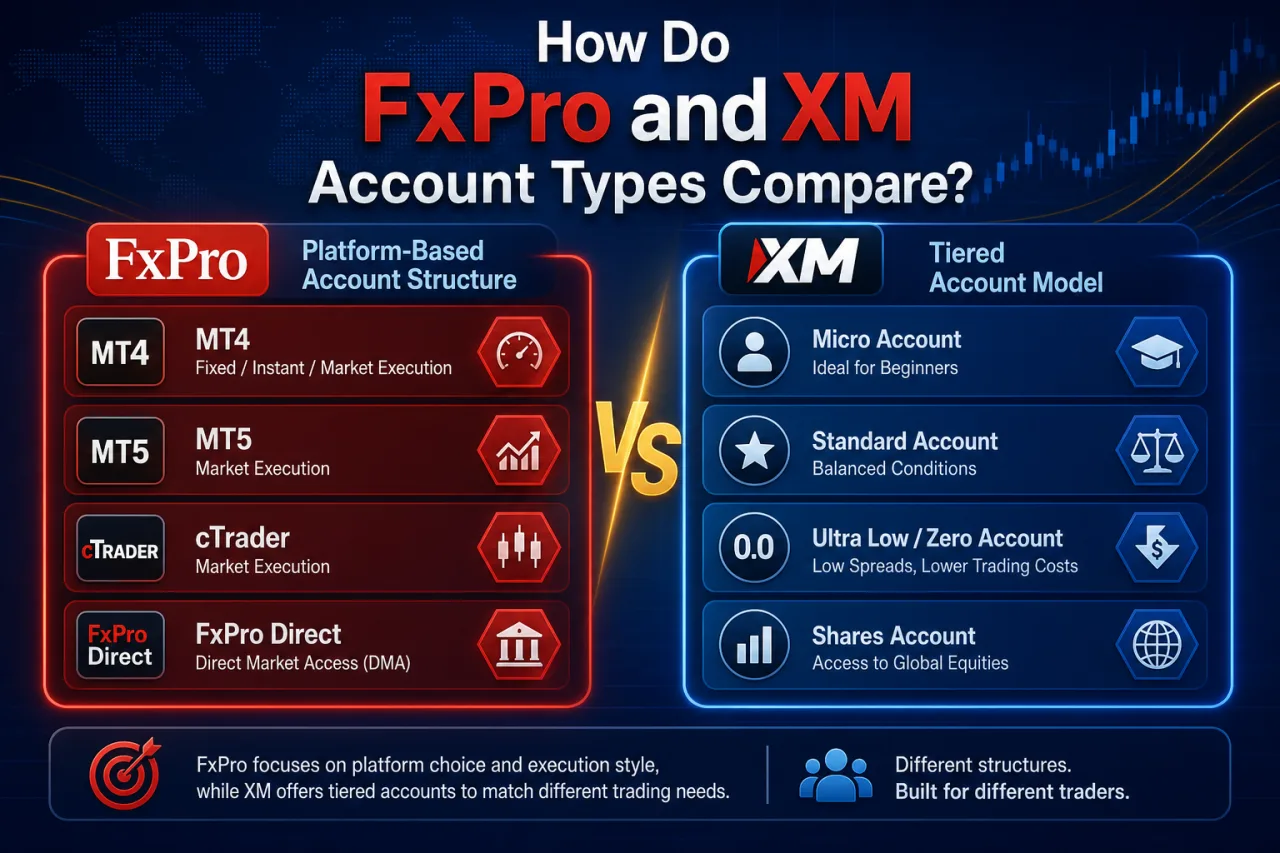
FxPro and XM structure their account lineups around different execution philosophies, with FxPro offering MT4 Fixed/Instant/Market, MT5, cTrader, and FxPro Direct, while XM provides Micro, Standard, Ultra Low/Zero, and Shares accounts. This structural split carries through spread type and target trader profile for each account line. The breakdown below separates FxPro’s platform-based account structure from XM’s tiered account model, covering how execution and cost design differ across each.
What Account Types Does FxPro Offer?
FxPro structures its account lineup around platform choice rather than a simple tiered ladder, offering MT4 with Instant or Market Execution, MT5, cTrader, and the proprietary FxPro Direct platform, each carrying its own spread and execution profile. This platform-based grouping differs from XM’s tiered Micro/Standard/Zero structure discussed elsewhere in this comparison.
On MT4, FxPro splits execution into Instant and Market Execution variants, with Instant accounts confirming fixed prices similar in concept to XM’s STP model, while Market accounts float spreads without commission. MT5 and cTrader both operate under Market Execution, routing orders toward liquidity providers with variable spreads. FxPro Direct, the broker’s own platform, follows the same Market Execution approach as MT5 and cTrader.
Commission structure varies by account: some MT4/MT5 lines carry zero commission with wider floating spreads, while others apply a fixed commission per lot alongside tighter raw spreads. The exact commission figures and spread ranges per FxPro account type vary across MT4, MT5, and cTrader and should be confirmed directly with FxPro before opening an account.
What Account Types Does XM Offer?
XM structures its account lineup into three main groups: Micro, Standard, and Ultra Low/Zero, each carrying a distinct spread and commission profile rather than a platform-based split like FxPro’s. This tiered model contrasts with FxPro’s platform-first structure covered above, since XM separates accounts primarily by cost design rather than by trading platform.
The Micro and Standard accounts both use STP-based Instant Execution with fixed-leaning spreads and no added commission, differing mainly in lot sizing rather than execution behavior. Micro accounts trade in micro lots, while Standard accounts trade in standard lot sizing, making Micro accounts generally more suited to smaller position sizing.
The Ultra Low/Zero account line shifts toward variable spreads paired with a commission per lot, positioning it closer to FxPro’s raw-spread account types discussed earlier. This account moves XM’s cost structure away from the fixed-spread approach of Micro and Standard toward a variable-spread-plus-commission model.
All three account types are available on both MT4 and MT5, giving traders platform flexibility without changing the underlying execution model. The exact spread ranges and commission rates per lot vary and should be confirmed directly with XM before account opening.
How Do Spreads, Commissions, and Minimum Deposits Compare Between FxPro and XM?
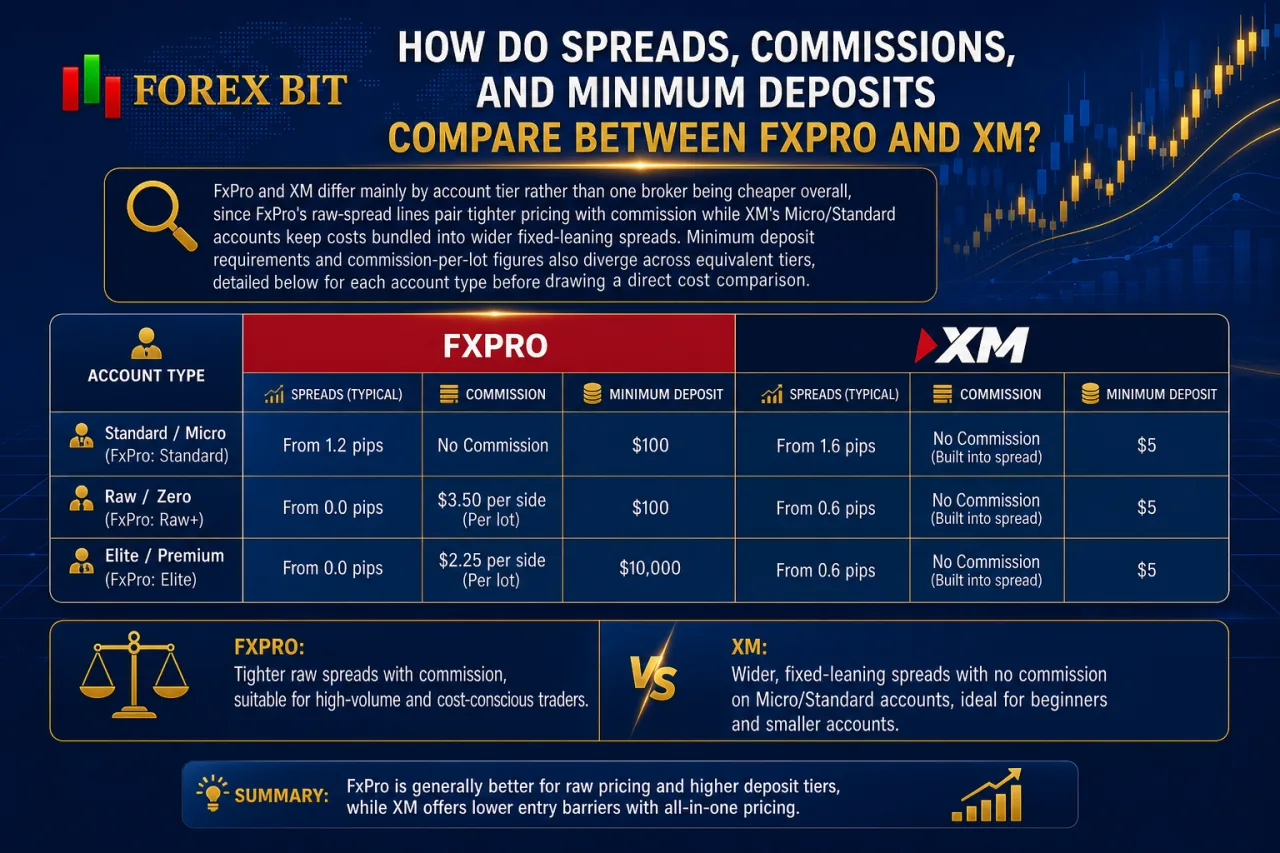
FxPro and XM differ mainly by account tier rather than one broker being cheaper overall, since FxPro’s raw-spread lines pair tighter pricing with commission while XM’s Micro/Standard accounts keep costs bundled into wider fixed-leaning spreads. Minimum deposit requirements and commission-per-lot figures also diverge across equivalent tiers, detailed below for each account type before drawing a direct cost comparison.
Which Broker Has Lower Spreads and Commissions: FxPro or XM?
FxPro’s cTrader and Market Execution accounts generally price tighter raw spreads paired with a per-lot commission, while XM’s Ultra Low/Zero account applies a similar variable-spread-plus-commission model against Standard/Micro’s wider commission-free pricing. This section narrows the earlier account-type breakdown down to a direct cost comparison between each broker’s low-spread tier.
On FxPro, cTrader and Market Execution accounts generally feature floating spreads that narrow toward zero during normal liquidity conditions, alongside a commission charged per lot traded, though exact figures should be confirmed directly with FxPro before opening an account.
XM’s Ultra Low/Zero account similarly floats spreads from a low base level and charges a separate commission per lot, positioning it against FxPro’s raw-spread lines rather than against XM’s own Micro or Standard accounts, though exact spread ranges and commission figures should be confirmed directly with XM before opening an account.
Neither broker discloses identical commission figures across all instruments, since crosses and exotic pairs typically carry wider raw spreads than major currency pairs on both platforms. Traders comparing exact per-lot costs between FxPro’s cTrader/Market accounts and XM’s Ultra Low/Zero tier should confirm current published rates directly with each broker before funding an account, since spread and commission figures adjust with liquidity conditions.
Which Broker Has a Lower Minimum Deposit Requirement?
XM generally sets a lower entry threshold on its Micro and Standard accounts than FxPro’s platform-based account lines, though exact figures for both brokers require direct confirmation before funding. This deposit gap ties directly into how accessible each broker feels for traders starting with limited capital.
XM’s Micro and Standard accounts target smaller initial funding, aligning with their STP-based Instant Execution and fixed-leaning spread design covered earlier. The Ultra Low/Zero tier typically asks for a higher opening balance, consistent with its variable-spread-plus-commission structure.
FxPro’s account lines, split by platform rather than tier, generally carry higher minimum deposit expectations across MT4, MT5, cTrader, and FxPro Direct compared to XM’s Micro and Standard entry points. This platform-first structure means the deposit requirement often shifts with the chosen execution route rather than a single fixed floor across all FxPro accounts.
For beginners with small starting capital, XM’s Micro and Standard accounts present a more accessible entry point given their lower funding threshold, while FxPro’s structure may suit traders already prepared to commit a larger opening balance toward ECN-style or raw-spread trading.Exact minimum deposit amounts for both brokers vary by account type and region, and should be confirmed directly with FxPro and XM before opening an account.
Which Broker Is Better Suited for Scalpers, Beginners, and MT4/MT5 Users?
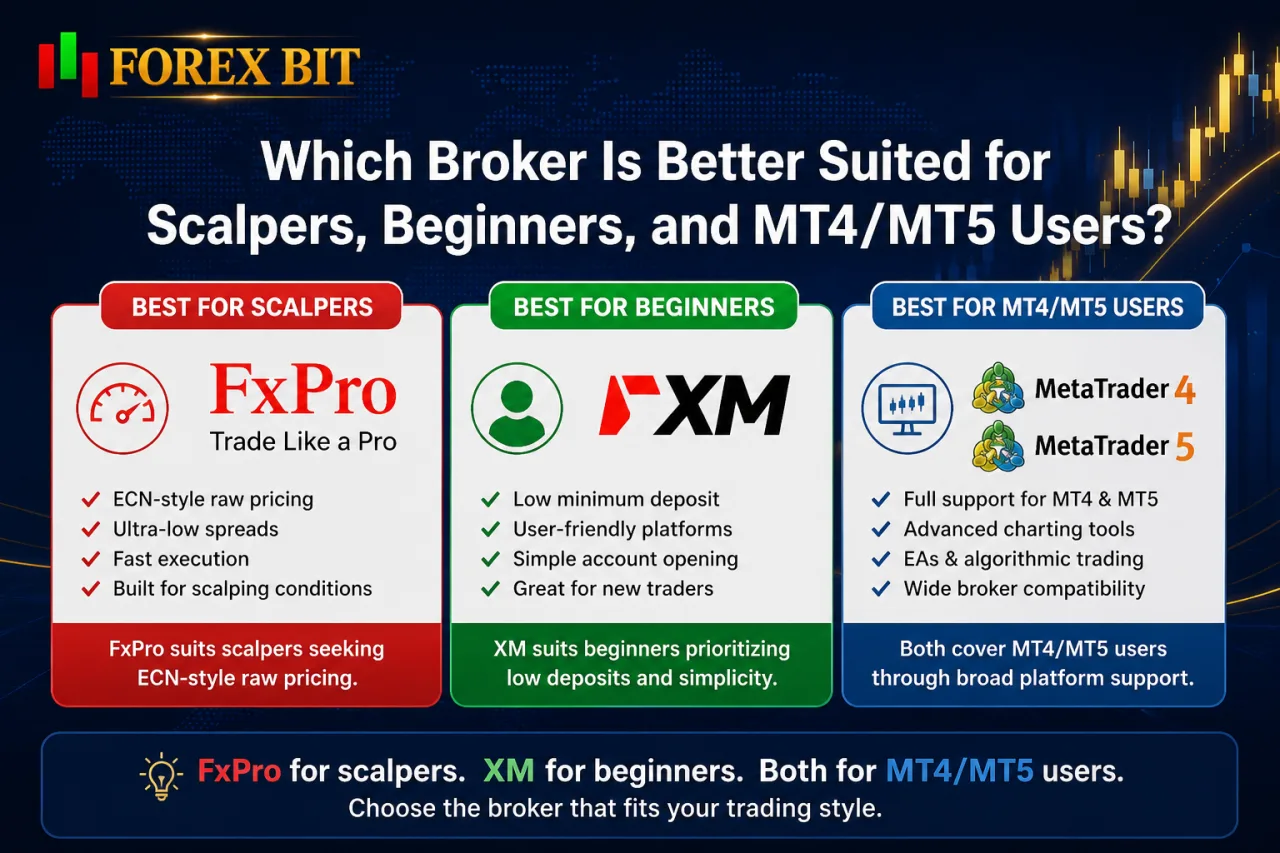
FxPro suits scalpers seeking ECN-style raw pricing, while XM suits beginners prioritizing low deposits and simplicity, and both cover MT4/MT5 users through broad platform support. This trader-type breakdown separates suitability by scalping conditions, beginner-friendliness, and platform depth, examined individually below.
Is FxPro or XM Better for Scalping?
FxPro suits scalping better than XM on a policy and execution level, since its Market Execution accounts route orders toward liquidity providers without dealing-desk intervention, while XM’s Instant Execution model prioritizes fixed price confirmation over raw fill speed. This distinction directly shapes how each broker’s fastest accounts handle rapid order entry and exit.
Both brokers permit scalping, but the execution mechanics differ:
- FxPro’s cTrader and MT4/MT5 Market Execution accounts allow orders to fill at prevailing market prices, which generally supports rapid position turnover without fixed requotes.
- XM’s Micro and Standard accounts confirm orders at a set price, meaning fast-moving scalping entries risk requotes or rejection if the market shifts beyond tolerance.
- XM’s Ultra Low/Zero account shifts toward variable spreads with commission, narrowing the gap with FxPro’s raw-spread scalping conditions.
Cost impact also differs by tier. FxPro’s raw-spread accounts pair tighter pricing with a per-lot commission, which suits high-frequency scalping when spread savings outweigh the added fee. XM’s Micro/Standard accounts keep costs inside wider fixed-leaning spreads, a structure less optimized for scalpers chasing tight raw pricing. Exact spread and commission figures for both brokers’ fastest-execution accounts require direct confirmation before trading.
Is FxPro or XM Better for Beginner Traders?
XM generally suits beginner traders better than FxPro, given its lower minimum deposit, simpler fixed-leaning spread structure, and Micro account sizing built for smaller position risk. This beginner-suitability question ties directly into account opening ease, deposit thresholds, demo access, and overall simplicity of trading conditions for new entrants.
Account opening on both brokers follows a standard online verification process, though XM’s Micro and Standard accounts pair a lower funding threshold with fixed-leaning spreads that remove much of the guesswork around variable pricing. FxPro’s platform-based structure, split across MT4 Instant/Market, MT5, cTrader, and FxPro Direct, generally asks for a higher opening balance and introduces execution-model choices that add a layer of decision-making before a beginner even places a first trade.
Both brokers offer demo accounts across their platform lineups, allowing new traders to test order execution and spread behavior before committing real funds. XM’s Micro account additionally allows micro-lot sizing, which keeps position risk smaller while a beginner adjusts to live market conditions, consistent with the lot sizing distinction already noted between XM’s Micro and Standard accounts.
For traders prioritizing simplicity and lower entry cost, XM’s Micro/Standard tier presents fewer variables than FxPro’s platform-first, execution-choice-driven structure.
Which Broker Offers a Better Experience for MT4/MT5 Users?
Both brokers deliver full MT4/MT5 integration, but FxPro extends its platform depth with cTrader and FxPro Direct, while XM pairs MT4/MT5 with a proprietary XM app rather than an alternative desktop platform. This platform-depth question ties directly into how each broker’s account types map onto MT4/MT5 versus their own additional tools.
FxPro offers MT4 across Instant and Market Execution variants plus MT5, both running the same broad instrument access already outlined across its platform lineup. cTrader and FxPro Direct sit alongside MT4/MT5 as separate execution routes rather than replacements, giving FxPro users a platform choice beyond the standard MetaTrader environment.
XM runs its Micro, Standard, and Ultra Low/Zero accounts on both MT4 and MT5 without a third desktop alternative. The XM app functions as a mobile companion for account management and trading rather than a full desktop-platform substitute like FxPro’s cTrader or FxPro Direct.
Desktop-to-mobile parity holds for both brokers on MT4/MT5, since order execution and account access remain consistent across devices. Traders wanting a non-MetaTrader desktop option find more depth with FxPro, while XM concentrates its additional tools on mobile convenience through the XM app.
What Other Trading Conditions Should You Check Before Choosing Between FxPro and XM?
Beyond execution and account structure, due diligence between FxPro and XM covers instrument range beyond forex and funding mechanics such as processing times, payment methods, and fees. These two factors sit outside the execution-model and account-tier comparison already covered, yet they shape day-to-day usability for traders working across multiple asset classes or moving funds frequently. The subsections below separate tradable instrument depth from deposit/withdrawal handling for each broker.
How Do FxPro and XM Compare in Range of Tradable Instruments?
FxPro generally lists a broader instrument range beyond forex, adding futures and a wide equity CFD selection, while XM concentrates on indices, commodities, shares, and cryptocurrency CFDs in regions where offered. This instrument-breadth question ties directly into how each broker positions itself beyond currency pairs, covering indices, commodities, shares/stock CFDs, futures, and crypto availability.
FxPro’s lineup spans indices, commodities, and a large stock CFD selection across MT4, MT5, cTrader, and FxPro Direct, alongside futures contracts on select platforms. This futures offering distinguishes FxPro from XM, which does not list futures contracts among its account offerings.
XM covers indices, commodities, and shares/stock CFDs across its Micro, Standard, and Ultra Low/Zero accounts on MT4 and MT5. Cryptocurrency CFD access on both brokers varies by regional regulation, so availability under FxPro and XM should be confirmed directly with each broker before assuming coverage in a given jurisdiction.
Both FxPro and XM offer CFD trading across multiple asset classes, including indices, commodities, shares, futures, and crypto, though the exact list of instruments and any regional restrictions vary and should be confirmed directly with each broker before opening an account.
How Do Deposit and Withdrawal Methods Differ Between FxPro and XM?
FxPro and XM differ mainly in funding channel variety and regional payment availability, though both brokers avoid charging deposit fees on most standard methods. This funding comparison ties into how quickly traders access their capital and which payment routes apply based on account jurisdiction.
FxPro generally supports bank transfer, credit/debit cards, and several e-wallets, with processing times varying by method, and card/e-wallet transactions typically clearing faster than bank wire transfers, though exact supported methods and processing times should be confirmed directly with FxPro before funding an account.
XM similarly offers bank transfer, cards, and e-wallet options, with electronic methods generally processing faster than bank wire transfers, though exact supported methods and processing times should be confirmed directly with XM before funding an account.
Withdrawal fees on both brokers generally depend on the method chosen and the region of the account, since some payment processors charge intermediary fees outside either broker’s control. Regional availability also varies, as certain e-wallets or local bank transfer options only apply to specific countries under each broker’s regulatory coverage. Traders should confirm current supported methods, processing speed, and any fees directly with FxPro and XM based on their account’s registered region before initiating a transfer.
Conclusion
The execution and account divide between FxPro and XM comes down to market access versus price certainty. FxPro’s Market Execution across MT4, MT5, cTrader, and FxPro Direct favors scalpers and traders wanting raw liquidity-based pricing, backed by a broader instrument range including futures. XM’s STP-based Instant Execution on Micro and Standard accounts, paired with lower minimum deposits and fixed-leaning spreads, favors beginners and those wanting predictable costs and simpler entry.
Both brokers cover MT4/MT5 fully, with FxPro extending platform depth through cTrader and XM adding mobile convenience via its app. The right choice depends on whether execution transparency or account accessibility matters more.
Michael Smith is a Forex Broker Comparison Specialist at Forex Bit, focusing on comparing brokers, trading platforms, account types, fees, spreads, commissions, and trading conditions. His work helps readers understand the key differences between providers so they can evaluate brokers based on their own trading needs and preferences.
Email: [email protected]

Best Brokers

Trade with the world’s largest retail broker and benefit from better - than - market conditions.

We offer a superior trading environment that puts traders in the best position to profit.

Trade with the best trading conditions. WIN THE BEST TRADING ACCOUNT AWARD.

Trade global markets with Interactive Brokers – a highly regulated multi-asset broker built for active and professional investors.






Forex Bit provides independent forex broker reviews, comparisons, guides, and industry news to help traders make informed decisions.
Best Brokers
Metatrader 5 Brokers
Metatrader 4 Brokers
Lowest Spread Forex Broker
Regulated Forex Brokers
Forex Copy Trading
Ctrader Brokers
Best Forex Broker For Beginners