
Comparing OANDA vs Forex.com? See how US regulation, spreads, and MT4/MT5 platforms stack up to find the right broker for your trading style.
OANDA vs Forex.com: US Regulation, Spreads & Platforms

OANDA and Forex.com both operate as CFTC/NFA-regulated brokers for US clients, but they differ in spreads, platform choice, and account structure. These distinctions directly affect trading costs and daily execution experience for anyone based in the United States.
Forex.com operates in the US under an entity registered with the CFTC and NFA, while OANDA runs its US operations through a separately regulated NFA member firm, though both use distinct legal entities to serve US clients. Both brokers meet the same core US regulatory requirements, though their global entities carry different oversight outside the US.
Forex.com generally advertises tighter raw spreads on its commission-based account tier, while OANDA’s spreads tend to be wider on its no-commission standard account. Commission structures and fee tiers vary by account type at both brokers.
Forex.com supports MT4, MT5, and its own proprietary web and mobile platform, whereas OANDA offers MT4 alongside its own trading platform without MT5 access. This platform gap matters most for traders who specifically need MT5 tools.
Forex Bit breaks down these regulatory, cost, and platform differences below to clarify OANDA vs Forex.com for US-based traders deciding where to open an account.
OANDA vs Forex.com: Which Broker Should US Traders Choose?
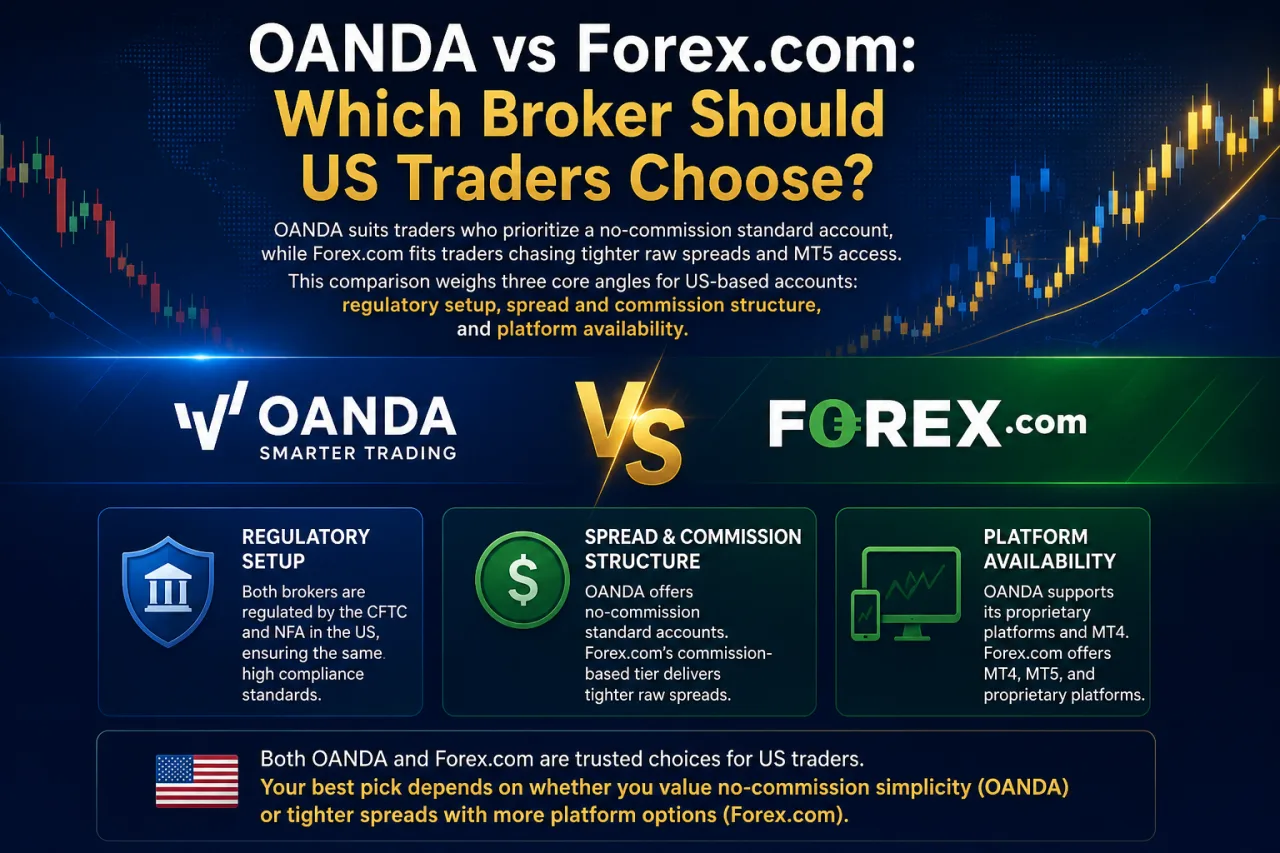
OANDA suits traders who prioritize a no-commission standard account, while Forex.com fits traders chasing tighter raw spreads and MT5 access. This comparison weighs three core angles for US-based accounts: regulatory setup, spread and commission structure, and platform availability.
Both brokers operate under CFTC and NFA oversight through their respective US entities, meeting the same baseline compliance standards. Where they diverge is cost and tooling: Forex.com’s commission-based tier undercuts OANDA’s standard spreads for high-frequency traders, while OANDA’s simpler pricing model appeals to traders who prefer predictable, all-in spreads without separate commission tracking.
Platform choice reinforces this split. Forex.com’s MT4, MT5, and proprietary platform lineup covers a broader range of trading styles, whereas OANDA’s MT4-plus-proprietary setup omits MT5 entirely.
The sections that follow break down each of these three angles in detail, starting with how US regulation shapes account protections and legal entity structure at both brokers.
Is OANDA or Forex.com Better Regulated for US Traders (CFTC/NFA Compliance)?
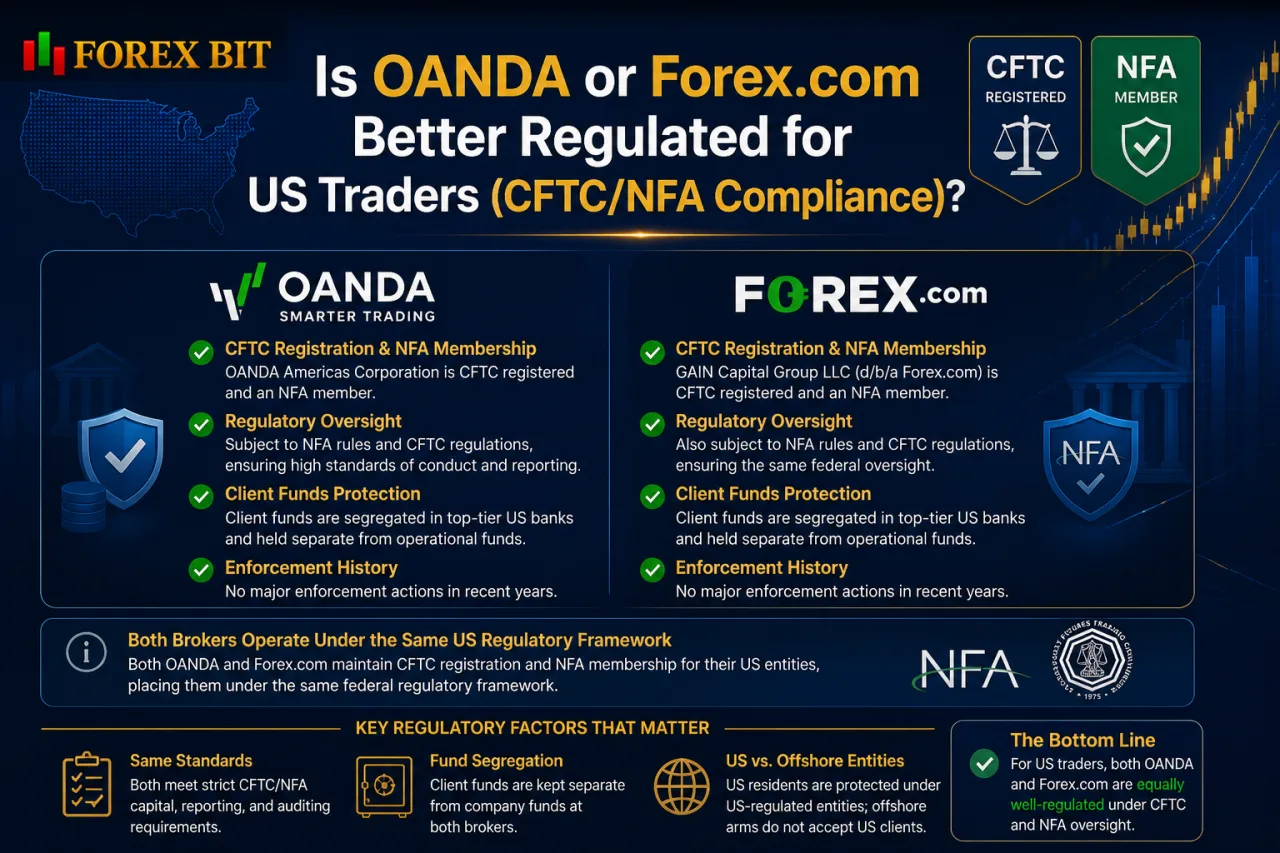
Both OANDA and Forex.com maintain CFTC registration and NFA membership for their US entities, placing them under the same federal regulatory framework. This regulatory question covers registration status, past enforcement history, and how client funds get segregated at each firm. The subsections below detail NFA membership specifics, any disciplinary record, and how each broker’s US entity differs from offshore arms restricted from serving US residents.
Are OANDA and Forex.com Both CFTC and NFA Regulated?
Yes, both OANDA and Forex.com hold active CFTC registration and NFA membership through their respective US entities, satisfying the same federal oversight requirements. This regulatory question turns on registration category, membership standing, and any compliance history tied to each NFA member ID.
Both brokers are registered with the CFTC and maintain NFA membership under their respective US entities, consistent with standard regulatory categories for US forex brokers.
Beyond the base registration, compliance history differs by firm and changes over time as the NFA updates disciplinary records. Both OANDA’s and Forex.com’s US entities are subject to NFA oversight, which includes the possibility of disciplinary actions for regulatory violations, though specific case details can vary between firms and over time.
Traders verifying either broker independently can cross-check registration status and disciplinary history directly through the NFA’s BASIC lookup tool using each firm’s member ID, rather than relying solely on broker-provided claims.
What Leverage Limits Apply to OANDA vs Forex.com Under US Rules?
NFA-mandated leverage caps apply equally to OANDA and Forex.com, limiting leverage on major currency pairs and applying lower limits on minor pairs for US-based accounts. This leverage question centers on whether either broker offers an edge through higher ratios, and the regulatory answer rules that out domestically.
Neither broker sets its own leverage ceiling for US clients since the CFTC and NFA dictate the maximum ratios across the industry. OANDA and Forex.com both apply the same tiered structure:
- Major pairs cap at 50:1 for both brokers.
- Minor and cross pairs cap at 20:1 for both brokers.
There is no meaningful leverage differentiation between OANDA and Forex.com within the United States, since federal rules override any broker-specific policy. Traders seeking higher leverage ratios typically look toward offshore entities of either brand, though those entities fall outside NFA oversight and outside the scope of this US-focused comparison. For US-based accounts, leverage is a non-factor when choosing between the two brokers.
How Do OANDA and Forex.com Spreads and Fees Compare?
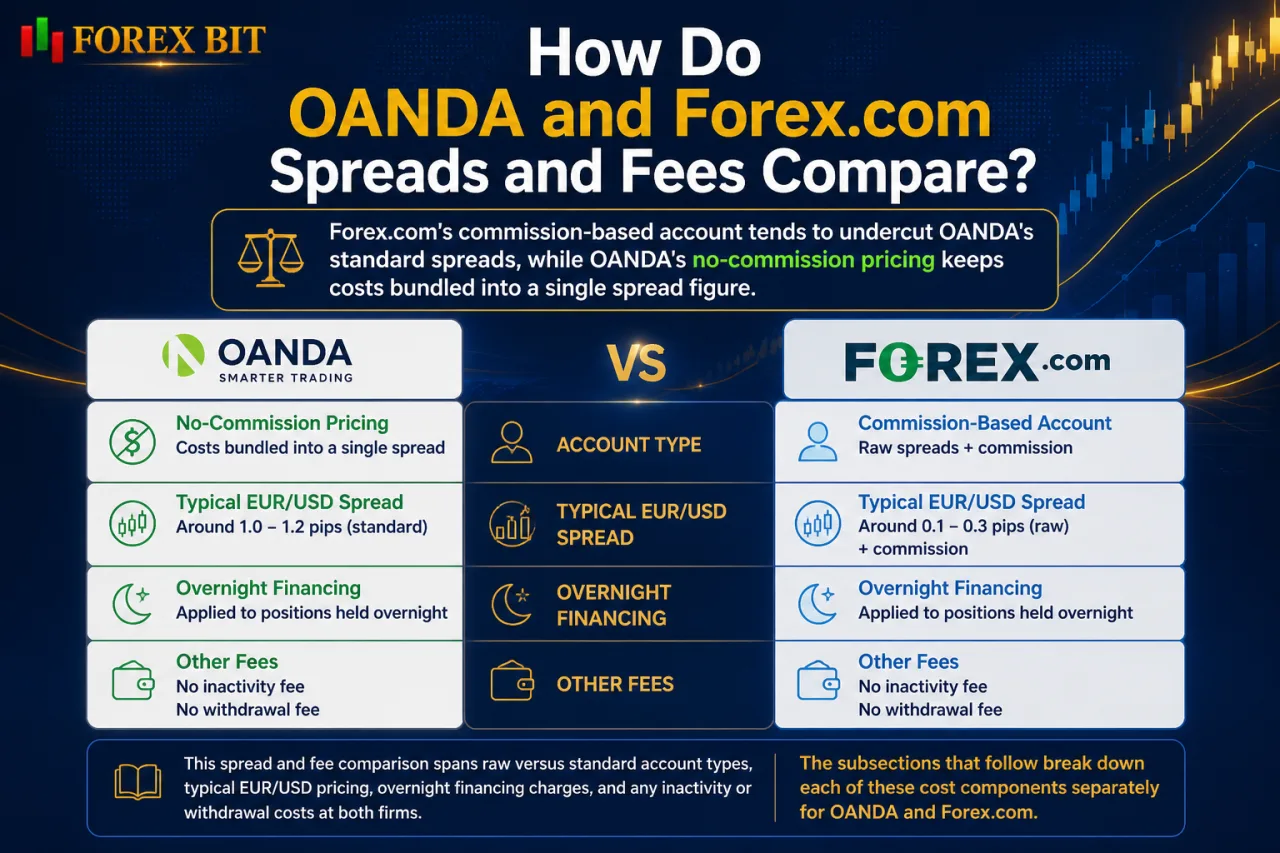
Forex.com’s commission-based account tends to undercut OANDA’s standard spreads, while OANDA’s no-commission pricing keeps costs bundled into a single spread figure. This spread and fee comparison spans raw versus standard account types, typical EUR/USD pricing, overnight financing charges, and any inactivity or withdrawal costs at both firms. The subsections that follow break down each of these cost components separately for OANDA and Forex.com.
Which Broker Offers Tighter Spreads on Major Currency Pairs?
Forex.com’s RAW pricing tier tends to post tighter raw spreads on major pairs like EUR/USD, GBP/USD, and USD/JPY than OANDA’s Core/Standard pricing, though once Forex.com’s per-side commission is factored into the all-in cost, the actual cost difference between the two can narrow. This spread comparison sets the two brokers’ commission-free and commission-based tiers side by side on the three most-traded majors.
Forex.com’s Standard account carries no separate commission but wider built-in spreads, while its RAW tier adds a per-lot commission on top of near-zero raw spreads. OANDA’s Standard account bundles all cost into the spread with no added commission, positioning it closer to Forex.com’s Standard tier than its RAW tier on a like-for-like basis.
- EUR/USD: Forex.com’s RAW account tier generally advertises tighter spreads than OANDA’s Standard account once commission costs are factored in, though the actual cost gap can narrow depending on market conditions.
- GBP/USD: Forex.com’s RAW account tier generally advertises tighter GBP/USD spreads than OANDA’s Standard account once commission costs are factored in, though the actual cost gap can narrow depending on market conditions.
- USD/JPY: Forex.com’s RAW account tier generally advertises tighter USD/JPY spreads than OANDA’s Standard account once commission costs are factored in, though the actual cost gap can narrow depending on market conditions.
Traders comparing Forex.com Standard against OANDA Standard, rather than against RAW, typically see closer parity between the two commission-free tiers.
Does OANDA or Forex.com Charge Commissions on Trading Accounts?
Yes, Forex.com charges a per-lot commission on its RAW pricing tier, while OANDA’s standard account stays commission-free and bundles all cost into the spread. This commission question hinges on account tier selection at each broker rather than a single blanket policy across the whole brand.
Forex.com splits its offering into two tracks: the Standard account carries no separate commission but wider built-in spreads, and the RAW account charges a fixed per-lot fee alongside near-zero raw spreads. Forex.com’s RAW account charges a per-side commission on each trade, with the exact rate depending on account currency and prevailing pricing schedules.
OANDA takes a simpler route for US clients, offering a Standard account that folds all trading cost into the spread with no added per-lot charge. Traders who prefer one consolidated spread figure over tracking commissions separately find OANDA’s structure more predictable, while traders chasing the lowest raw execution cost on Forex.com’s RAW tier accept the commission line item in exchange for tighter quoted spreads.
What Other Account Fees Should Traders Compare Between OANDA and Forex.com?
Beyond spreads and commissions, OANDA and Forex.com also differ in inactivity charges, minimum deposit requirements, and currency conversion fees on funding transactions. Non-trading costs like these accumulate quietly for infrequent traders or those funding accounts in a non-base currency, so a full cost comparison between the two brokers weighs these charges alongside quoted spreads. OANDA applies an inactivity fee to dormant accounts, while Forex.com applies its own separate inactivity policy, though the exact thresholds and charge amounts are not consistently published and are subject to change, so traders confirm current figures directly with each broker before opening an account.
Neither broker publicly requires a large minimum deposit to open a standard US account, though exact figures can differ and are subject to change over time, and traders verify the current minimum on each broker’s official site rather than relying on a fixed number.
Withdrawal and deposit fees also vary by funding method at each firm, and currency conversion charges apply when a trader deposits or trades in a currency that differs from the account’s base currency. Both OANDA and Forex.com apply currency conversion charges on non-base-currency transactions, and the exact conversion rate markup differs between the two brokers and is not always disclosed as a fixed percentage.
Traders who fund accounts in a single currency and trade actively avoid most of these non-trading charges, while infrequent traders or those using multiple funding currencies feel the impact more directly. Given that exact fee schedules change over time, direct confirmation with OANDA and Forex.com support or their official fee pages remains the most reliable way to compare these charges.
How Do OANDA and Forex.com Trading Platforms Compare?
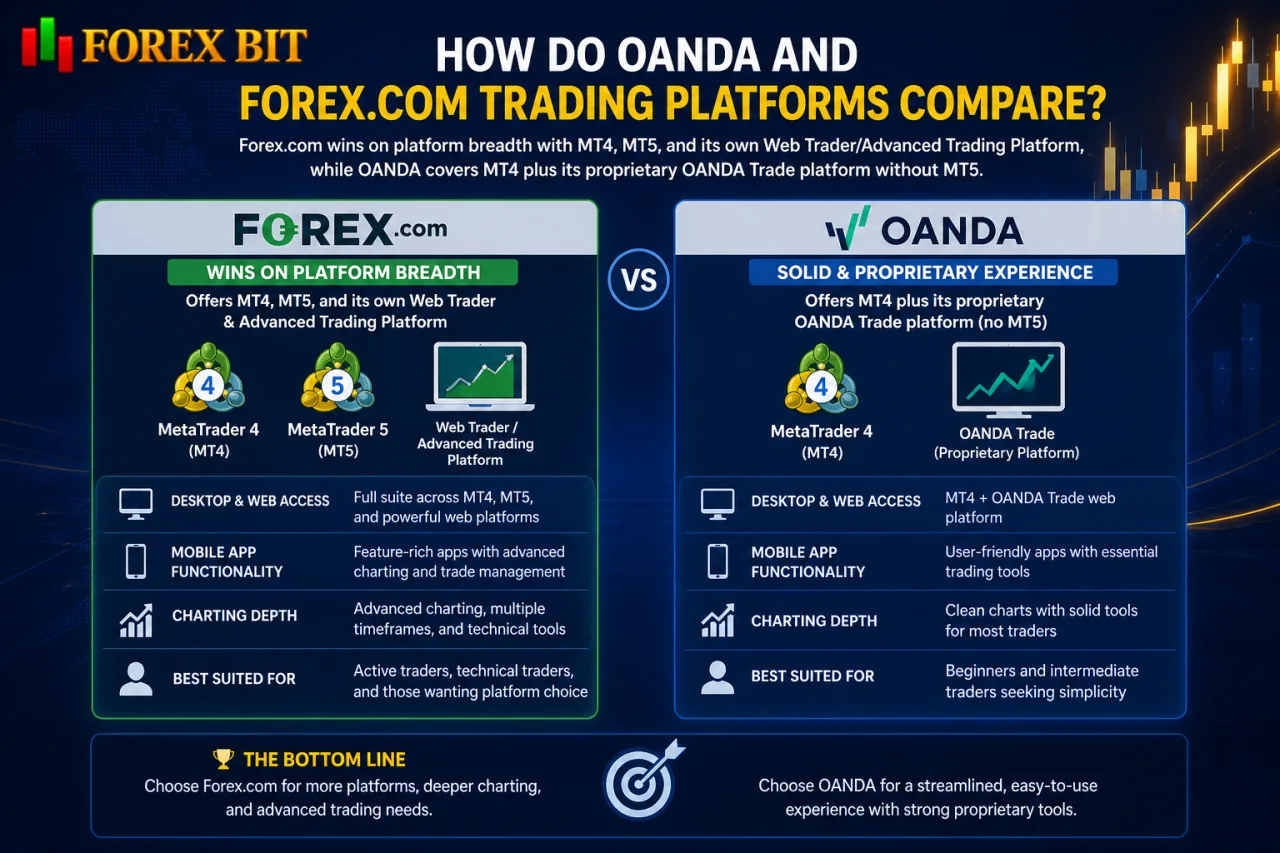
Forex.com wins on platform breadth with MT4, MT5, and its own Web Trader/Advanced Trading Platform, while OANDA covers MT4 plus its proprietary OANDA Trade platform without MT5. This platform comparison spans desktop and web access, mobile app functionality, charting depth, and how each interface suits beginner versus active traders. The following breakdown separates platform availability, mobile tools, and usability by trader level for both brokers.
Does OANDA or Forex.com Support MetaTrader 4 or MetaTrader 5?
Forex.com’s US platform lineup includes both MetaTrader 4 and MetaTrader 5, while OANDA’s US offering includes MetaTrader 4 but not MetaTrader 5, though platform availability can change over time and should be confirmed directly with each broker.
This MetaTrader availability question comes down to which broker gives traders the full MT4/MT5 pairing versus a partial offering.
Forex.com keeps both MetaTrader versions active for US accounts alongside its own Web Trader and Advanced Trading Platform, giving MT5 users access to features like additional timeframes and an expanded order system. OANDA has not added MT5 to its US offering, keeping MT4 as its sole third-party platform option next to the proprietary OANDA Trade platform.
Traders who specifically need MT5 tools, such as its built-in economic calendar or netting/hedging flexibility, find that requirement met only at Forex.com. Traders satisfied with MT4’s charting and expert advisor support see no functional gap between the two brokers on that front.
What Are the Key Differences Between OANDA’s and Forex.com’s Proprietary Platforms?
OANDA’s proprietary platform prioritizes streamlined charting and simple order entry, while Forex.com’s Advanced Trading Platform is built on TradingView, offering more advanced charting tools and wider access to algorithmic trading features. That distinction in charting engine shapes how each platform handles order types, automation, and ease of use for different trader levels.
OANDA Trade covers standard order types and a built-in economic calendar within a clean, uncluttered interface suited to traders who want quick execution without a steep learning curve. Its charting stays functional but lighter than a dedicated TradingView-based setup.
Forex.com’s Advanced Trading Platform, by contrast, layers TradingView’s charting library on top of its order execution, adding a wider indicator library and more advanced drawing tools. Forex.com also offers API trading access for traders building automated or algorithmic strategies outside MT4/MT5, though exact API features and eligibility requirements should be confirmed directly with the broker.
For beginners, OANDA’s simpler layout reduces friction when learning order placement, while active or algorithmic traders on Forex.com gain more charting depth and automation flexibility through its TradingView integration and API options.
What Other Unique Features Set OANDA and Forex.com Apart?
OANDA differentiates itself through fractional pip pricing and extensive historical rate data, while Forex.com leans on StoneX-backed research and third-party integrations like Trading Central. These niche tools sit outside the spread, commission, and platform comparisons already covered above. The subsections below separate OANDA’s pricing/data tools from Forex.com’s research and integration ecosystem.
Which Broker Provides Better Research Tools and Trading Signals?
Forex.com provides stronger third-party research through Trading Central signals and TradingView-integrated tools, while OANDA relies on its own proprietary market analysis and economic calendar built directly into OANDA Trade. This research comparison weighs in-house analysis tools against licensed third-party signal providers.
OANDA’s research centers on its own economic calendar, order book data, and market commentary generated internally rather than sourced from outside vendors. Forex.com also supplements its platforms with Trading Central’s technical analysis and pattern recognition signals, giving traders algorithm-generated trade ideas alongside TradingView’s charting and idea-sharing community, though exact feature scope should be confirmed directly with the broker.
Traders who prefer a broker’s own market view without third-party noise lean toward OANDA’s self-contained tools. Traders seeking automated signal generation and a broader community-driven charting layer find that depth only through Forex.com’s Trading Central and TradingView integration.
Does Either Broker Offer API or Algorithmic Trading Access?
Yes, both brokers offer API-based algorithmic trading access, with OANDA’s well-known REST API serving as its primary route and Forex.com covering similar ground through its own API alongside MT4/MT5 expert advisors. This API access question turns on documentation depth, ease of setup for retail traders, and whether the offering targets developers or algo-focused institutional-style accounts.
OANDA’s REST API remains a long-standing feature for US accounts, giving developers programmatic access to pricing, order execution, and account data without routing through MT4/MT5. Forex.com’s API access exists as a comparable offering for automated strategy development, though exact documentation depth and eligibility requirements should be confirmed directly with the broker.
Retail traders without coding experience typically find MT4/MT5 expert advisors more accessible at Forex.com, while developers building custom systems gravitate toward OANDA’s REST API for its established documentation history.
Conclusion
Both brokers satisfy identical CFTC/NFA rules and leverage caps, so the choice for US traders comes down to cost structure and platform needs rather than regulatory safety. Forex.com fits active or algo-oriented traders who want RAW-tier pricing, MT5 access, TradingView charting, and Trading Central signals alongside API and expert advisor support.
OANDA suits traders who prefer a single bundled spread with no commission tracking, a simpler proprietary interface, self-contained research tools, and an established REST API for custom development. Neither firm holds a universal edge; the better pick depends on whether raw spreads and MT5 or predictable pricing and streamlined tools matter more to a given trading style.
Michael Smith is a Forex Broker Comparison Specialist at Forex Bit, focusing on comparing brokers, trading platforms, account types, fees, spreads, commissions, and trading conditions. His work helps readers understand the key differences between providers so they can evaluate brokers based on their own trading needs and preferences.
Email: [email protected]

Best Brokers

Trade with the world’s largest retail broker and benefit from better - than - market conditions.

We offer a superior trading environment that puts traders in the best position to profit.

Trade with the best trading conditions. WIN THE BEST TRADING ACCOUNT AWARD.

Trade global markets with Interactive Brokers – a highly regulated multi-asset broker built for active and professional investors.






Forex Bit provides independent forex broker reviews, comparisons, guides, and industry news to help traders make informed decisions.
Best Brokers
Metatrader 5 Brokers
Metatrader 4 Brokers
Lowest Spread Forex Broker
Regulated Forex Brokers
Forex Copy Trading
Ctrader Brokers
Best Forex Broker For Beginners