
Comparing Octa vs Exness? See which broker wins on spreads, current bonuses, and minimum deposit for 2026 before you open an account.
Octa vs Exness: Spreads, Bonuses & Min Deposit 2026

Exness offers tighter spreads than Octa on major currency pairs, with EUR/USD spreads often averaging under 1 pip on standard accounts compared to Octa’s typically wider range. Octa provides a mix of fixed and floating spread options depending on account type. Trading costs also depend on commission structures tied to each broker’s account tiers, which vary between raw-spread and standard offerings.
Octa and Exness both run periodic deposit bonuses and cashback-style promotions, though availability shifts by region and account type. These offers often come with trading volume conditions before funds become withdrawable.
Octa and Exness set different minimum deposit requirements depending on the account type chosen, with Exness generally offering lower entry thresholds than Octa. This gap in entry cost matters most for beginner traders testing strategies with limited capital.
Choosing between these two brokers depends on which factor carries more weight for a trader’s strategy, cost efficiency, promotional value, or ease of account setup. Forex Bit breaks down these differences below to help traders match each broker’s structure with their own trading style, starting with how spreads and trading costs compare in practice.
Octa vs Exness: Which Broker Is Better for Spreads, Bonuses, and Minimum Deposit in 2026?
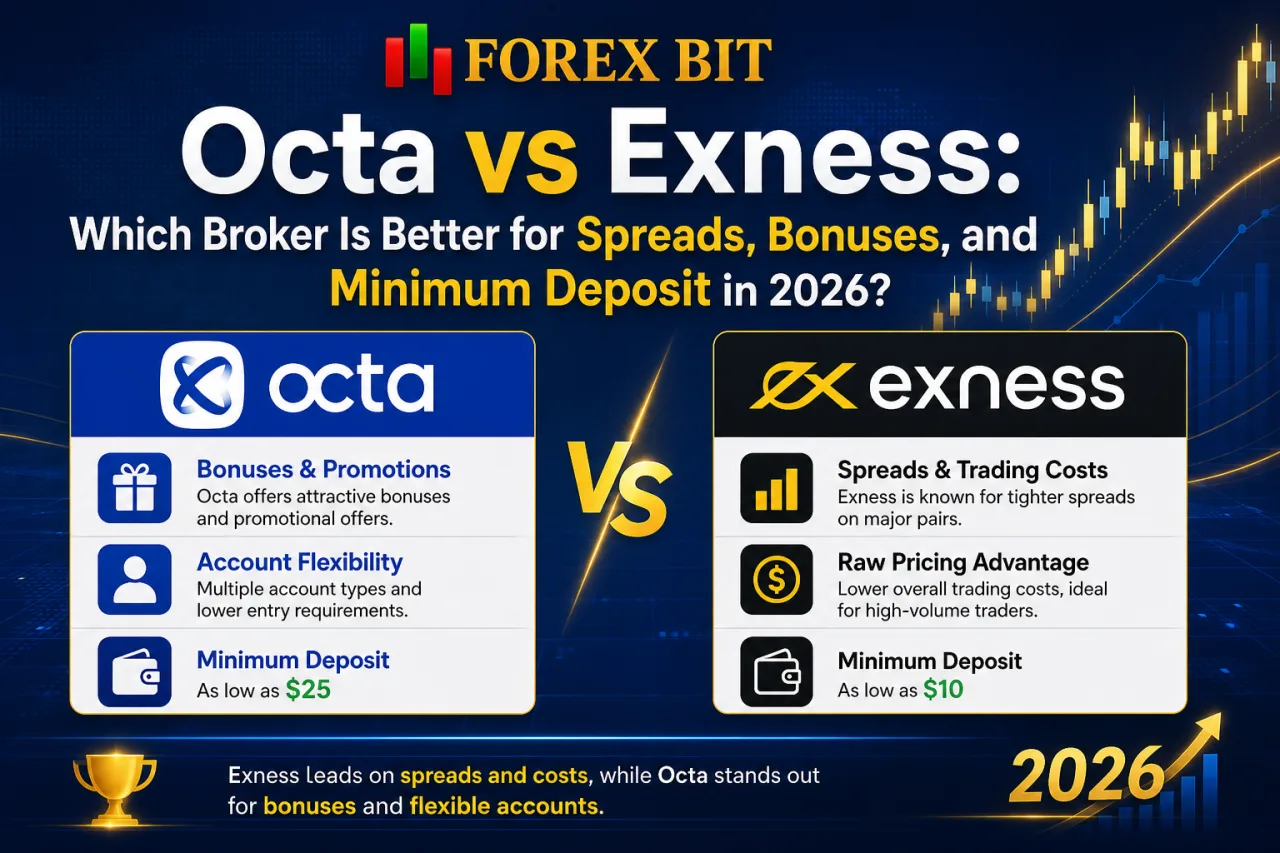
Octa and Exness both operate as regulated forex brokers, with Exness generally holding an edge on raw trading costs while Octa leans on account flexibility and promotional offers.
This comparison narrows in on three factors that most directly affect trading outcomes: spreads, bonuses, and minimum deposit requirements. Exness tends to attract cost-conscious and high-volume traders due to its narrower spread structure on major pairs. Octa appeals more to traders who value promotional incentives and varied account configurations alongside standard trading conditions.
Neither broker holds a universal advantage across every category covered here. The sections below unpack each factor individually, showing where Exness pulls ahead on pricing efficiency and where Octa’s account setup or bonus terms may better fit a different trading approach.
Which Broker Offers Tighter Spreads and Lower Trading Costs, Octa or Exness?
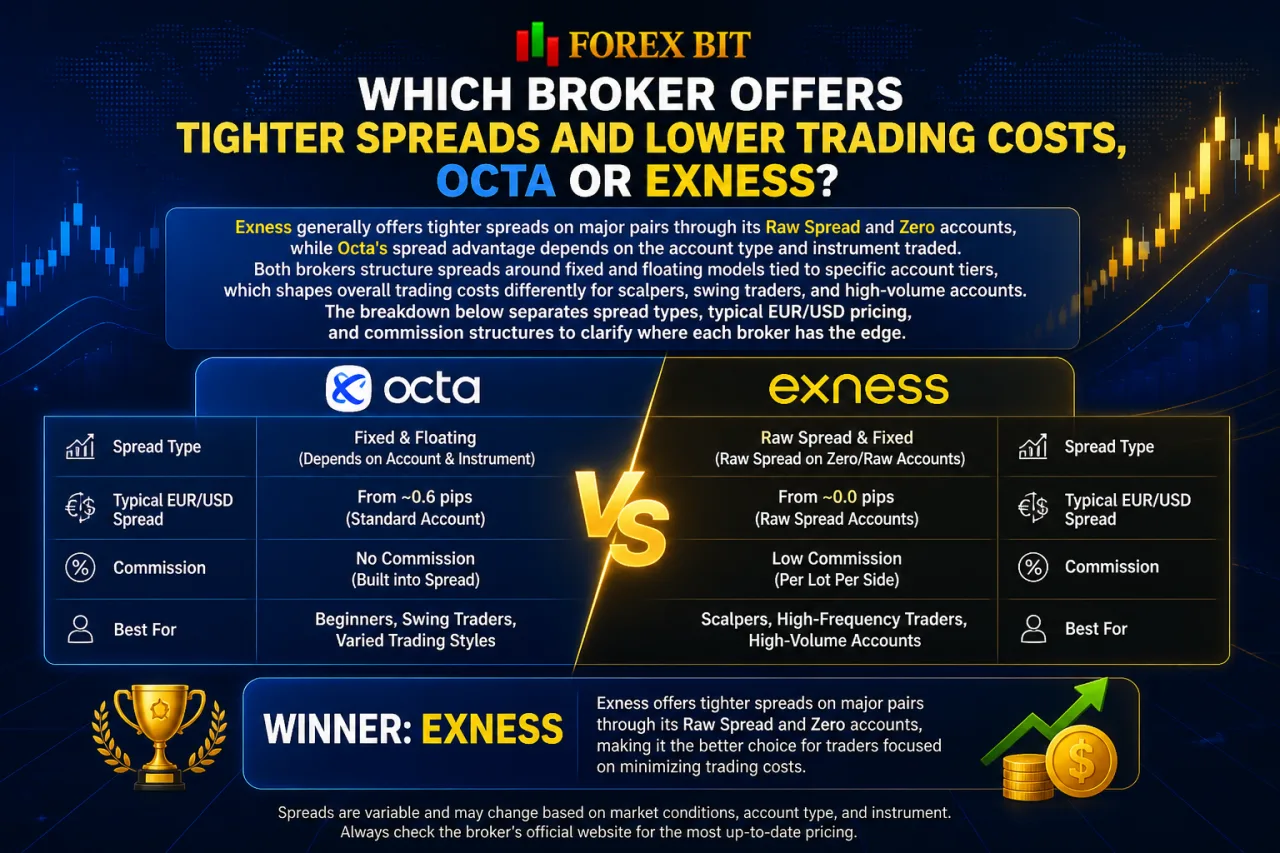
Exness generally offers tighter spreads on major pairs through its Raw Spread and Zero accounts, while Octa’s spread advantage depends on the account type and instrument traded. Both brokers structure spreads around fixed and floating models tied to specific account tiers, which shapes overall trading costs differently for scalpers, swing traders, and high-volume accounts. The breakdown below separates spread types, typical EUR/USD pricing, and commission structures to clarify where each broker stands.
What Spreads Does Octa Offer Across Its Account Types?
Octa structures spreads by account type, generally offering commission-free floating spreads on its Standard-style accounts and tighter raw spreads paired with a per-lot commission on its ECN-style accounts.
This mirrors how spread costs shift depending on which Octa account a trader opens, whether on MT4 or MT5. The commission-free account type suits traders who prefer predictable, all-in pricing without a separate per-trade fee. The ECN-style account instead lowers the raw spread but adds a fixed commission, a structure that generally favors scalpers and high-volume traders who benefit from tighter pricing despite the added fee. Both account types remain available across Octa’s MT4 and MT5 platforms, meaning platform choice does not restrict access to either spread model. The practical difference comes down to whether a trader values simplicity in cost calculation or the lower headline spread that comes with commission-based pricing.
What Spreads Does Exness Offer Across Its Account Types?
Exness structures spreads across its main account types, generally offering commission-free floating spreads on entry-level accounts and tighter raw spreads paired with a per-lot commission on its ECN-style accounts.
This layout answers the question of how Exness spreads shift depending on account choice, mirroring the account-based pricing approach seen with Octa. The Standard and Standard Cent accounts run on a commission-free, floating-spread model, meaning the spread itself covers the broker’s cost without a separate per-lot fee. Raw Spread and Zero accounts instead lower the base spread significantly, sometimes close to zero on major pairs like EUR/USD, but add a fixed commission per lot traded.
This split generally makes Raw Spread and Zero accounts more suitable for scalpers and high-frequency traders who benefit from tighter headline pricing despite the added commission, while Standard-type accounts fit traders who prefer simpler, all-in cost calculation without tracking a separate fee line.
Does Octa or Exness Charge Trading Commissions?
Both Octa and Exness charge trading commissions, but only on their ECN-style accounts, while their commission-free accounts price everything into the spread instead. This split ties directly into the account tiers already outlined for spread pricing above.
Commission policy at both brokers follows the same underlying logic. Octa’s ECN-style account pairs a raw spread with a fixed per-lot commission, while its commission-free account carries no separate fee. Exness mirrors this structure, charging a per-lot commission on Raw Spread and Zero accounts while keeping Standard and Standard Cent accounts commission-free.
This means overall trading cost depends less on which broker a trader picks and more on which account type within that broker gets selected. Traders comparing all-in cost need to add the commission to the raw spread on ECN-style accounts, then weigh that combined figure against the wider, commission-free spread on Standard-type accounts.
What Deposit Bonuses or Promotions Does Each Broker Currently Offer in 2026?
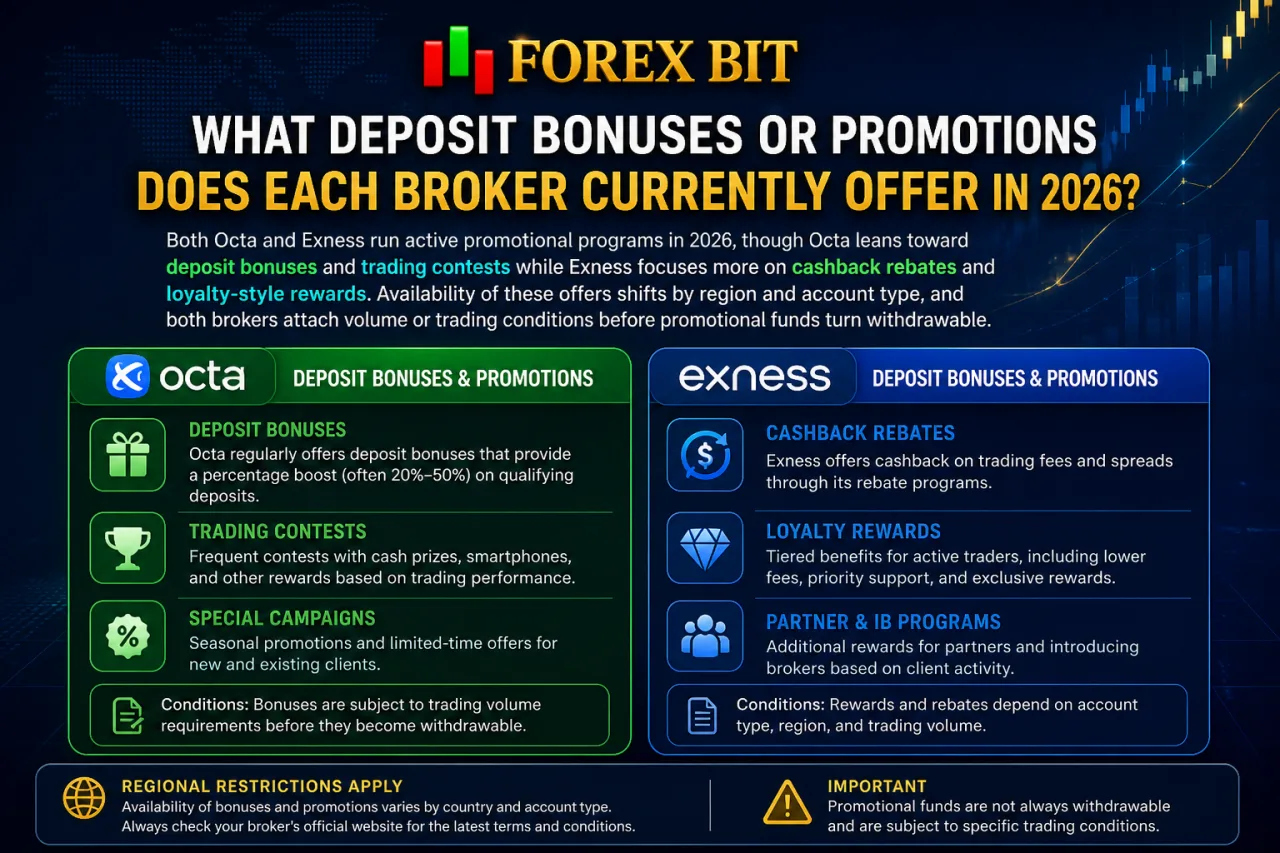
Both Octa and Exness run active promotional programs in 2026, though Octa leans toward deposit bonuses and trading contests while Exness focuses more on cashback rebates and loyalty-style rewards. Availability of these offers shifts by region and account type, and both brokers attach volume or trading conditions before promotional funds turn withdrawable.
The next two sections break down how each broker structures its current bonus offers, along with the regional restrictions that determine who actually qualifies.
What Bonus Programs Does Octa Offer?
Octa’s bonus programs currently center on deposit-based promotions and trading contests, with eligibility tied to account type, region, and minimum trading volume.
This structure directly answers what bonus types Octa runs and how a trader qualifies for each one.
- Deposit bonuses credit extra trading funds based on a percentage of the deposited amount, subject to a required trading volume before withdrawal.
- Trading contests reward top-performing participants ranked by profit or trading volume over a set contest period.
- Cashback-style rebates return a portion of trading costs to eligible accounts based on lot volume traded.
Eligibility for these promotions generally excludes certain regions and restricts participation to specific account types opened directly through Octa’s promotional pages. Traders working with Octa’s ECN-style commission accounts may face different bonus terms than those on its commission-free account, since volume-based conditions interact differently with each pricing structure already outlined for spreads and commissions.
What Bonus Programs Does Exness Offer?
Exness limits deposit bonuses in several regulated jurisdictions, shifting its 2026 promotional focus toward cashback rebates and loyalty-based rewards instead of upfront bonus credits.
This regulatory constraint directly answers what bonus types Exness runs and why its offers look different from Octa’s deposit-based structure.
Exness’s promotional lineup centers on ongoing rebate programs rather than one-time deposit matches:
- Cashback rebates return a portion of spread or commission costs based on lot volume traded, credited on a recurring schedule.
- Loyalty-style rewards scale payouts to account activity and trading tenure rather than deposit size.
- Partner and referral incentives reward introduced clients through volume-linked commission sharing.
Traders under stricter regulatory entities generally see fewer promotional options than those registered under Exness’s offshore entities, where rebate programs remain the primary incentive rather than deposit-matching offers.
Are Octa and Exness Bonuses Available in All Regions?
No, Octa and Exness bonuses are not available in all regions, since regulatory restrictions, account eligibility, and country-specific rules limit which traders can claim these promotions. This regional gap ties directly into the bonus structures already outlined for each broker above.
Several factors narrow eligibility beyond simple availability:
- Regulators in certain jurisdictions prohibit bonus-based incentives outright, removing deposit bonuses for clients registered under those regulated entities.
- Offshore entities at both brokers generally retain broader access to promotions, including deposit bonuses and cashback rebates, than clients under stricter regulatory oversight.
- Account type restricts eligibility further, since ECN-style commission accounts often carry different bonus terms than commission-free accounts.
- Verification requirements exclude unverified accounts from claiming or withdrawing promotional funds until identity checks clear.
Traders confirming eligibility need to check which entity holds their account, since Octa and Exness both operate multiple regulated and offshore entities with separate bonus policies.
What Is the Minimum Deposit Required to Open an Account with Octa vs Exness?
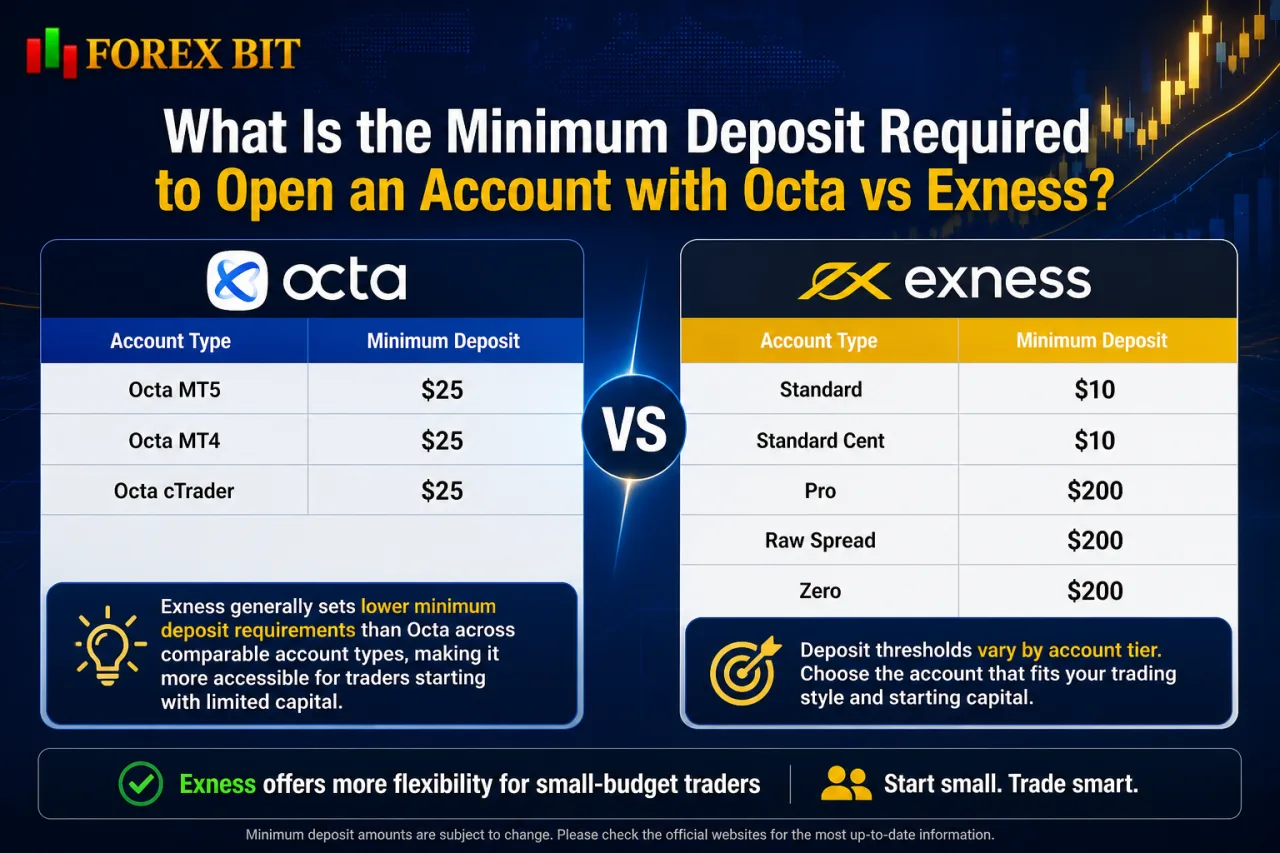
Exness generally sets lower minimum deposit requirements than Octa across comparable account types, making it more accessible for traders starting with limited capital. This gap builds directly on the account tiers already outlined for spreads and commissions, since deposit thresholds shift depending on which Standard-type or ECN-style account a trader selects at each broker. The two sections below break this down by account type and by capital accessibility for small-budget traders.
What Is Octa’s Minimum Deposit by Account Type?
Octa and Exness set different minimum deposit requirements depending on the account type chosen, with Exness generally offering lower entry thresholds than Octa, and within Octa’s own lineup, commission-free accounts generally require a lower entry amount than its ECN-style account.
This directly addresses the minimum deposit tiers tied to the account structure already outlined for spreads and commissions above. Octa’s account lineup breaks down by threshold as follows:
- Commission-free account: lower minimum deposit, aimed at beginner and low-capital traders, with Octa’s commission-free option generally requiring a smaller entry amount than its ECN-style account.
- ECN-style account: higher minimum deposit tied to raw-spread and per-lot commission pricing, generally set above Octa’s commission-free account threshold.
Traders selecting between these tiers weigh the lower entry cost of the commission-free option against the tighter raw spreads available once the higher deposit threshold for the ECN-style account gets met.
What Is Exness’s Minimum Deposit by Account Type?
Exness sets its minimum deposit by account type, with Standard and Standard Cent accounts generally requiring a smaller entry amount and Raw Spread and Zero accounts carrying a higher threshold, while some entities apply no fixed minimum at all.
This mirrors the account-based deposit structure already outlined for Octa above, though Exness’s tiering runs across a wider set of account types tied to different regulated entities.
- Standard and Standard Cent accounts carry a lower entry threshold, and some regulated entities apply no fixed minimum deposit for these account types.
- Raw Spread and Zero accounts generally require a higher minimum deposit tied to their commission-based, tighter-spread pricing.
- Deposit thresholds vary by the regulated entity a trader registers under, since Exness operates multiple licensed and offshore entities with separate account terms.
Traders comparing entry cost against Octa’s tiers need to confirm which Exness entity governs their account, since the no-minimum policy on entry-level accounts does not extend uniformly across every jurisdiction Exness operates in.
Which Broker Is Better Suited for Different Types of Traders?
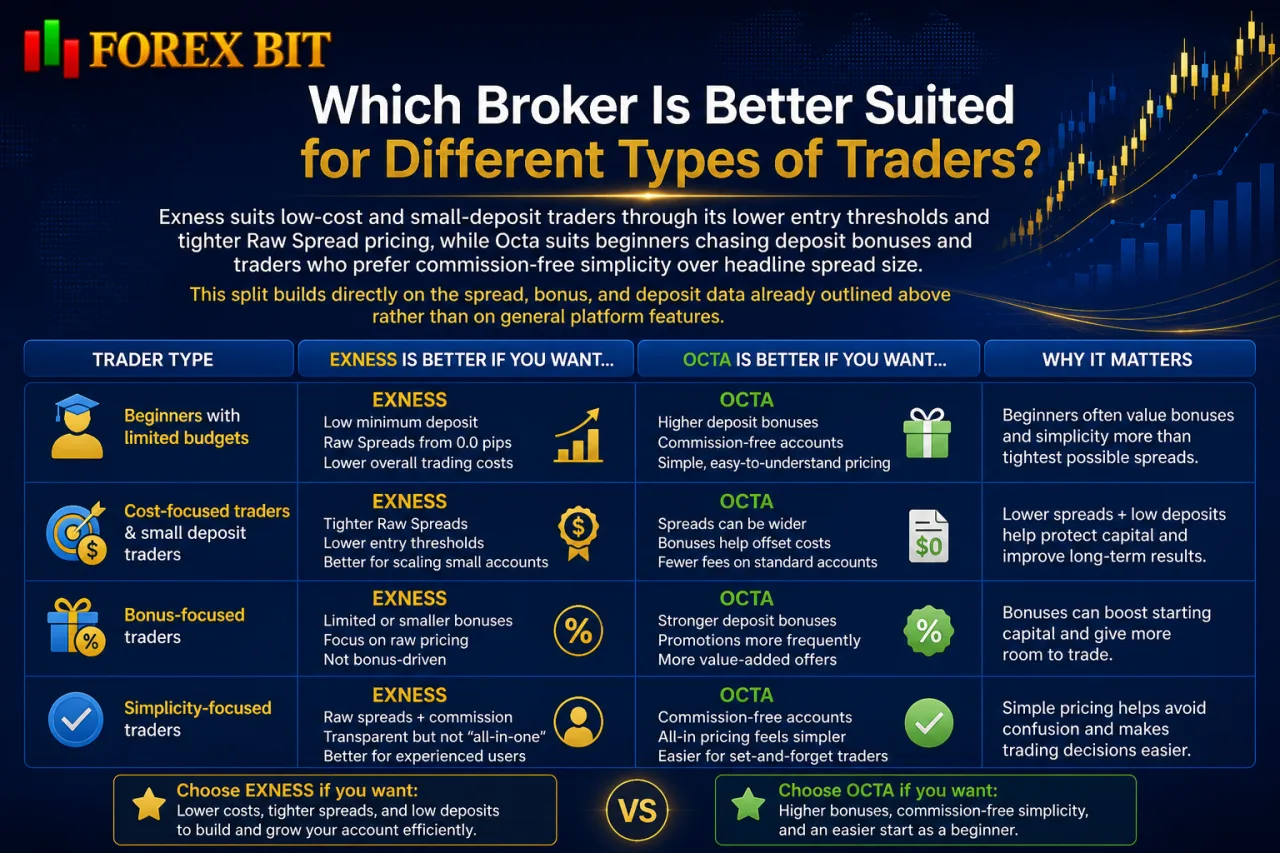
Exness suits low-cost and small-deposit traders through its lower entry thresholds and tighter Raw Spread pricing, while Octa suits beginners chasing deposit bonuses and traders who prefer commission-free simplicity over headline spread size. This split builds directly on the spread, bonus, and deposit data already outlined above rather than on general platform features.
Looking at actual trading styles clarifies this fit further. A day trader opening and closing several positions on major forex pairs within a single session feels the impact of Exness’s Raw Spread pricing directly, since each round-turn commission stacks up quickly across dozens of trades. A swing trader holding positions for days or weeks cares less about per-trade spread size and more about overnight costs and account stability, a scenario where Octa’s commission-free structure and bonus credit add convenience without punishing lower trade frequency.
Matching trader type to broker fit also depends on which factor a trader prioritizes:
- Beginners with limited capital lean toward Exness, since its Standard-type accounts carry a smaller minimum deposit and, in some entities, no fixed minimum at all.
- Scalpers and high-volume traders lean toward Exness’s Raw Spread and Zero accounts, where near-zero headline spreads on major pairs offset the added per-lot commission.
- Bonus-focused traders lean toward Octa, since its deposit-based promotions and trading contests offer more upfront value than Exness’s cashback-and-loyalty model, particularly for traders under Octa’s offshore entities.
- Low-cost, commission-averse traders lean toward Octa’s commission-free account or Exness’s Standard account, both of which price everything into the spread without a separate fee line.
Traders under stricter regulatory entities at either broker generally see fewer bonus options, which shifts the practical fit toward cost-based criteria over promotional value.
What Other Account Protections Support the Cost Structure at Octa and Exness?
Octa and Exness both back their cost structure with negative balance protection and swap-free account options, extending savings beyond spreads and deposit terms already covered above. These two protections shape real trading cost differently than pricing or promotions, since they guard against loss exposure and overnight financing charges rather than headline fees. The sections below separate how each broker applies negative balance protection and structures its swap-free offering.
Do Octa and Exness Offer Negative Balance Protection?
Yes, Octa and Exness both offer negative balance protection, guaranteeing that client accounts cannot fall below zero even after volatile market moves. This protection ties directly into the cost structure already outlined for spreads and commissions, since it caps downside risk regardless of leverage used.
Coverage at both brokers applies primarily under their regulated and offshore entities, with the guarantee automatically resetting any negative balance back to zero.
- Octa: Applies negative balance protection across its retail client accounts, absorbing losses beyond deposited funds rather than passing them to the trader.
- Exness: Applies negative balance protection across its client accounts, aiming to prevent debt exposure from slippage or gapping during high-volatility events. The exact scope of this policy varies by regulated entity and jurisdiction, so traders should confirm the specific terms that apply to their account directly with Exness.
- Fees: Neither broker charges a separate fee for this safeguard, since it functions as a standard account-level policy rather than an optional add-on.
Do Octa and Exness Offer Swap-Free Accounts?
Yes, both Octa and Exness offer swap-free accounts, applying the exemption to eligible clients under specific regional or religious criteria rather than as a default setting. This swap-free option extends the account protections already outlined for negative balance coverage, replacing overnight interest charges with an alternative fee structure.
Eligibility and conditions differ slightly between the two brokers.
- Octa activates swap-free status on request, generally tied to account verification and regional eligibility rather than automatic enrollment.
- Exness applies swap-free trading across eligible account types, though some instruments or holding periods may carry an administrative fee instead of a standard swap charge.
- Both brokers restrict swap-free status from certain high-swap or exotic instruments regardless of account type.
Traders holding positions overnight need to confirm swap-free eligibility directly with each broker, since instrument coverage and verification requirements shift the actual cost savings beyond the spread and commission structure already covered above.
Conclusion
The Octa vs Exness comparison comes down to pricing structure over brand superiority. Exness holds the edge for cost efficiency, with tighter Raw Spread and Zero account pricing plus lower or non-existent minimum deposit thresholds, making it the stronger pick for scalpers, high-volume traders, and beginners with limited starting capital.
Octa counters with stronger deposit-based bonuses and trading contests, favoring traders who value upfront promotional value and commission-free simplicity over headline spread size. Regional and entity-specific restrictions shape bonus access and deposit minimums at both brokers, so confirming account jurisdiction remains essential before final selection between the two.
Michael Smith is a Forex Broker Comparison Specialist at Forex Bit, focusing on comparing brokers, trading platforms, account types, fees, spreads, commissions, and trading conditions. His work helps readers understand the key differences between providers so they can evaluate brokers based on their own trading needs and preferences.
Email: [email protected]


Best Brokers

Trade with the world’s largest retail broker and benefit from better - than - market conditions.

We offer a superior trading environment that puts traders in the best position to profit.

Invest and trade global markets with eToro – a Nasdaq-listed multi-asset platform built around social investing and CopyTrader.

Trade with the best trading conditions. WIN THE BEST TRADING ACCOUNT AWARD.






Forex Bit provides independent forex broker reviews, comparisons, guides, and industry news to help traders make informed decisions.
Best Brokers
Metatrader 5 Brokers
Metatrader 4 Brokers
Lowest Spread Forex Broker
Regulated Forex Brokers
Forex Copy Trading
Ctrader Brokers
Best Forex Broker For Beginners