
Wondering what happens if a forex broker fails? See how fund segregation, compensation schemes & regulation protect your money—and what to do next.
What Happens If a Forex Broker Fails? Trader Guide

When a forex broker fails, client funds and open positions depend on how the broker held money and which regulator oversaw its license. In a well-regulated setup, uninvested cash sits in segregated bank accounts separate from the broker’s operating funds, while open trades are typically closed out or transferred to another broker during insolvency proceedings.
Segregated accounts reduce the risk of client money being used to pay a broker’s debts, but they do not guarantee full recovery of every trader’s balance. Segregation alone cannot cover shortfalls caused by fraud, mismanagement, or losses in the broker’s own trading book.
Traders should immediately gather account statements, trade history, and broker communications, then file a claim with the relevant compensation scheme or insolvency administrator. Acting quickly and being aware of any claim deadline set by the administrator or regulator is critical to recovering eligible funds.
Investor protection after a broker collapse varies significantly by region, with some jurisdictions offering formal compensation schemes and others providing none. Regulators such as the FCA in the UK and CySEC in Cyprus operate investor compensation funds that reimburse eligible clients up to a defined limit if a broker fails, while offshore-licensed entities often leave traders with limited legal recourse.
Traders are advised to check the current compensation limits and eligibility rules directly on the relevant regulator’s official website before relying on any figure. Forex Bit breaks down these regional differences next, starting with exactly what happens to your money and open trades if a forex broker fails.
What Happens to Your Money and Open Trades If a Forex Broker Fails?

Broker failure means the firm enters insolvency, administration, or has its license revoked, triggering an immediate freeze on trading access, withdrawals, and account control. This differs case by case depending on how the platform shut down and where client money was held.
The first sign traders notice is usually a locked trading terminal. From that point, several consequences tend to follow at once:
- Trading platform access gets suspended or restricted by the broker or the appointed administrator.
- Open positions may be force-closed at prevailing market prices or transferred to a receiving broker, depending on the insolvency process.
- Withdrawal requests get frozen until an administrator reviews the broker’s books and client fund records.
- Fund recovery status depends heavily on whether client money sat in a properly segregated account and which regulator oversaw the failed entity.
No single outcome applies to every collapse. A broker regulated in a jurisdiction with strict segregation rules and an active compensation scheme tends to offer a more predictable recovery process. An offshore entity with weak oversight rarely offers the same protection, and clients often have little practical recourse if funds go missing. Traders should treat every insolvency case as unique until an administrator or regulator publishes formal findings.
Are Segregated Client Accounts Enough to Protect Your Funds When a Broker Collapses?
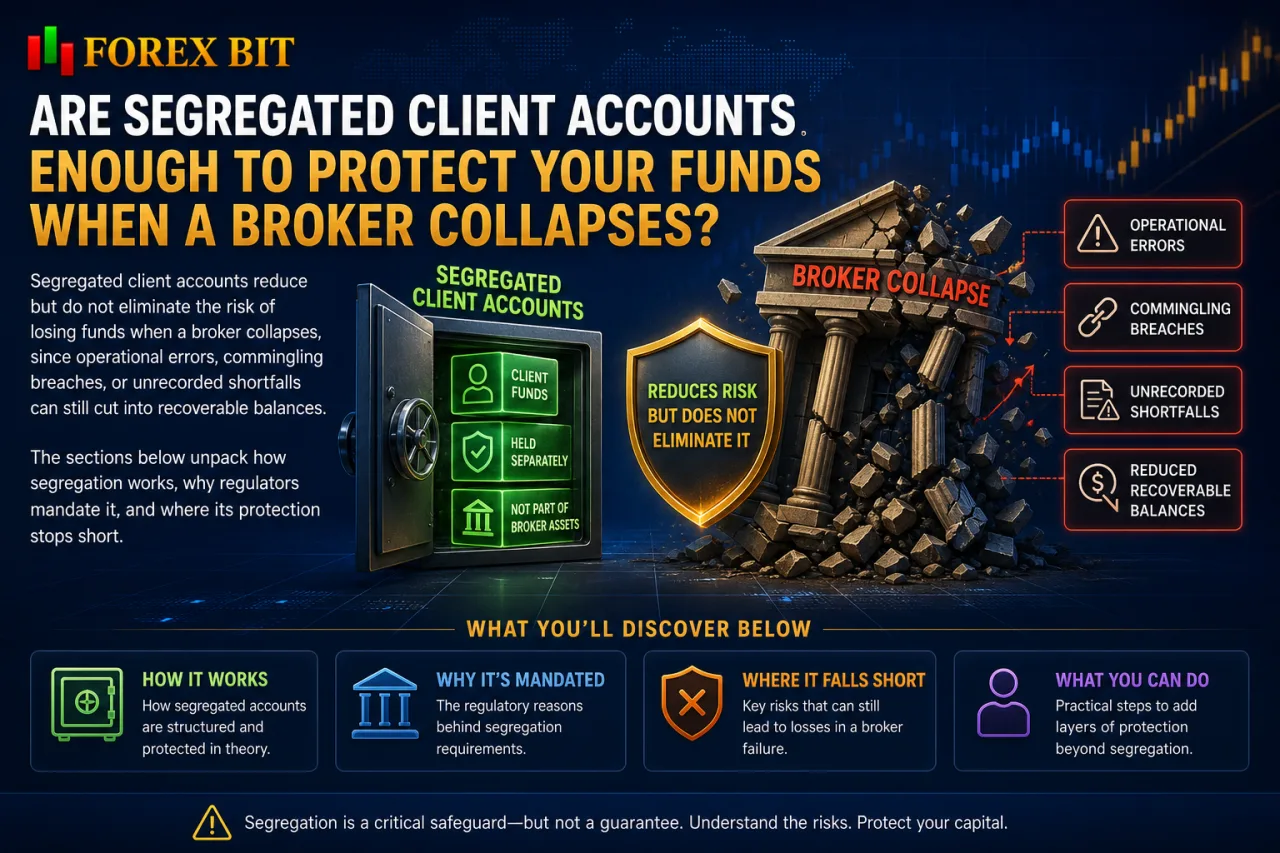
Segregated client accounts reduce but do not eliminate the risk of losing funds when a broker collapses, since operational errors, commingling breaches, or unrecorded shortfalls can still cut into recoverable balances. The sections below unpack how segregation works, why regulators mandate it, and where its protection stops short.
What Is Negative Balance Protection and Does It Still Apply During a Broker Failure?
Negative balance protection is a broker policy that caps a trader’s losses at the account balance, preventing a debit balance beyond deposited funds under normal trading conditions. This mechanism matters for insolvency because its enforcement depends on the broker’s solvency and the entity that issued the protection.
Negative balance protection works during regular market operation because the broker itself absorbs any shortfall between a client’s margin and the actual market price during extreme volatility or slippage. Regulators in the EU and UK impose leverage restrictions on certain licensed entities and generally require negative balance protection for retail clients.
Once a broker enters insolvency, that guarantee becomes uncertain. The administrator manages remaining assets on behalf of creditors, and the broker’s promise to cover negative balances holds no priority over other claims. A trader with a negative balance owed by the broker may find that debt effectively unenforceable, while a trader owed a positive balance still competes with other creditors for recovery through the insolvency process.
What Compensation Schemes Can Reimburse Traders If a Broker Goes Bankrupt?
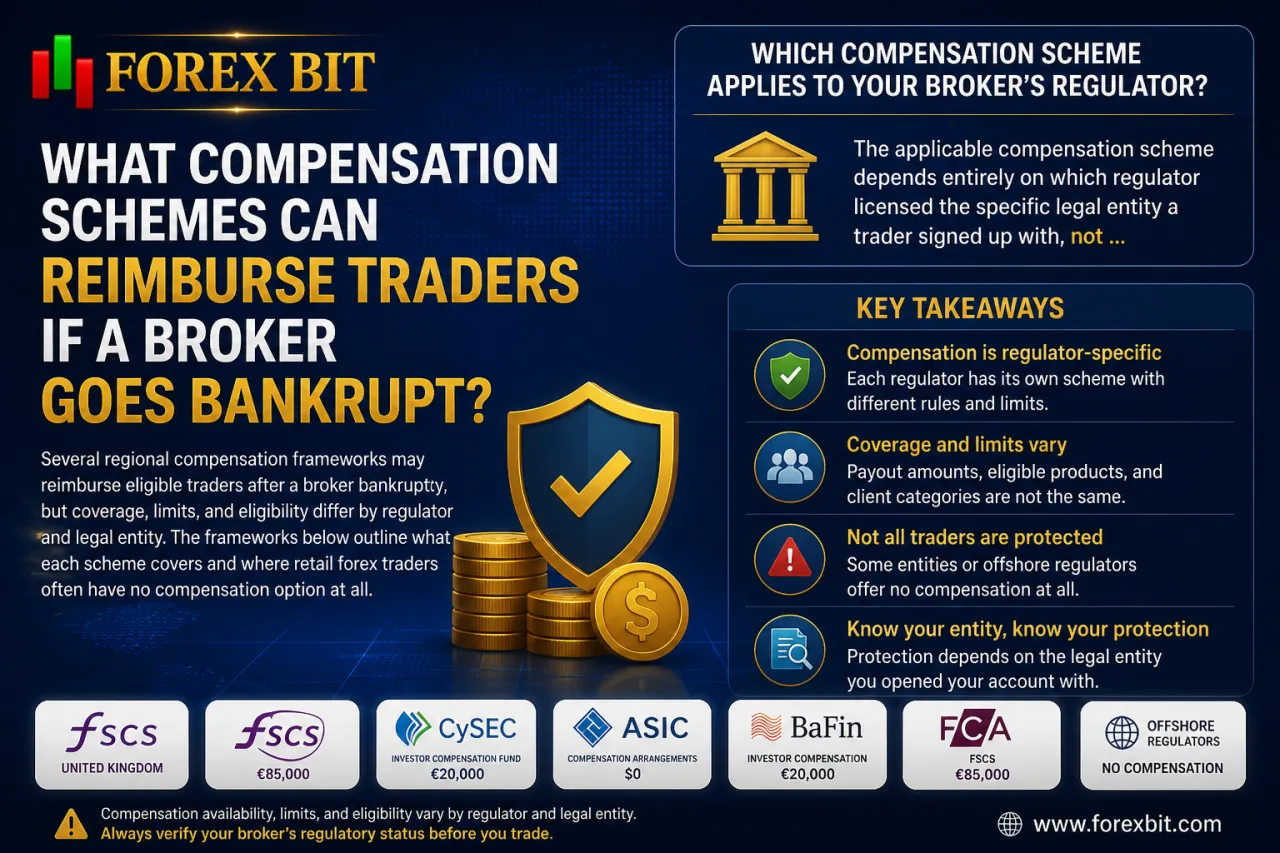
Several regional compensation frameworks may reimburse eligible traders after a broker bankruptcy, but coverage, limits, and eligibility differ by regulator and legal entity. The frameworks below outline what each scheme covers and where retail forex traders often have no compensation option at all.
The applicable compensation scheme depends entirely on which regulator licensed the specific legal entity a trader signed up with, not the broker’s brand name. A single broker group often operates several regulated entities, each falling under a different protection framework.
- The FCA’s Financial Services Compensation Scheme (FSCS) covers eligible UK-regulated clients up to a defined limit if the firm cannot meet its liabilities, though traders should verify the current limit directly with the scheme before relying on it.
- The Investor Compensation Fund (ICF) under CySEC protects eligible Cyprus-regulated clients up to a defined cap per claim, though traders should verify the current limit directly with CySEC before relying on it.
- The SIPC in the United States does not apply to retail forex trading accounts, since its coverage targets securities and cash held with SIPC-member broker-dealers.
- Australia’s National Guarantee Fund covers specific market-related default events and does not extend general compensation to retail forex trading losses.
Many offshore-regulated entities, including those licensed in jurisdictions with minimal oversight, offer no compensation scheme whatsoever, leaving traders reliant solely on the insolvency process to recover funds. Verifying the exact regulator and entity tied to a trading account remains the only way to confirm which, if any, scheme applies.
How Do Compensation Limits and Eligibility Rules Differ Between Regulators?
Compensation limits and eligibility rules differ mainly by coverage cap, client classification, and claims-processing timeline, with each regulator setting its own thresholds independently. This comparison builds on the FCA, CySEC, SIPC, and Australian frameworks already outlined, focusing on how their rules diverge in practice.
Coverage caps set the clearest split between regulators. The FCA and CySEC each publish a maximum reimbursement figure per eligible client, but these caps change over time and traders should confirm current amounts on the regulator’s official site rather than relying on third-party summaries.
Eligibility rules also diverge sharply. Most compensation schemes cover retail clients only, since professional clients are generally classified as capable of assessing risk without the same protective safety net. A trader reclassified as professional to access higher leverage may lose eligibility for compensation entirely, even under an FCA- or CySEC-regulated entity.
Processing timelines vary as well:
- FCA and CySEC schemes follow published administrative procedures once a firm formally fails.
- SIPC and Australia’s National Guarantee Fund do not process retail forex claims, since neither scheme extends to this asset class.
- Offshore-licensed entities offer no comparable claims process, leaving timelines undefined.
Traders should verify caps, eligibility, and timelines directly on each regulator’s official website before assuming coverage applies.
What Should a Trader Do Immediately After a Broker Collapse or Bankruptcy Announcement?
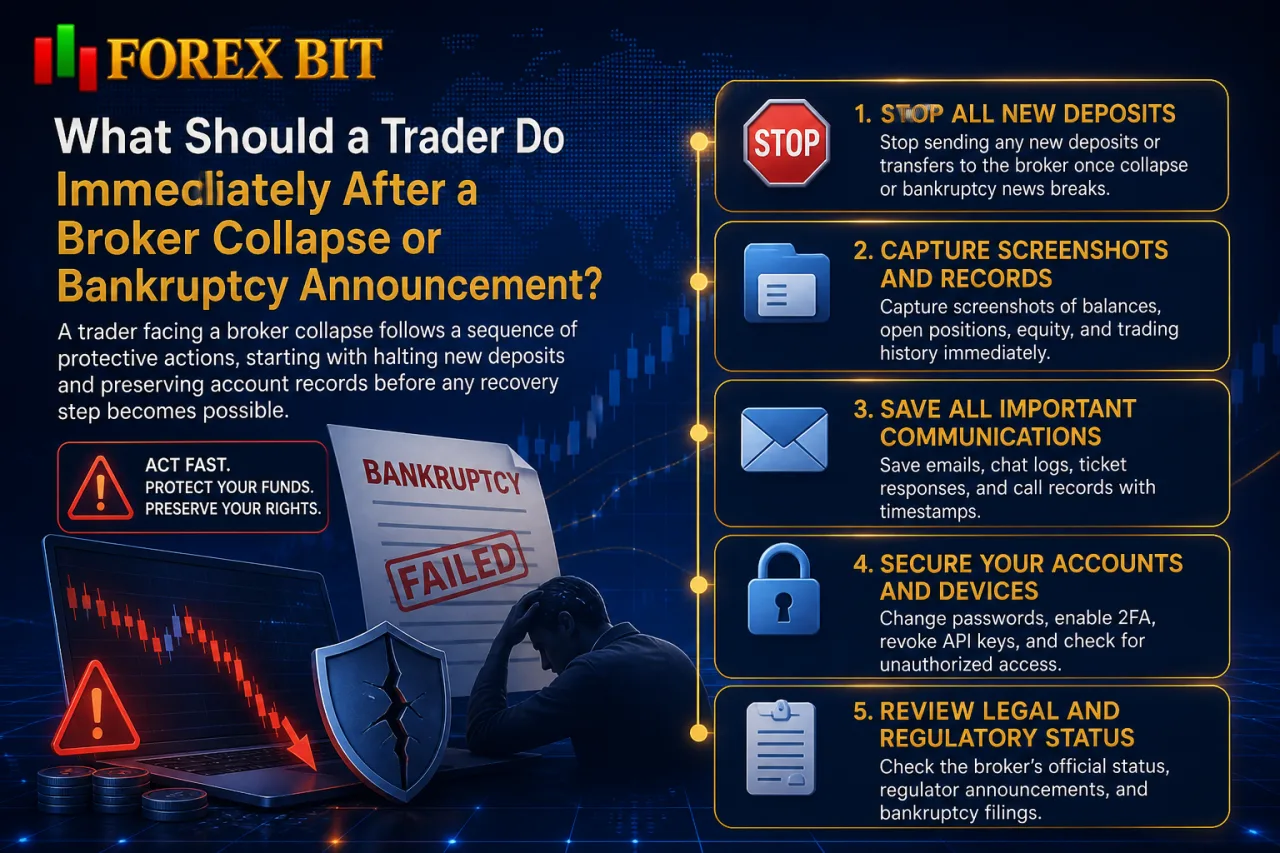
A trader facing a broker collapse follows a sequence of protective actions, starting with halting new deposits and preserving account records before any recovery step becomes possible. Each action below builds on the fund-protection and compensation gaps already outlined, focusing on what a trader controls directly in the hours and days after a collapse or bankruptcy announcement.
- Stop sending any new deposits or transfers to the broker once collapse or bankruptcy news breaks.
- Capture screenshots of account balances, open positions, transaction history, and platform notices before access disappears.
- Submit a withdrawal request regardless of approval likelihood, since the timestamped attempt supports a later claim.
- Contact the licensing regulator directly to confirm the broker’s status and locate the appointed administrator or liquidator.
- File a claim with the relevant compensation scheme immediately if the entity qualifies under a scheme like the FSCS or ICF.
- Check the regulator’s and administrator’s official channels regularly for updates on claims deadlines and fund recovery progress.
- Reject unsolicited offers from third parties claiming to “recover” lost funds for an upfront fee, since these approaches commonly target traders who previously held accounts with failed brokers.
Acting on documentation and official contacts first keeps a trader’s claim position stronger than waiting for the broker to issue guidance.
How Can a Trader Verify the Broker’s Regulatory Status and Legal Entity Before Filing a Claim?
A trader verifies regulatory status by checking which specific legal entity held the trading account, then cross-referencing that entity’s license number on the regulator’s public register. This step matters because a single broker brand often runs several legal entities across different jurisdictions, and only the entity named on the account agreement determines which protections and compensation scheme actually apply.
The verification process runs through a few checks:
- Locate the exact legal entity name printed on account opening documents, trade confirmations, or the broker’s terms and conditions, since this name rarely matches the marketing brand.
- Copy the license number listed on the broker’s website or account statement and search it directly on the regulator’s official public register rather than trusting the broker’s own claims.
- Confirm the register entry shows an active status, matching entity name, and matching license number, since a suspended or revoked license changes the recovery process entirely.
- Identify the jurisdiction tied to that specific entity, since rules on segregation, negative balance protection, and compensation eligibility differ by regulator.
Traders who signed up with an offshore entity of a multi-license broker group often find no compensation scheme applies, even if the same brand holds an FCA or CySEC license elsewhere. Filing a claim against the wrong entity or regulator wastes time an administrator’s claim deadline does not allow.
How Does Investor Protection Differ Across Regulatory Regions When a Broker Fails?
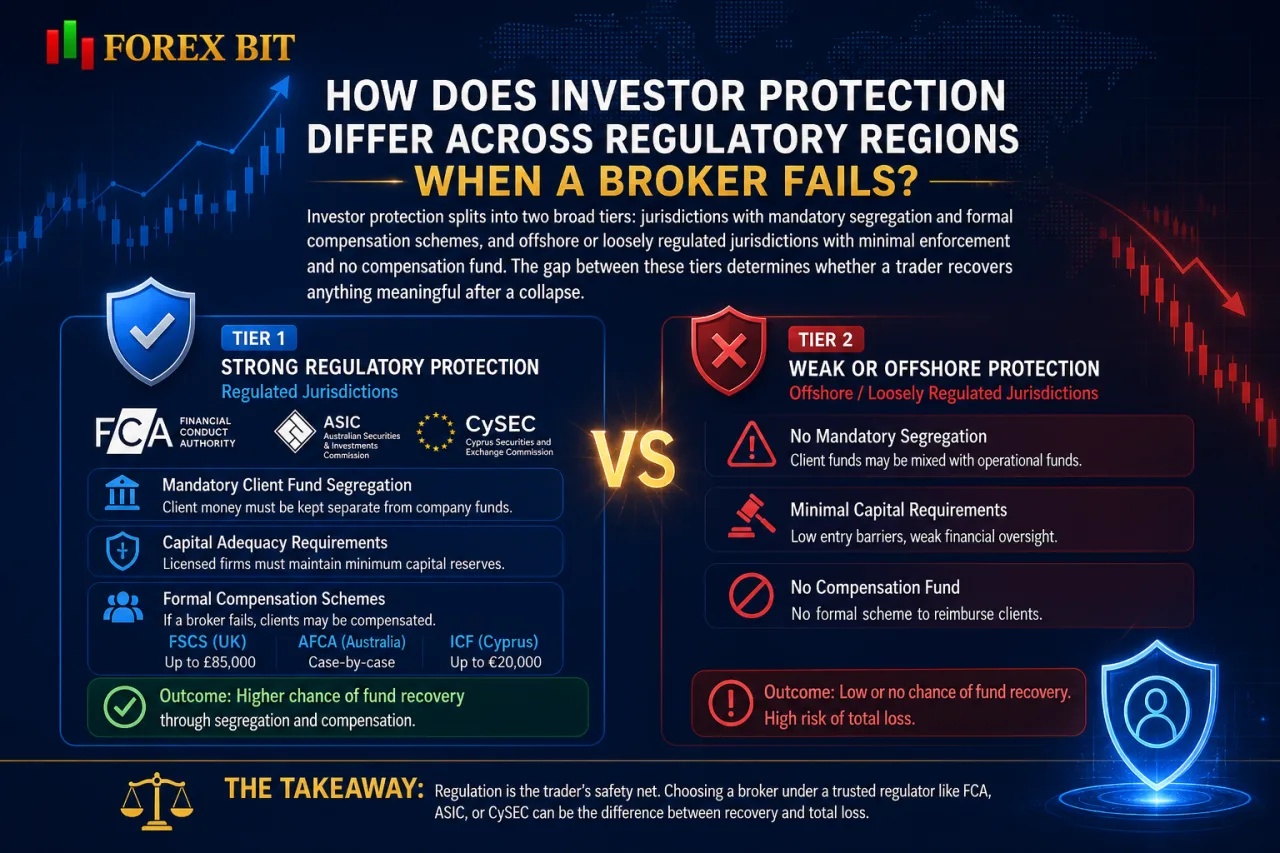
Investor protection splits into two broad tiers: jurisdictions with mandatory segregation and formal compensation schemes, and offshore or loosely regulated jurisdictions with minimal enforcement and no compensation fund. The gap between these tiers determines whether a trader recovers anything meaningful after a collapse.
Regulators such as the FCA, ASIC, and CySEC operating under ESMA-aligned standards require client fund segregation, impose capital adequacy rules on licensed firms, and back their oversight with a compensation scheme covering eligible retail clients. These regulators also conduct periodic audits and enforce reporting obligations that can give an administrator usable records when a broker fails.
Offshore registrations in some Caribbean or Pacific island jurisdictions operate under a different posture entirely:
- Impose lighter capital and reporting requirements on registered entities.
- Skip mandatory segregation enforcement in practice, even where rules exist on paper.
- Offer no investor compensation fund for retail forex clients.
- Provide little regulatory follow-through once a firm stops responding to client requests.
A single broker group commonly registers multiple entities across both tiers, so the protection a trader gets depends entirely on which entity holds the account, not the parent brand’s reputation.
What Rare but Important Scenarios Can Complicate Fund Recovery After a Broker Failure?
Fund recovery gets complicated by a set of uncommon but recurring scenarios: cross-border jurisdiction conflicts, liquidity provider defaults, ongoing fraud investigations, and pre-collapse misuse of segregated funds. Each scenario slows or reduces recovery differently, and the sections below cover how these rare complications play out for traders.
Can Traders Recover Funds Faster by Using a Class Action or Group Claim?
Group or class claims sometimes speed up an administrator’s response, but this outcome depends entirely on the insolvency framework of the jurisdiction where the broker’s legal entity is registered. This is not a guaranteed path to faster recovery, and the mechanism itself connects directly to the fund-recovery gaps already outlined for offshore versus regulated entities.
Collective action carries real trade-offs traders weigh before joining one:
- Consolidates fragmented individual claims into a single filing, which can push an administrator to prioritize review of that group over scattered single-client requests.
- Depends on whether the jurisdiction’s insolvency law even recognizes collective creditor claims for retail forex clients, since some regimes only process individual claims.
- Requires shared legal costs among claimants, reducing individual expense but adding coordination time before filing.
- Offers no fixed timeline or guaranteed payout increase over filing individually.
Traders considering this route should consult a licensed attorney familiar with the specific jurisdiction’s insolvency process before joining or organizing a group claim.
Conclusion
A forex broker failure locks trading access, freezes withdrawals, and puts recovery in the hands of an administrator, with outcomes shaped by how strictly the licensing regulator enforced segregation and whether a compensation scheme like the FSCS or ICF backs that entity. Offshore-registered entities within the same broker group often leave clients without any comparable safety net.
The path to recovering eligible funds runs through documented evidence, prompt claims to the correct regulator, and confirmation of the exact legal entity tied to the account, since brand reputation carries no weight in an insolvency proceeding. Verifying that entity before trouble starts remains the strongest protection available.
Isabella Brown is the Forex Trading Guide Manager at Forex Bit, focusing on educational content about broker safety, trading costs, account types, platforms, and key Forex/CFD concepts. Her work helps readers understand trading terms, broker conditions, and practical checks before evaluating or using a brokerage service.
Email: [email protected]



Best Brokers

Trade with the world’s largest retail broker and benefit from better - than - market conditions.

We offer a superior trading environment that puts traders in the best position to profit.

Trade with the best trading conditions. WIN THE BEST TRADING ACCOUNT AWARD.

Trade global markets with Interactive Brokers – a highly regulated multi-asset broker built for active and professional investors.






Forex Bit provides independent forex broker reviews, comparisons, guides, and industry news to help traders make informed decisions.
Best Brokers
Metatrader 5 Brokers
Metatrader 4 Brokers
Lowest Spread Forex Broker
Regulated Forex Brokers
Forex Copy Trading
Ctrader Brokers
Best Forex Broker For Beginners