
Curious about ASIC CFD refunds? Discover which brokers are affected, why refunds were ordered, and how eligible traders can claim compensation.
ASIC CFD Refunds: What Traders Need to Know Now

Traders can check CFD refund eligibility by reviewing any notification emails from their broker or contacting the broker directly to confirm their account status. These notifications typically outline the specific trading period and account activity that qualifies for compensation.
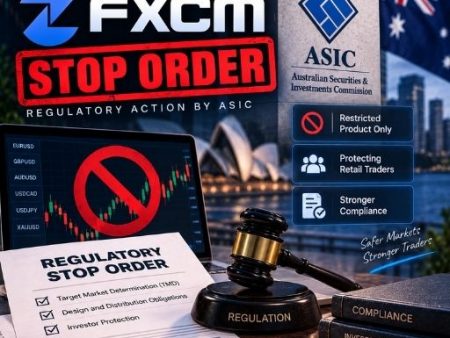
ASIC ordered CFD refunds after finding that certain brokers breached obligations related to the design and distribution of CFD products. The regulator determined that affected clients were sold products inconsistent with their financial objectives or risk profile.
Some brokers have faced refund actions tied to CFD compliance failures. The list of affected firms and account numbers is updated as ASIC completes its review of individual cases.
The CFD refund process generally involves broker notification, client verification, and a payment window determined by the specific enforcement action. Traders who believe they qualify but have not received communication are encouraged to contact their broker’s compliance team.
Understanding these refund mechanisms starts with a clear picture of what ASIC CFD refunds actually cover and how they apply to individual trading accounts. Forex Bit breaks down this framework below, beginning with what ASIC CFD refunds are.
What Are ASIC CFD Refunds?
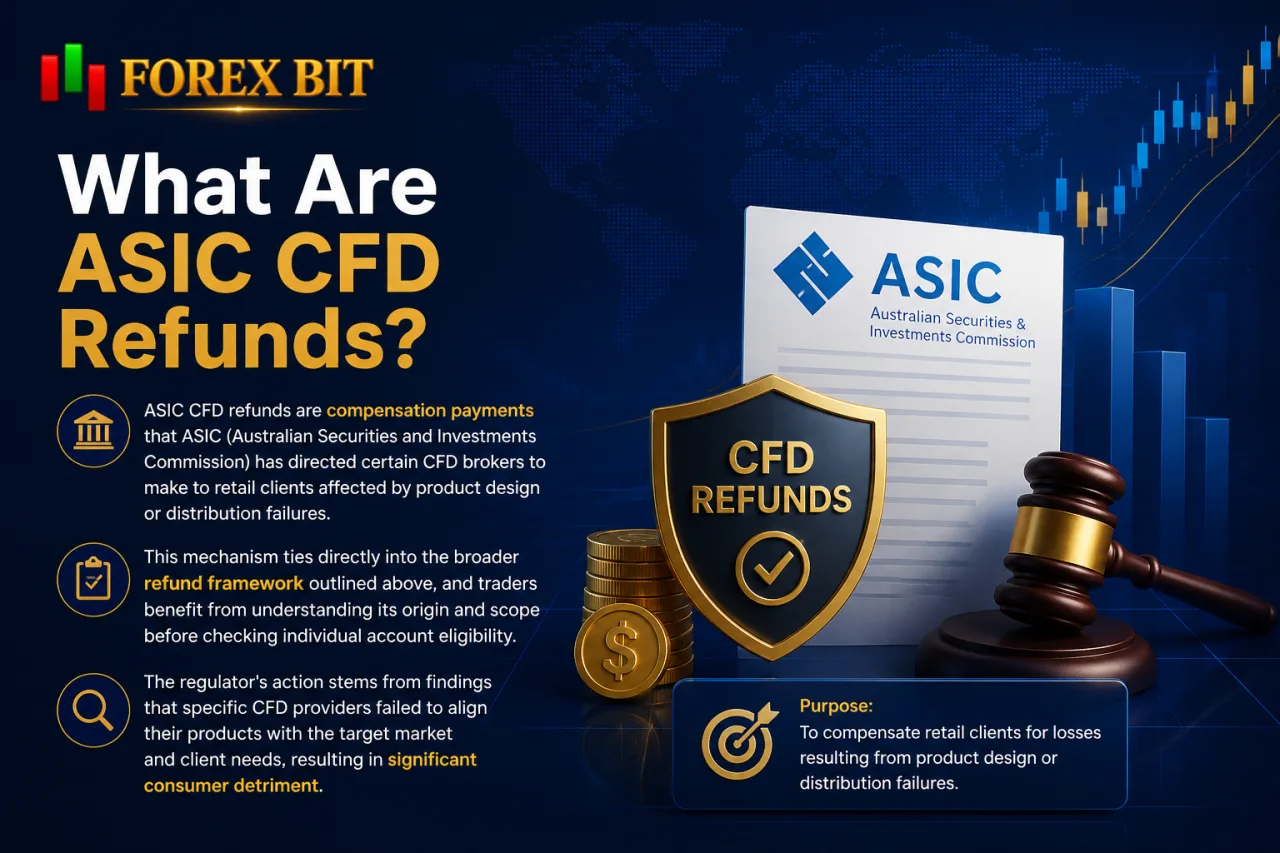
ASIC CFD refunds are compensation payments that ASIC (Australian Securities and Investments Commission) has directed certain CFD brokers to make to retail clients affected by product design or distribution failures. This mechanism ties directly into the broader refund framework outlined above, and traders benefit from understanding its origin and scope before checking individual account eligibility.
The regulator’s action stems from findings that specific CFD providers failed to align their products with the design and distribution obligations introduced for retail derivatives issuers. These obligations require brokers to define an appropriate target market for CFD products and restrict distribution to clients who fit that profile. In practice, this means brokers are expected to:
- Define a clear target market for each CFD product based on client risk profile and trading experience.
- Restrict distribution so that CFDs are not sold to clients outside that defined target market.
- Review and adjust distribution practices when a mismatch between the product and the client base is identified.
When brokers were found to have sold CFDs outside these boundaries, ASIC required remediation for the clients involved. This became a point of active concern for Australian traders as ASIC increased scrutiny of leveraged retail products. Not every account holder automatically qualifies for a refund, and outcomes depend on each broker’s specific compliance findings.
Why Did ASIC Order CFD Refunds to Traders?
ASIC ordered CFD refunds after identifying specific regulatory breaches tied to how brokers designed, disclosed, and managed CFD products for retail clients. These breaches connect directly to the design and distribution failures described above, and they explain why remediation became mandatory rather than optional for the brokers involved.
The enforcement action followed findings across several compliance areas rather than a single failure. Regulatory reviews identified the following issues:
- Inadequate risk disclosure, where clients were not given clear information about potential losses linked to leveraged CFD positions.
- Misclassified client risk profiles, placing traders into target markets that did not match their actual financial circumstances or objectives.
- Weak leverage and margin close-out practices that failed to protect clients from outsized losses during volatile market conditions.
These combined failures triggered ASIC enforcement because they violated design and distribution obligations meant to prevent unsuitable retail clients from accessing high-risk leveraged products.
For traders, this means refund eligibility often traces back to one or more of these documented compliance gaps rather than a general dissatisfaction with trading outcomes.
Is This Refund Action Legally Binding on Brokers?
Yes, ASIC’s CFD remediation action is legally binding on brokers, enforced through statutory powers under the Corporations Act rather than voluntary guidance. This legal weight connects directly to the compliance breaches described above, since ASIC does not merely recommend remediation but formally requires it once a design and distribution failure is confirmed.
Several mechanisms give this action binding force. ASIC typically relies on enforceable undertakings, formal agreements in which a broker commits to specific remediation steps, including client refunds, under ASIC’s ongoing supervision. Breaching an enforceable undertaking can expose a broker to further regulatory action, including court proceedings.
ASIC also holds direct intervention powers over CFD product distribution, allowing it to impose conditions or restrictions on non-compliant brokers. Past enforcement cases involving retail derivatives issuers have established precedent for this approach, reinforcing that once ASIC directs remediation, compliance is a legal obligation rather than a discretionary business decision.
For traders, this framework means eligible refunds are not dependent on broker goodwill, since the obligation to pay stems from regulatory enforcement.
How Do You Check Eligibility for an ASIC CFD Refund?
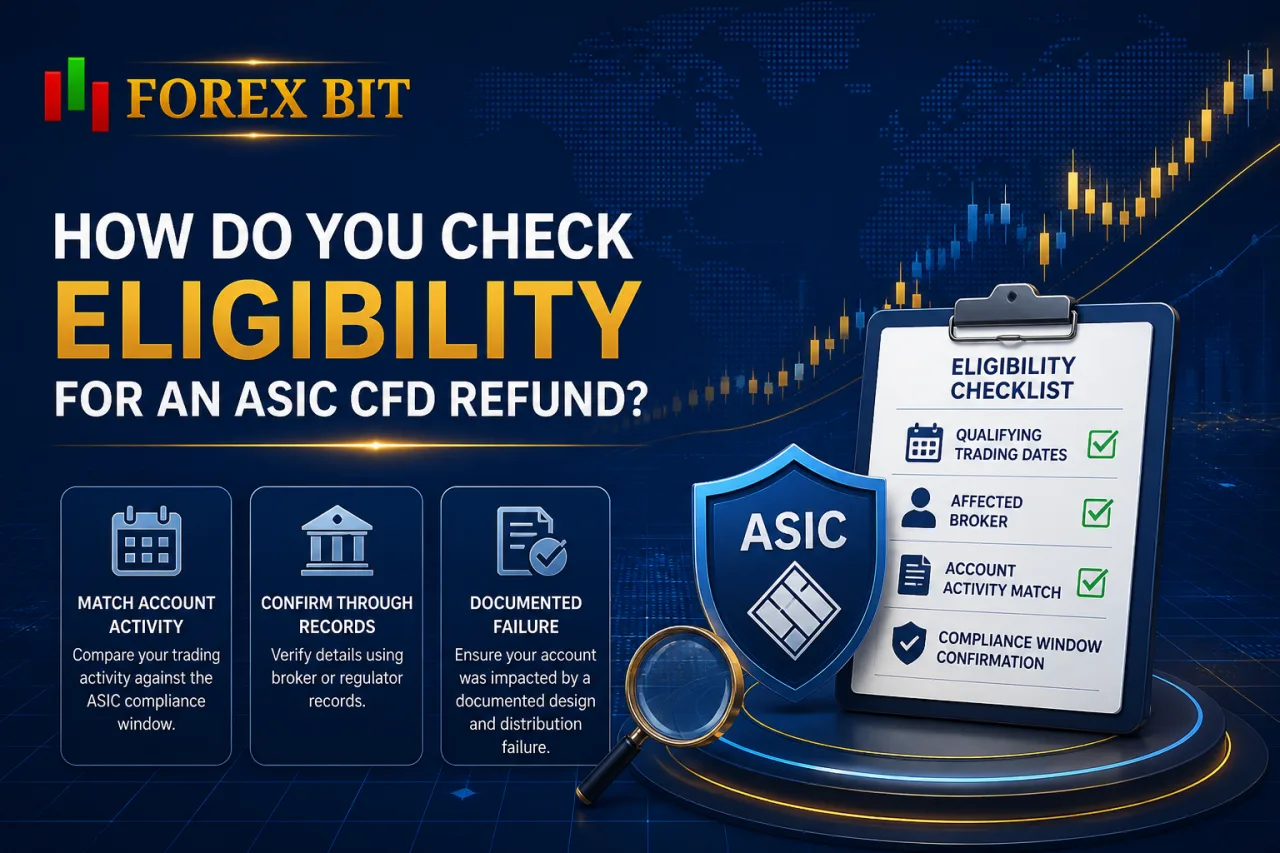
Traders check eligibility for an ASIC CFD refund by matching their account activity against a specific compliance window, then confirming through broker or regulator records. This process builds on the enforcement framework described above, where remediation applies only to accounts affected by a documented design and distribution failure.
Eligibility depends on several linked factors rather than a single check. The sections below walk through the trading dates that qualify, how affected broker accounts are identified, why retail versus wholesale classification matters, and how traders confirm their status through official channels.
What Documents or Records Do You Need to Confirm Eligibility?
Traders confirm ASIC CFD refund eligibility with four core records: trading statements, account opening dates, client agreements, and broker correspondence. These documents connect directly to the confirmation process described above, since brokers and ASIC rely on them to match an account against a specific enforcement finding rather than a general complaint.
Each document serves a distinct verification purpose:
- Trading statements confirm the exact positions and dates a client held CFD products during the affected period.
- Account opening dates establish whether the account existed within the timeframe covered by the remediation order.
- Client agreements show which product disclosure statement and target market determination applied at the time of trading.
- Correspondence records, including onboarding emails and risk profile questionnaires, verify how the client was classified when the account was opened.
Traders who retain these records typically resolve eligibility questions faster, since brokers cross-check submitted documents against internal compliance data before confirming a refund amount. Missing records do not automatically disqualify a claim, though brokers may request additional verification before processing payment.
Are Both Retail and Wholesale Clients Eligible for Refunds?
No, ASIC’s CFD remediation generally covers retail clients only, while wholesale or sophisticated investors typically fall outside the scope of refund eligibility. This distinction connects directly to the design and distribution obligations described above, since those rules were built specifically to protect retail investors from unsuitable leveraged products.
Three factors explain why the classification matters for eligibility.
- Retail clients receive product disclosure statements and target market determinations, documents that wholesale clients are not legally required to receive.
- Wholesale classification, typically based on asset thresholds or professional investor status, removes many of the consumer protection obligations that triggered the original enforcement action.
- Brokers assess client classification at account opening, so a trader’s status during the affected trading period determines whether the account falls within the remediation.
Traders uncertain about their classification confirm status through the client agreement or onboarding records referenced earlier, since reclassification after the fact does not change historical eligibility.
Which Brokers Are Affected by ASIC CFD Refund Actions?
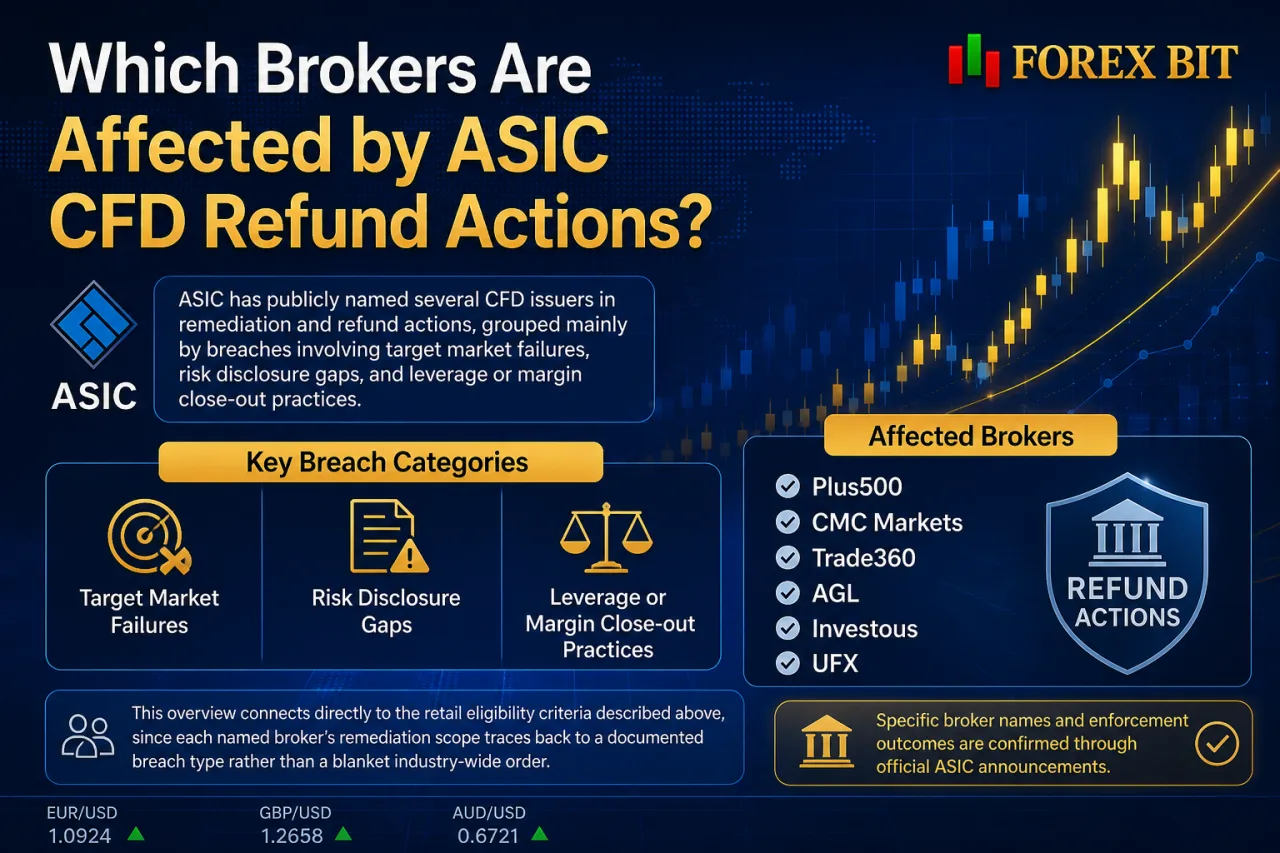
ASIC has publicly named several CFD issuers in remediation and refund actions, grouped mainly by breaches involving target market failures, risk disclosure gaps, and leverage or margin close-out practices. This overview connects directly to the retail eligibility criteria described above, since each named broker’s remediation scope traces back to a documented breach type rather than a blanket industry-wide order.
[[CẦN_DẪN_CHỨNG: list of specific CFD issuer names publicly identified by ASIC in remediation or refund actions, with corresponding ASIC media release reference numbers or links]]
Specific broker names and enforcement outcomes are confirmed through official ASIC media releases, and traders verifying an affected firm reference those official statements rather than secondhand summaries.
Breach groupings generally fall into a few recurring categories:
- Target market misalignment, where clients outside the defined retail profile received CFD access.
- Inadequate risk disclosure, where loss potential was not clearly communicated before account activation.
- Margin and leverage management failures, where close-out settings did not limit client losses during volatile conditions.
Traders confirming whether their broker appears on ASIC’s list check the regulator’s enforceable undertakings register directly, since this record reflects the most current status of each named firm’s remediation progress.
What Specific Breaches Were Found at Each Affected Broker?
Breach types differ by broker, falling into three recurring categories: target market failures, disclosure gaps, and margin close-out or leverage management deficiencies. This categorization follows directly from the breach groupings described above, since ASIC’s remediation actions treat each firm’s compliance failure as a distinct finding rather than a single industry-wide fault.
Reviewing named firms individually clarifies why refund scope varies across brokers.
- Target market breaches occur when a broker’s distribution practices allowed retail clients outside the defined risk profile to access CFD products.
- Disclosure breaches occur when a broker failed to communicate loss potential clearly before a client opened a leveraged position.
- Margin and leverage breaches occur when a broker’s close-out settings did not trigger in time to limit client losses during volatile trading conditions.
Traders confirming which category applies to a specific broker should check that firm’s individual enforceable undertaking, since ASIC publishes breach details separately for each named issuer rather than in a single combined report. This distinction matters because a client’s eligibility and refund basis depend on the exact breach type documented against the broker holding their account, not on breaches recorded against other firms in the same enforcement wave.
How Long Does It Take to Receive a CFD Refund from an ASIC Action?
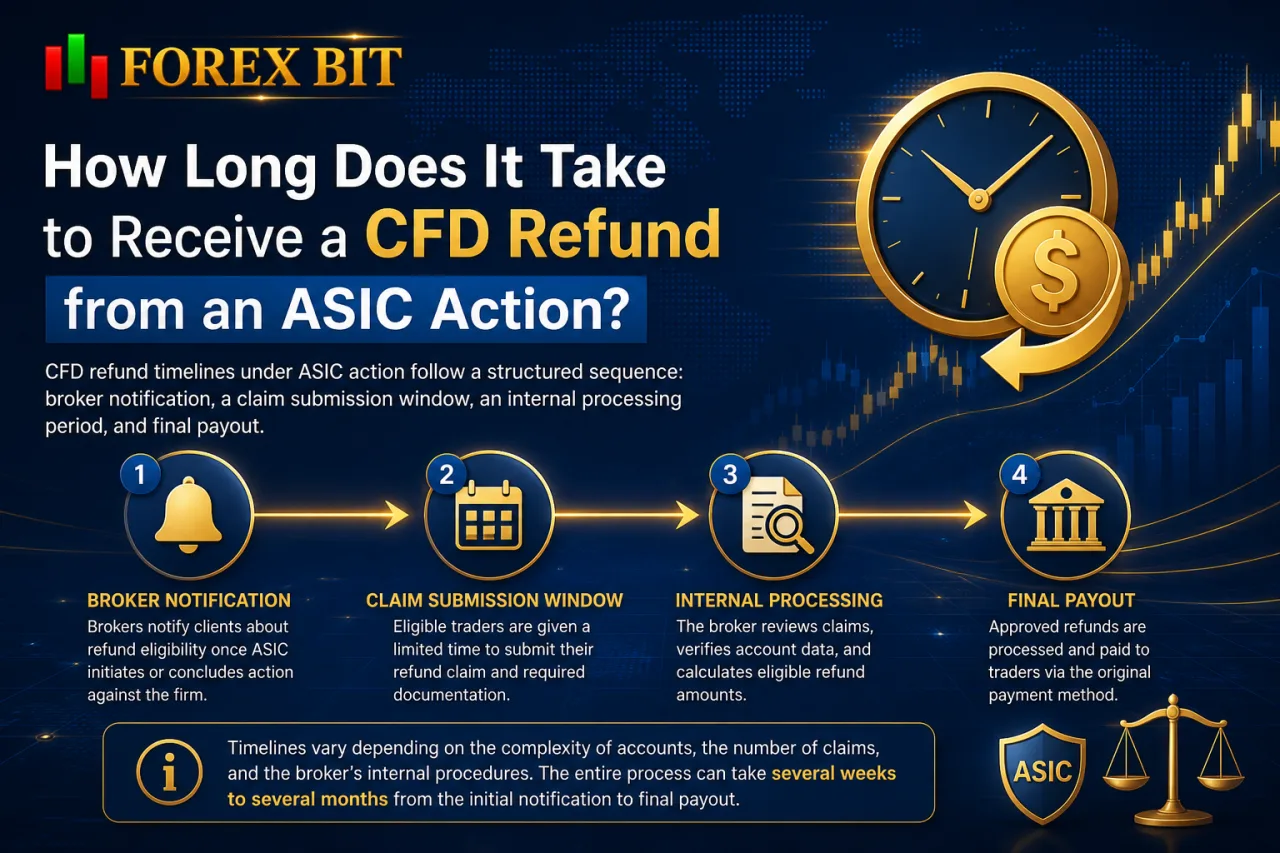
CFD refund timelines under ASIC action follow a structured sequence: broker notification, a claim submission window, an internal processing period, and final payout. Each stage depends on the compliance window already confirmed against a trader’s account.
The sequence generally breaks down into these phases:
- Notification. Brokers notify clients about ASIC CFD refund eligibility once the enforceable undertaking or remediation program is finalized, typically through direct email or account correspondence. This marks the formal starting point of the refund timeline for an individual account. Exact notification dates vary by broker and depend on when each firm completed its internal remediation review.
- Claim submission window. The length of this window is set individually by each broker’s remediation program, agreed with ASIC as part of the enforceable undertaking. The submission period only opens once a client has been formally identified as eligible. No single fixed duration applies across all brokers, as ASIC does not mandate one universal payout timeframe for every CFD remediation case.
Traders who suspect eligibility but received no notice contact their broker’s compliance team directly rather than waiting indefinitely, since notification triggers the claim submission window that follows.
Traders confirm their specific deadline through the notification communication itself, since this document typically states the exact submission and processing dates that apply to their account.
What Are the Steps in the ASIC CFD Refund Claim Process?
The ASIC CFD refund claim process follows five steps: notification, verification, claim submission, broker calculation, and payment. This sequence maps out what happens from the moment a broker flags an account through to the final payout.
- Receive notification from the broker confirming inclusion in the remediation program, typically sent by email or account correspondence.
- Verify account details against trading statements, account opening dates, and client agreements to confirm the trading period matches the compliance window.
- Submit the claim or response within the deadline stated in the broker’s notification, including any requested supporting documents.
- Await the broker’s internal calculation, where the firm determines the refund amount based on documented losses tied to the breach.
- Receive payment once the broker finalizes the calculation and processes the transfer under the terms of its enforceable undertaking.
Brokers set the exact timeframe for each step individually. ASIC does not mandate a single uniform schedule across all remediation programs. Traders who miss a submission deadline contact the broker’s compliance team directly to confirm whether a late claim can still be processed.
What Should You Do If You Haven’t Been Contacted But Believe You Qualify?
Traders who believe they qualify but have not received notification contact their broker’s compliance team directly, then escalate to ASIC or AFCA if the broker does not respond. This proactive step addresses the notification gap described earlier, since remediation programs rely on broker records that can occasionally miss an eligible account.
Two escalation paths apply depending on the response received.
- Contacting the broker first, requesting written confirmation of whether the account falls within the compliance window and remediation scope.
- Requesting a case reference number and expected response timeframe to track the inquiry.
- Lodging a complaint with the Australian Financial Complaints Authority (AFCA) if the broker fails to respond or disputes eligibility without clear justification.
- Reporting the concern to ASIC directly through its official complaint channel if the broker or AFCA process does not resolve the matter.
Traders retain copies of all correspondence sent during this process, since these records support any later complaint filed with AFCA or ASIC. Missed accounts are not automatically excluded from remediation, though resolution depends on the trader raising the issue rather than waiting for further broker outreach.
What Rare Scenarios Can Complicate an ASIC CFD Refund Claim?
Several edge cases complicate an ASIC CFD refund claim: closed accounts, overseas relocation, joint ownership, and broker administration. Each scenario shifts how eligibility gets verified or how payment reaches the client, extending the standard notification and payout process described earlier. The situations below outline how each edge case affects a claim.
Closed trading accounts do not automatically remove refund eligibility, since remediation applies to the trading period rather than the account’s current status. Brokers still rely on historical records to confirm whether the closed account traded within the compliance window.
Traders who have since moved overseas remain eligible, though brokers may request updated identification or banking details to complete payment. Cross-border transfers can extend processing time depending on the receiving bank.
Joint ownership accounts require agreement or verification from all named holders before a broker releases refund funds. This mirrors the client agreement checks described earlier, since ownership records determine who receives payment.
Brokers that entered administration or liquidation before completing remediation shift refund responsibility toward the appointed administrator or liquidator. In these cases, affected clients pursue their claim through the insolvency process rather than the broker’s original compliance team, since the enforceable undertaking may no longer be enforceable against a dissolved entity.
What Happens If the Broker Becomes Insolvent Before Paying Refunds?
Broker insolvency shifts refund responsibility away from the original compliance team toward an appointed administrator or liquidator, since the enforceable undertaking may no longer bind a dissolved entity. This extends the administration scenario noted earlier, where remediation claims move into a formal insolvency process rather than a standard broker-managed payout.
Three factors shape how affected clients pursue payment in this situation.
- Filing a claim with the appointed liquidator, since this party takes over financial obligations once ASIC’s enforceable undertaking can no longer be directly enforced against the insolvent firm.
- Checking eligibility for compensation through the compensation scheme of last resort, where applicable, since this mechanism addresses losses that insolvency proceedings alone may not fully recover.
- Being treated as an unsecured creditor in many cases, since remediation debts typically compete with other claims against the broker’s remaining assets during liquidation.
Traders in this position track the insolvency case through the liquidator’s official communications, since payout timing and amount depend on available assets rather than the original remediation schedule.
Do Overseas or Former Australian Residents Still Qualify for Refunds?
Yes, overseas relocation or former Australian residency status does not remove eligibility for ASIC CFD refunds. Remediation applies to the trading period rather than current residency, so this nuance connects directly to the joint ownership and closed-account scenarios described earlier, since eligibility continues to hinge on historical account activity rather than a client’s present location.
Three factors support continued eligibility in this scenario.
- Trading history during the compliance window remains the primary qualifying factor, not present-day address or citizenship.
- Brokers process payments to overseas bank accounts, though updated identification and banking details are typically required to complete the transfer.
- Cross-border payments extend processing timelines depending on the receiving bank and applicable currency conversion steps.
Traders who relocated internationally after closing their Australian account confirm their status through the same broker correspondence and client agreement records used for domestic claims. No separate remediation category applies to overseas or former residents under ASIC’s stated scope.
Conclusion
ASIC CFD refunds trace back to documented design and distribution failures, and eligibility hinges on matching account activity to the specific compliance window tied to a named broker’s enforceable undertaking. Traders confirm status through notification emails, trading statements, and client agreements, then submit claims within the deadline each broker sets under ASIC’s supervision.
Closed accounts, overseas relocation, joint ownership, and broker insolvency each shift the verification path without automatically removing eligibility. Clients who suspect they qualify without receiving contact escalate directly to the broker, then AFCA or ASIC. This structured process gives affected traders a clear route to confirm and claim compensation owed under regulatory enforcement.
William Johnson is a Forex & Broker News Analyst at Forex Bit, focusing on broker updates, regulatory developments, payment changes, and security-related news. His work helps readers stay informed about important industry developments and understand how these changes may affect broker services and trading conditions.
Email: [email protected]
Best Brokers

Trade with the world’s largest retail broker and benefit from better - than - market conditions.

We offer a superior trading environment that puts traders in the best position to profit.

Trade with the best trading conditions. WIN THE BEST TRADING ACCOUNT AWARD.

Trade global markets with Interactive Brokers – a highly regulated multi-asset broker built for active and professional investors.






Forex Bit provides in-depth analysis of commodities, forex, and stock markets to help traders make informed investment decisions.
Best Brokers
Metatrader 5 Brokers
Metatrader 4 Brokers
Lowest Spread Forex Broker
Regulated Forex Brokers
Forex Copy Trading
Ctrader Brokers
Best Forex Broker For Beginners