
Curious what triggered the Union Standard ASIC penalty? See the case details, breach findings, and what it means for traders today.
Union Standard ASIC Penalty: Case Study for Traders

The regulatory case involving Union Standard International Group Pty Ltd, also known as USG or USGFX, is now supported by a substantial public record from the Australian Securities and Investments Commission (ASIC) and the Federal Court of Australia.
Union Standard was an Australian contracts-for-difference (CFD) issuer operating under Australian Financial Services Licence 302792. ASIC suspended the licence in July 2020 after the company entered external administration and cancelled it on 14 September 2020 following the appointment of liquidators.
The regulatory case later developed into civil penalty proceedings. In December 2024, the Federal Court found Union Standard and two former corporate authorised representatives, EuropeFX and TradeFred, responsible for systemic unconscionable conduct and other breaches occurring between 2018 and 2020.
In June 2026, the Federal Court ordered total penalties of $300.2 million, including $156.7 million against Union Standard, making the case one of ASIC’s most significant CFD enforcement outcomes.
Forex Bit outlines this case as a guide to checking broker regulatory status rather than as a fully confirmed penalty record. The following breakdown covers what is known and what still needs verification about the ASIC action involving Union Standard (USG Australia).
What Was the ASIC Enforcement Action Against Union Standard (USG Australia)?
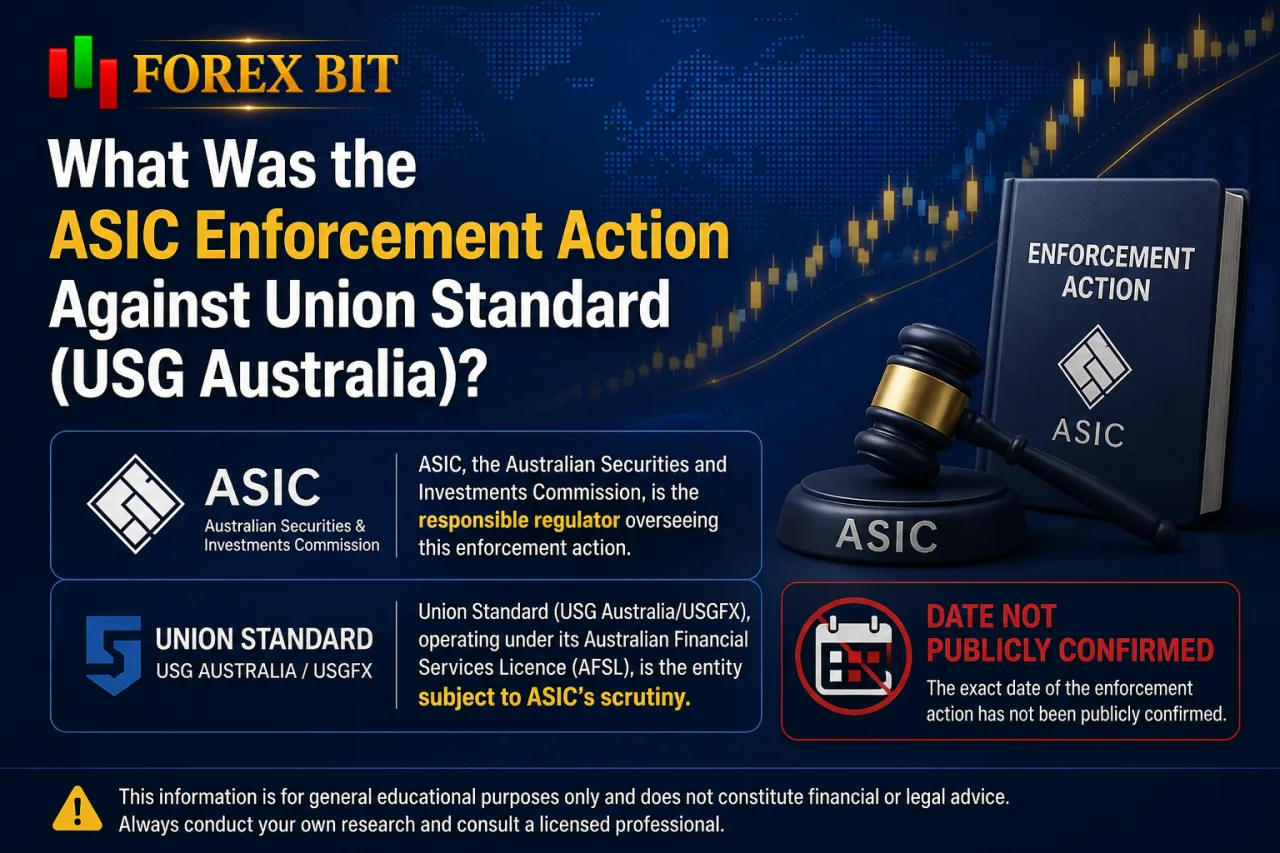
ASIC’s action against Union Standard involved several separate regulatory and court steps rather than one single penalty.
Union Standard, trading as USGFX, held AFS licence 302792 and issued retail OTC derivatives including margin forex products and CFDs. ASIC first became involved through investigations and court proceedings relating to Union Standard and its authorised representatives, including EuropeFX and TradeFred.
In December 2020, ASIC commenced civil penalty proceedings against Union Standard, EuropeFX and TradeFred. ASIC alleged that Union Standard provided margin FX services to China-based customers in circumstances where those transactions exposed the customers to potential breaches of Chinese law, and that Union Standard failed to satisfy its obligation to provide financial services efficiently, honestly and fairly.
The Federal Court ultimately found in December 2024 that Union Standard breached its obligations and was also liable for misconduct committed by its authorised representatives under its AFS licence.
When Did ASIC Take Action Against Union Standard?
There are several important dates in the case.
- December 2019: ASIC obtained Federal Court asset restraint orders against EuropeFX and TradeFred while investigating the conduct. Union Standard also gave an undertaking to keep specified funds in a separate bank account.
- July 2020: ASIC suspended Union Standard’s AFS licence after the company entered external administration.
- 14 September 2020: ASIC cancelled AFS licence 302792 following the appointment of liquidators.
- December 2020: ASIC commenced civil penalty proceedings in the Federal Court.
- 20 December 2024: the Federal Court delivered its liability judgment, finding systemic unconscionable conduct and other contraventions.
- 11 June 2026: the Federal Court ordered the penalties, which ASIC announced on 12 June 2026.
Therefore, describing the case with one single “ASIC action date” would be misleading. The matter developed over several years through investigation, licence action, litigation, liability findings and finally monetary penalties.
What Type of Regulatory Action Was Issued (Fine, License Condition, or Court Action)?
The Union Standard case involved both administrative licence action and Federal Court civil penalty proceedings.
ASIC suspended Union Standard’s AFS licence in July 2020 because the company had entered external administration. The licence was then cancelled on 14 September 2020 under section 915B of the Corporations Act after liquidators were appointed.
Separately, ASIC commenced civil proceedings in December 2020. After the Federal Court found contraventions in 2024, it ordered total monetary penalties of $300.2 million in June 2026:
| Entity | Penalty |
| Union Standard | $156.7 million |
| EuropeFX | $114.1 million |
| TradeFred | $29.4 million |
| Total | $300.2 million |
ASIC described these as the highest penalties secured in connection with an ASIC matter at the time.
The licence cancellation and the later monetary penalty should therefore be treated as different regulatory events. The 2020 licence cancellation followed Union Standard’s external administration and liquidation, whereas the 2026 penalties resulted from the Federal Court enforcement case concerning misconduct.
What Rule or License Condition Did Union Standard Breach According to ASIC?
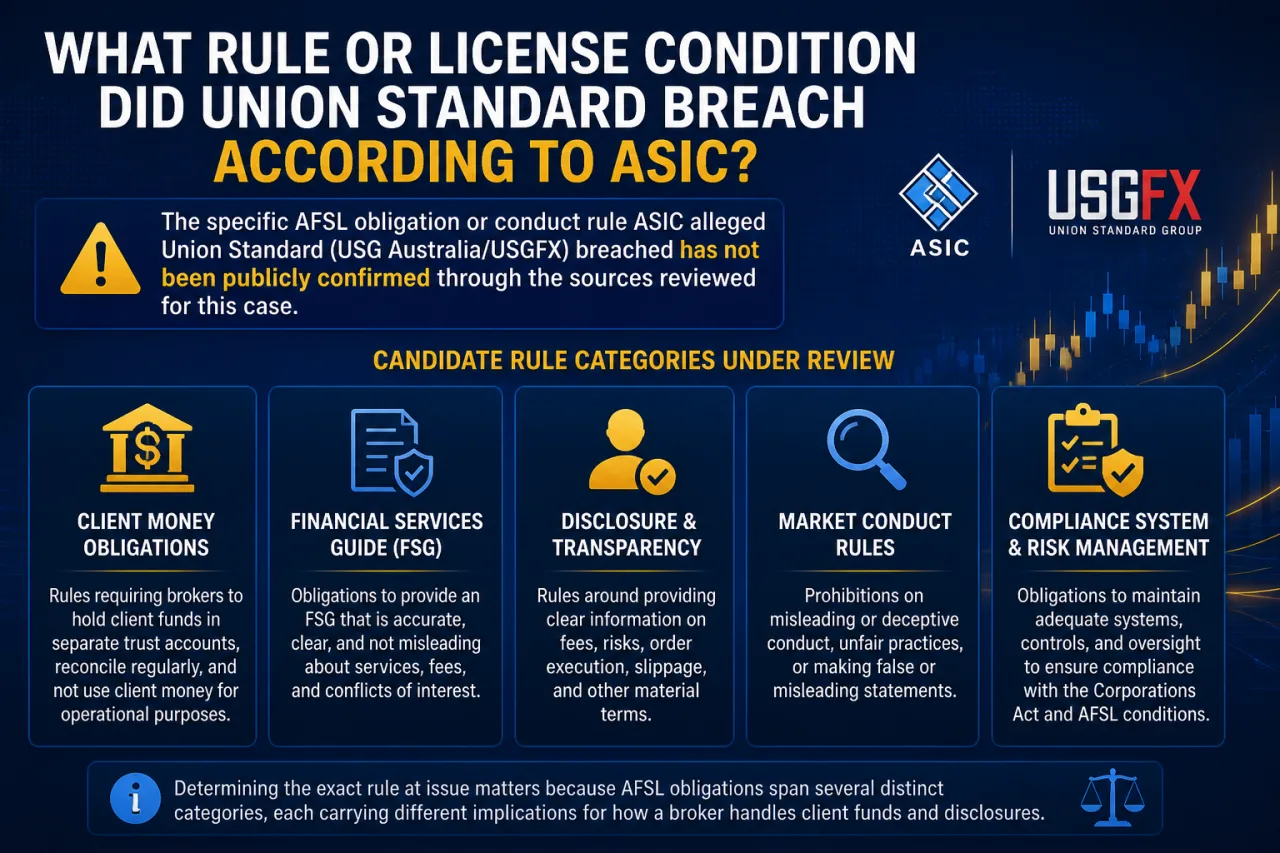
One of the central findings concerned the general obligation imposed on Australian financial services licensees by section 912A(1)(a) of the Corporations Act.
ASIC originally alleged that Union Standard failed to do all things necessary to ensure that the financial services covered by its licence were provided efficiently, honestly and fairly. The allegation related in part to Union Standard providing margin FX services to China-based clients despite knowing, or being expected to know, that doing so could expose those clients to potential liability under Chinese law.
In December 2024, the Federal Court upheld this aspect of ASIC’s case. ASIC described it as an Australian first: the Court found that the general obligations of an AFS licensee can apply when financial services are provided under an Australian licence to customers outside Australia.
Union Standard was also held responsible as the AFS licensee for conduct committed by its authorised representatives EuropeFX and TradeFred. The Court found misconduct including systemic unconscionable conduct, misleading or deceptive representations and unlicensed personal financial advice.
Was the Breach Related to CFD Leverage or Margin Trading Rules?
The principal Union Standard findings should not be described as a breach of ASIC’s CFD leverage caps or margin close-out rules.
The conduct considered by the Court occurred primarily between 2018 and 2020 and involved issues such as unconscionable conduct, misleading representations, unlicensed personal advice, responsibility for authorised representatives and Union Standard’s obligation to provide services efficiently, honestly and fairly.
ASIC’s separate CFD product intervention order was announced in October 2020 and took effect on 29 March 2021. That market-wide framework introduced leverage limits ranging from 30:1 to 2:1 depending on the underlying asset, standardised margin close-out protections, negative balance protection and restrictions on inducements.
Therefore, the Union Standard penalty should not be presented as enforcement specifically for breaching those leverage limits. The CFD product intervention regime is a broader regulatory framework that took effect after much of the conduct examined in the Union Standard proceedings.
How Did ASIC Determine the Breach Occurred?
ASIC’s investigation developed through regulatory surveillance, court applications and evidence gathered concerning Union Standard and its authorised representatives.
In December 2019, ASIC sought Federal Court asset restraint orders to protect customer funds while its investigation was underway. The Court imposed orders against EuropeFX and TradeFred, while Union Standard provided an undertaking to keep specified funds separately.
ASIC then commenced civil penalty proceedings in December 2020. The litigation relied on extensive customer and documentary evidence concerning the companies’ sales practices, representations, financial advice and treatment of clients.
The Federal Court found, among other things, that EuropeFX and TradeFred:
- profited substantially from customer trading losses;
- incentivised account managers to encourage larger deposits;
- failed to adequately explain the risks of CFDs;
- made misleading or deceptive representations;
- pressured vulnerable or inexperienced clients to trade and deposit more money; and
- provided personal advice without the required authorisation.
Union Standard was held liable for relevant misconduct because it was the AFS licensee that had authorised EuropeFX and TradeFred to operate.
Did Clients of Union Standard Receive Refunds or Compensation After the ASIC Action?
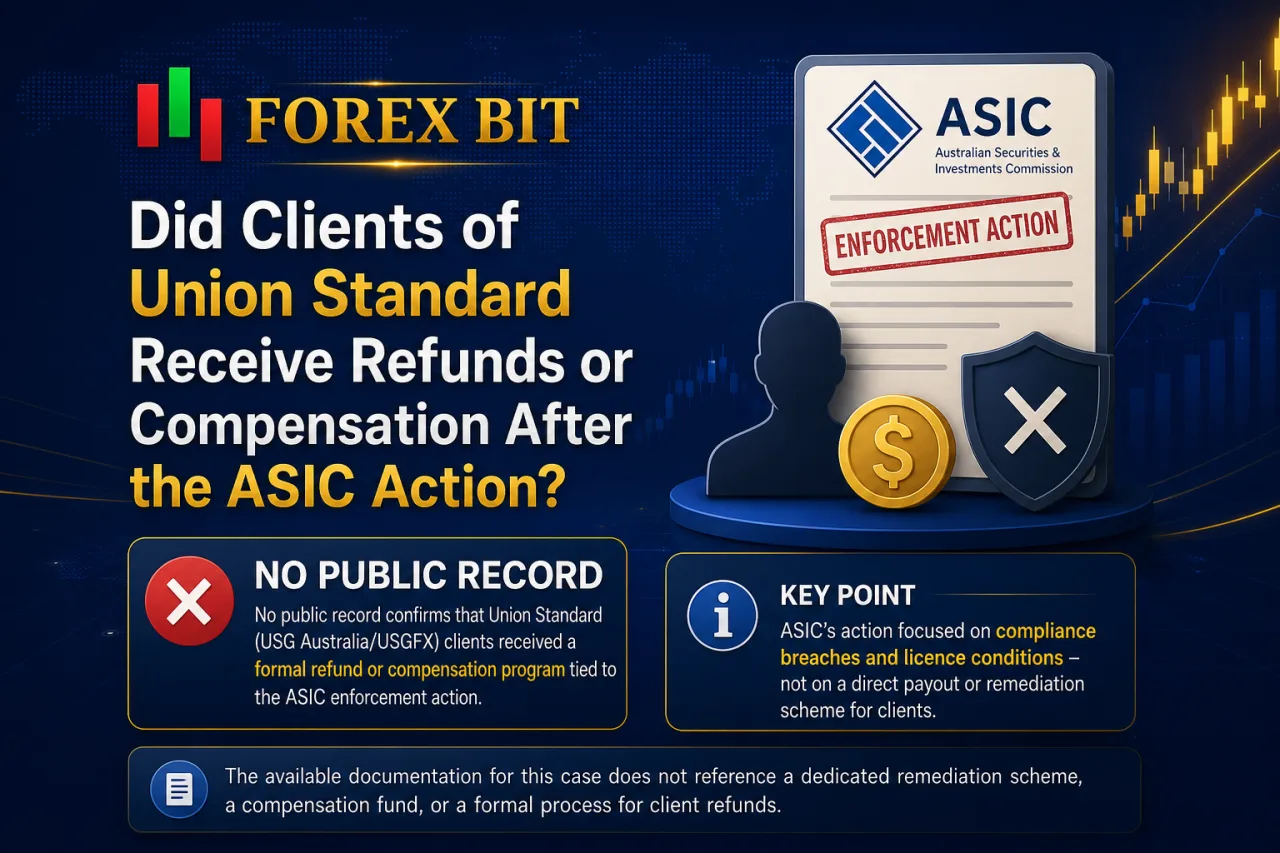
There was not a general court-ordered refund program for all Union Standard customers announced as part of the June 2026 penalty orders.
However, the Federal Court did order EuropeFX to refund customers’ net deposits, in addition to imposing monetary penalties and a permanent restraint on EuropeFX from carrying on a financial services business or providing financial product advice.
This refund order should not be confused with a universal compensation scheme covering every Union Standard or USGFX customer.
When ASIC cancelled Union Standard’s AFS licence in 2020, it temporarily allowed the liquidators to continue certain activities, including maintaining a dispute-resolution scheme and arrangements for compensating retail clients. That provision allowed necessary liquidation-related protections to continue; it did not establish that all affected clients would automatically receive compensation.
ASIC’s June 2026 update also stated that investors were still attempting to recover millions of dollars lost following Union Standard’s collapse.
Affected former customers therefore need to distinguish between the specific EuropeFX refund order, liquidation claims and any other individual recovery rights.
Is Union Standard Still Licensed and Operating in Australia After the Penalty?
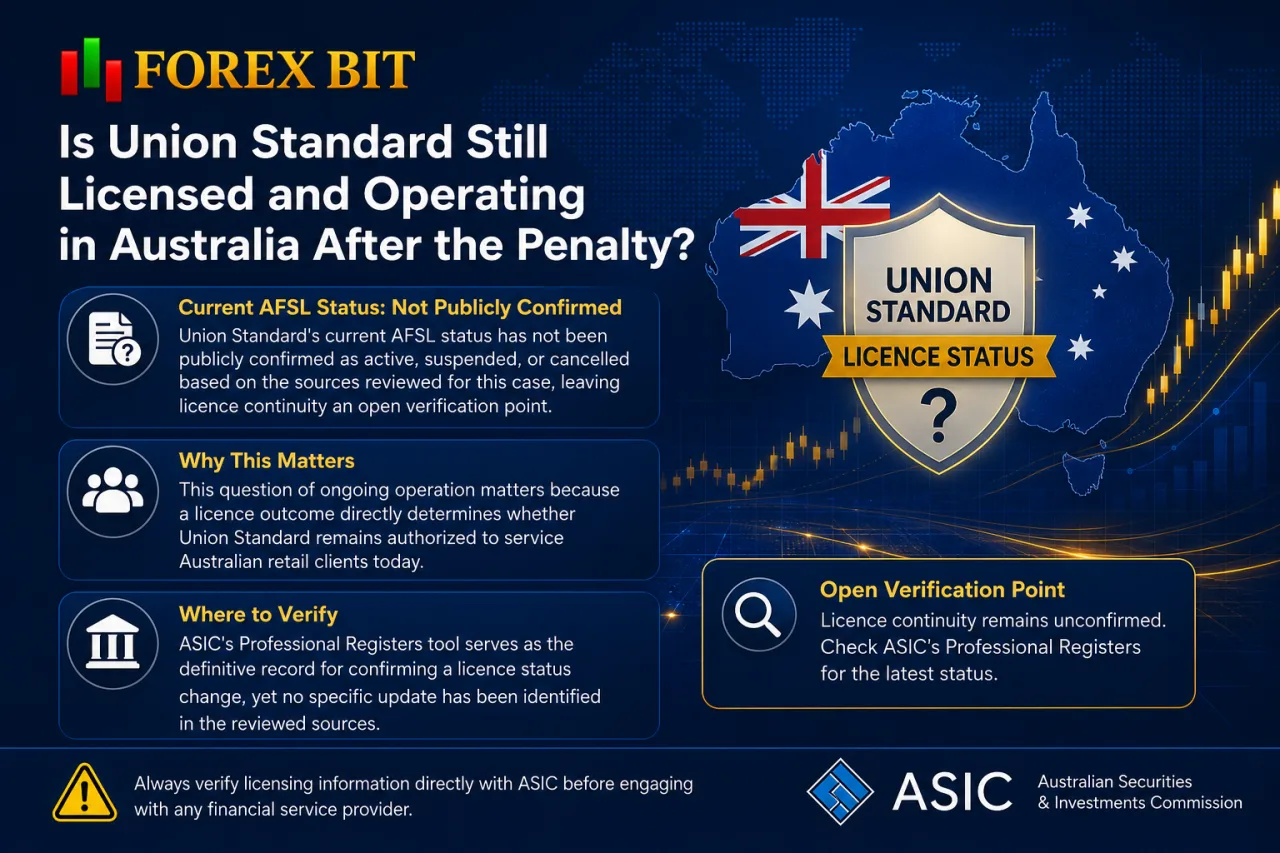
No. Union Standard is not currently licensed under the AFS licence discussed in this case.
ASIC cancelled Union Standard International Group Pty Ltd’s Australian Financial Services Licence 302792 on 14 September 2020. The cancellation followed the appointment of court-ordered liquidators on 3 September 2020.
ASIC’s more recent enforcement material describes Union Standard as a collapsed CFD issuer and identifies the company as being in liquidation.
The licence cancellation occurred years before the final $156.7 million penalty was imposed in 2026. Therefore, the penalty did not newly remove an active Australian licence; Union Standard’s AFS licence had already been cancelled in 2020.
For traders, this distinction matters. A historical website, company name or brand reference to USGFX should not be taken as evidence that Union Standard remains authorised to provide Australian financial services under AFSL 302792.
What Broader Compliance Changes Has Union Standard Made Since the ASIC Penalty?
There is no meaningful basis for describing a new operational compliance program adopted by Union Standard after the June 2026 penalty, because Union Standard had already collapsed and entered liquidation years earlier.
The company entered voluntary administration on 8 July 2020, liquidators were appointed on 3 September 2020, and its AFS licence was cancelled later that month.
Accordingly, claims that Union Standard responded to the 2026 penalty by restructuring its compliance team, updating its current client disclosures or introducing new operating controls would require specific evidence and should not be stated without it.
What can be verified is that the broader Australian CFD regulatory environment changed substantially after the period of misconduct examined in this case. ASIC introduced its CFD product intervention order from March 2021, restricting leverage, standardising margin close-out protections, providing negative balance protection and restricting inducements.
These were market-wide reforms, however, and should not be described as compliance changes made by Union Standard itself.
Did Union Standard’s Case Influence ASIC’s Approach to Other CFD Brokers?
The Union Standard case has genuine precedent significance, but its impact should be described carefully.
After the Federal Court’s December 2024 decision, ASIC said the judgment set an important precedent for Australian financial services licensees providing services to overseas customers under an AFS licence. The Court confirmed that the obligation to provide services efficiently, honestly and fairly is not limited to financial services provided to customers physically located in Australia.
The 2026 penalty decision also reinforced another regulatory principle: an AFS licensee can be held accountable for misconduct carried out by authorised representatives operating under its licence. ASIC said the case demonstrates that licensees cannot outsource responsibility for misconduct performed under their authorisation.
However, it would go too far to say that the Union Standard case itself created ASIC’s CFD leverage rules. Those restrictions arose through ASIC’s separate product-intervention process and took effect in March 2021.
Its clearest precedent value therefore concerns AFS licensee responsibility, authorised representatives and cross-border provision of financial services, rather than the creation of Australia’s general CFD leverage framework.
Conclusion
The Union Standard case is now supported by a clear regulatory and court record. ASIC suspended Union Standard’s AFS licence in July 2020 and cancelled AFSL 302792 in September 2020; civil proceedings commenced later that year, the Federal Court found serious contraventions in December 2024, and in June 2026 the Court imposed $156.7 million in penalties against Union Standard as part of $300.2 million in total penalties.
The case was not primarily a penalty for violating ASIC’s later CFD leverage caps. Its central issues included the obligation to provide financial services efficiently, honestly and fairly, misconduct by authorised representatives, misleading conduct, unlicensed personal advice and systemic unconscionable conduct.
For traders, the practical lesson is to verify a broker’s current licence status, legal entity and regulatory history directly with the relevant regulator, rather than relying on old branding or historical claims of regulation.
William Johnson is a Forex & Broker News Analyst at Forex Bit, focusing on broker updates, regulatory developments, payment changes, and security-related news. His work helps readers stay informed about important industry developments and understand how these changes may affect broker services and trading conditions.
Email: [email protected]

Best Brokers

Trade with the world’s largest retail broker and benefit from better - than - market conditions.

We offer a superior trading environment that puts traders in the best position to profit.

Trade with the best trading conditions. WIN THE BEST TRADING ACCOUNT AWARD.

Trade global markets with Interactive Brokers – a highly regulated multi-asset broker built for active and professional investors.






Forex Bit provides in-depth analysis of commodities, forex, and stock markets to help traders make informed investment decisions.
Best Brokers
Metatrader 5 Brokers
Metatrader 4 Brokers
Lowest Spread Forex Broker
Regulated Forex Brokers
Forex Copy Trading
Ctrader Brokers
Best Forex Broker For Beginners