
Curious what ASIC’s stop order means for FXCM clients? See what changed, who’s affected, and what traders should check next.
FXCM ASIC Stop Order: What Changed for Traders

A stop order from Australia’s financial regulator against FXCM temporarily halts the issue and distribution of certain FXCM-branded derivative products to retail clients in Australia. The order does not shut down FXCM entirely, but it restricts certain offerings until compliance conditions are met.
The stop order was issued because FXCM’s target market determination for the affected product did not meet design and distribution obligations. This regulatory requirement is designed to ensure risky derivative products reach only suitable retail traders.
Only FXCM clients holding or seeking access to the specific product named in the ASIC order are directly affected, not all account types. The restriction applies specifically to the product identified in ASIC’s order and does not extend to FXCM’s broader account offerings by default. Other FXCM accounts and services outside the flagged product generally continue operating as normal.
Traders with open positions or funds tied to the restricted product should verify their account status directly through FXCM’s official channels and review any related notices. Confirming whether existing trades, pending withdrawals, or margin requirements are impacted helps avoid confusion during the restriction period.
Forex Bit breaks down what the ASIC stop order against FXCM actually covers, starting with a clear explanation in the next section, What Is the ASIC Stop Order Against FXCM?
What Is the ASIC Stop Order Against FXCM?
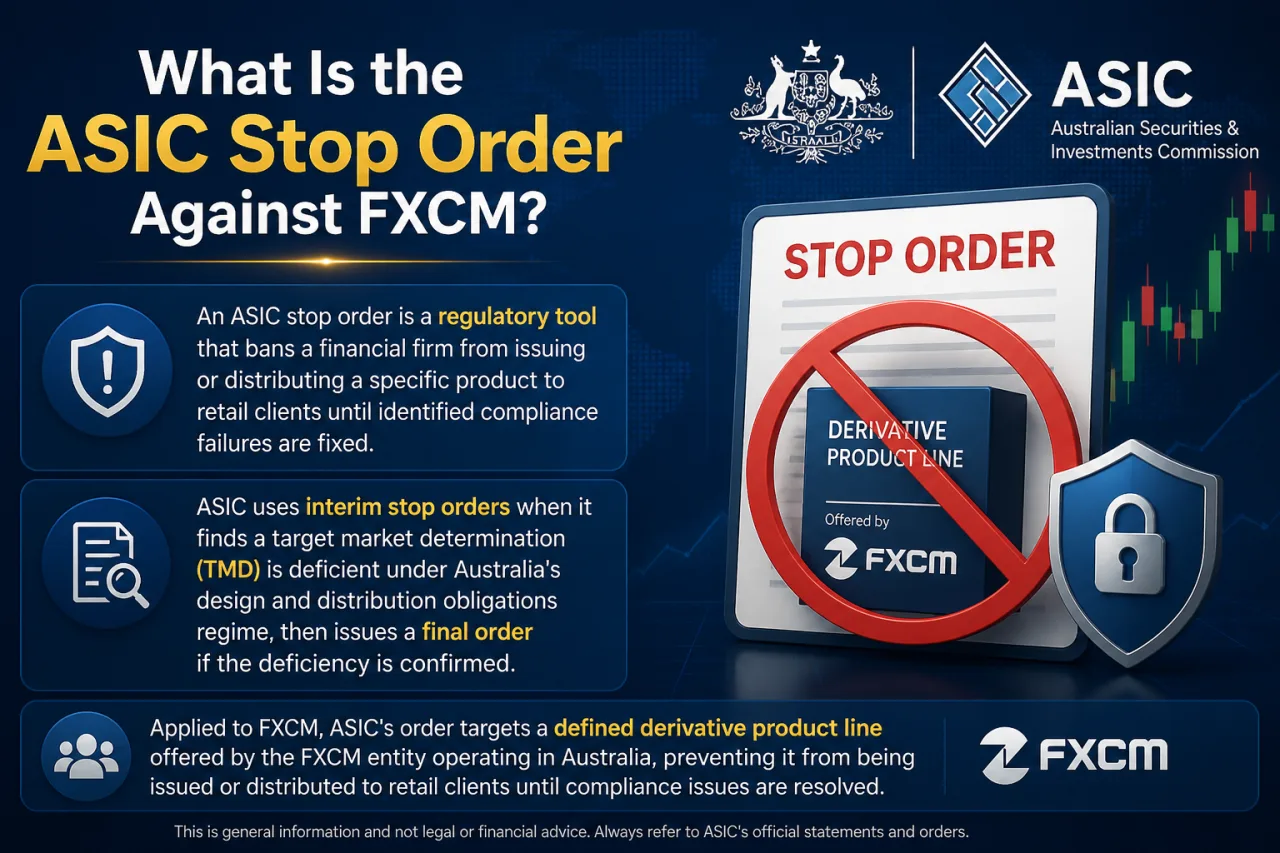
An ASIC stop order is a regulatory tool that bans a financial firm from issuing or distributing a specific product to retail clients until identified compliance failures are fixed. ASIC uses interim stop orders when it finds a target market determination (TMD) is deficient under Australia’s design and distribution obligations regime, then issues a final order if the deficiency is confirmed.
Applied to FXCM, ASIC’s order targets a defined derivative product line offered by the FXCM entity operating under its Australian license, not the broker’s full suite of accounts and services. The order stems from ASIC’s review finding that the TMD for that product failed to properly define the class of consumers it is suitable for, a core requirement of the design and distribution obligations framework introduced to protect retail traders from mismatched risk exposure.
The interim order took effect once ASIC formally issued it, with the restriction remaining active until FXCM addresses the identified TMD gaps. ASIC’s public register and media release remain the primary source for the order’s exact scope, product name, and duration.
Why Did ASIC Issue the Stop Order on FXCM?
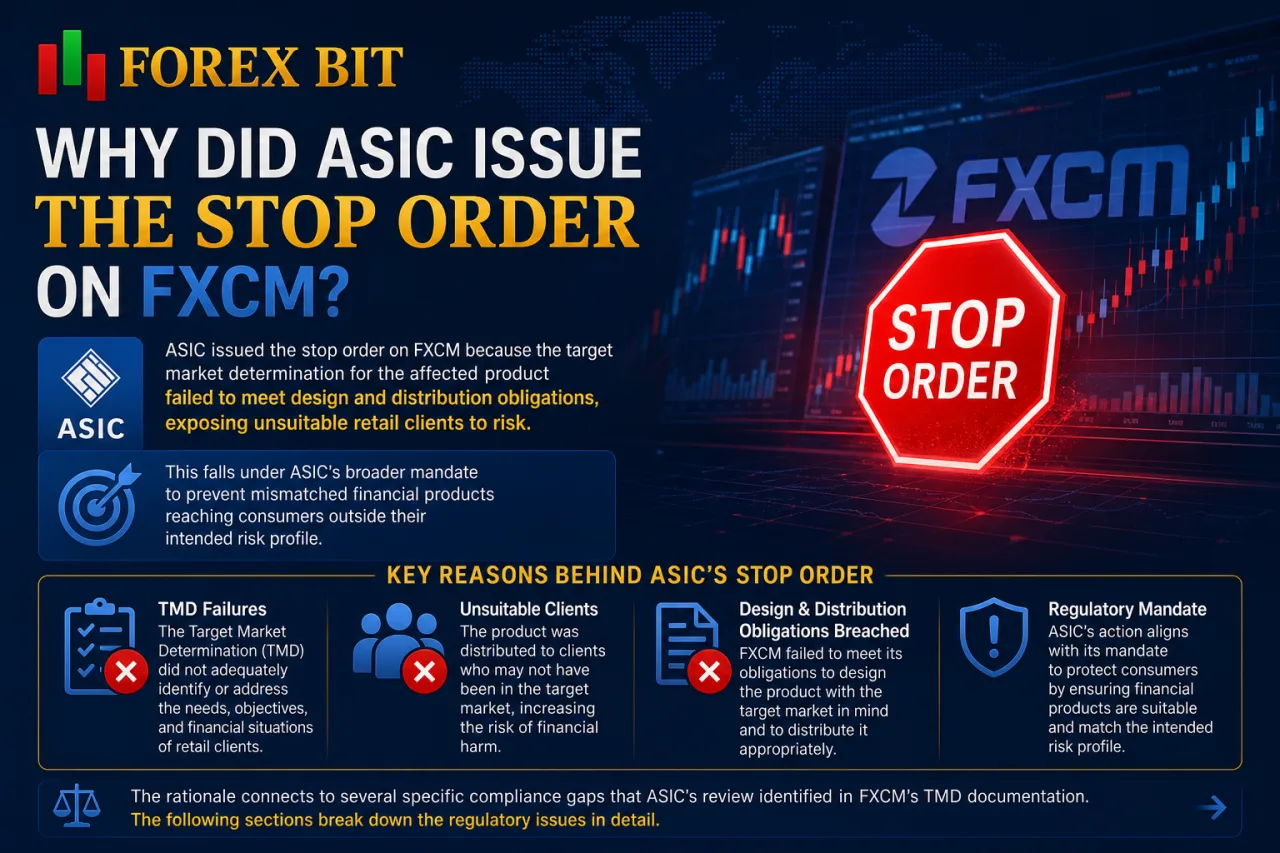
ASIC issued the stop order on FXCM because the target market determination for the affected product failed to meet design and distribution obligations, exposing unsuitable retail clients to risk. This falls under ASIC’s broader mandate to prevent mismatched financial products reaching consumers outside their intended risk profile.
The rationale connects to several specific compliance gaps that ASIC’s review identified in FXCM’s TMD documentation. The following sections break down the regulatory basis behind this action, covering the product design concerns and disclosure shortfalls ASIC flagged:
- TMD definition gap: The TMD did not adequately define the class of consumers for whom the product is appropriate, a core requirement under the design and distribution obligations regime.
- Disclosure gap: The documentation fell short in setting out the conditions and restrictions needed to keep the product from reaching consumers outside its intended target market.
Any commentary beyond ASIC’s official statements, including trader speculation or third-party interpretation about broader CFD market risks, remains separate from the regulator’s stated basis for the order.
What Products or Services Does the Stop Order Cover?
The ASIC stop order covers a specific FXCM-branded derivative product line tied to the deficient target market determination, not FXCM’s full range of trading services. This scope question determines which FXCM offerings remain restricted and which continue operating normally during the interim period.
The restricted category falls under retail derivative products subject to Australia’s design and distribution obligations regime. This means the order applies narrowly to the product whose TMD ASIC found deficient rather than every instrument FXCM lists. ASIC’s stop order specifies the particular FXCM-branded product line and its associated target market determination as the subject of the interim restriction.
Products and services outside that named determination, including other account types and instruments not covered by the flagged TMD, are not subject to the restriction. Traders should distinguish between the specific product named in the order and FXCM’s broader Australian offering, since the two are not treated identically under the stop order’s terms.
Which FXCM Clients or Accounts Are Affected by the Stop Order?
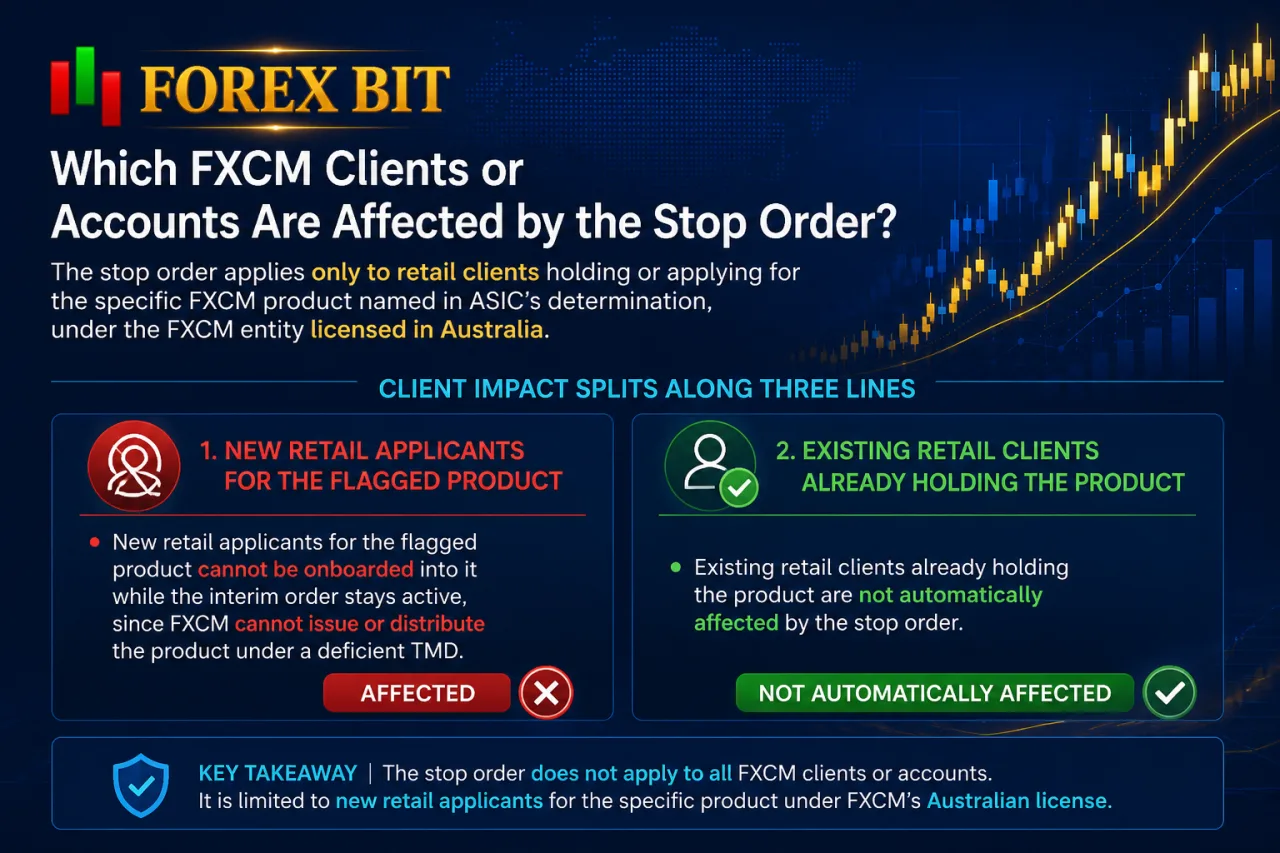
The stop order applies only to retail clients holding or applying for the specific FXCM product named in ASIC’s determination, under the FXCM entity licensed in Australia. Client impact splits along three lines worth separating clearly.
New retail applicants for the flagged product cannot be onboarded into it while the interim order stays active, since FXCM cannot issue or distribute the product under a deficient TMD. Existing retail clients already holding the product are not automatically forced out of positions, but FXCM cannot add new distribution of that same product to them either. Wholesale or professional clients generally fall outside the scope of design and distribution obligations rules, as these protections are aimed specifically at retail consumers.
Clients under other FXCM regulated entities outside Australia, operating under separate licenses in other jurisdictions, fall outside ASIC’s jurisdiction and this order entirely. The restriction is entity-specific and product-specific, not a global action against the FXCM brand.
What Exactly Changed for Traders After the FXCM Stop Order?
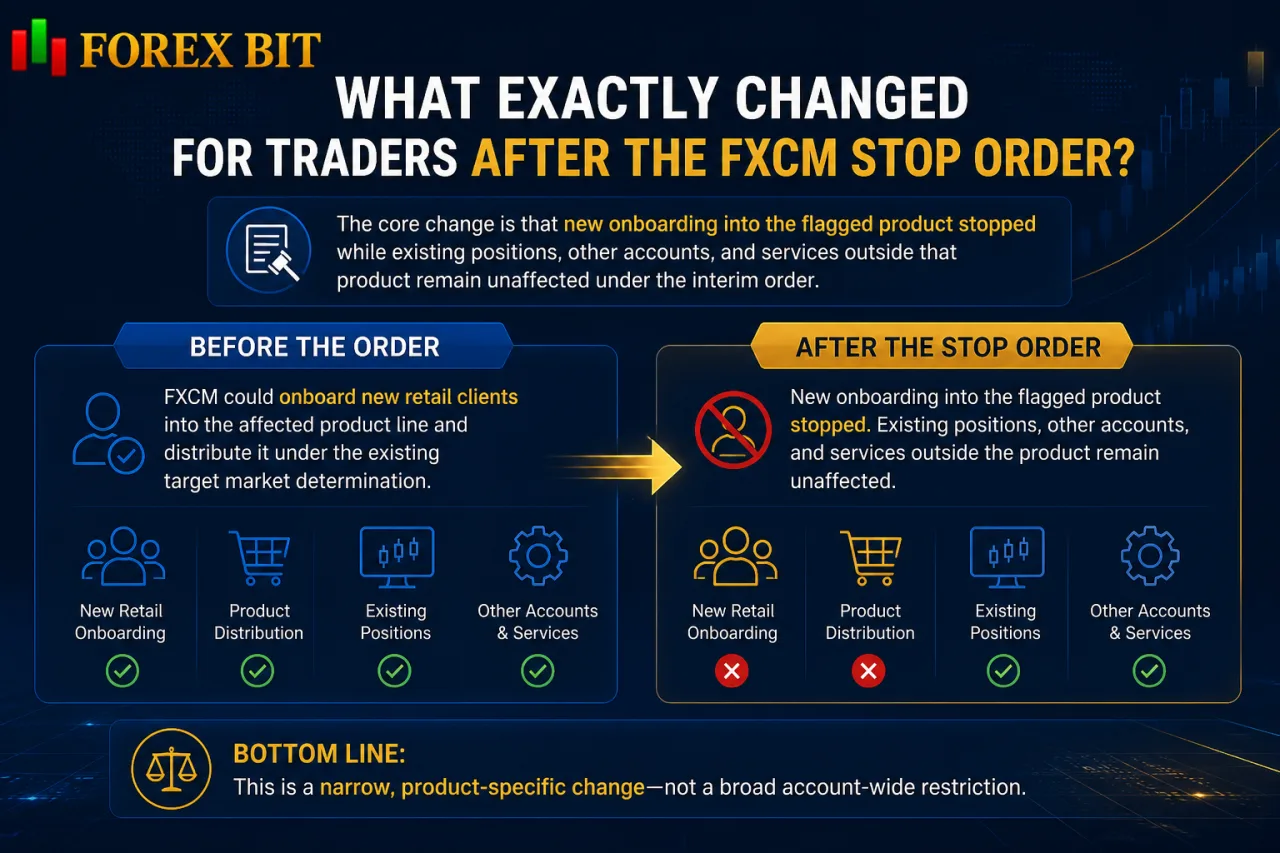
The core change is that new onboarding into the flagged product stopped while existing positions, other accounts, and services outside that product remain unaffected under the interim order. Comparing conditions before and after the stop order highlights a narrow but specific shift in trading conditions rather than a broad account-wide restriction.
Before the order, FXCM could onboard new retail clients into the affected product line and distribute it under the existing target market determination without regulatory interruption. After the order, that onboarding path for the specific flagged product is closed to new retail applicants until FXCM corrects the TMD deficiency ASIC identified.
- Opening new positions in other, non-flagged FXCM products continues as before the order.
- Onboarding of new retail clients into the specific flagged product stopped once the interim order took effect.
- Availability of the named product for new distribution is currently restricted, while unrelated products remain listed.
- Account opening for services outside the flagged product proceeds through FXCM’s standard process, unchanged by the order.
Existing clients already holding the restricted product are not reported as having positions forcibly closed under the order itself. Traders confirming their exact status should rely on FXCM’s official communications and ASIC’s published order rather than assumptions about scope.
What Should Traders Do About Open Positions and Funds Right Now?

Traders check open position status directly through their FXCM account dashboard first, then confirm whether the position falls under the flagged product before deciding on any further action. Verifying account status resolves most uncertainty since the stop order restricts new onboarding rather than forcing closures on existing holdings.
Closing or hedging existing positions is not mandated by the ASIC order itself, since the restriction targets new distribution rather than open trades. Traders holding the affected product still weigh their own risk tolerance and margin exposure when deciding whether to maintain, reduce, or close a position, independent of the regulatory action.
Contacting FXCM support through official channels, such as the client portal, verified phone lines, or registered email, confirms whether a specific account or product is named in the order. Fund safety and segregation status is verified the same way, by requesting written confirmation from FXCM rather than relying on assumptions.
Monitoring updates works best through two sources:
- Checking ASIC’s public register and media releases for the order’s current status.
- Reviewing FXCM’s official newsroom or client notices for compliance updates.
Relying on unofficial forums or secondhand summaries risks outdated or inaccurate information during an active regulatory review.
Is FXCM Still a Regulated and Operating Broker in Australia?
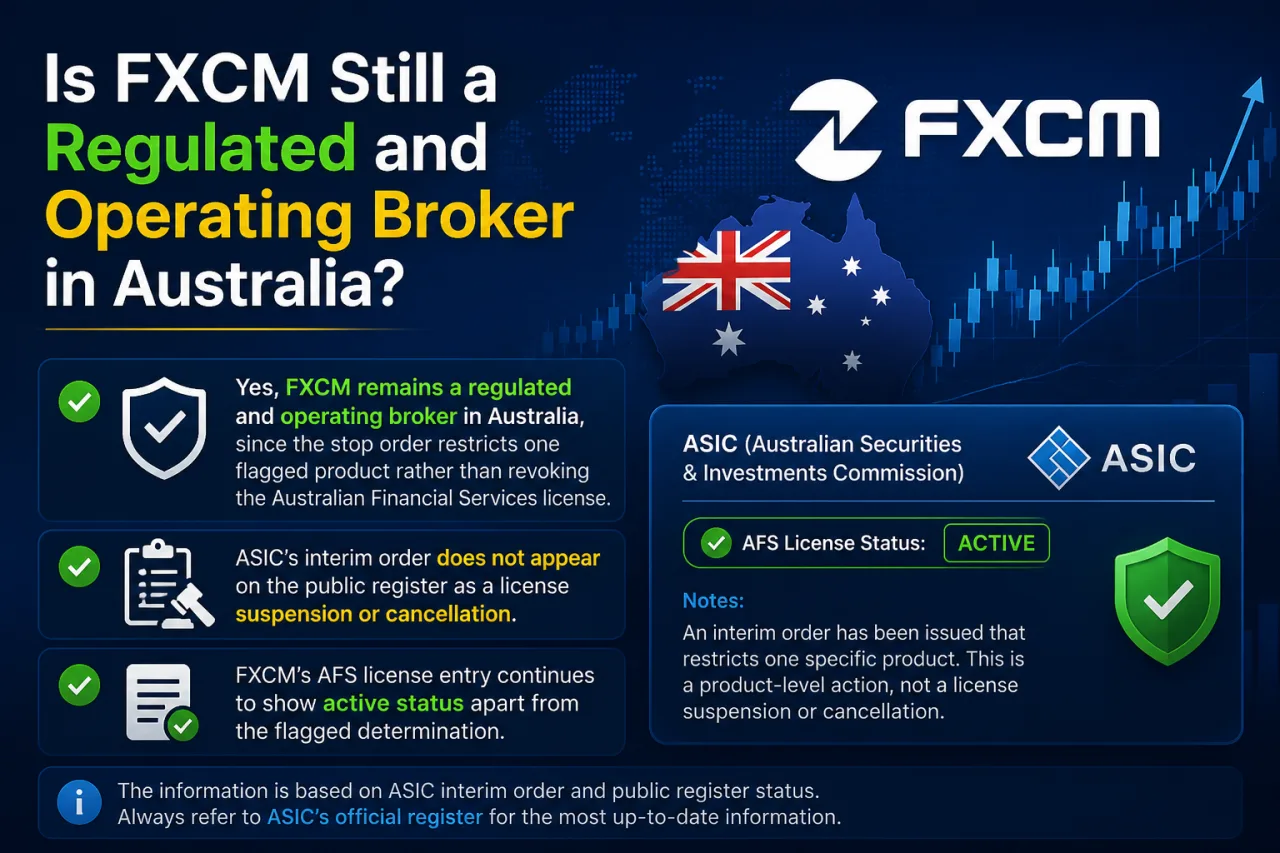
Yes, FXCM remains a regulated and operating broker in Australia, since the stop order restricts one flagged product rather than revoking the Australian Financial Services license. This regulatory status question comes down to distinguishing a product-level restriction from a license-level action.
ASIC’s interim order does not appear on the public register as a license suspension or cancellation, and FXCM’s AFS license entry continues to show active status apart from the flagged determination. The order functions as a targeted compliance measure tied to one deficient target market determination, not a finding against FXCM’s overall fitness to hold a license.
Three points support this distinction:
- Accounts and services outside the flagged product continue operating under FXCM’s existing AFS license.
- ASIC’s stop order mechanism exists specifically to address TMD gaps, separate from license revocation powers.
- FXCM retains its regulatory registration on ASIC’s public register throughout the interim restriction period.
Traders looking to verify FXCM’s license standing during this period can search the ASIC Connect Professional Registers, the official lookup tool ASIC provides for checking the current license status, conditions, and any recorded regulatory actions tied to an AFS license holder.
How Does the FXCM ASIC Stop Order Compare to Previous ASIC Actions on CFD Brokers?
The FXCM stop order fits a recurring ASIC pattern of targeting deficient target market determinations under design and distribution obligations rather than singling out FXCM for unique treatment. This shift moves the discussion from FXCM-specific trader impact to a broader regulatory enforcement trend, covered here strictly as editorial analysis rather than confirmed FXCM-specific fact.
ASIC’s enforcement history under design and distribution obligations shows a general pattern of interim stop orders applied across the CFD and forex brokerage sector, generally tied to target market determination gaps rather than fraud or insolvency findings. This observation reflects a broader regulatory trend rather than a documented list of specific broker names or verified case-by-case precedents.
This pattern reflects ASIC’s consistent enforcement priority since design and distribution obligations took effect, focusing on whether TMDs correctly define suitable consumer classes rather than broader business conduct. Common threads across this type of enforcement typically include:
- Reviewing TMD wording for vague or overly broad target consumer definitions.
- Issuing interim orders first, followed by final orders if deficiencies remain unresolved.
- Restricting new product distribution while leaving existing client positions largely untouched.
- Requiring firms to revise TMDs before resuming full distribution.
Viewed this way, the FXCM order reads as consistent with ASIC’s standard DDO enforcement approach rather than an isolated or unusually severe action against the broker.
What Does This Mean for the Broader CFD Industry Under ASIC Oversight?
Increased ASIC scrutiny under the design and distribution obligations regime signals a sustained industry-wide push toward stricter TMD compliance across CFD and forex providers, not an isolated FXCM issue. This broader implication question shifts focus from FXCM’s individual case to the regulatory trend shaping the wider CFD sector, presented here as editorial analysis rather than confirmed FXCM-specific fact.
Analysts reading ASIC’s enforcement pattern suggest CFD and forex brokers operating in Australia face growing pressure to tighten TMD wording, narrow target consumer definitions, and revise distribution conditions proactively rather than reactively.
This trend carries practical weight for traders comparing brokers, since firms with clearer, better-defined TMDs face lower risk of sudden stop orders disrupting product access.
For the wider market, this pattern points toward:
- Tighter documentation standards across CFD providers under DDO rules.
- More frequent interim orders as ASIC continues reviewing existing TMDs.
- Reduced likelihood of surprise account-wide restrictions, since orders typically target specific products.
None of this constitutes an ASIC statement about FXCM’s future conduct or industry-wide intent.
Conclusion
ASIC’s stop order against FXCM comes down to one narrow action: a deficient target market determination blocked new retail onboarding into a single flagged derivative product, while FXCM’s Australian license, other account types, and existing open positions continue functioning normally.
The measure reflects a standard design and distribution obligations enforcement step rather than a fraud finding or license revocation, placing FXCM within a broader pattern of similar ASIC actions against CFD providers. Traders holding or seeking the affected product confirm their exact status through FXCM’s official channels and ASIC’s public register, rather than assuming the restriction extends beyond its stated scope.
William Johnson is a Forex & Broker News Analyst at Forex Bit, focusing on broker updates, regulatory developments, payment changes, and security-related news. His work helps readers stay informed about important industry developments and understand how these changes may affect broker services and trading conditions.
Email: [email protected]



Best Brokers

Trade with the world’s largest retail broker and benefit from better - than - market conditions.

We offer a superior trading environment that puts traders in the best position to profit.

Trade with the best trading conditions. WIN THE BEST TRADING ACCOUNT AWARD.

Trade global markets with Interactive Brokers – a highly regulated multi-asset broker built for active and professional investors.






Forex Bit provides in-depth analysis of commodities, forex, and stock markets to help traders make informed investment decisions.
Best Brokers
Metatrader 5 Brokers
Metatrader 4 Brokers
Lowest Spread Forex Broker
Regulated Forex Brokers
Forex Copy Trading
Ctrader Brokers
Best Forex Broker For Beginners