
Wondering about forex broker KYC requirements? See accepted documents, verification steps, and how KYC affects your deposits and withdrawals.
Forex Broker KYC Requirements: Verification Guide

Forex broker KYC requirements involve verifying a trader’s identity, address, and sometimes source of funds before allowing full trading and withdrawal access. This process protects both the broker and client accounts from fraud and unauthorized activity while satisfying anti-money laundering obligations.
Accepted identity documents typically include a passport, national ID card, or driver’s license, paired with a recent utility bill or bank statement as proof of address. Some brokers may request a selfie holding the document for additional confirmation.
Deposit and withdrawal rules under KYC/AML compliance generally require that funds be withdrawn only through the same method and account used for depositing. This prevents third-party transactions and reduces the risk of financial crime.
Verification timelines and regulatory requirements differ by region, with some jurisdictions mandating stricter document checks than others. Forex Bit outlines these variations below to help traders understand what to expect. The next section explains what KYC verification actually means at a forex broker.
What Is KYC Verification at a Forex Broker?
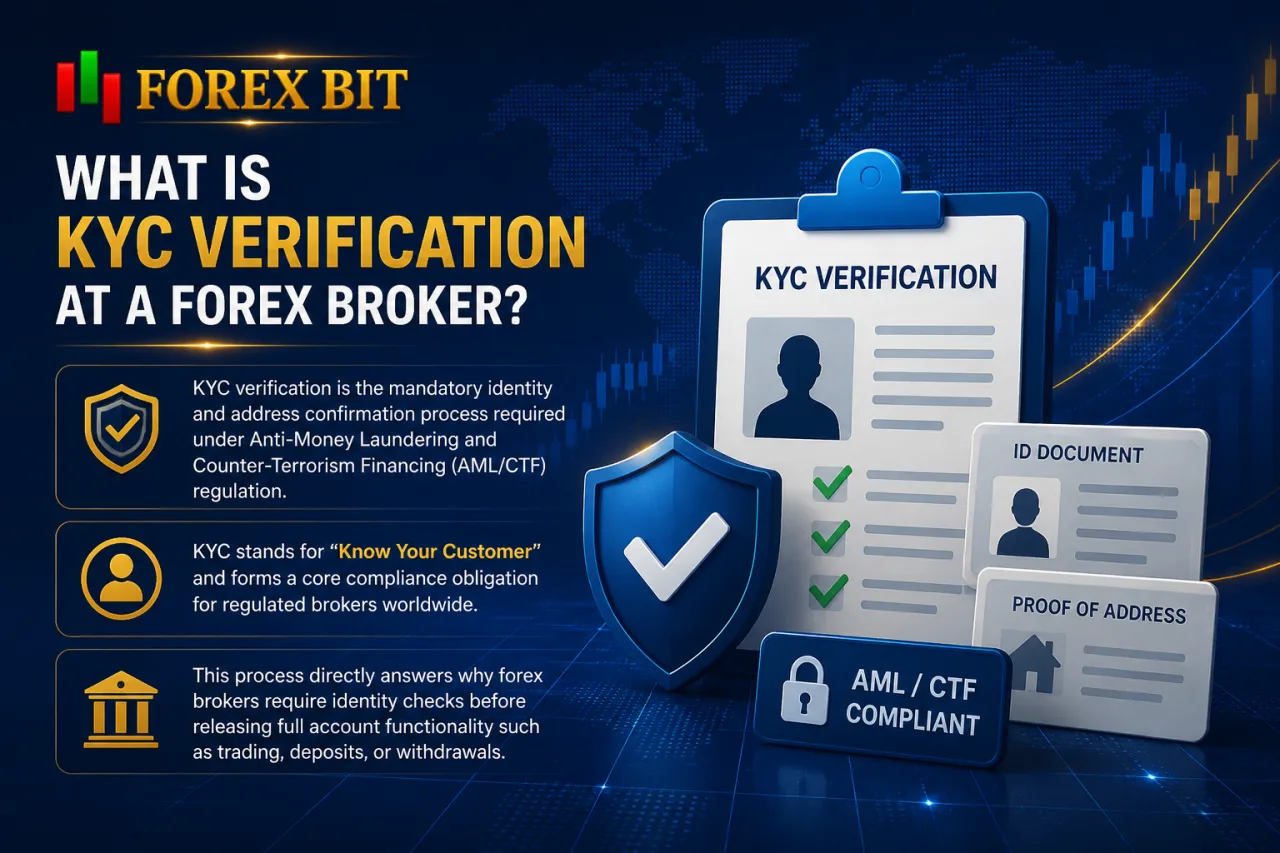
KYC verification at a forex broker is the mandatory identity and address confirmation process required under anti-money laundering and counter-terrorism financing (AML/CTF) regulation before a client accesses full trading, deposits, or withdrawals. KYC stands for “Know Your Customer” and forms a core compliance obligation for regulated brokers worldwide.
This process directly answers why forex brokers require identity checks before releasing full account functionality. Regulated brokers operate under licensing conditions set by financial authorities, and these conditions legally mandate client identification to prevent fraud, identity theft, and illicit fund movement through trading accounts.
KYC serves several connected purposes:
- Confirms the applicant’s identity matches the account holder.
- Verifies the client’s residential address for regulatory reporting.
- Screens accounts against sanctions lists and politically exposed person (PEP) databases.
- Supports source-of-funds checks for larger deposits or withdrawals.
Brokers operating without completed KYC risk violating their license terms, which is why most restrict withdrawals and full deposit limits until verification finishes, as outlined earlier regarding same-method withdrawal rules.
What Documents Are Required for Forex Broker KYC Verification?
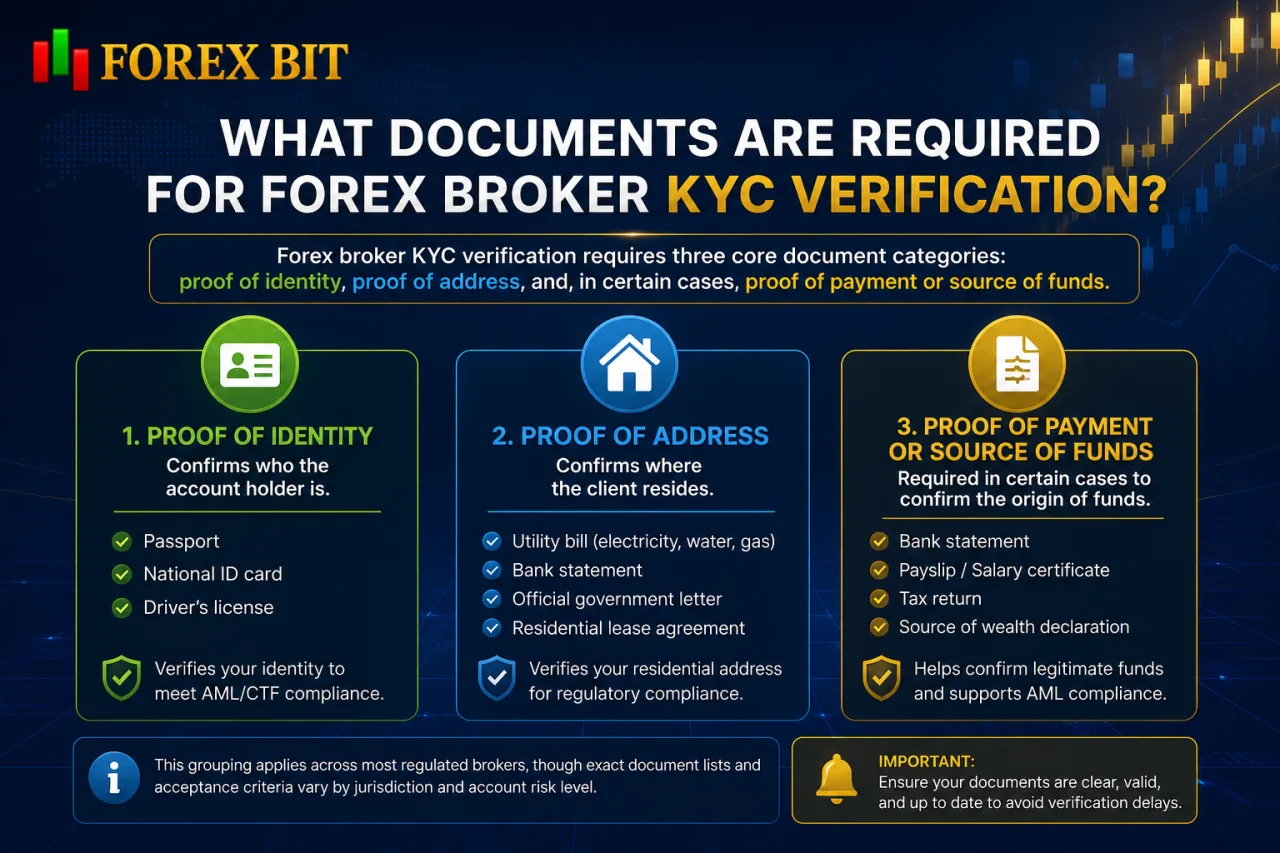
Forex broker KYC verification requires three core document categories: proof of identity, proof of address, and, in certain cases, proof of payment or source of funds. Each category confirms a different compliance requirement tied to AML/CTF obligations.
This grouping applies across most regulated brokers, though exact document lists and acceptance criteria vary by jurisdiction and account risk level. Proof of identity confirms who the account holder is, proof of address confirms where the client resides for regulatory reporting, and proof of payment or source of funds confirms the origin of deposited money for larger or flagged transactions. The following sections break down what each category typically involves and how brokers apply these checks during onboarding.
Which Identity Documents Are Accepted?
Three government-issued documents satisfy the proof-of-identity requirement: a passport, a national ID card, or a driver’s license. Each document confirms the applicant’s legal name, date of birth, and photo against the account registration details.
Brokers apply consistent conditions across these three accepted formats rather than favoring one document type over another. The core requirements include:
- Validity: the document carries a current, unexpired status at the time of submission.
- Clarity: the uploaded scan or photo shows all four corners, readable text, and no glare or blur.
- Matching name: the full name on the document matches exactly the name entered during account registration.
- Completeness: both sides of national ID cards or driver’s licenses are submitted where the document contains information on the reverse side.
Passports typically satisfy identity verification alone since they combine photo, signature, and nationality data in a single document. National ID cards and driver’s licenses sometimes require a supporting proof-of-address document submitted separately, since some regional versions do not display a residential address on the card itself.
Which Address Documents Are Accepted?
Three document types satisfy the proof-of-address requirement: a utility bill, a bank statement, or a government-issued letter, each dated within a recent issuance window. These documents confirm the client’s residential address matches the details entered during account registration.
This requirement applies alongside identity verification, particularly for national ID cards or driver’s licenses that omit a residential address on the document face. Brokers commonly accept these documents only when issued within the last three to six months, since older documents may no longer reflect a client’s current address.
Format requirements apply consistently across all three accepted document types:
- Showing the client’s full name and residential address printed clearly on the document.
- Displaying the issuing institution’s name, such as a utility company, bank, or government office.
- Including a visible issue date that falls within the accepted timeframe.
- Matching the address format expected under the broker’s regulatory jurisdiction.
Bank statements and utility bills typically arrive as PDF downloads or scanned paper copies, while government-issued letters, such as tax correspondence or residency certificates, serve as alternatives when standard bills are unavailable.
How Does the Forex Broker Verification Process Work Step by Step?
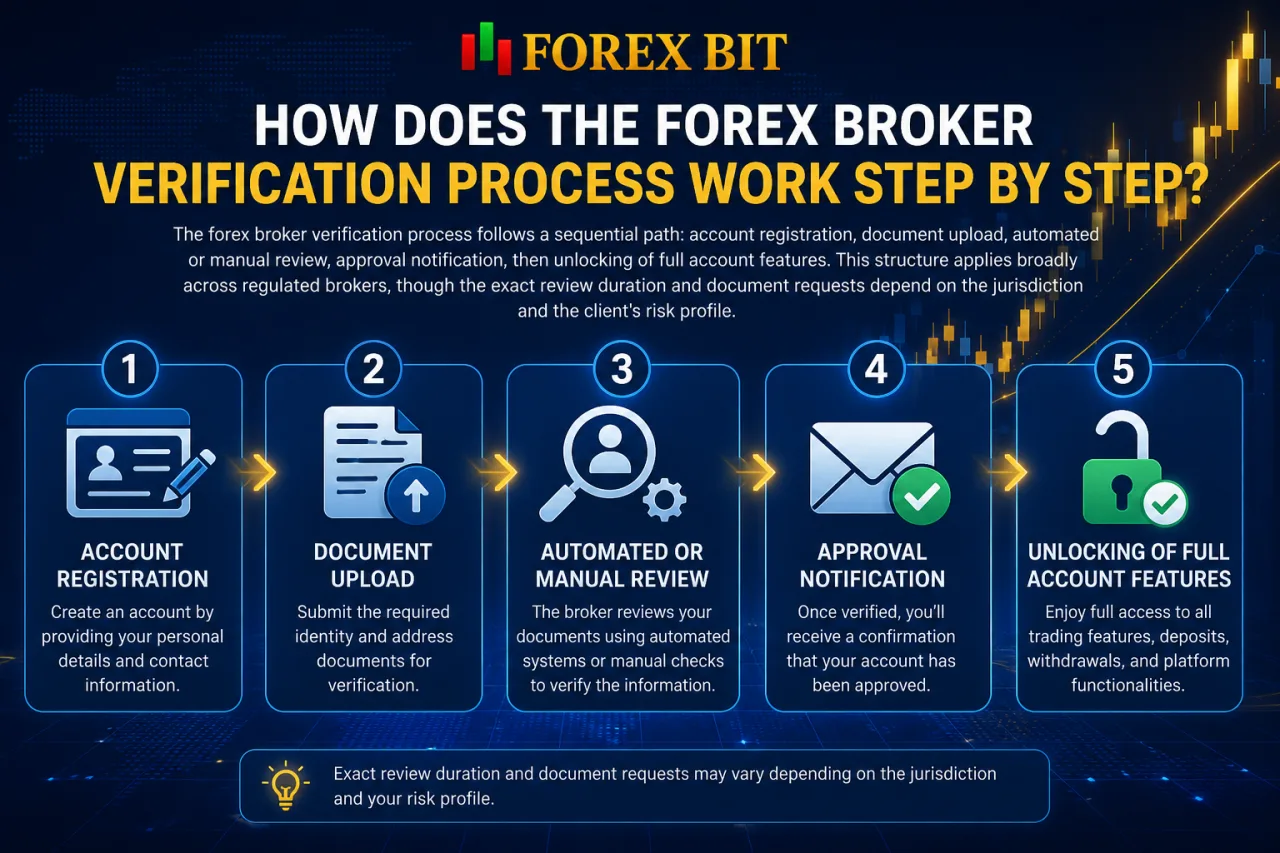
The forex broker verification process follows a sequential path: account registration, document upload, automated or manual review, approval notification, then unlocking of full account features. This structure applies broadly across regulated brokers, though the exact review duration and document requests depend on the jurisdiction and the client’s risk profile, building on the identity and address document categories outlined above. The subsections below break down what happens at each stage of this sequence.
What Happens During Document Review and Approval?
Document review at a forex broker combines automated data checks with manual compliance officer verification before an application receives approval or a resubmission request. This dual-layer review process determines how quickly and accurately a KYC application moves through the broker’s compliance queue.
Automated systems scan uploaded documents first, cross-checking name spelling, document expiry dates, and image quality against the account registration data. Files that pass this initial screen move to a compliance officer for manual review, where the reviewer confirms the document matches the client’s declared identity and address details discussed earlier.
Several outcomes follow this review stage:
- Approving the application when documents satisfy identity and address requirements.
- Rejecting a document and requesting resubmission when a scan is blurry, cropped, or expired.
- Flagging an application for additional source-of-funds evidence when deposit activity appears inconsistent.
- Notifying the client of the review outcome through the client portal or registered email address.
Brokers typically communicate resubmission requests and approval confirmations directly inside the account dashboard, with a parallel email notification sent to the client’s registered address for record-keeping purposes.
How Long Does Forex Broker KYC Verification Take?
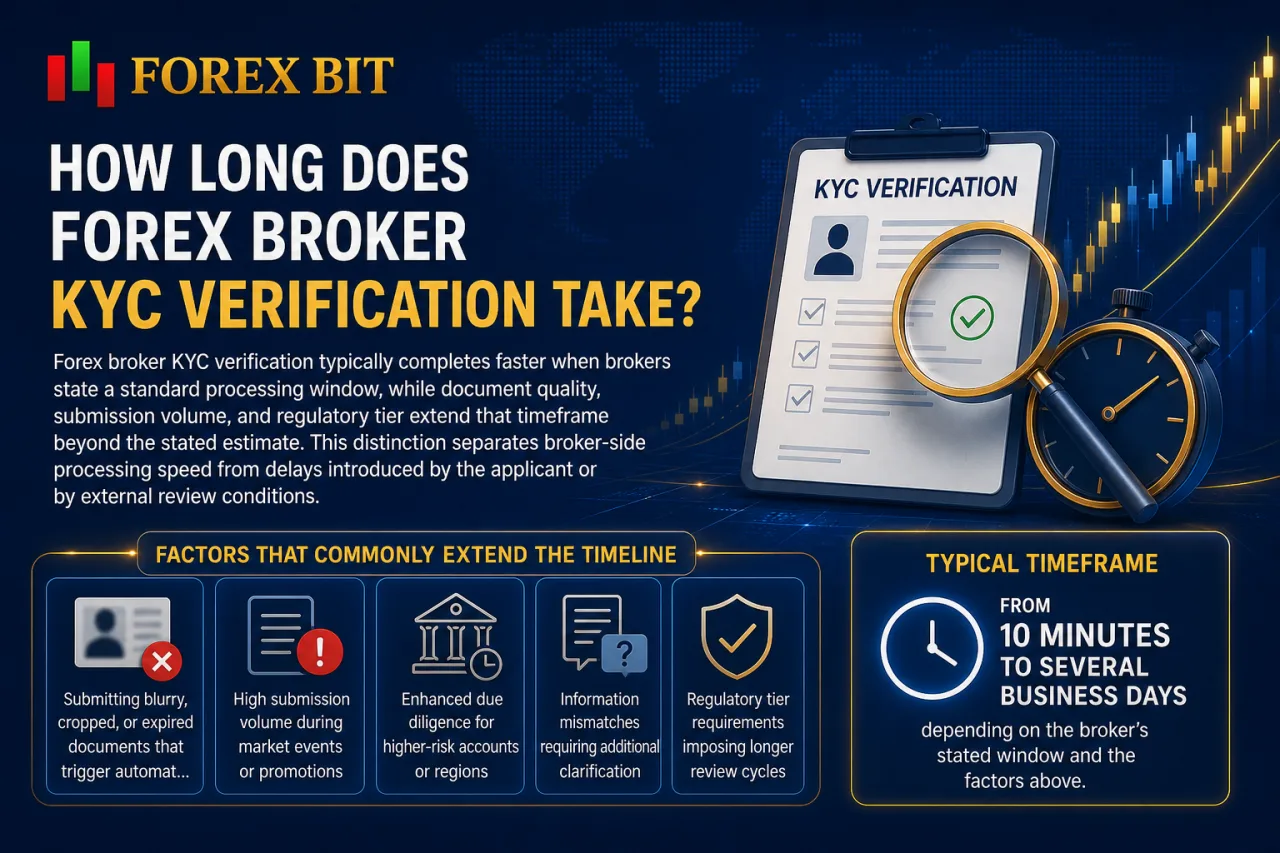
Forex broker KYC verification typically completes faster when brokers state a standard processing window, while document quality, submission volume, and regulatory tier extend that timeframe beyond the stated estimate. This distinction separates broker-side processing speed from delays introduced by the applicant or by external review conditions.
Several factors commonly extend the timeline beyond a broker’s stated target:
- Submitting blurry, cropped, or expired documents that trigger automatic rejection and resubmission requests, as described earlier regarding document review outcomes.
- Applying during periods of high registration volume, which slows manual compliance review queues.
- Falling under a stricter regulatory tier that mandates enhanced due diligence or source-of-funds checks.
- Mismatching the name, address, or date of birth between the submitted document and the account registration details.
Broker-side processing refers strictly to the time compliance staff or automated systems spend reviewing a correctly submitted file. Applicant-side delays, such as incomplete uploads or mismatched details, sit outside that window and restart the review clock upon resubmission. Exact verification durations vary by broker and are not guaranteed unless the broker confirms them in official documentation.
How Are KYC and Deposit/Withdrawal Rules Connected?
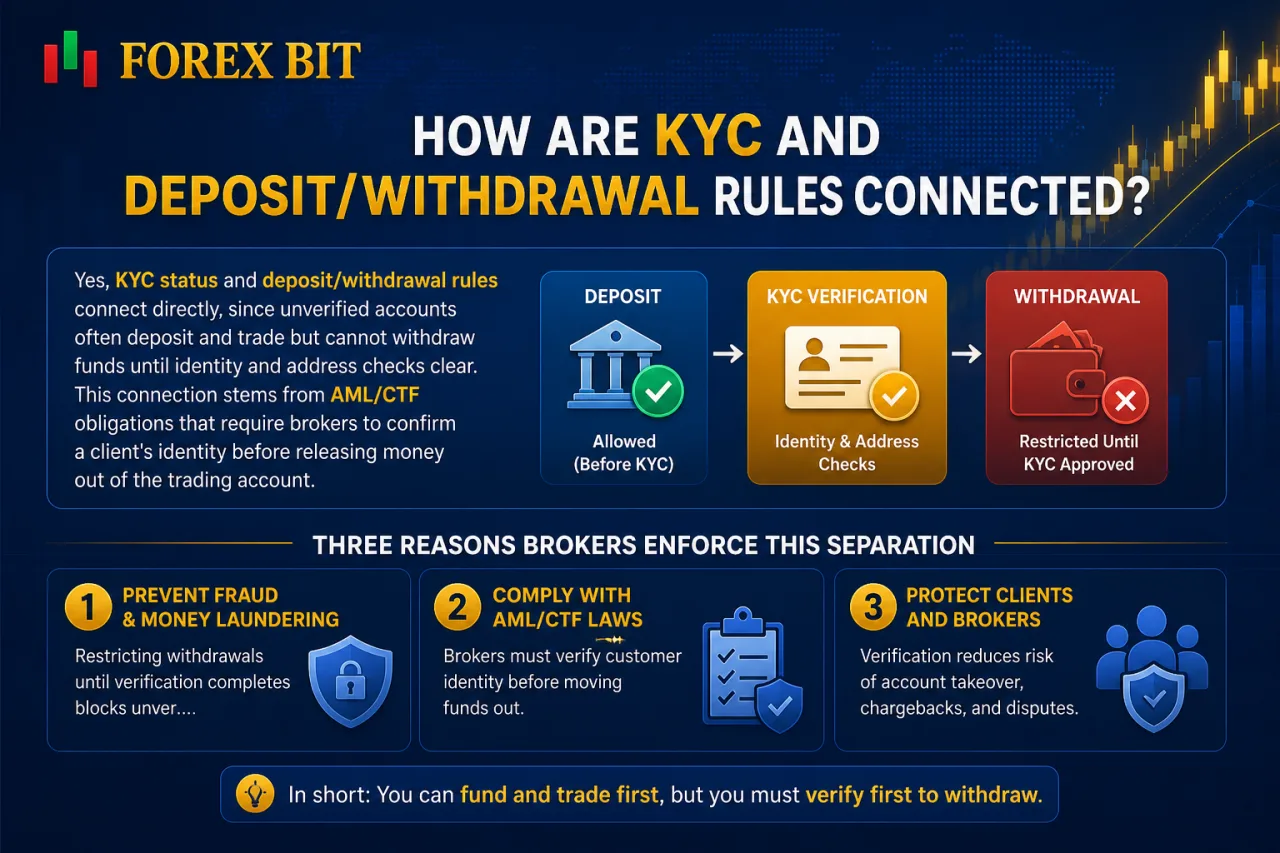
Yes, KYC status and deposit/withdrawal rules connect directly, since unverified accounts often deposit and trade but cannot withdraw funds until identity and address checks clear. This connection stems from AML/CTF obligations that require brokers to confirm a client’s identity before releasing money out of the trading account.
Three reasons explain why brokers enforce this separation between funding access and withdrawal access. Restricting withdrawals until verification completes blocks unverified individuals from using a broker account to move illicit funds. Requiring KYC before payout also confirms the person requesting the withdrawal matches the verified account holder rather than a third party. Enforcing this step protects the broker’s regulatory license, since permitting unverified withdrawals violates the licensing conditions described earlier regarding compliance obligations.
The same-method rule mentioned earlier in this guide reinforces this link. Withdrawals typically return to the original funding source or payment method used for the deposit, meaning a card deposit exits back to that card and an e-wallet deposit exits back to that same e-wallet account. This rule prevents third-party transactions and keeps the verified account holder as the sole recipient of any payout.
Do KYC Requirements Differ by Region or Regulator?
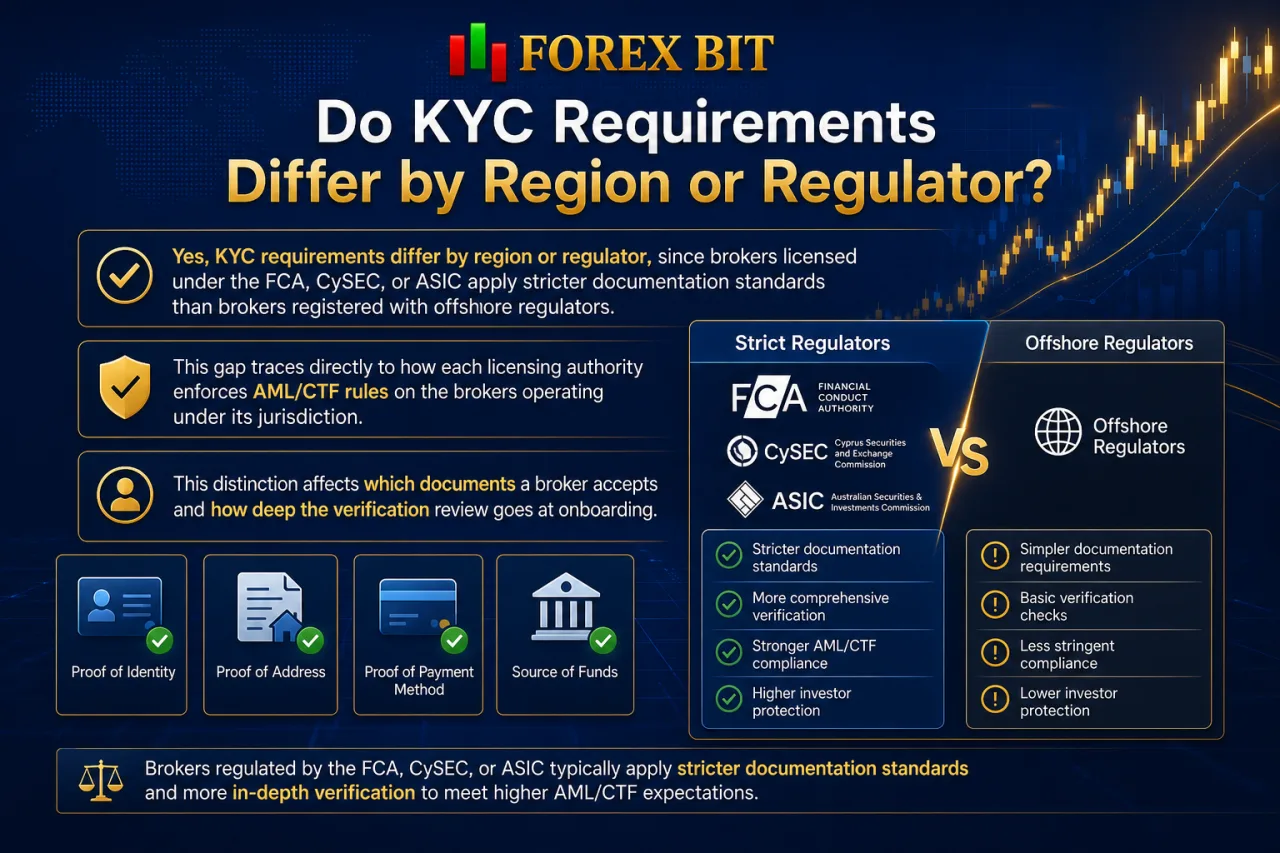
Yes, KYC requirements differ by region or regulator, since brokers licensed under the FCA, CySEC, or ASIC apply stricter documentation standards than brokers registered with offshore regulators. This gap traces directly to how each licensing authority enforces AML/CTF rules on the brokers operating under its jurisdiction.
This distinction affects which documents a broker accepts and how deep the verification review goes at onboarding. Brokers regulated by the FCA, CySEC, or ASIC typically apply enhanced due diligence, meaning source-of-funds evidence and stricter address-matching checks accompany standard identity documents. Regulated brokers generally require ongoing monitoring of client transactions after initial approval, extending beyond the one-time document check applied at offshore firms.
Offshore regulators generally impose lighter documentation demands, often accepting a single identity document alongside a self-declared address without requiring a separate proof-of-address file. Local AML laws in the broker’s home jurisdiction shape this variation further, since stricter national financial crime legislation pushes brokers toward deeper verification tiers regardless of the client’s own country of residence.
What Are the Less Common KYC Checks Some Forex Brokers Apply?
Some forex brokers apply enhanced due diligence layers beyond standard identity and address checks, including source-of-wealth reviews, video verification calls, and periodic re-verification. These additional layers typically trigger under specific risk conditions rather than applying to every account.
This distinction matters because these checks extend well past the passport-and-utility-bill baseline described earlier in this guide. Brokers reserve deeper verification for accounts flagged by risk scoring or regulatory tier, connecting back to the enhanced due diligence tier mentioned under stricter regulators. The subsections below break down each of these less common verification layers individually.
What Is a Source-of-Funds or Source-of-Wealth Check?
A source-of-funds or source-of-wealth check is an enhanced due diligence step requiring proof of income, bank statements, or a written wealth declaration to confirm the origin of deposited money. This check confirms that trading capital comes from a legitimate, traceable source rather than an undisclosed or unlawful origin.
This layer connects to the deposit and withdrawal rules discussed earlier, since brokers apply it selectively rather than to every account. Common triggers include:
- Depositing a lump sum that exceeds the broker’s standard threshold for a single transaction.
- Requesting a withdrawal disproportionate to prior deposit or trading activity.
- Triggering a risk-based AML monitoring alert through unusual account behavior.
- Falling under enhanced due diligence rules tied to a stricter regulatory tier, as noted earlier regarding FCA, CySEC, and ASIC oversight.
Accepted evidence typically includes payslips, tax returns, employment letters, or bank statements showing the deposited amount’s origin, submitted through the same client portal used for identity and address documents.
Why Might a Broker Restrict Third-Party Payments?
Brokers restrict third-party payments because deposits and withdrawals must originate from and return to an account registered in the verified client’s own name. This rule connects directly to the same-method withdrawal principle described earlier in this guide.
Several reasons explain why brokers reject cards, bank accounts, or e-wallets belonging to someone other than the account holder:
- Preventing money laundering by blocking funds routed through unrelated third-party financial accounts.
- Confirming the deposit source matches the verified identity documents submitted during KYC review.
- Avoiding disputes over fund ownership when a card or wallet belongs to a spouse, relative, or business partner.
- Protecting the broker’s regulatory license, since accepting third-party funds breaches AML/CTF obligations discussed earlier.
Compliance teams typically flag mismatched payment details automatically, triggering a rejected transaction or a request for additional ownership proof before the deposit or withdrawal proceeds.
Conclusion
Forex broker KYC verification centers on three document categories: government-issued identity proof, recent address confirmation, and, for larger or flagged transactions, source-of-funds evidence. The process moves through registration, document upload, automated and manual review, and finally approval before full deposit and withdrawal access opens. Regulatory tier shapes the depth of this check, with FCA, CySEC, and ASIC brokers applying stricter, ongoing monitoring compared to lighter offshore standards.
Withdrawals stay tied to the original funding method and to the verified account holder alone, blocking third-party transactions. Traders preparing for onboarding should ready a valid passport or ID alongside a dated utility bill or bank statement, expecting review timelines to extend if documents arrive unclear or incomplete.
William Johnson is a Forex & Broker News Analyst at Forex Bit, focusing on broker updates, regulatory developments, payment changes, and security-related news. His work helps readers stay informed about important industry developments and understand how these changes may affect broker services and trading conditions.
Email: [email protected]



Best Brokers

Trade with the world’s largest retail broker and benefit from better - than - market conditions.

We offer a superior trading environment that puts traders in the best position to profit.

Trade with the best trading conditions. WIN THE BEST TRADING ACCOUNT AWARD.

Trade global markets with Interactive Brokers – a highly regulated multi-asset broker built for active and professional investors.






Forex Bit provides in-depth analysis of commodities, forex, and stock markets to help traders make informed investment decisions.
Best Brokers
Metatrader 5 Brokers
Metatrader 4 Brokers
Lowest Spread Forex Broker
Regulated Forex Brokers
Forex Copy Trading
Ctrader Brokers
Best Forex Broker For Beginners