
Wondering how long do forex withdrawals take? See processing times by method, fees, and KYC steps that affect when your funds actually arrive.
How Long Do Forex Withdrawals Take? Full Timeline Guide

Forex withdrawals typically take between one and five business days from request approval to funds arriving in the trader’s account. Withdrawal processing times vary by payment method, with e-wallets typically being the fastest option, bank transfers taking longer, and card withdrawals falling somewhere in between. The exact duration depends on the payment method chosen and the broker’s internal processing schedule.
Withdrawal speed varies significantly by payment method, with e-wallets generally processing faster than bank transfers or card refunds. E-wallets generally offer the fastest withdrawal speeds, card withdrawals take a moderate amount of time, and bank transfers tend to be the slowest option. Card and bank transactions often involve additional clearing steps handled by external financial institutions.
Delays most commonly stem from incomplete KYC verification or mismatched account details submitted during the withdrawal request. A common cause of forex withdrawal delays is incomplete or unverified KYC documentation, which brokers must resolve before releasing funds. Brokers cannot release funds until identity and payment ownership are fully confirmed.
Faster withdrawals depend on completing verification in advance and using the same payment method for both deposits and withdrawals. Completing KYC verification in advance and choosing a fast payment method, such as an e-wallet, ensures quicker forex withdrawals and avoids unnecessary processing delays. Forex Bit outlines the specific timelines and requirements traders should expect before requesting a withdrawal. The sections below break down typical broker withdrawal timelines, the two-stage process behind every request, and how processing speed compares across bank transfers, cards, and e-wallets.
How Long Does a Forex Broker Withdrawal Typically Take?
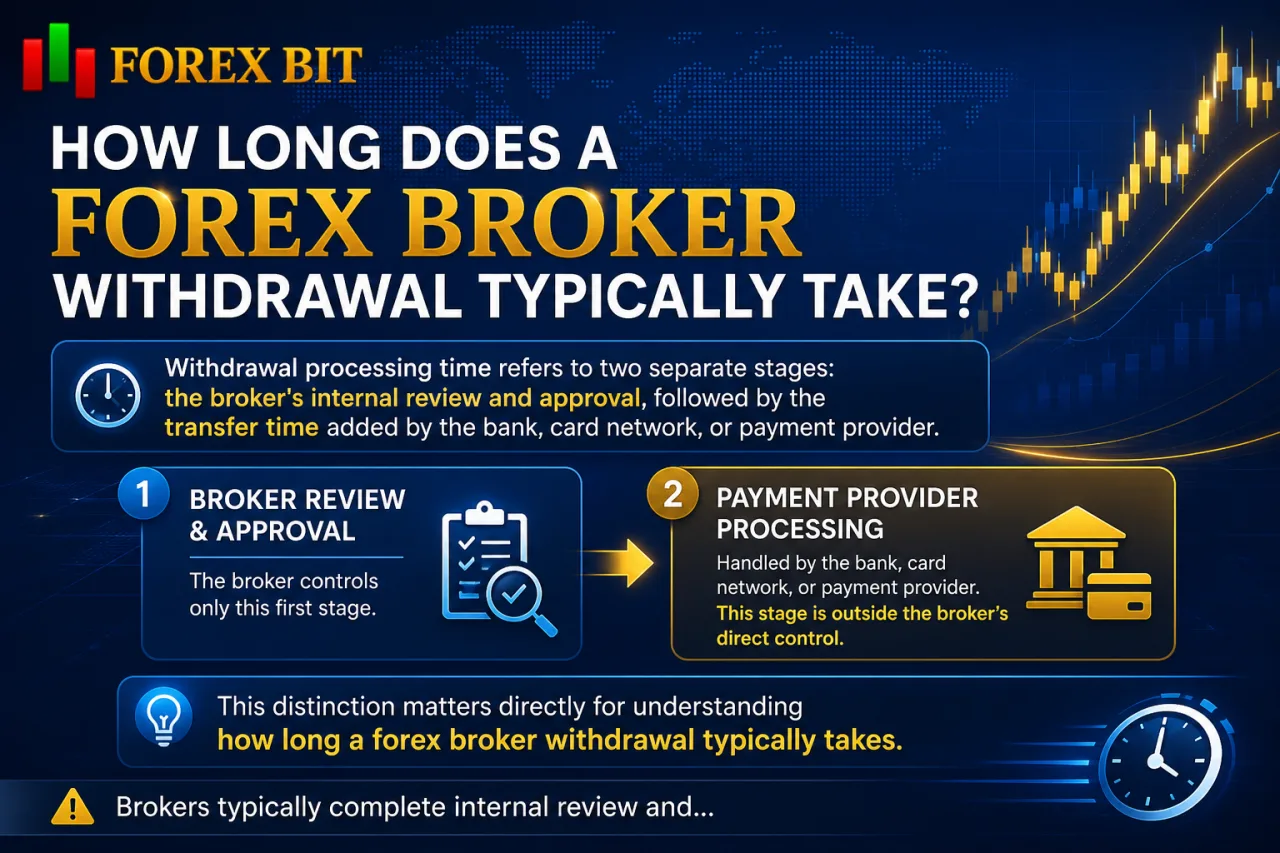
Withdrawal processing time refers to two separate stages: the broker’s internal review and approval, followed by the transfer time added by the bank, card network, or payment provider. The broker controls only the first stage; the second stage falls under the payment provider’s own settlement schedule and sits outside the broker’s direct control.
This distinction matters directly for understanding how long a forex broker withdrawal typically takes. Brokers typically complete internal review and approval within a few business days, after which the payment provider’s transfer time runs separately and adds to the total wait.
A few clarifications apply to this timeline:
- Broker-side approval covers identity checks, KYC status, and matching the withdrawal request to the original deposit method.
- Payment provider transfer time covers bank clearing, card issuer processing, or e-wallet network settlement after the broker releases funds.
- No fixed total duration applies universally, since combined timelines shift based on payment method and jurisdiction.
- No guarantee of an exact withdrawal time exists unless a broker states it explicitly in its official terms.
Traders reviewing a broker’s withdrawal policy distinguish these two stages before estimating a realistic total timeframe.
What Are the Two Stages of a Forex Withdrawal Timeline?
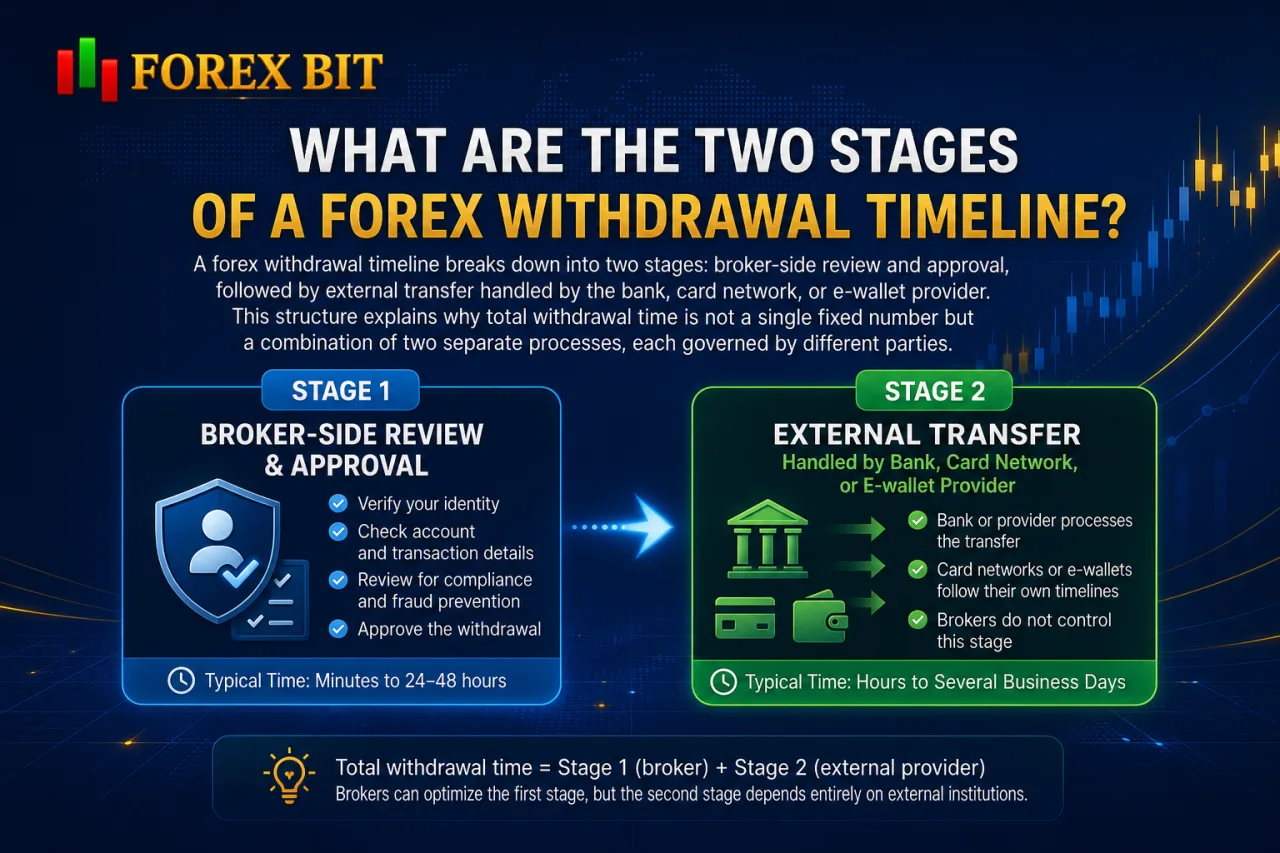
A forex withdrawal timeline breaks down into two stages: broker-side review and approval, followed by external transfer handled by the bank, card network, or e-wallet provider. This structure explains why total withdrawal time is not a single fixed number but a combination of two separate processes, each governed by different parties. The following breakdown covers what happens at each stage and why brokers cannot shorten the second one.
Stage one and stage two work as follows:
- Internal broker review confirms KYC status, matches the withdrawal request to the original deposit source, and authorizes fund release.
- External transfer begins once the broker approves the request, moving funds through the bank’s clearing system, card issuer’s network, or e-wallet provider’s settlement process.
- Total processing time equals the sum of broker approval time plus provider transfer time, since neither stage runs in parallel.
- Provider transfer speed sits outside the broker’s authority, as banks, card networks, and e-wallet operators each apply their own internal settlement schedules.
This division explains why identical withdrawal requests processed by the same broker can still finish at different speeds depending on which payment channel carries the second stage.
What Happens During the Broker’s Internal Processing Stage?
The broker’s internal processing stage involves four sequential checks: request validation, balance and margin verification, compliance or KYC review, and final manager approval before funds release. This stage covers everything the broker controls before handing the withdrawal off to a bank, card network, or e-wallet provider for actual transfer.
Each check serves a distinct purpose within the approval workflow:
- Validating the withdrawal request confirms the amount, destination account, and payment method match the trader’s account records.
- Checking account balance and margin usage confirms sufficient free equity remains after the withdrawal, since open positions or unrealized losses affect eligibility.
- Reviewing compliance and KYC status confirms identity documents, address proof, and payment ownership meet the broker’s verification requirements.
- Approving the request through a manager or automated system finalizes authorization and releases funds to the external transfer stage.
Brokers typically complete internal review and approval within a few business days, depending on account status and documentation completeness. Requests with fully completed KYC and no outstanding compliance flags generally clear this stage faster than accounts requiring additional document review or manual manager sign-off.
What Happens During the Bank or Payment Provider’s Stage?
The bank or payment provider’s stage begins once the broker releases the withdrawal, moving funds through the bank’s clearing system, card issuer’s network, or e-wallet operator’s settlement process, each running on its own independent schedule. This stage falls entirely outside the broker’s authority, addressing what happens once approval leaves the broker’s system.
Three factors shape how this external stage unfolds:
- Bank transfers route through interbank clearing networks, which apply settlement cycles set by the receiving institution rather than the broker.
- Card refunds return through the card network’s own reversal process, which follows the issuer’s internal timetable.
- E-wallet transfers move through the provider’s settlement layer, which typically confirms deposits into the trader’s wallet faster than bank or card channels once released.
No broker holds authority to accelerate any of these external settlement schedules once funds leave its system. A withdrawal marked “approved” by the broker still depends on the receiving institution’s own processing queue before it reaches the trader’s account.
How Does Withdrawal Time Compare Across Payment Methods (Bank Transfer, Card, E-Wallet)?
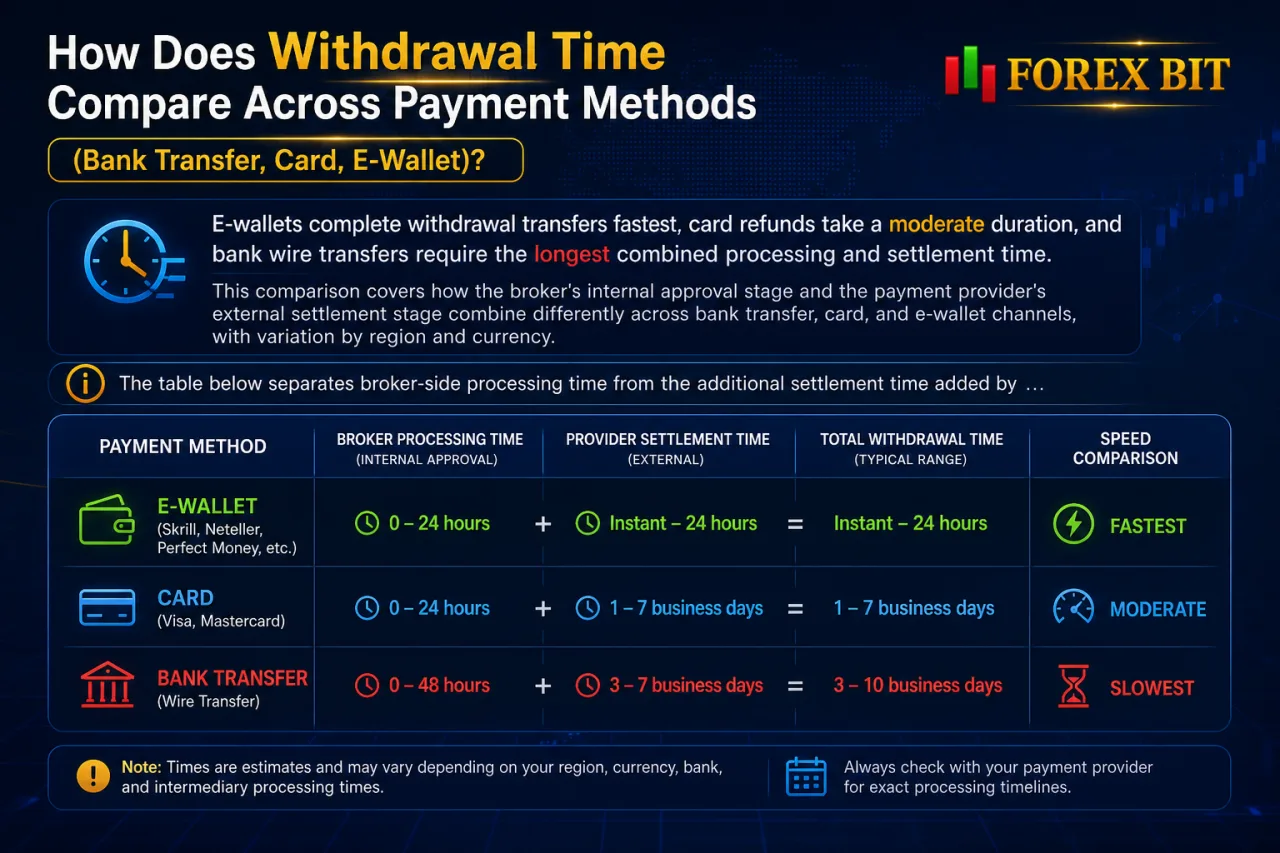
E-wallets complete withdrawal transfers fastest, card refunds take a moderate duration, and bank wire transfers require the longest combined processing and settlement time. This comparison covers how the broker’s internal approval stage and the payment provider’s external settlement stage combine differently across bank transfer, card, and e-wallet channels, with variation by region and currency. The settlement estimates below are general approximations for comparing methods relative to one another, not fixed figures guaranteed by any single broker or provider.
The table below separates broker-side processing time from the additional settlement time added by the receiving institution.
| Payment Method | Broker Processing Time | Provider Settlement Time |
|---|---|---|
| Bank wire transfer | A few business days for internal review and approval | After the broker releases the payment, bank wire transfers typically require an estimated 3-5 additional business days for interbank clearing, with the exact time varying by receiving bank and cross-border currency route. |
| Debit/credit card | A few business days for internal review and approval | Card refunds typically go through an estimated 2-5 business days of settlement via the card issuer’s reversal network, which often takes longer for cross-border cards. |
| E-wallet (Skrill, Neteller, PayPal) | A few business days for internal review and approval | An estimated 0-1 business day of settlement once the provider confirms the transfer into the trader’s e-wallet, since e-wallets generally settle faster than other payment methods. |
Regional and currency factors shift these figures further. Cross-border bank transfers routed through correspondent banks generally extend clearing time beyond domestic transfers, and currency conversion steps add processing on top of standard settlement.
Card networks and e-wallet providers each apply their own regional cutoff times and holiday schedules, which affect when a released withdrawal actually posts to the trader’s account.
How Long Does Bank Transfer Withdrawal Take?
Bank transfer withdrawals take longer than card or e-wallet methods, combining a few business days of broker approval with an additional multi-day clearing period once the payment leaves the broker’s account. International wires generally extend beyond domestic transfers due to correspondent banking routes and currency conversion steps.
Several factors shape the exact bank transfer timeline:
- Domestic wire transfers clear through a single national banking network, often reaching the trader’s account faster than cross-border wires once the broker releases funds.
- International wire transfers route through one or more intermediary banks, each applying its own processing window before crediting the receiving account.
- SWIFT messaging carries payment instructions between banks, and delays occur when a transaction passes through multiple correspondent institutions rather than a direct banking relationship.
- Bank cut-off times determine same-day versus next-day processing, since a withdrawal submitted after a bank’s daily cut-off shifts into the following business day’s clearing cycle.
- Currency conversion adds a settlement step when the trader’s receiving account holds a different currency than the one withdrawn, extending total transfer time beyond a same-currency wire.
Weekends and bank holidays in either the broker’s or the receiving bank’s jurisdiction pause clearing activity entirely, adding non-business days to the total wait beyond the broker’s own internal approval stage.
How Long Does Card Withdrawal Take?
Card withdrawals take a moderate amount of time compared to other methods, combining a few business days of broker approval with an additional settlement period set by the card issuer’s reversal network. This timeline addresses how long a card withdrawal takes and why it sits between e-wallets and bank transfers in overall speed.
Card networks apply specific rules that shape this timeline:
- Card networks route refunds through a reversal process rather than a standard purchase transaction, and this reversal follows the issuer’s own internal schedule rather than the broker’s.
- Refund-to-card limits cap the amount a broker returns to a card relative to the original deposited amount, and brokers redirect any excess balance to an alternative payment method.
- Cross-border cards often extend settlement time further, since the issuing bank applies additional verification steps when the card and broker operate in different countries.
- Card issuer cut-off schedules determine which business day a reversal posts to the cardholder’s statement, delaying visibility even after the broker releases funds.
Card withdrawals sometimes exceed e-wallet processing time because card reversal networks were originally built for refunding purchases, not for standalone cash withdrawals, adding an extra layer of settlement logic absent from e-wallet transfers.
How Long Does E-Wallet Withdrawal Take?
E-wallet withdrawals complete fastest among payment methods, combining a few business days of broker approval with a comparatively short settlement period once the provider confirms the transfer. This timeline addresses why e-wallet transfers outpace bank wires and card refunds once the broker’s internal review clears the request.
Several factors explain this speed advantage:
- Settling transfers directly into the trader’s wallet balance bypasses the multi-party clearing chains that bank wires and card networks require.
- Avoiding correspondent banking routes removes the intermediary steps that extend cross-border bank transfer times.
- Skipping card reversal logic eliminates the issuer-side processing window that card withdrawals depend on.
Final crediting speed still depends on the e-wallet provider’s own processing queue rather than the broker, since providers such as Skrill, Neteller, or PayPal each apply their own internal settlement schedule after the broker releases funds. Regional restrictions or additional verification checks imposed by the e-wallet provider itself can extend this final step beyond the broker’s control.
What Factors Can Delay or Speed Up a Forex Withdrawal?

Several factors delay or speed up a forex withdrawal: incomplete KYC verification, mismatched payment details, weekends and holidays, withdrawal amount thresholds, first-time withdrawal review, high request volume, and currency conversion. These factors sit on top of the two-stage broker approval and provider settlement timeline covered earlier, shifting the total wait longer or shorter depending on account status and payment channel. The subsections below break down each factor individually.
Is KYC Verification a Common Reason for Withdrawal Delays?
Yes, incomplete or pending KYC verification ranks among the most common reasons for forex withdrawal delays. Three conditions explain why this happens: unverified identity documents block the broker’s compliance review, mismatched or expired address proof triggers manual follow-up, and pending source-of-funds checks on larger withdrawals extend the broker’s internal approval stage covered earlier.
This factor connects directly to the broker’s compliance check described in the internal processing stage. When identity or address verification remains incomplete at the time of a withdrawal request, the broker cannot move the request past compliance review into fund release, regardless of how fast the chosen payment method settles afterward.
Completing KYC before submitting a withdrawal request reduces this risk in a few ways:
- Submitting identity and address documents ahead of the withdrawal request removes the compliance check as a bottleneck.
- Matching the payment method’s registered name to the trading account name avoids ownership mismatch holds.
- Updating expired documents proactively prevents last-minute resubmission requests from the broker.
Traders who verify their account fully before requesting a withdrawal generally move straight into the broker’s balance and approval checks, skipping the compliance-driven pause that unverified accounts commonly face.
Do Weekends, Holidays, or Bank Cut-Off Times Affect Withdrawal Speed?
Yes, weekends, bank holidays, and daily cut-off times affect forex withdrawal speed, since processing only runs on business days and any request submitted outside that window queues for the next available business day. This factor sits alongside KYC status as a timing variable that shifts the total wait beyond the broker’s own internal approval stage.
Three conditions explain how this queuing works:
- Submitting a withdrawal request after a bank’s or broker’s daily cut-off pushes processing into the following business day rather than the same day.
- Requesting a withdrawal on a weekend delays both broker review and provider settlement until the next business day, since neither stage operates outside standard banking hours.
- Overlapping public holidays in the broker’s jurisdiction and the receiving bank’s country extend the queue further, since clearing networks pause activity in both regions simultaneously.
A withdrawal approved by the broker late on a Friday, for example, typically does not enter the bank’s or e-wallet provider’s settlement queue until the following Monday or the next business day after a holiday.
How Can Traders Withdraw Funds Faster and Avoid Processing Issues?
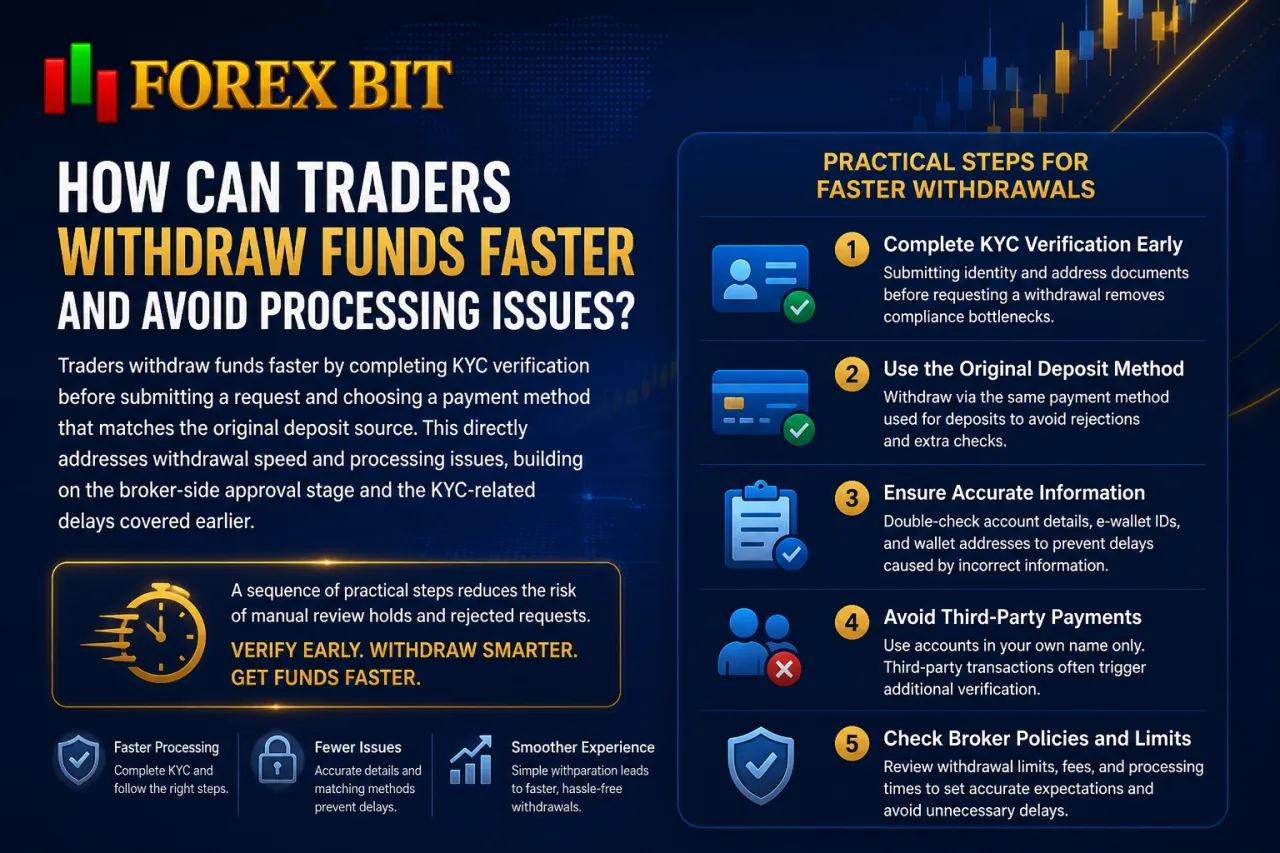
Traders withdraw funds faster by completing KYC verification before submitting a request and choosing a payment method that matches the original deposit source. This directly addresses withdrawal speed and processing issues, building on the broker-side approval stage and the KYC-related delays covered earlier. A sequence of practical steps reduces the risk of manual review holds and rejected requests.
- Completing identity and address verification before requesting a withdrawal removes compliance review as a bottleneck.
- Matching the withdrawal method to the original deposit channel avoids ownership-mismatch holds, since brokers typically return funds through the same payment route used to fund the account.
- Confirming that the name on the receiving card, bank account, or e-wallet matches the KYC-verified account name prevents rejection at the broker’s validation stage.
- Submitting requests early in the business day increases the chance of same-day processing before the broker’s or bank’s daily cut-off.
- Requesting the full available balance instead of partial or mismatched amounts avoids additional manual checks tied to unusual withdrawal patterns.
- Monitoring email regularly for verification requests prevents a pending withdrawal from stalling while the broker waits for a document or confirmation response.
Following each step in sequence moves a withdrawal request through the broker’s internal checks without triggering the compliance or validation delays described earlier in this guide.
What Rare Situations Can Cause Unusual Withdrawal Delays?
Rare withdrawal delays trace back to a handful of edge cases: source-of-funds checks on large amounts, licensing-entity regulatory holds, third-party payment restrictions, currency conversion disputes, and anti-fraud reviews triggered by unusual account activity. These scenarios sit outside the standard KYC and cut-off-time factors covered earlier, and each one pauses the broker’s internal approval stage until resolved. The subsections below outline how each edge case unfolds.
Why Might a Broker Request Source-of-Funds Documentation?
A broker requests source-of-funds documentation when a withdrawal amount exceeds an internal threshold or when regulatory obligations require enhanced due diligence beyond standard KYC. This trigger extends the internal processing stage described earlier, since the compliance team pauses fund release until the trader supplies additional proof.
Enhanced due diligence typically arises from a few specific conditions:
- Requesting a withdrawal amount above the broker’s internal threshold can prompt a manual compliance review beyond standard identity checks.
- Operating under a specific regulatory license obligates the broker to verify the origin of large deposits or withdrawals under anti-money-laundering rules.
- Showing an unusual pattern of rapid deposits followed by withdrawals raises a flag for additional financial background review.
Traders asked for source-of-funds proof typically submit bank statements, payslips, or business income records, and the broker’s compliance team holds the withdrawal until this documentation clears review.
Can Withdrawing to a Third-Party Account Cause Rejection or Delay?
Yes, withdrawing to a third-party account typically triggers rejection or delay, since brokers enforce a standard rule that funds return only to the account holder’s own verified payment method. This restriction connects directly to the ownership-mismatch check covered in the broker’s internal validation stage.
Three reasons explain why brokers hold or reject third-party withdrawal requests:
- Matching the receiving account name to the KYC-verified trader name confirms the withdrawal reaches the actual account owner rather than another individual.
- Blocking third-party transfers reduces money-laundering risk, since anti-fraud compliance frameworks require funds to trace back to the same identity that funded the account.
- Flagging a name mismatch pauses the request for manual compliance review, extending the broker’s internal approval stage until the trader resolves the discrepancy or supplies matching payment details.
A request submitted with a bank account, card, or e-wallet registered under a different name than the trading account typically stalls at the compliance check rather than proceeding to fund release.
Conclusion
Forex withdrawal duration comes down to two combined stages: the broker’s internal approval, typically resolved within a few business days, plus a separate settlement period controlled by the bank, card issuer, or e-wallet provider. E-wallets clear this second stage fastest, cards fall in the middle, and bank wires require the longest total wait, especially across borders. Verified KYC status, matching payment ownership, and submitting requests within business hours keep a request moving without added holds. Rare cases involving large sums, regulatory checks, or third-party accounts remain the main exceptions capable of extending an otherwise predictable timeline.
William Johnson is a Forex & Broker News Analyst at Forex Bit, focusing on broker updates, regulatory developments, payment changes, and security-related news. His work helps readers stay informed about important industry developments and understand how these changes may affect broker services and trading conditions.
Email: [email protected]



Best Brokers

Trade with the world’s largest retail broker and benefit from better - than - market conditions.

We offer a superior trading environment that puts traders in the best position to profit.

Trade with the best trading conditions. WIN THE BEST TRADING ACCOUNT AWARD.

Trade global markets with Interactive Brokers – a highly regulated multi-asset broker built for active and professional investors.






Forex Bit provides in-depth analysis of commodities, forex, and stock markets to help traders make informed investment decisions.
Best Brokers
Metatrader 5 Brokers
Metatrader 4 Brokers
Lowest Spread Forex Broker
Regulated Forex Brokers
Forex Copy Trading
Ctrader Brokers
Best Forex Broker For Beginners