
Confused about raw spread vs standard account costs? See how commissions and spread markups really compare so you can trade at the lowest cost.
Raw Spread vs Standard Account: Commission & Markup Explained

Raw spread accounts charge a fixed commission per trade on top of near-zero spreads, while standard accounts embed broker markup directly into wider spreads without a separate commission line. This structural difference determines how the true cost of a trade is calculated across both account types.
Spread markup on standard accounts works by adding a margin on top of the raw interbank spread before it reaches the trader. Brokers earn revenue this way instead of billing commission separately, keeping the pricing structure simpler on the surface.
Active traders and scalpers pay less total cost on raw spread accounts because tight spreads plus commission fall below the wider markup embedded in standard accounts as trade frequency rises. This gap widens further with high-volume strategies that execute dozens of trades per session.
Total trading cost is measured by adding the spread paid at execution to any commission charged per lot, then comparing that combined figure across both account types. Forex Bit breaks down this calculation using real spread and commission data to show where each account structure actually saves money. The comparison below starts with the core distinction between raw spread and standard accounts before examining markup mechanics and cost outcomes for frequent traders.
What Is the Difference Between a Raw Spread Account and a Standard Account?
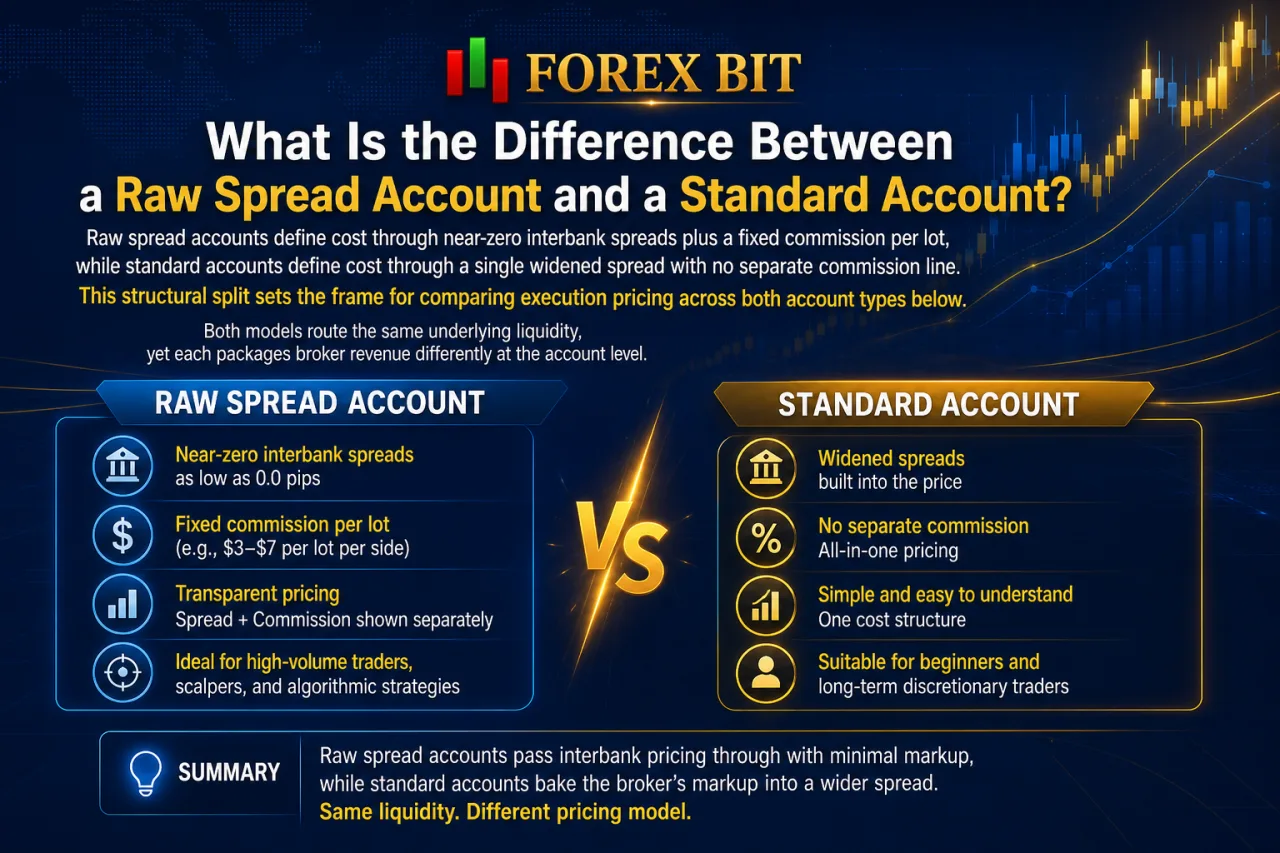
Raw spread accounts define cost through near-zero interbank spreads plus a fixed commission per lot, while standard accounts define cost through a single widened spread with no separate commission line. This structural split sets the frame for comparing execution pricing across both account types below.
Both models route the same underlying liquidity, yet each packages broker revenue differently at the account level.
- Raw spread accounts pass interbank pricing through with minimal markup, then bill a fixed commission on the trade itself.
- Standard accounts skip the commission line entirely, folding broker margin directly into a wider spread quoted at execution.
The account structure a trader picks determines whether the total cost shows up as two separate charges or one combined figure, a distinction that shapes how spread markup and commission mechanics work in the sections that follow.
What Is a Raw Spread Account?
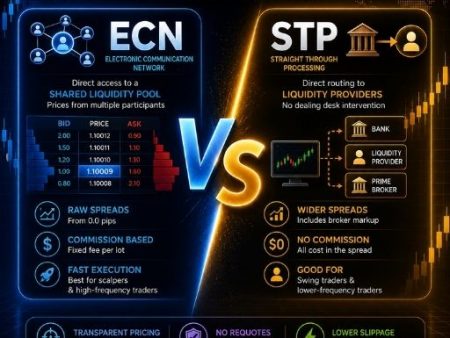
A raw spread account is an ECN-style account type that passes through raw interbank pricing directly from liquidity providers, often starting from 0.0 pips, with the broker charging a separate visible commission per lot traded. This model defines the raw spread side of the raw spread vs standard account comparison introduced above.
The commission line sits apart from the spread itself, so the two charges remain visible and separately trackable on every trade confirmation.
- Pricing streams straight from liquidity providers with minimal broker intervention on the spread.
- Spreads compress toward 0.0 pips during highly liquid conditions on major pairs. During liquid market conditions on major pairs, spreads on raw spread accounts can compress to near-zero, though actual pricing varies by broker and changes with market conditions.
- Commission charges apply per lot as a fixed, disclosed fee rather than being folded into the price.
This structure keeps the interbank rate largely intact, shifting broker revenue entirely into the commission rather than into spread markup.
What Is a Standard Account?
A standard account is a broker account type that charges no explicit commission, instead embedding cost as a markup added directly on top of the raw market spread. This definition sets the standard account side of the comparison against the raw spread structure described above.
The trader pays this cost implicitly, since the wider spread displayed at execution already contains the broker’s margin rather than listing it as a separate fee.
- Pricing shows one combined number instead of splitting spread and commission into two line items.
- Markup gets added to the raw interbank spread before the quote reaches the trading platform.
- Cost stays hidden inside the spread itself, with no per-lot commission charge appearing on trade confirmations.
This structure keeps the fee model simple to read at a glance, though it shifts the entire broker revenue into the spread rather than into a disclosed commission line.
How Do Brokers Add Spread Markup Instead of Charging Commission on Standard Accounts?
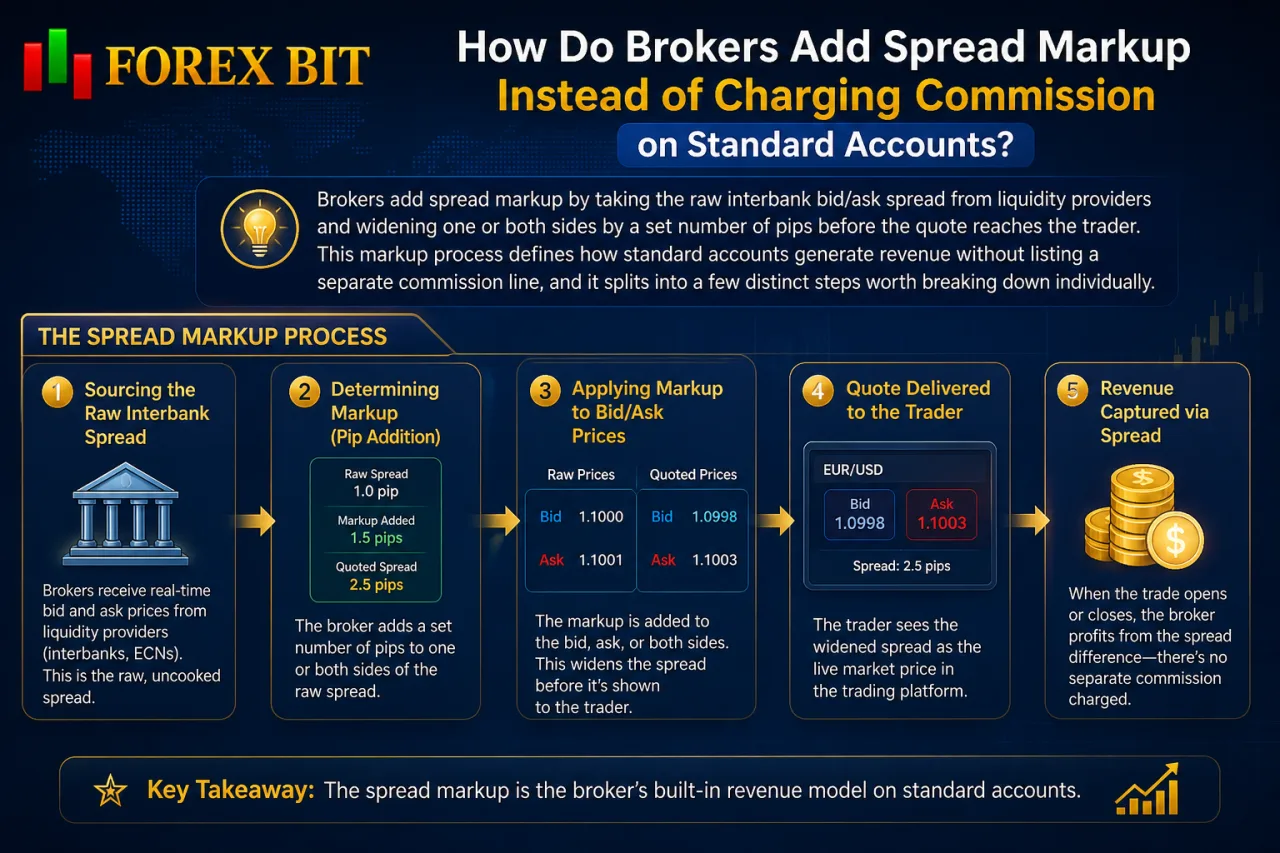
Brokers widen the raw interbank spread by a set pip amount before quoting it to traders. This markup process defines how standard accounts generate revenue without listing a separate commission line, and it splits into a few distinct steps worth breaking down individually.
The mechanism starts upstream, at the point where the broker receives pricing before any markup gets applied.
- Sourcing the raw bid/ask spread directly from liquidity providers or a liquidity pool.
- Widening the bid, the ask, or both sides by a fixed or variable pip amount.
- Quoting the marked-up spread to the trader as a single combined figure.
- Retaining the difference between the raw spread and the quoted spread as broker margin.
This markup stays embedded in the price itself rather than appearing as a disclosed fee, which is the core reason standard accounts show no commission line despite the broker still earning revenue on every trade.
How Is the Markup Amount Calculated and Applied to the Quoted Spread?
To calculate the markup amount, a broker takes the raw interbank spread and adds a fixed number of pips on top before displaying the final quote to the trader. This calculation logic determines how the markup gets applied to the quoted spread across different instruments and market conditions.
The pip amount added is not a single fixed rule across every pair or every hour of the trading day.
Major pairs like EUR/USD typically receive a smaller markup than exotic pairs, though the exact size of that markup varies by broker.
- Exotic or less liquid instruments carry wider markup because raw spreads on those pairs already run higher.
- Liquidity conditions widen or narrow the markup, since thinner liquidity pushes brokers to add more buffer.
- Time of day shifts the markup, with session overlaps generally supporting tighter markup than low-liquidity hours.
This variable structure means the same broker can apply a different markup to the same pair depending on when and under what conditions the trade executes, rather than applying one static pip value at all times.
Why Is Spread Markup Less Transparent Than a Separate Commission Fee?
Spread markup stays less transparent than a separate commission fee because the broker’s margin gets folded into the quoted spread itself, leaving no distinct line item for the trader to inspect. This transparency gap on standard accounts ties directly back to the markup mechanics described above.
A trade confirmation on a commission-based account lists the fee openly, while a standard account confirmation shows only the final spread with no breakdown of raw rate versus markup.
- Blending the raw interbank spread and the broker margin into one displayed number removes any visible split between the two.
- Withholding the raw rate from the trader’s view prevents a direct comparison against the marked-up quote shown on screen.
- Varying the markup by pair, session, and liquidity condition, as described earlier, makes the hidden cost harder to track consistently over time.
- Omitting a per-lot fee line from the trade confirmation leaves commission-style accounts with a clearer, itemized cost record by comparison.
This combination of a single blended figure and a fee that shifts with market conditions keeps the true broker margin on standard accounts effectively invisible at the point of execution.
Which Account Type Is Cheaper for Active Traders and Scalpers?
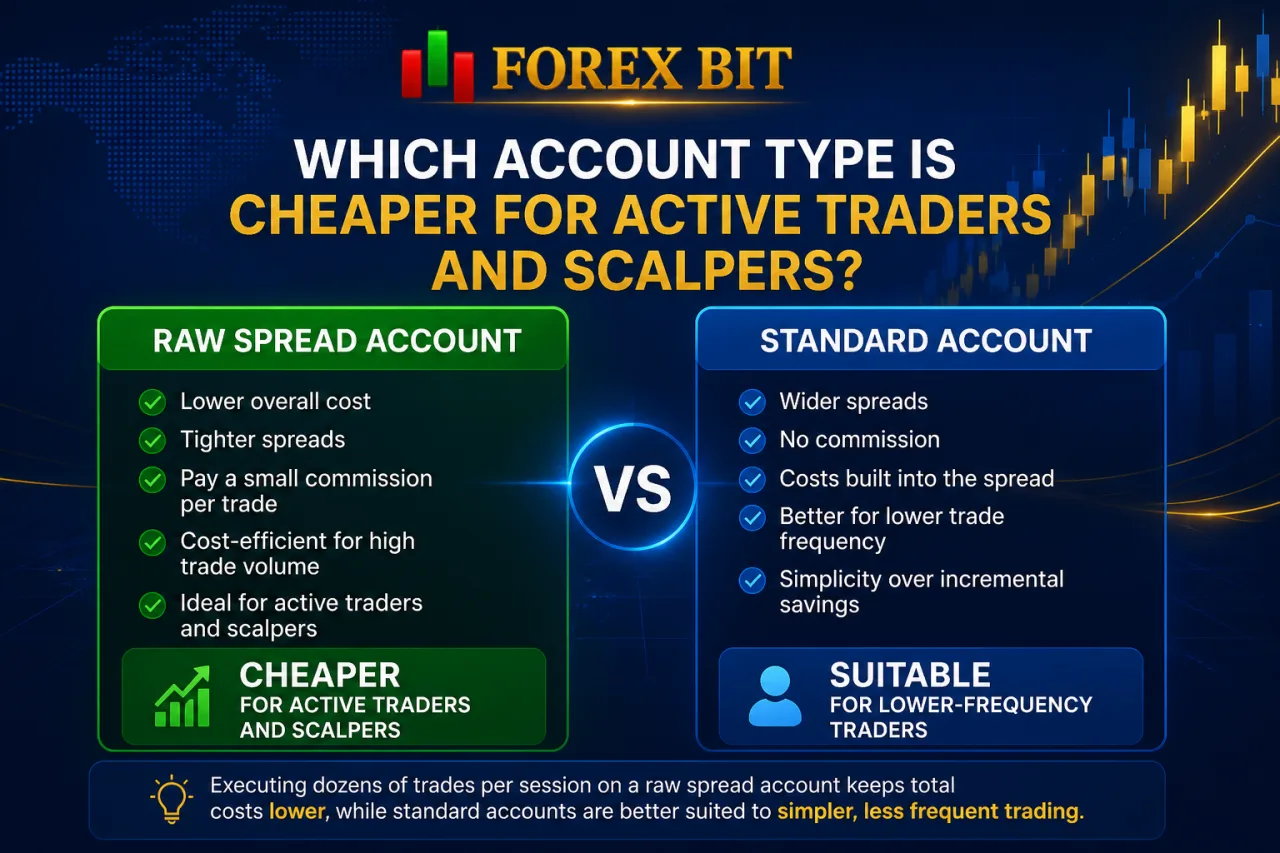
Raw spread accounts cost less for active traders and scalpers, while standard accounts fit lower-frequency traders who prioritize simplicity over incremental savings. This cost gap traces directly back to how each account type structures spread and commission.
The two account types serve different trading styles because their cost components scale differently with trade volume. That difference shows up clearly once trade frequency and position size enter the picture.
- Executing dozens of trades per session on a raw spread account keeps the combined spread-plus-commission cost below the wider markup embedded in a standard account quote.
- Running fewer trades at larger position sizes reduces the advantage of a fixed per-lot commission, since the savings from tighter spreads matter less when trade count stays low.
- Preferring one combined cost figure over two separate charges points a trader toward the standard account structure regardless of the underlying total cost.
- Reading a trade confirmation without tracking a separate commission line stays simpler on a standard account, even when the total paid runs higher over many trades.
The specific mechanics behind each account’s suitability for high-frequency versus lower-volume trading appear in the sections below.
Why Do Scalpers Typically Prefer Raw Spread Accounts?
Yes, scalpers typically prefer raw spread accounts because tight interbank spreads plus a fixed commission cost less than a marked-up spread repeated across dozens of trades per session. This preference ties directly to how scalping cost sensitivity magnifies the raw spread versus standard account gap discussed earlier.
Scalping strategy relies on small profit targets per trade, so even a minor pip difference in cost compounds fast across high trade volume.
- Targeting a few pips of profit per trade leaves little room for a wide standard-account markup to eat into net gains.
- Repeating dozens of trades per session multiplies any per-trade cost difference into a meaningful total by the end of the day.
- Knowing the fixed commission upfront lets a scalper calculate breakeven pip targets precisely, unlike a markup that shifts by pair and session.
- Compounding a wider spread across high trade frequency erodes profit margins faster than a raw spread plus disclosed commission structure.
This cumulative effect on cost, rather than the cost of any single trade, drives the preference toward raw spread accounts among scalpers.
When Might a Standard Account Be More Cost-Effective for Low-Frequency Traders?
Yes, a standard account turns more cost-effective for low-frequency traders whose holding periods stretch across hours or days, since the wider markup applies once per trade rather than compounding across dozens of entries. This scenario shifts the earlier cost comparison, which favored raw spread accounts under high trade frequency, back toward the simpler standard structure once trade count drops.
The advantage of tight raw spreads only compounds meaningfully when a trader repeats entries often, so a position trader or swing trader captures little of that benefit.
- Holding a position for hours or days reduces the number of times the spread cost gets paid, shrinking the gap between raw and marked-up pricing.
- Placing only a handful of trades per week limits how much a fixed commission fee adds up compared to a single embedded spread.
- Targeting larger profit moves per trade makes a few extra pips of spread markup less significant relative to the overall gain.
- Avoiding a separate commission line keeps trade confirmations simpler for traders who value ease of tracking over marginal savings.
At low trade volume, the combined spread-plus-commission cost on a raw spread account often lands close enough to the standard account’s markup that the pricing difference becomes comparably small.
How Does Total Trading Cost Compare Between Raw Spread and Standard Accounts?
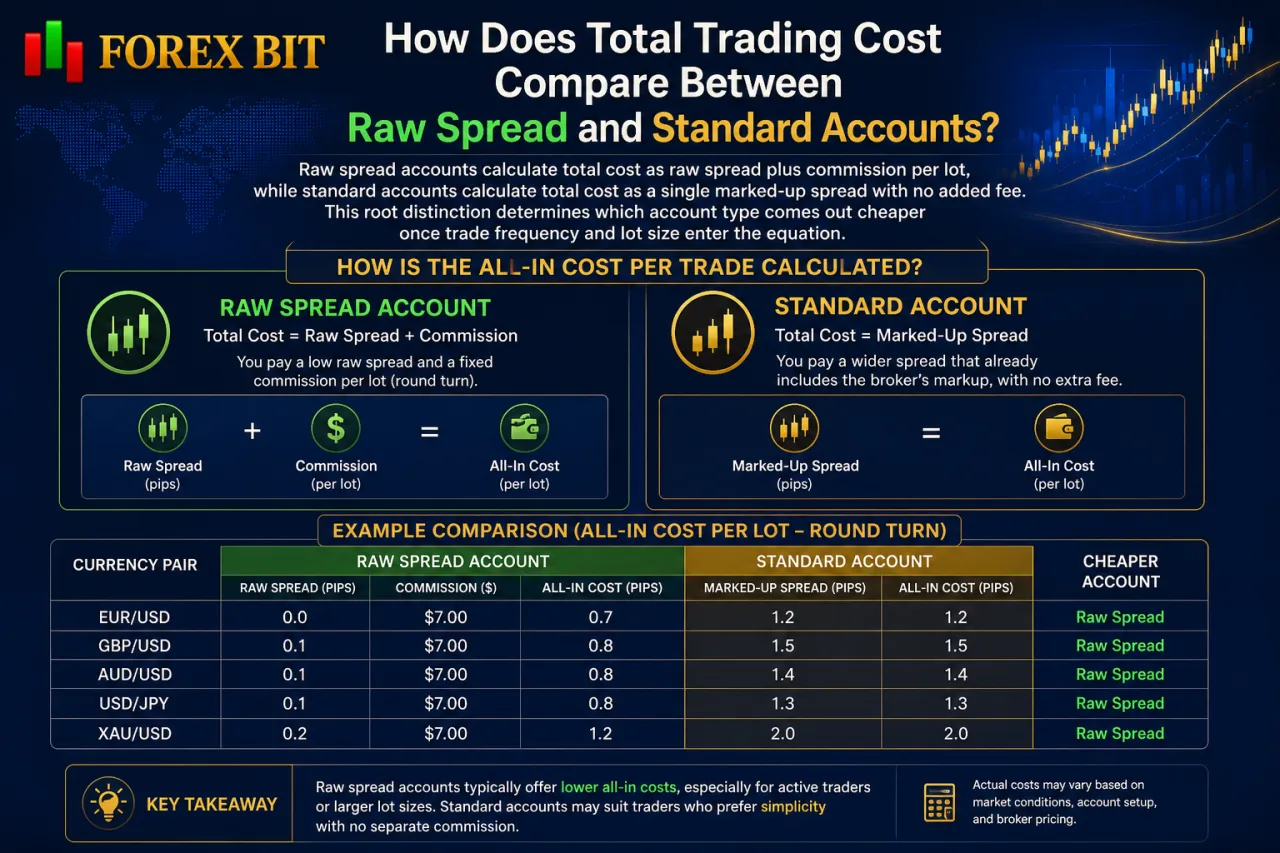
Raw spread accounts calculate total cost as raw spread plus commission per lot, while standard accounts calculate total cost as a single marked-up spread with no added fee. This root distinction determines which account type comes out cheaper once trade frequency and lot size enter the equation. The comparison below breaks the calculation logic apart for each account model, then describes the outcome pattern that typically plays out across a few major currency pairs.
A raw spread account calculates all-in cost per trade by adding the raw interbank spread, which often sits near zero pips on major pairs, to a fixed commission charged per lot. This calculation method keeps the two cost components visible and separately verifiable on the trade confirmation.
- Sourcing the raw spread directly from the liquidity feed before any markup applies.
- Adding a fixed commission charge per lot, disclosed upfront by the broker.
- Summing both figures into one combined pip-equivalent cost for the trade.
This two-part formula lets a trader isolate exactly how much of the total cost comes from market pricing versus broker fee, unlike the blended figure produced on a standard account.
A standard account calculates all-in cost per trade by reading the quoted spread alone, since that number already contains the broker markup with no separate fee added afterward. This single-figure calculation removes the need to add a second line item to reach the final cost.
The quoted spread on a standard account functions as both the entry cost and the broker’s revenue combined into one displayed value. A trader multiplies that spread by lot size to reach the total cost, without checking a commission schedule.
Example Cost Comparison Pattern Across Major Currency Pairs
Actual spread and commission figures differ from one broker to another and shift with live market conditions, so no fixed table of numbers applies universally across providers. For this reason, a trader checks the current pricing page of a specific broker directly before comparing the two account types on any given currency pair.
- On a raw spread account, the total cost reflects a near-zero interbank spread plus a separately disclosed commission per lot, and this combined figure moves with each broker’s own fee schedule.
- On a standard account, the total cost reflects a single quoted spread that already bundles the broker markup, and this figure moves with each broker’s own pricing policy.
- Across major pairs such as EUR/USD, GBP/USD, and USD/JPY, the gap between the two account types narrows or widens mainly based on each broker’s specific pricing rather than any fixed industry-wide figure.
At low trade volume, the two totals often land close enough that pair-specific and broker-specific figures decide which account type ends up cheaper.
How Do You Calculate the All-In Cost of a Trade on Each Account Type?
Calculating all-in cost applies one formula across both account types: total cost equals spread in pips multiplied by pip value, plus commission per lot where applicable. This formula ties directly back to the two cost structures described earlier, letting a trader place raw spread and standard account pricing on the same numerical footing.
Applying the formula on a raw spread account follows three steps.
- Reading the raw spread quoted at execution, often near zero pips on major pairs.
- Multiplying that spread figure by the pip value for the traded lot size.
- Adding the fixed commission charged per lot to reach the final all-in cost.
Applying the same formula on a standard account skips the last step, since no commission line exists to add.
- Reading the single marked-up spread shown at execution.
- Multiplying that spread by the pip value for the traded lot size.
- Stopping there, since the quoted number already contains the broker’s full markup.
Running both calculations side by side on the same currency pair and lot size produces two comparable totals, showing directly which account structure costs less for that specific trade rather than relying on a general assumption about either model.
What Other Factors Beyond Spread and Commission Affect the Real Cost of Raw Spread and Standard Accounts?
Beyond spread and commission, real cost between raw spread and standard accounts shifts with execution quality, swap rates, deposit fees, and slippage during volatile sessions. These secondary factors sit outside the core markup versus commission structure already outlined, yet they directly change which account type ends up cheaper for a given trading style. The sections below break each factor apart individually.
Does Order Execution Speed or Slippage Differ Between Raw Spread and Standard Accounts?
Yes, order execution speed and slippage differ between raw spread and standard accounts because raw spread accounts route orders through ECN/STP liquidity with variable spreads, while standard accounts often use dealing-desk-style execution with more fixed pricing. This execution gap connects directly to how each account structures spread and commission, since the routing model behind the quote shapes how reliably that quote holds during a live trade.
Execution quality changes what a trader actually pays beyond the spread and commission figures shown on screen.
- Widening variable spreads on raw spread accounts during volatile sessions can erase part of the cost advantage that tight interbank pricing normally provides.
- Passing orders through ECN/STP liquidity pools on raw spread accounts exposes trades to real-time market depth, which shifts price during fast-moving conditions.
- Holding spreads more fixed on standard accounts reduces quote-to-quote variability, though this comes from the broker’s own pricing model rather than raw market depth.
- Offsetting apparent spread savings with slippage happens when a raw spread account fills an order at a worse price than quoted during a news release or liquidity gap.
This means the cheaper account on paper does not always end up cheaper at the point of actual fill, since execution routing and slippage sit outside the spread and commission figures alone.
How Do Swap Rates or Overnight Fees Differ Between Raw Spread and Standard Accounts?
Swap rates differ between raw spread and standard accounts because brokers often set separate overnight fee schedules per account type, meaning identical positions can carry different holding costs depending on which account holds them. This variance sits outside the spread and commission structure already outlined, yet it changes the real cost of any trade held past the daily rollover cutoff.
This distinction matters most for swing or position traders whose positions stay open across multiple sessions rather than closing within minutes.
Applying separate swap tables to raw spread and standard accounts lets a broker price overnight risk independently of the spread or commission model used.
- Holding a position overnight on a commission-based account adds the swap charge on top of the spread-plus-commission total already paid at entry.
- Holding the same position overnight on a standard account adds the swap charge on top of the marked-up spread already embedded in the quote.
- Comparing swap rates directly between account types matters more for multi-day holds than for trades closed within the same session.
A trader planning to hold positions overnight checks the specific swap schedule tied to each account type rather than assuming the rate stays identical across raw spread and standard structures.
Conclusion
The core distinction comes down to how each account packages broker revenue: raw spread accounts split cost into near-zero spreads plus a disclosed per-lot commission, while standard accounts fold that same revenue into one wider, blended spread. Scalpers and high-frequency traders gain measurably from the raw spread structure as trade count rises, while low-frequency, longer-holding traders find the standard account’s single-figure pricing close in cost and simpler to track.
Execution quality, slippage, and swap schedules sit outside this markup-versus-commission split but still shift real cost. Choosing between the two ultimately depends on trade frequency, holding period, and whether transparent itemization or pricing simplicity matters more to the individual trader.
Michael Smith is a Forex Broker Comparison Specialist at Forex Bit, focusing on comparing brokers, trading platforms, account types, fees, spreads, commissions, and trading conditions. His work helps readers understand the key differences between providers so they can evaluate brokers based on their own trading needs and preferences.
Email: [email protected]


Best Brokers

Trade with the world’s largest retail broker and benefit from better - than - market conditions.

We offer a superior trading environment that puts traders in the best position to profit.

Trade global markets with Interactive Brokers – a highly regulated multi-asset broker built for active and professional investors.

Invest and trade global markets with eToro – a Nasdaq-listed multi-asset platform built around social investing and CopyTrader.






Forex Bit provides independent forex broker reviews, comparisons, guides, and industry news to help traders make informed decisions.
Best Brokers
Metatrader 5 Brokers
Metatrader 4 Brokers
Lowest Spread Forex Broker
Regulated Forex Brokers
Forex Copy Trading
Ctrader Brokers
Best Forex Broker For Beginners