
Wondering why your forex withdrawal is pending? See common causes, realistic processing times, and steps to resolve delays fast.
Forex Withdrawal Pending: Causes, Timelines & Fixes

A forex withdrawal marked “pending” means the broker or payment provider has received the request but has not yet completed the transfer of funds. This status reflects an in-progress transaction, not a rejection or cancellation.
Broker-side processing generally takes a few business days, while bank or card issuer settlement can add further time on top of that. These two timeframes are separate, and confusing them is a common reason traders assume a delay when none exists.
Pending withdrawals are most often caused by incomplete KYC verification, mismatched payment details, or processing limits tied to a specific payment method. Anti-fraud checks and source-of-funds reviews can also extend the waiting period beyond the broker’s standard schedule.
When a withdrawal remains pending past the expected window, contacting support with the transaction ID and confirming account verification status are the first practical steps. Forex Bit outlines these fixes and the underlying causes in detail below, starting with what a pending status actually indicates on a trading account.
What Does It Mean When a Forex Withdrawal Is Pending?
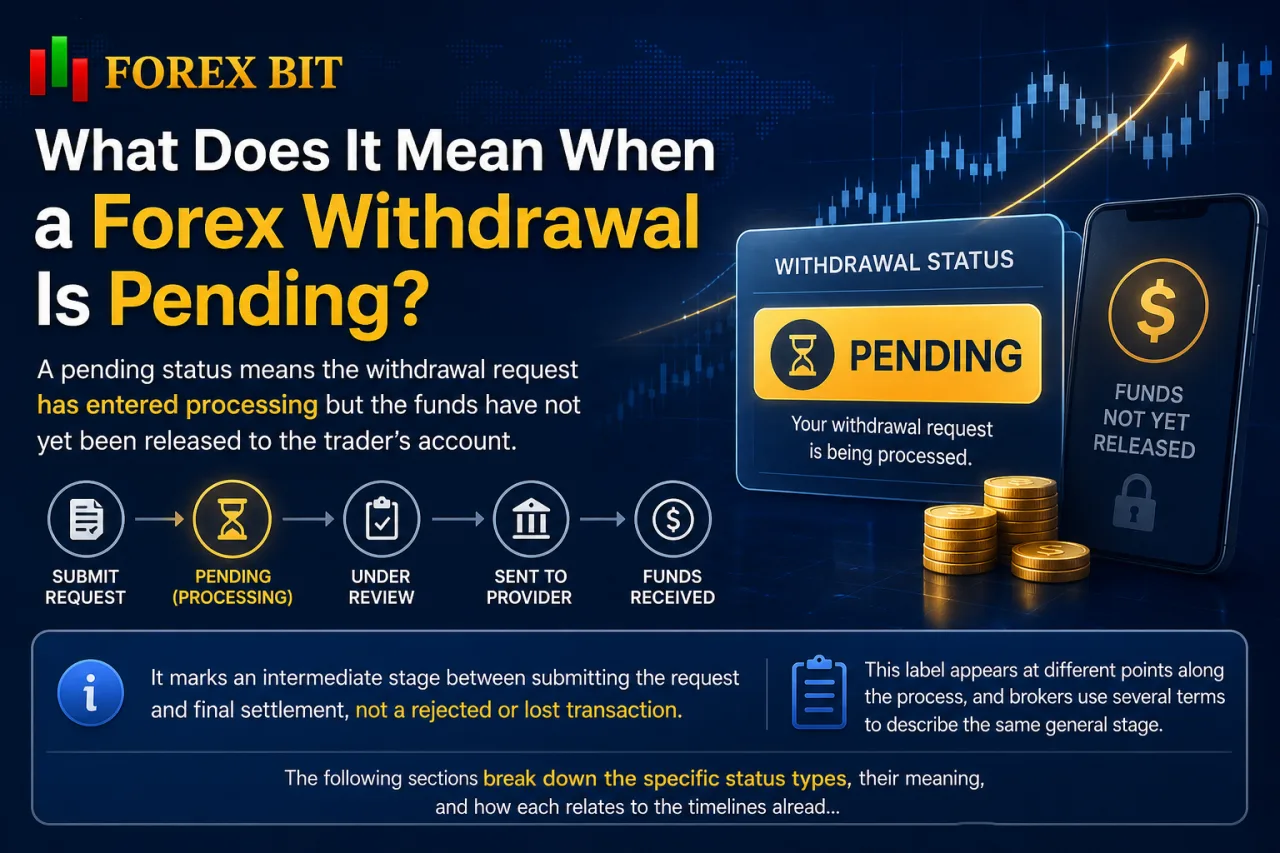
A pending status means the withdrawal request has entered processing but the funds have not yet been released to the trader’s account. It marks an intermediate stage between submitting the request and final settlement, not a rejected or lost transaction.
This label appears at different points along the process, and brokers use several terms to describe the same general stage. The following sections break down the specific status types, their meaning, and how each relates to the timelines already outlined for broker processing and bank settlement.
Is a Pending Withdrawal the Same as a Rejected or Failed Withdrawal?
No, a pending withdrawal is not the same as a rejected or failed withdrawal, since each status reflects a distinct stage in the payment cycle. Pending indicates the request is still active and moving through processing, rejected means the broker or payment provider declined the transaction, and failed means the transfer attempt did not complete due to a technical or banking issue.
These three outcomes carry different implications for a trader monitoring a withdrawal request. A pending status requires no action beyond waiting within the disclosed timeframe, while rejected and failed statuses typically require the trader to correct an issue and resubmit the request.
Brokers generally notify traders of each outcome through one or both of the following channels:
- Email notifications sent to the registered account address, detailing the status change and any reason provided.
- Client portal updates, where the withdrawal history section reflects the current status alongside a timestamp and, in some cases, a rejection or failure code.
Rejection reasons commonly relate to incomplete verification, mismatched account details, or violations of the payment method’s usage terms. Traders who receive a rejected or failed notice generally need to review the stated reason before submitting a new withdrawal request, rather than treating it as an extension of the original pending transaction.
What Are the Common Stages a Withdrawal Request Goes Through?
A withdrawal request moves through six typical stages: submission, internal broker review, KYC/compliance check, approval, transfer to the payment provider or bank, and final receipt of funds by the client. Each stage adds a distinct layer of processing before the trader sees the money in their account.
The trader initiates the process by submitting the request through the client portal, specifying the amount and payout method. The broker’s back office then reviews the request for accuracy, checking that the withdrawal amount aligns with account balance and trading terms.
Compliance staff verify that KYC documentation is complete and current at this stage, which is where mismatched details or missing verification most often stall progress. Once compliance clears the request, an authorized team member approves it internally before it moves outside the broker’s system.
The approved request then passes to the payment provider or banking partner responsible for executing the transfer. Funds only reach the client’s account once that provider or bank completes settlement on its own schedule, separate from the broker’s internal processing window described earlier in this article.
How Long Does a Forex Withdrawal Normally Take to Process?
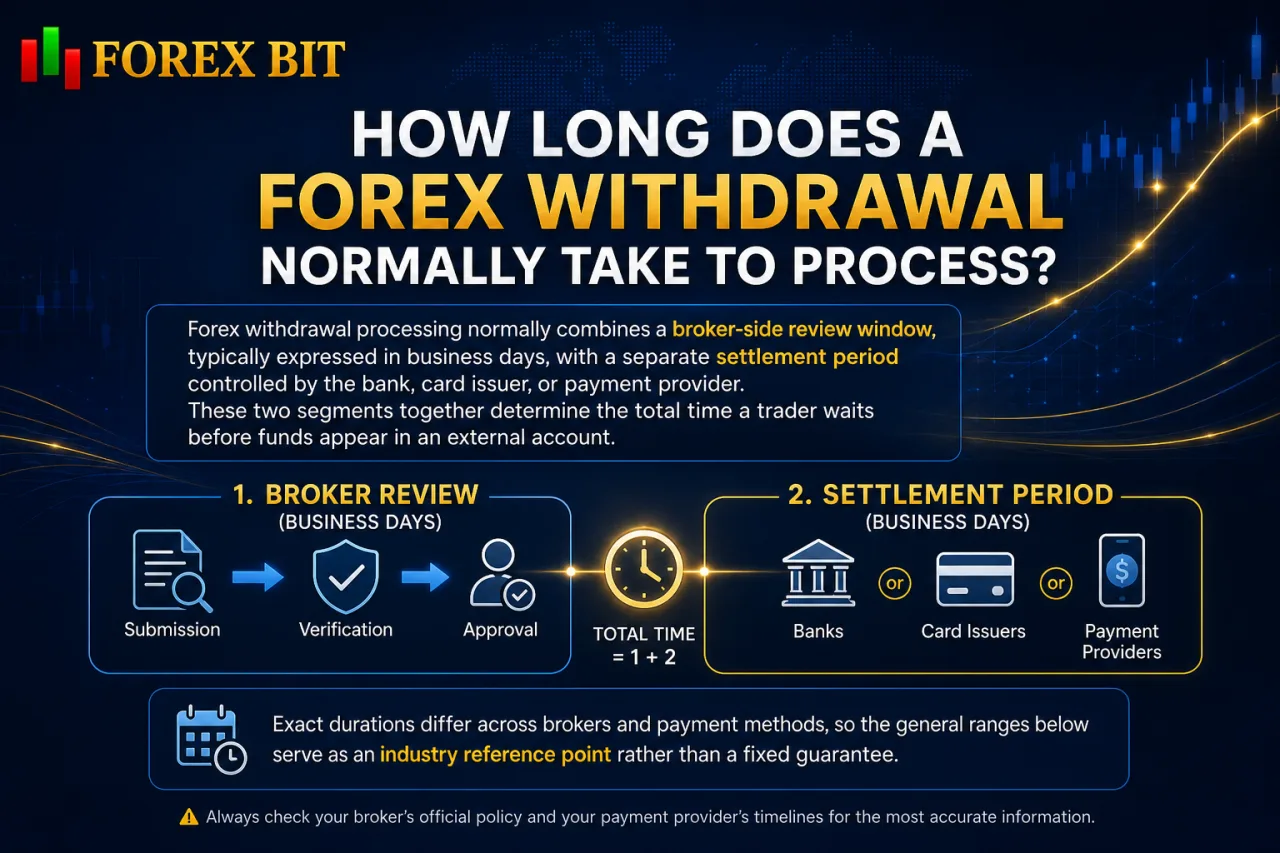
Forex withdrawal processing normally combines a broker-side review window, typically expressed in business days, with a separate settlement period controlled by the bank, card issuer, or payment provider. These two segments together determine the total time a trader waits before funds appear in an external account.
Exact durations differ across brokers and payment methods, so the general ranges below serve as an industry reference point rather than a fixed guarantee. The two sections that follow break this timeline down by broker-side handling and by the additional delay banks or card networks may add on top of it.
Broker Processing Time vs Bank or Payment Provider Delay: What Is the Difference?
Broker processing time covers only the internal review and approval of the withdrawal request, while bank or payment provider delay covers the separate settlement period an external institution needs to credit the funds. These two segments run one after another, not simultaneously, which explains why the total wait almost always exceeds the broker’s stated processing window.
The broker’s SLA measures the internal cycle already described: submission, review, KYC checks, and approval. Once the broker releases the funds, control passes entirely to an outside party, and the broker’s disclosed timeframe no longer applies to what happens next.
- Bank transfers depend on the receiving bank’s own clearing schedule, which the broker does not control.
- Card refunds depend on the card issuer’s processing cycle before the amount posts to the statement.
- E-wallet providers apply their own internal crediting rules once funds arrive from the broker.
Because each external party adds its own processing layer, a trader can see the broker mark a request as “completed” while the funds remain in transit through the banking or card network on the receiving end.
Do Processing Times Vary by Withdrawal Method (Bank Transfer, Card, E-wallet)?
Yes, processing times vary by withdrawal method, with e-wallets settling fastest, bank wires taking longest, and card refunds depending on the issuer’s own cycle. This variance sits on top of the broker-side review window already described, since each payment rail applies a different settlement mechanism once the broker releases funds.
E-wallet providers generally credit balances soon after receiving the broker’s transfer, as their internal systems process transactions without routing through traditional banking networks. E-wallet transfers commonly complete faster than bank or card methods once released by the broker.
Bank wires move through correspondent banking and clearing systems, which adds more steps than an e-wallet transfer. International or cross-border wires typically take longer than domestic transfers because they pass through intermediary bank processing.
Card refunds depend on the issuing bank’s own posting cycle rather than the broker’s or the payment processor’s schedule. These patterns describe general tendencies across payment methods, not fixed or guaranteed durations for any specific broker or transaction.
What Causes a Forex Withdrawal to Stay Pending?
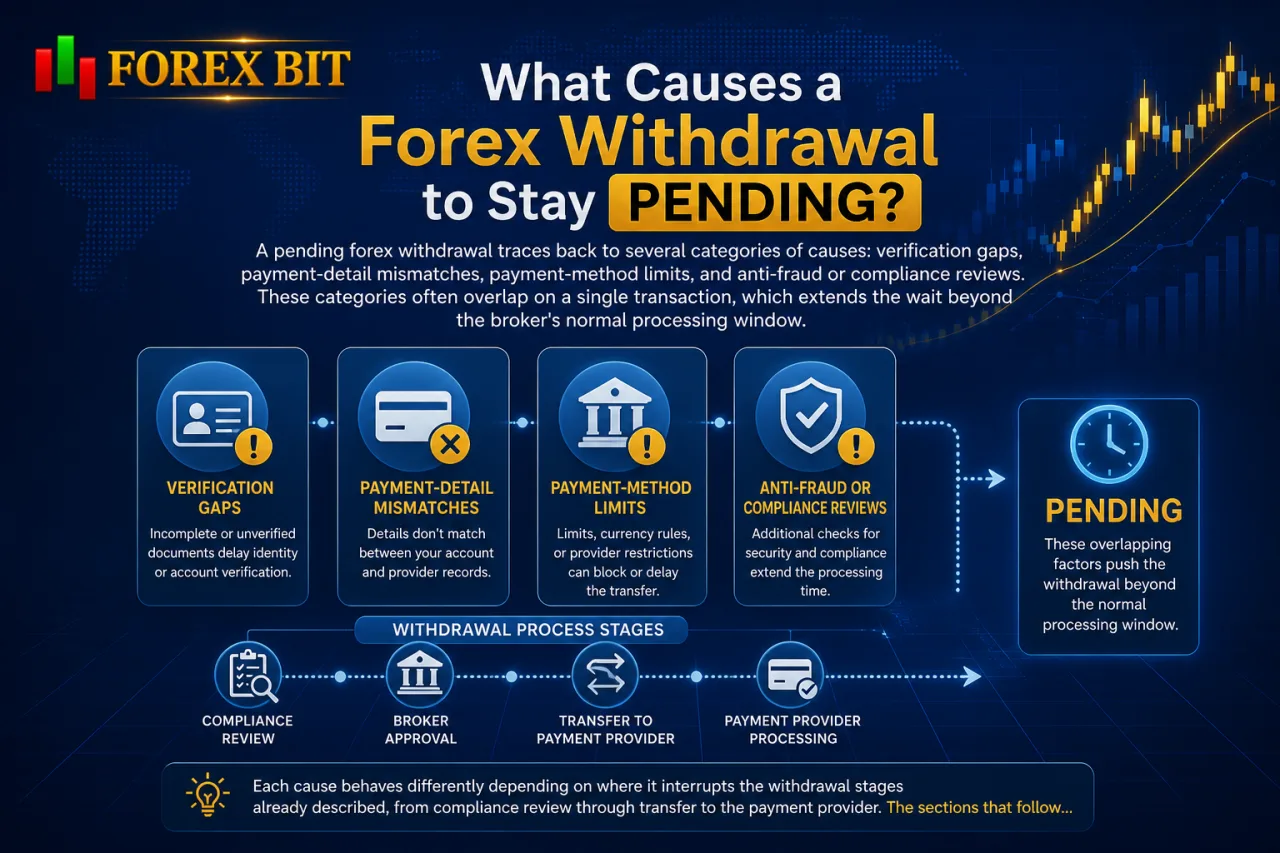
A pending forex withdrawal traces back to several categories of causes: verification gaps, payment-detail mismatches, payment-method limits, and anti-fraud or compliance reviews. These categories often overlap on a single transaction, which extends the wait beyond the broker’s normal processing window.
Each cause behaves differently depending on where it interrupts the withdrawal stages already described, from compliance review through transfer to the payment provider. The sections that follow examine KYC-related holds and payment-method-specific restrictions in more detail, since these two areas account for most of the delays traders encounter after submitting a request.
Can Incomplete KYC or Verification Cause a Withdrawal Delay?
Yes, incomplete KYC or verification causes a withdrawal delay, since compliance teams hold the request until identity, address, and funding-source documentation clears review. This connects directly to the compliance-check stage described earlier, where mismatched details most often stall a withdrawal before it reaches the payment provider.
Several verification gaps trigger this type of hold:
- Unverified identity documents, such as an expired passport or ID that does not match the account registration name.
- Unconfirmed proof of address, when the submitted utility bill or bank statement falls outside the broker’s accepted date range.
- Pending compliance checks still under manual review by the broker’s back office.
- Source-of-funds requests, which brokers commonly apply to larger withdrawals to confirm the origin of deposited funds, though the exact threshold varies by broker.
A withdrawal generally remains pending until every required document passes verification, since compliance clearance is a mandatory step before funds move to the payment provider. Traders who submit outdated or mismatched paperwork extend this stage regardless of how quickly the broker’s system processes the initial request.
Which Payment Method Issues Can Delay a Withdrawal?
Five recurring payment-method issues delay a withdrawal: mismatched account name, unsupported currency, bank rejection of the transfer, card issuer holds, and incorrect payment details entered by the trader. Each issue interrupts the transfer stage after broker approval, separate from the KYC-related holds described earlier.
These problems surface once the broker releases funds to the payment provider or bank, since that party then applies its own verification rules before crediting the account. The list below outlines each issue and where it typically stalls the transaction:
- Mismatched account name, where the name on the receiving bank account or card does not match the name registered on the trading account.
- Unsupported currency, where the destination bank or e-wallet does not accept the currency the broker sends, forcing a conversion step or a rejection.
- Bank rejection, where the receiving bank declines the incoming transfer due to internal compliance rules or account restrictions on the client’s side.
- Card issuer holds, where the issuing bank places a temporary hold on the refund pending its own fraud or verification checks.
- Incorrect payment details, where the trader enters a wrong account number, routing code, or wallet address at submission.
Brokers generally require withdrawals to return to the original deposit method, which makes a mismatched name or unsupported currency a frequent cause of delay.
What Other Broker-Side or Account Factors Can Trigger a Pending Status?
Several broker-side and account factors trigger a pending status beyond KYC and payment-method issues: open trading positions, unmet bonus or turnover requirements, manual compliance review, high withdrawal volume during peak periods, and first-time withdrawal checks. These factors sit at the account and internal-review level rather than the payment-transfer level already covered.
Each factor interacts with the withdrawal stages differently, and the list below outlines how they hold a request:
- Open trading positions that tie up margin the broker requires before releasing the requested balance.
- Unmet bonus or turnover requirements, where promotional terms restrict withdrawal until the trader meets a trading-volume condition.
- Manual compliance review, applied selectively to transactions flagged for closer inspection beyond the standard KYC check.
- High withdrawal volume during peak periods, which backs up the broker’s internal queue and extends the review stage.
- First-time withdrawal checks, where brokers commonly apply extra verification on a trader’s initial payout request regardless of amount.
Brokers generally disclose bonus and turnover conditions within the account’s promotional terms, since these clauses can directly restrict withdrawal eligibility until satisfied.
What Should You Do If Your Withdrawal Stays Pending Too Long?
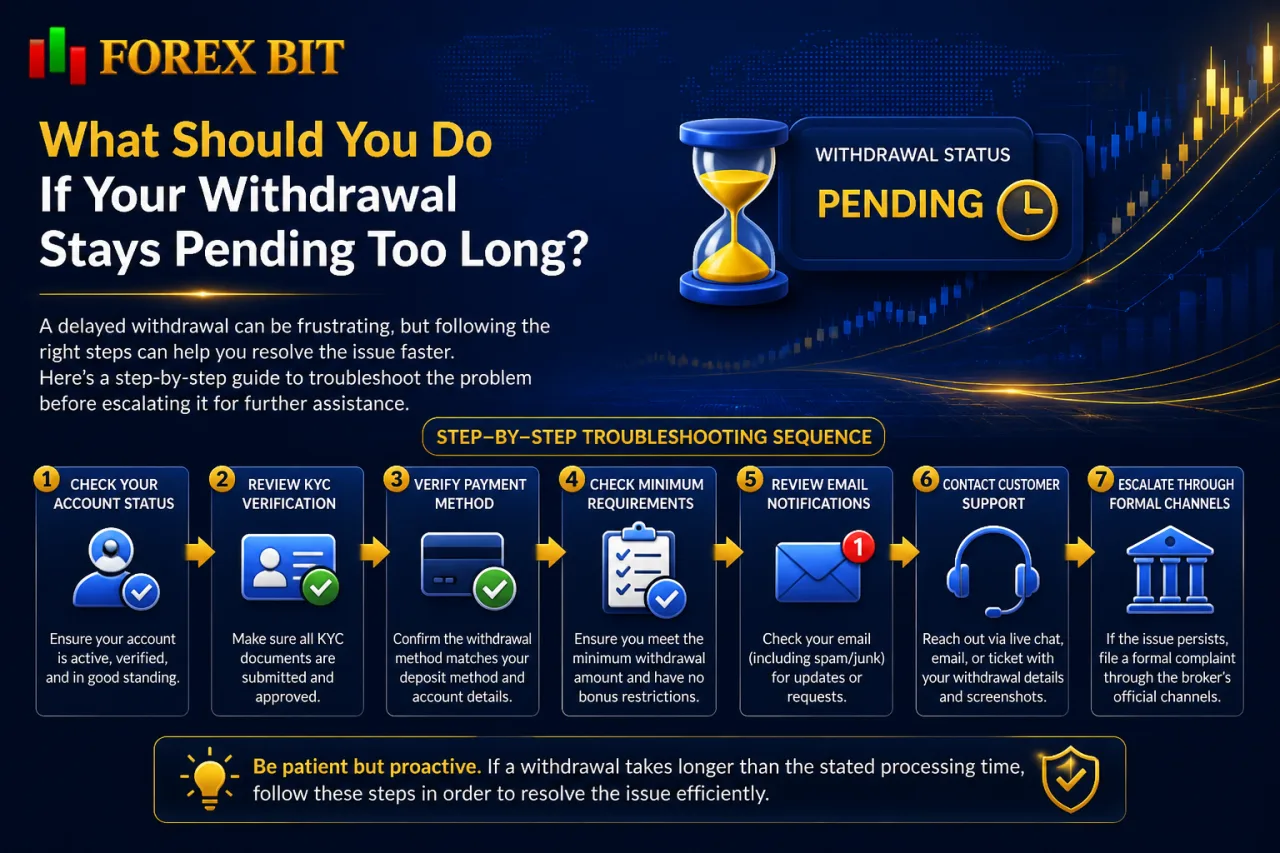
A trader facing a delayed pending withdrawal follows a step-by-step troubleshooting sequence before escalating, starting with checking account status and ending with formal complaint channels. This sequence addresses the causes already outlined, from KYC gaps to payment-method mismatches, and separates a normal processing delay from a stalled request that requires direct action. The order matters, since each step rules out a simpler explanation before moving to a more formal escalation path.
How Do You Check the Status of a Pending Withdrawal?
Checking a pending withdrawal status starts with the client portal’s transaction history, followed by confirmation emails, then the reference or transaction ID for tracing the transfer with a bank or payment provider. This sequence follows the withdrawal stages already outlined, moving from broker-side records to external settlement tracking.
The client portal remains the primary source, since most brokers display a live status label such as pending, processing, or completed next to each withdrawal entry. This section typically also shows the submission date and the payment method selected.
Confirmation emails supplement the portal by recording each status change as it happens, including approval or transfer notices sent to the registered address. These messages often contain the same reference number shown in the portal.
That reference or transaction ID becomes essential once funds leave the broker’s system, since:
- Banks use it to trace an incoming wire during their own clearing process.
- Card networks reference it when confirming a refund posting date.
- E-wallet providers match it against incoming transfer records on their end.
Traders unable to locate a clear status update generally contact support directly, citing the transaction ID for a manual check.
When Should You Contact Broker Support About a Delayed Withdrawal?
Contacting broker support about a delayed withdrawal follows once the request passes the broker’s stated maximum processing window without a status change. This threshold connects directly to the processing timelines already outlined, since a request still within that disclosed window reflects normal handling rather than a stalled transaction.
Reaching out before that window closes rarely produces new information, as the request likely sits at a stage the broker’s system has already accounted for. Once the stated maximum passes, support contact becomes a practical next step rather than a premature escalation.
Preparing specific details speeds up the support review:
- Transaction ID or reference number tied to the withdrawal request.
- Account number registered with the broker.
- Date the withdrawal request was originally submitted.
- Payment method selected at submission, along with the amount requested.
Support teams generally use these details to trace the request across the internal stages already described, from compliance review through transfer to the payment provider. Providing this information at first contact reduces the number of follow-up exchanges needed before support locates the specific transaction.
What Rare or Regulatory-Specific Situations Can Affect a Pending Withdrawal?
Rare or jurisdiction-specific situations affecting a pending withdrawal fall into a few distinct groups: regulatory freezes, dispute-related holds, and cross-border transfer restrictions. These edge cases sit outside the standard KYC and payment-method causes already outlined, since they originate from external authorities or formal disputes rather than the broker’s routine internal review. The subsections below examine jurisdiction-specific holds and dispute-related freezes in more detail.
Can Regulatory or Anti-Money-Laundering Reviews Extend a Withdrawal Hold Indefinitely?
Yes, regulatory or anti-money-laundering reviews extend a withdrawal hold beyond the broker’s standard timeline, since these checks operate under legal obligations that override normal processing schedules. This scenario differs from the KYC and payment-method causes already outlined, because the broker often has limited discretion over how long an external authority or mandated investigation takes to resolve.
A few conditions typically explain why these holds run longer:
- Regulator-mandated checks that require the broker to freeze funds pending an official inquiry.
- Anti-money-laundering investigations tied to unusual transaction patterns or flagged source-of-funds concerns.
- Cross-agency information requests that depend on response times outside the broker’s internal systems.
Regulated brokers generally disclose in their legal or AML policy documents that compliance-related holds can fall outside standard processing windows. Traders facing this situation typically receive limited detail on the investigation itself, since brokers disclose only what compliance obligations permit during an active review.
What Can You Do If a Pending Withdrawal Leads to a Dispute with the Broker?
A trader escalates a withdrawal dispute through three formal channels beyond direct support: filing a regulator complaint, requesting written explanation from the broker, and using an ombudsman or financial dispute resolution service. This escalation path applies only after support contact has failed to resolve the pending status through the transaction ID and account checks already outlined.
The order generally moves from least to most formal, since each step documents the dispute further before involving an outside authority.
- Requesting a written explanation from the broker’s compliance or support team, creating a documented record of the stated reason for the delay.
- Filing a complaint with the broker’s regulator, referencing the license number and jurisdiction under which the broker operates.
- Escalating to an ombudsman or financial dispute resolution service, where the regulatory framework provides one for retail trading disputes.
Regulated brokers generally disclose their complaint-handling procedure and relevant regulator contact details within their legal documentation or terms of business. Traders pursuing this route typically retain all transaction IDs, emails, and support correspondence, since a regulator or ombudsman review relies on that documented history rather than a verbal account of the dispute.
Conclusion
A pending forex withdrawal signals an in-progress transfer rather than a lost or rejected payment, with the total wait combining the broker’s internal review window and a separate settlement period controlled by the bank, card issuer, or e-wallet. Most delays trace back to incomplete KYC, mismatched payment details, method-specific restrictions, or account-level factors like open positions and unmet turnover conditions.
Rare cases involving regulatory holds or disputes extend beyond standard timelines entirely. Tracking the request through the client portal, confirming verification status, and contacting support with the transaction ID resolves most delays before formal escalation becomes necessary.
William Johnson is a Forex & Broker News Analyst at Forex Bit, focusing on broker updates, regulatory developments, payment changes, and security-related news. His work helps readers stay informed about important industry developments and understand how these changes may affect broker services and trading conditions.
Email: [email protected]



Best Brokers

Trade with the world’s largest retail broker and benefit from better - than - market conditions.

We offer a superior trading environment that puts traders in the best position to profit.

Invest and trade global markets with eToro – a Nasdaq-listed multi-asset platform built around social investing and CopyTrader.

Trade with the best trading conditions. WIN THE BEST TRADING ACCOUNT AWARD.






Forex Bit provides in-depth analysis of commodities, forex, and stock markets to help traders make informed investment decisions.
Best Brokers
Metatrader 5 Brokers
Metatrader 4 Brokers
Lowest Spread Forex Broker
Regulated Forex Brokers
Forex Copy Trading
Ctrader Brokers
Best Forex Broker For Beginners